In global teams, the real challenge isn’t distance, it’s understanding. As organizations expand across regions, language barriers have quietly become one of the biggest causes of operational friction, from misinterpreted emails to meetings lost in translation.
A 2025 workplace communication study found that 75% of employees say communication directly influences their job satisfaction, and 57% report that better communication reduces misunderstandings. When those conversations span multiple languages, the stakes are even higher.
For developers building collaboration platforms, content teams managing global workflows, and operations leaders steering hybrid teams, multilingual communication is no longer a nice-to-have. It’s the foundation of alignment, productivity, and trust.
This guide breaks down how multilingual communication strengthens modern teams, explores how AI is closing the language gap in real time, and shows which platforms are redefining cross-language collaboration through natural voice and speech intelligence.
Quick Snapshot
- Effective multilingual communication is crucial for remote and hybrid teams to improve collaboration, reduce misunderstandings, and boost team performance.
- AI-powered voice solutions, such as Resemble AI’s multilingual TTS and voice cloning, can fill language gaps in real time, enhancing communication.
- Developing cultural awareness and clear communication practices is key to overcoming language barriers and improving team cohesion in multilingual environments.
- Multilingual communication should be embedded into company culture to create a more inclusive and productive work environment, benefiting both global teams and clients.
Why Multilingual Communication Is More Than Translation?
Multilingual communication enables people from different linguistic backgrounds to collaborate seamlessly, but true effectiveness goes beyond using translation tools. It’s not just about translating words but understanding the cultural nuances, tone, and context behind the language.
For example, what sounds direct and efficient in one language might feel abrupt or disrespectful in another. Without that nuance, even simple exchanges, project updates, client emails, or product documentation can lead to costly misunderstandings.
Modern multilingual communication integrates AI-powered translation, text-to-speech (TTS), and natural language processing (NLP) to interpret not just what is being said but how it’s being said. That’s how enterprises move from basic accessibility to cultural fluency, where every team member feels included, heard, and aligned, regardless of their native language.
However, to ensure multilingual communication is effective, certain key components must be in place.

Key Elements That Make Multilingual Communication Work
Building an effective multilingual communication strategy requires more than just translation software. It needs a combination of technology, cultural intelligence, and process design to ensure clarity, inclusion, and collaboration across global teams.
Here are the key elements that make multilingual communication work at scale:
| Element | Why It Matters | Example / Implementation |
|---|---|---|
| Clear, simple language | Reduces ambiguity and misinterpretation across translations | Use plain English in global emails; confirm understanding with short summaries after meetings |
| Cultural awareness | Avoids tone or context missteps that damage trust | Adjust phrasing by region (e.g., formal in Japan, conversational in the U.S.); localize idioms |
| Real-time translation | Keeps collaboration seamless across time zones | Integrate live captioning, multilingual chatbots, or AI-powered TTS during calls |
| Voice parity | Preserves emotional tone across languages | Use multilingual voice cloning to replicate tone and empathy for each region |
| Inclusivity | Ensures all members can participate equally | Rotate languages in team updates; offer captioning and accessible voice tools |
The rise of remote and hybrid work has amplified the need for seamless multilingual communication, making it a critical factor in team success.
Once these building blocks are in place, teams can focus on where multilingual communication drives the most tangible impact: collaboration, inclusion, and performance at scale.
Why Multilingual Communication Matters for Global Teams?

In a world where teams collaborate across regions, languages, and time zones, communication has become the defining factor for productivity and inclusion. Here’s what the latest 2025 data reveals about why multilingual communication now sits at the heart of global performance:
1. The Global Coordination Challenge
According to Microsoft’s 2025 Work Trend Index, over 30% of all meetings now span multiple time zones, and after-hours meetings (post–8 p.m.) have increased significantly since 2020. This adds a heavy “coordination tax” on teams, creating fatigue, delays, and misunderstandings.
When those meetings involve multiple languages, miscommunication multiplies unless conversations are structured, translated, and clarified in real time.
2. AI Productivity Potential Depends on Multilingual Delivery
McKinsey (2025) estimates that AI could unlock $4.4 trillion in annual productivity gains across global enterprises. However, this potential is only realized when insights and automation are communicated effectively across languages.
That’s why modern enterprises are layering NLP, text-to-speech (TTS), speech-to-speech, and localized prompting systems, ensuring that AI-generated intelligence reaches every team member, in every language they work in.
3. Clear Communication Drives Faster Growth
Forrester’s 2024 analysis found that organizations defined as “customer-obsessed,” i.e., those prioritizing clarity and personalization in communication, achieved 41% faster revenue growth and 49% higher profit growth compared to less engaged peers.
These results extend internally, too: when employees can collaborate clearly across languages, decision-making accelerates and execution improves.
4. Human Sustainability and Inclusion Boost Outcomes
The Deloitte 2024 Global Human Capital Trends Report found that companies emphasizing “human sustainability”, including communication clarity, inclusivity, and cultural awareness, are nearly 2× more likely to report improved business and human outcomes. As Deloitte describes it, today’s workplace is increasingly “boundaryless,” crossing regions, languages, and cultures.
Multilingual communication is a strategic productivity layer that determines how well distributed teams collaborate, innovate, and scale in a global market.
Now that we’ve established why multilingual communication drives measurable business impact, let’s explore how AI and emerging technologies are transforming it, from translation to truly natural, multilingual collaboration.
How AI and Technology Are Redefining Multilingual Communication

McKinsey’s 2025 State of AI Report notes that language-related AI applications are among the top three enterprise use cases driving measurable productivity gains worldwide. Here’s how modern AI and voice technologies, especially those powered by Resemble AI, are enabling this shift from translation to authentic, human-like understanding across global teams.
1. Real-Time Speech Translation and Voice Clarity
AI-driven translation tools can now process speech across over 100 languages with remarkable accuracy and sub-second latency. This enables live multilingual meetings, support calls, and hybrid collaboration without waiting for interpreters or post-call transcripts.
Resemble’s Speech-to-Speech engine supports real-time voice translation in 149+ languages, preserving tone, emotion, and inflection—allowing every team member to speak naturally while being understood instantly.
2. Multilingual Text-to-Speech for Seamless Voice Output
Instead of robotic or uniform voices, modern Text-to-Speech (TTS) systems use deep neural networks to generate expressive, natural voices across multiple languages. This helps organizations communicate brand messages consistently in localized contexts.
Resemble’s TTS platform offers 142+ languages and dialects, allowing teams to turn AI-translated text or chat outputs into natural speech with emotion control and prosody tuning, ideal for training, onboarding, and customer engagement across regions.
3. Emotional and Contextual Accuracy in Communication
AI tools that combine Natural Language Processing (NLP) with emotion recognition can now detect tone, sentiment, and intent, ensuring translations convey empathy and cultural nuance rather than literal meaning.
Audio Intelligence from Resemble analyzes emotional tone, dialect, and linguistic context to ensure AI-generated voices sound emotionally accurate and culturally sensitive, critical for cross-border communication and customer support.
4. Voice Consistency and Localization at Scale
Multinational companies often struggle to maintain a consistent brand voice across languages. Voice cloning now allows businesses to recreate and adapt the same speaker’s tone for global markets, saving time and maintaining trust.
With Rapid Voice Clone 2.0, Resemble can replicate a voice with as little as 20–30 seconds of audio, ensuring consistent brand identity while localizing accents and expressions for different markets.
5. Authenticity, Security, and Trust in AI Communication
As AI-generated voices become indistinguishable from human ones, enterprises need verification systems that protect authenticity. Ethical AI deployment is essential to prevent misuse or deepfake impersonation.
- PerTh Neural Watermarker: Embeds an invisible, tamper-proof watermark into AI-generated voices to verify their origin and integrity, even after editing or compression.
- Identity Voice Enrollment: Registers and consent-verifies each speaker before cloning, ensuring compliance and ethical AI voice use.
6. AI-Enabled Collaboration Across Channels
AI tools are now integrating directly into collaboration ecosystems—meeting platforms, CRMs, and internal messaging tools, enabling multilingual interactions everywhere teams work.
7. Localized Voices at Scale
Asynchronous content (videos, learning modules) benefits from native-sounding audio, not just captions. Localize lets you dub a single voice to ~100 languages, so the same performance ships globally without re-recording.
8. Real-time Deepfake Defense in Communications
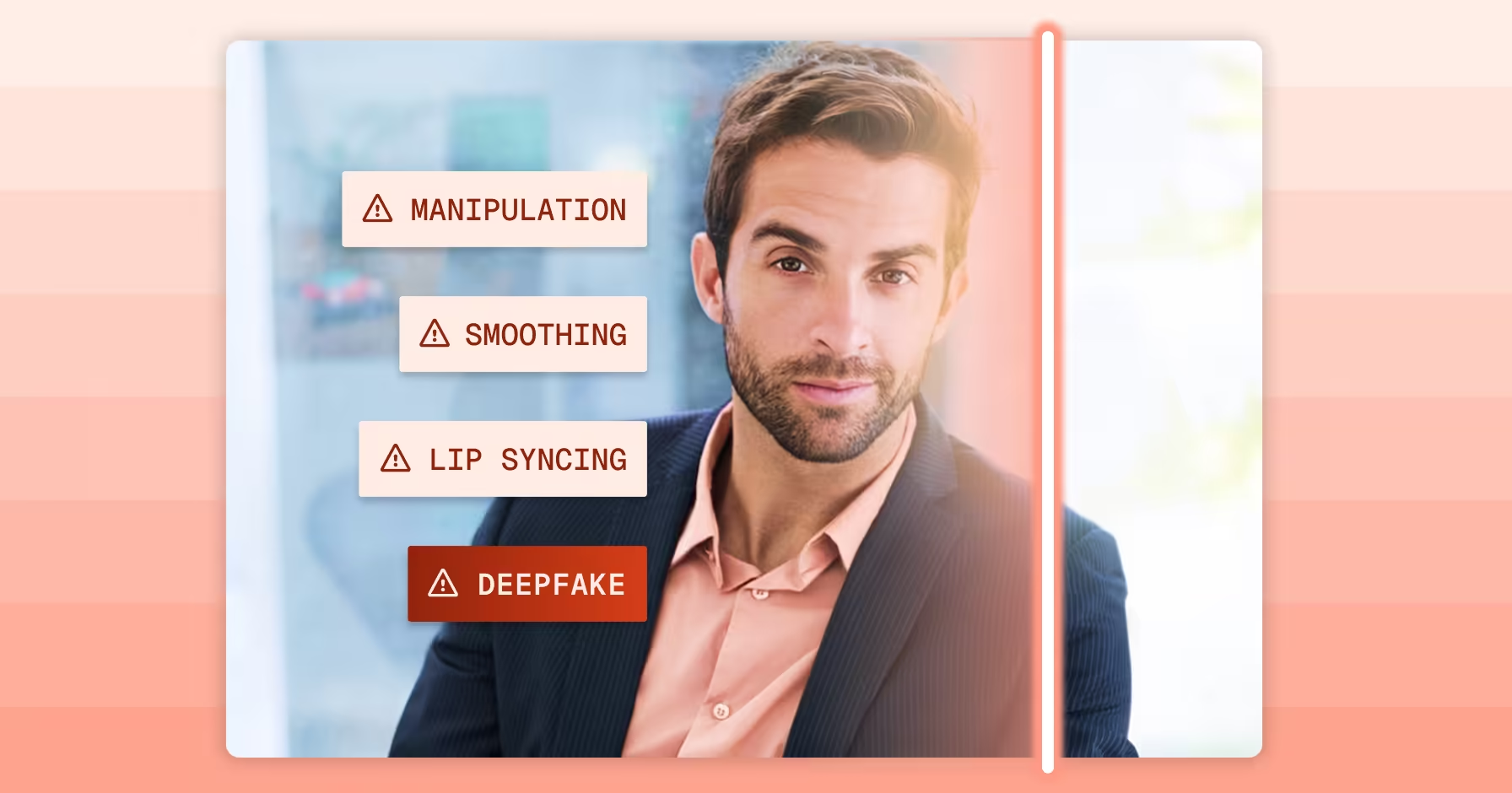
Security teams must screen inbound audio to prevent impersonation. DETECT-2B flags synthetic/tampered audio with ~94% accuracy, across 30+ languages, in ~200 ms, appropriate for screening calls/voice notes before action.
Net effect: pair your NLP stack (intent, entities, dialogue) with multilingual synthesis, instant conversion, and verifiable provenance to make collaboration both seamless and trustworthy.
As multilingual communication becomes increasingly AI-driven, measuring its value is critical. Beyond inclusion, leaders need proof of impact, metrics that link better understanding to faster decisions, higher satisfaction, and real business performance.
Also Read: Advancing Ethical AI: Resemble AI’s Commitment to the AI Voluntary Code of Conduct

Measuring the ROI of Multilingual Communication
Many multilingual-communication efforts fall short because they’re treated as a “nice to have” rather than as measurable business levers. To ensure investment pays off, metrics must be clearly defined, tracked, and aligned to outcomes. This is how it becomes a performance strategy instead of a cost.
| Metric | Description | Example / Implementation |
|---|---|---|
| Comprehension Score | The percentage of participants in multilingual meetings or content who fully understood the key takeaways. | Run post-meeting or post-training pulse surveys in each language. |
| Time-to-Decision | How language clarity and localization reduce delays in workflow, approvals, or execution. | Compare the average decision time before and after multilingual AI tools. |
| CSAT / NPS (multilingual) | Customer or internal satisfaction metrics segmented by language/region, to surface gaps in experience. | Build dashboards comparing satisfaction rates across language groups. |
| Response Accuracy | Error rate in translated voice/chat responses or misunderstood multilingual communications. | Track the number of escalations, rework, or corrections tied to language issues. |
Why do these matter:
- If comprehension scores are low, then multilingual communication isn’t doing its job—it’s just “available”.
- If time-to-decision is high, the investment isn’t speeding workflows.
- Segmenting CSAT/NPS by language reveals hidden dissatisfaction or risk in non-dominant markets.
- High error or rework rates tied to language undermine both cost savings and trust.
Practical implementation tips:
- Establish baseline metrics before rolling out multilingual tools or processes.
- Use mixed-method monitoring: quantitative (survey, logs, dashboards) + qualitative (feedback in native language).
- Link multilingual metrics to financial KPIs (e.g., faster time-to-decision to lower project cost).
- Build accountability: integrate multilingual metrics in both communication and business-unit dashboards.
- Reiterate that localization/voice tools are not a one-time fix—they require ongoing measurement and improvement.
Also Read: Exploring the Process of Building a Multilingual Voice Cloner
Conclusion
Multilingual communication is how modern teams collaborate, innovate, and grow. As global workforces expand and cross-regional projects become the norm, clarity across languages directly determines productivity, trust, and inclusion.
AI-powered voice and language tools make this shift possible in real time. When your systems can translate, speak, and understand context across 100+ languages, you remove the friction that slows decisions and distances teams. The result isn’t just better communication; it’s better performance.
Platforms like Resemble AI extend that capability further, combining multilingual voice synthesis, real-time speech translation, and consent-based watermarking to make global communication sound authentic, secure, and human. When teams can hear and be heard in their own languages, with tone, emotion, and intent intact, collaboration becomes connection.
Book a demo with Resemble AI today and see how our tools can help your team communicate more effectively across languages and cultures.
FAQs
Q1. How can multilingual communication improve customer service in my business?
A1. Multilingual communication can significantly enhance customer service by enabling teams to interact with clients in their preferred languages. This helps avoid miscommunication, reduces frustration, and leads to quicker resolution of issues. Offering support in multiple languages increases customer satisfaction, strengthens relationships, and boosts brand loyalty.
Q2. What tools can help my team with multilingual communication across different time zones?
A2. AI-powered solutions like Resemble AI’s multilingual TTS and voice cloning can assist your team in communicating effectively across different time zones. These tools provide real-time translation and seamless interaction, ensuring that time zone differences don’t create communication gaps or delays in decision-making.
Q3. How do I ensure that my multilingual team understands cultural nuances in communication?
A3. To ensure cultural nuances are understood, incorporate cultural sensitivity training and provide language support tools that recognize these subtleties. AI-driven solutions like Resemble AI’s voice synthesis can also help convey emotional tone and context, making communication more accurate and respectful across different cultures.
Q4. How does multilingual communication contribute to team productivity and collaboration?
A4. Multilingual communication improves team productivity by reducing misunderstandings and the need for constant clarifications. It helps teams stay aligned, make faster decisions, and collaborate more effectively, as all members can communicate in a way that is clear and accessible to them.
Q5. What are the security concerns around using AI for multilingual communication?
A5. While AI-driven multilingual communication solutions offer great efficiency, it’s crucial to address security concerns. Resemble AI incorporates features like AI watermarking and deepfake detection to ensure responsible use and prevent misuse, ensuring the integrity and confidentiality of your communication.