



The Deepfake Watchlist is Resemble AI's weekly surveillance of synthetic media incidents, ongoing cases, and disputed content shaping the news cycle. Each week we track confirmed incidents, emerging attack vectors, and claims under investigation, alongside the provenance, detection, and policy threads running underneath them.
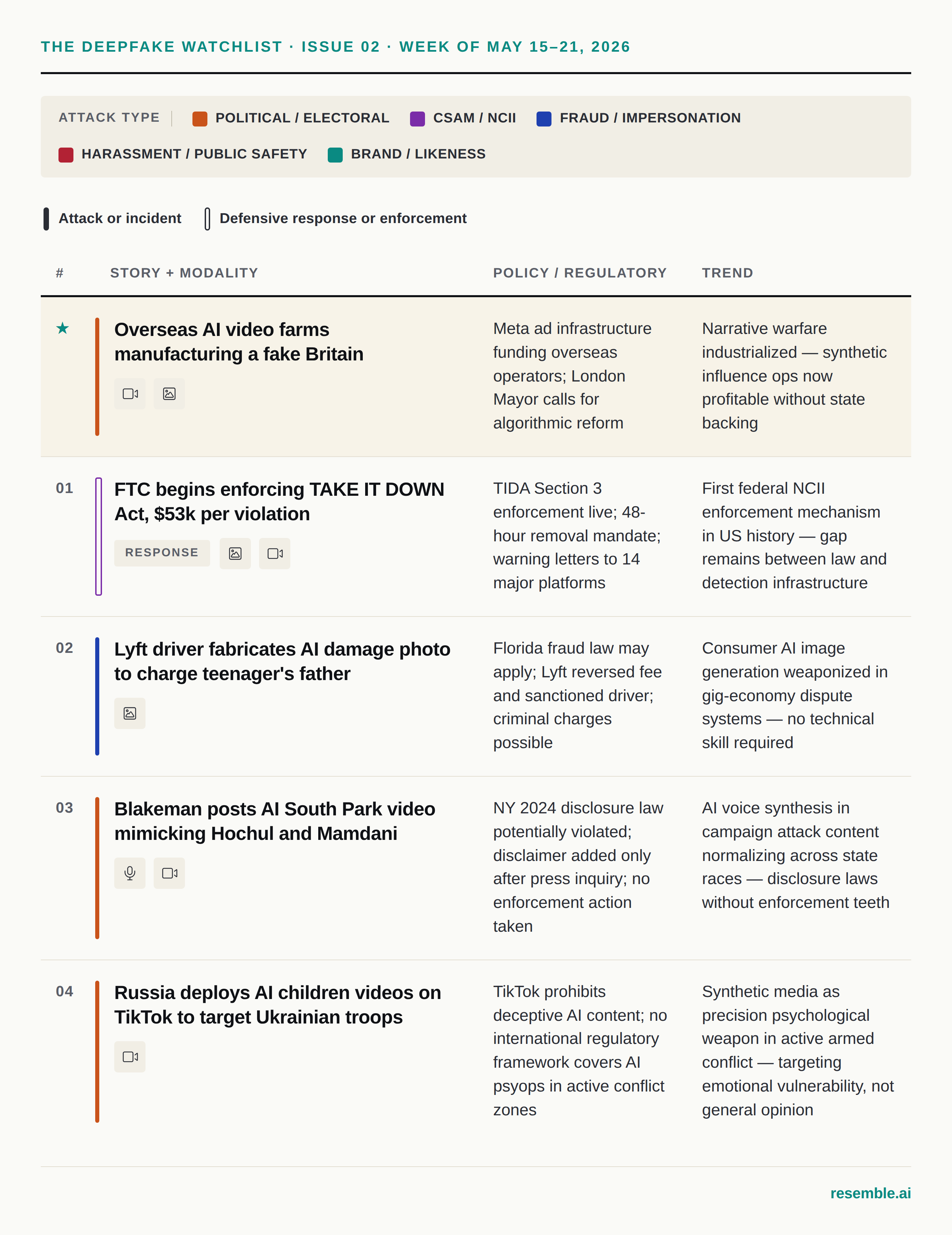
★ Featured: The overseas AI video farms manufacturing a fake Britain
BBC Panorama's Anti-immigration AI videos traced to overseas fakers, published May 15 by social media investigations correspondent Marianna Spring, documents dozens of interconnected Facebook and Instagram accounts run from Sri Lanka, Vietnam, the Maldives, Iran, and the UAE producing AI-generated video content depicting the UK as an Islamized, collapsing civilization, accumulating tens of millions of views through Meta's own ad monetization infrastructure.
- Category: Political / Electoral
- Type: Attack
- Modality: Video, Image
- Policy / Regulatory: Meta said it takes coordinated inauthentic behavior seriously and has global teams working to disrupt it, but no accounts had been confirmed removed at the time of reporting; London Mayor Sir Sadiq Khan called on platforms to amend algorithms to stop rewarding division and label AI content clearly.
- Trend: Narrative warfare industrialized: synthetic influence operations now self-financing through platform ad revenue, operable without state backing or technical sophistication.
- Attack vector: AI-generated video posted to Facebook and Instagram pages impersonating British nationals, cross-promoted through coordinated account networks, monetized through Meta's creator payment infrastructure.
- What we saw in the content: The videos carry the forensic signatures we train DETECT-3B Omni to flag, for example:
- Faces in the "elderly pensioner" talking-head clips show the over-smoothed skin texture and soft halo at the hairline consistent with portrait diffusion model outputs.
- The House of Commons footage depicting men in traditional Arab clothing shows background architecture with the spatial inconsistency typical of image-to-video generation: columns and benches that shift perspective between cuts.
- The 2050 city-walk footage shows pedestrian motion blur applied uniformly rather than selectively, a common artifact when video models generate crowd scenes.
- Text elements like Halal stall signs and Arabic-style bunting render with the slight smearing characteristic of diffusion models not specifically tuned for legible text generation.
.jpg)
BBC Panorama spoke directly to operators behind several accounts. One said they "mostly post to get a reaction for the sake of engagement which boosts my followers and money," paid through Instagram's monetization scheme. Several had previously been running MAGA content targeting US audiences before pivoting to anti-immigration narratives about Britain, which puts the ideological framing second to the platform economics. London Mayor Sir Sadiq Khan told the BBC he has seen evidence of Russian and Chinese state involvement, though direct attribution remains difficult to verify.
Research cited by the BBC puts human accuracy at detecting AI fakes at around 55%, barely above chance, and people consistently overestimate their own ability to spot them. Prof Yvonne McDermott Rees at Queen's University Belfast added that the more AI content people consume, the less able they are to trust authentic material. A commenter on the "Great British People" Facebook page put it plainly: "It's probably AI but the fact is that he is right about everything." Synthetic volume erodes the epistemic floor, independent of whether any individual video is believed.
The attack requires no technical sophistication, no state budget, and no particular ideology: just an AI video tool, Meta's algorithm, and a willingness to generate outrage content. Provenance at the point of generation, content that carries a verifiable signal of its origin before it reaches a platform, is the only defensive response that addresses the problem at the right layer rather than chasing individual accounts after the views have already accumulated.
1. FTC begins enforcing TAKE IT DOWN Act Section 3, with $53,088-per-violation penalties
Gizmodo's FTC's Strict Anti-Deepfake Rule Kicks in Today. Here's What That Means for Grok reports that May 19 marked the enforcement start date for Section 3 of the TAKE IT DOWN Act (TIDA), requiring covered platforms to establish a removal process for nonconsensual intimate imagery: including AI-generated deepfakes: and to remove content along with all known identical copies within 48 hours of a valid request. FTC Chairman Andrew Ferguson sent warning letters to Amazon, Apple, Alphabet, Bumble, Discord, Match Group, Meta, Microsoft, Pinterest, Reddit, Snapchat, TikTok, and X. Civil penalties run to $53,088 per violation.
- Category: CSAM / NCII
- Type: Response
- Modality: Image, Video
- Policy / Regulatory: TIDA Section 3 enforcement live as of May 19, 2026; FTC has launched TakeItDown.ftc.gov for victim complaints; the law covers "digital forgeries": AI-generated content: alongside real images.
- Trend: First federal NCII enforcement mechanism in US history; the gap between what the law requires platforms to do and what platforms can currently detect at upload remains unaddressed.
- Attack vector: N/A: regulatory response to AI-generated and distributed nonconsensual intimate imagery across covered platforms.
For years the US had no federal mechanism requiring platforms to act on nonconsensual intimate imagery at all, let alone on a timer. The first person convicted under TIDA, a Columbus, Ohio man who used more than 120 AI platforms to create and distribute sexual images of minors and non-consenting adult women, was sentenced last month, putting a concrete case behind the law's intent.
The critics are pointing at something real. Columbia researcher Kaylee Williams told Gizmodo that the burden of identifying and reporting harmful content still falls on victims, and the reporting process retraumatizes them. The EFF's India McKinney raised the censorship risk: a 48-hour removal window creates pressure for platforms to act without verification, and President Trump said during the bill's passage that he intended to use it against his critics. TIDA tells platforms how fast to remove content after notification. It does not yet require them to know whether content is synthetic before they host it.
2. A Lyft driver used AI to fabricate car damage and charge a teenager's father
BocaNewsNow's LYFT DRIVER SCAM: Boca Raton Area Driver Uses AI To Accuse Rider reports that a Lyft driver in the Boca Raton area generated an AI image of supposed damage to his vehicle, fast food strewn across the backseat, submitted it to Lyft as photographic evidence, and had a cleanup fee charged to a teenage girl's father. The girl identified the image as AI-generated. Lyft investigated, confirmed the fraud, reversed the charge, reimbursed the rider, and sanctioned the driver. Criminal charges are reportedly under consideration.
- Category: Fraud / Impersonation
- Type: Attack
- Modality: Image
- Policy / Regulatory: Florida fraud statutes apply; Lyft's internal review caught the fabrication after the family escalated; no specific synthetic media statute covers this attack vector.
- Trend: Consumer-tier AI image generation weaponized for small-scale financial fraud in gig-economy dispute systems: no technical skill required, scales across any platform that accepts a photo as evidence.
- Attack vector: AI-generated still image submitted through Lyft's damage reporting system as fabricated photographic evidence, triggering a financial penalty against the rider.
Lyft's dispute process, like those of Uber, Airbnb, and DoorDash, was built when submitting a photo meant submitting evidence of something real. The teenager recognized the AI-generated watermark on sight, which is how this got caught: a slightly more skilled generation with a different tool would likely have gone undetected. The attack surface is broad: every gig-economy dispute system that accepts a photo as evidence is now exposed to this at essentially zero cost per attempt. Detection at the point of submission is the defensive answer, and the technology exists. The question is whether platforms wait for a pattern of cases to accumulate before requiring it.
3. Blakeman posts AI South Park video mimicking Hochul and Mamdani, may have violated New York law
City & State New York's Hochul said what??? Blakeman AI video may have violated election law reports that Nassau County Executive Bruce Blakeman, the Republican gubernatorial nominee, posted an AI-generated South Park-style campaign video on May 19 using synthetic voices mimicking Gov. Kathy Hochul and Mayor Zohran Mamdani arguing in favor of green energy mandates. The video was posted without an AI disclaimer, potentially violating New York's 2024 AI-in-political-ads disclosure law. Blakeman's campaign denied any violation, then added a disclaimer after City & State inquired.
- Category: Political / Electoral
- Type: Attack
- Modality: Audio, Video
- Policy / Regulatory: New York State's 2024 election law requires AI disclosure in political advertising; no enforcement action taken as of reporting; Gov. Hochul's proposed ban on AI deepfakes of opposing candidates has not passed.
- Trend: AI voice synthesis in campaign attack content normalizing across state-level races: disclosure law exists on paper, enforcement does not.
- Attack vector: AI-generated animation with voice-cloned audio of sitting elected officials, posted on social media as political attack content without initial AI disclosure.
Adding a disclaimer only after press inquiry is what disclosure law without enforcement teeth produces. The Blakeman video also sits at an unresolved legal edge: does an animated South Park parody using cloned voices constitute the "malicious deepfake" Hochul's proposed ban targets, or is it protected political satire? The campaign clearly hoped the format gave it cover. Andrew Cuomo ran a fabricated AI video of Mamdani during the 2025 mayoral race and deleted it after backlash. Blakeman ran one during a 2026 gubernatorial campaign and added a disclaimer after a reporter called. The tools are cheaper each cycle and the political cost is falling.
4. Russia is using AI-generated TikTok videos of children to erode Ukrainian soldier morale
The UNN reported on May 19 that Russia is increasing its use of AI-generated videos of children on TikTok targeting Ukrainian military personnel, with content designed to exploit family connections and undermine front-line morale.
- Category: Political / Electoral
- Type: Attack
- Modality: Video
- Policy / Regulatory: TikTok prohibits deceptive AI-generated content and applies AI-Generated labels to realistic footage, but enforcement against state-actor operations at scale remains inconsistent; no international regulatory framework covers AI-generated psychological operations in active conflict zones.
- Trend: Synthetic media deployed as a precision psychological weapon against a specific military population, targeting emotional vulnerability rather than general public opinion.
- Attack vector: AI-generated video content posted to TikTok: a platform accessible in Europe and the US but banned in Russia: using children as emotional leverage against Ukrainian soldiers with family ties.
This is a psychographic operation directed at soldiers through their most reliable emotional vulnerability, on a platform they actually use. The military effectiveness of that attack is distinct from the epistemological one and harder to address: soldiers consuming TikTok near the front are not in a position to run forensic analysis. Provenance infrastructure, content that signals its synthetic origin at the moment of encounter, is the only intervention that scales to this context, because platform-level labeling after the fact does not reach users who are already emotionally engaged before they have reason to question what they're seeing.
Honorable mentions
A Texas man was federally charged this week for creating and distributing AI-generated pornographic images of politicians, actresses, musicians, and women he personally knew across multiple platforms. The May 20 case is notable for the breadth of targets: public figures and private individuals run through the same toolchain.
In Halifax, a man was acquitted of charges related to creating and distributing deepfake nudes of five women after a court found a gap in Canada's Criminal Code that left the conduct unaddressed. The May 21 ruling is a reminder that TIDA's US enforcement milestone this week has no equivalent in many jurisdictions.
The pattern
- Enforcement arrived, but law and detection infrastructure are still not in sync. TIDA Section 3 going live on May 19 is the most significant US regulatory milestone in synthetic media since the law was signed. But the BBC investigation shows Meta's own ad infrastructure funding overseas operators, the Blakeman campaign adding a disclosure only after press inquiry, and the Halifax acquittal all happened in the same week. Laws require platforms to act within 48 hours of notification. They do not yet require platforms to know whether submitted content is synthetic in the first place.
- The commodity tier is the real frontier. The Lyft story is the week's most underrated signal: a gig-economy driver, a consumer AI tool, a $75 damage fee, no technical skill required. The BBC investigation found something structurally identical at a different scale: a Sri Lanka-based operator running a 20-million-view influence campaign because Meta's algorithm pays for it. The attack surface for synthetic media fraud has become as broad as the economy itself.
- EU AI Act Article 50 transparency obligations take effect in August. The BBC investigation and the Blakeman story both circle the same problem: synthetic content reaching audiences without any signal that it was generated rather than captured. Article 50 will require AI-generated content to be labeled at the point of output in EU jurisdictions, which could create pressure for platform-level disclosure standards globally. Whether that pressure lands before the 2026 US midterm cycle accelerates is the question to watch.
Watching next week
- TIDA platform compliance. The first complaints filed through TakeItDown.ftc.gov will test whether platforms built real removal infrastructure or paper processes.
- Blakeman disclosure enforcement. Whether New York's election regulators treat the after-the-fact disclaimer as compliant or a violation will signal how seriously the state's AI-in-ads law is actually enforced.
- Halifax legislative response. The acquittal has drawn public attention in Canada; watch for whether Parliament accelerates pending synthetic NCII legislation.
- Russia-Ukraine AI psyop documentation. The TikTok children-video campaign is likely broader than a single incident; additional reporting from Sensity AI, Graphika, or DFRLab could surface this week.
The Deepfake Watchlist publishes every Friday. Subscribe to receive it in your inbox, or follow Zohaib Ahmed on LinkedIn for the weekly social companion. Track every documented incident in the Resemble Deepfake Incident Database, and read the full methodology in our 2025 Deepfake Threat Report.