

Candidate fraud in remote hiring happens when an applicant misrepresents identity, credentials, location, skills, or interview authenticity to gain a role. The risk is no longer limited to fake resumes.
The FBI’s 2025 IC3 Annual Report describes AI-involved employment scams that may include voice spoofing or possible voice deepfakes during online interviews, with reported losses of almost $13 million.
For HR, recruiting, IT, and security teams, the practical question is clear: how do you confirm that the person applying, interviewing, accepting the offer, and receiving access is the same legitimate candidate? The answer is a layered process that combines recruiter observations, structured interviews, work-sample verification, identity checks, live meeting protection, and access review.
Key Takeaways
- Candidate fraud in remote hiring can include fake resumes, synthetic identities, proxy interviews, AI-assisted answers, deepfake video, voice spoofing, and location misrepresentation.
- The strongest approach is layered detection. One indicator may have a simple explanation; repeated mismatches across the hiring funnel deserve review.
- Verification depth should match role risk. Roles with access to code, customer data, finance systems, infrastructure, or admin tools need stronger checks.
- Live interviews need more than behavioral observation when synthetic video or voice manipulation is a concern.
- For high-risk interviews, live meeting protection can add audio and video authenticity review before a candidate advances.
- Candidate experience still matters. The goal is to reduce risk without treating every remote applicant as suspicious.
What Candidate Fraud Looks Like In Remote Hiring
Candidate fraud is different from ordinary resume embellishment because it raises questions about who is actually being evaluated and who will receive access after hiring. A candidate who rounds up years of experience may be just misrepresenting qualifications. But candidate fraud creates a deeper risk when identity, interview authenticity, work eligibility, skill ownership, or access responsibility is unclear.
Common patterns include:
- Fabricated resumes with invented employers, projects, or credentials
- Synthetic or stolen identities
- Fake references
- Proxy interviews where someone else answers for the applicant
- Deepfake-assisted video interviews involving face swaps, voice clones, or AI filter impersonation
- AI-generated work samples with unclear authorship
- Real-time coaching during interviews
- Location misrepresentation that appears during payroll, tax, or access review
The core concern is same-person continuity: whether the person who submitted the application is the same person who completed the assessment, joined the interview, accepted the offer, and will receive credentials.
That matters most when the role creates access risk. In a low-access role, candidate fraud may lead to hiring waste, delayed projects, or a replacement search. In roles tied to engineering, finance, cybersecurity, IT administration, or customer-data operations, the same issue can become an identity and access-control problem because the wrong person may receive credentials, devices, or sensitive system access.
Why Remote Hiring Makes Candidate Verification Harder
Remote hiring makes candidate verification harder because evidence is scattered across different systems, teams, and stages of the process.
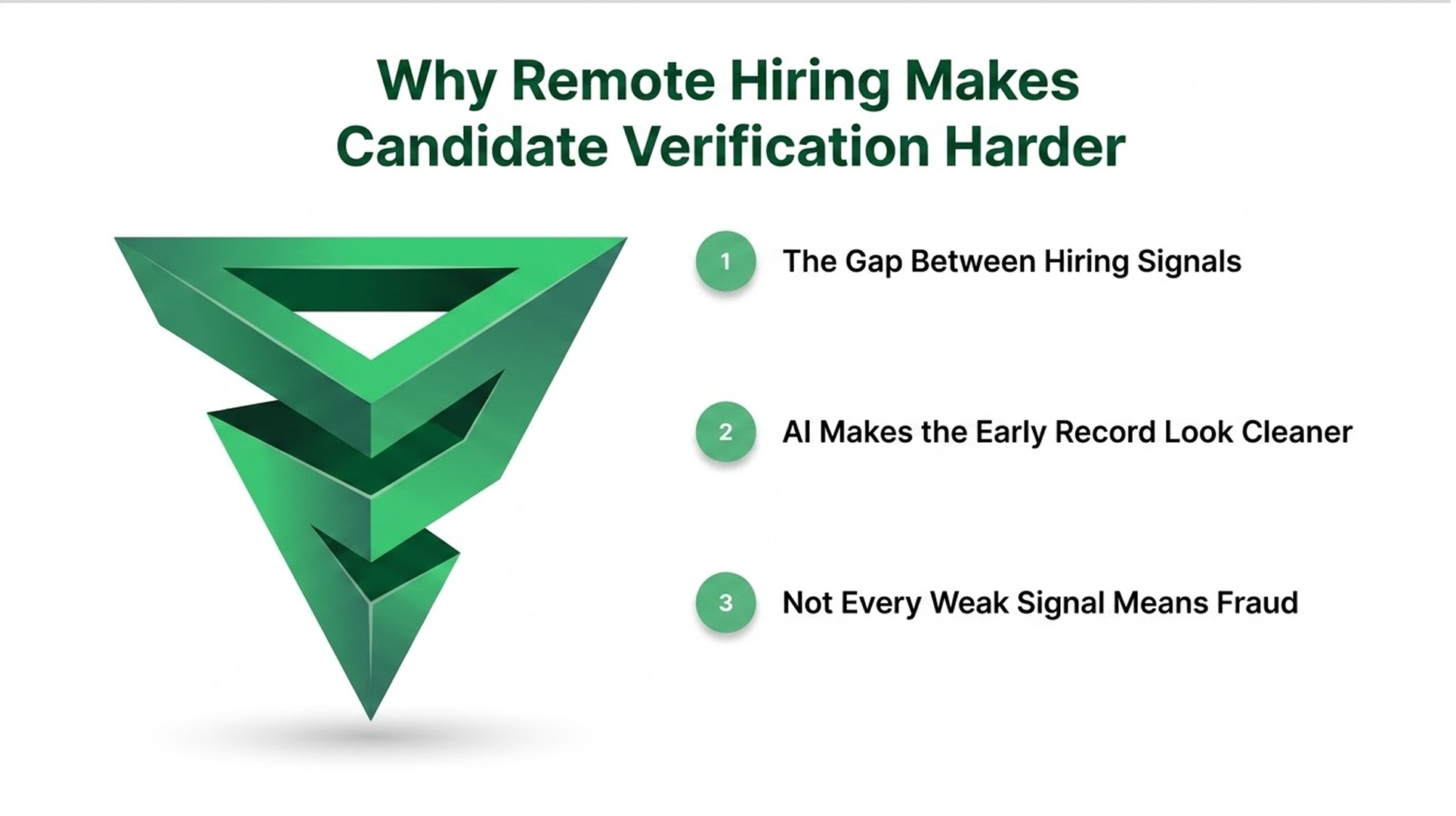
The Gap Between Hiring Signals
A recruiter may review a polished resume in an applicant tracking system. The hiring manager may only see the candidate during a video interview. A background check may happen later through a third-party process. IT may ship a laptop after the offer is accepted. Security may not see warning signs until the person starts accessing company systems.
Risk builds when no one sees the full picture. Each team may only see its own part of the hiring record.
AI Makes the Early Record Look Cleaner
AI adds more pressure to this workflow because it can help produce materials that look consistent at first glance.
These can include resumes, profile images, interview scripts, work samples, synthetic audio, or manipulated video. Together, they can make an applicant appear complete before the hiring team has tested ownership, identity, and live performance.
Not Every Weak Signal Means Fraud
This is why candidate fraud review needs to stay measured. Camera issues, nervous answers, limited online presence, privacy concerns, bandwidth problems, or device limitations may all have benign explanations.
The practical goal is to match the verification process to the risk created by the role.
For teams hiring into high-access remote roles, this is also where live meeting protection becomes worth evaluating. Resemble AI can help security and recruiting teams verify the authenticity of live audio and video during interviews on Zoom, Microsoft Teams, Google Meet, and Webex without replacing the broader hiring review process.
Also Read: How to Protect Yourself from Deepfake Live Video Calls
Where Candidate Fraud Shows Up Across The Hiring Funnel
Candidate fraud is easier to detect when each hiring stage has a clear verification process. The application stage checks profile consistency, assessments test skill ownership, interviews confirm the person behind the profile, onboarding reviews access risk, and post-hire monitoring closes the loop if new anomalies appear.
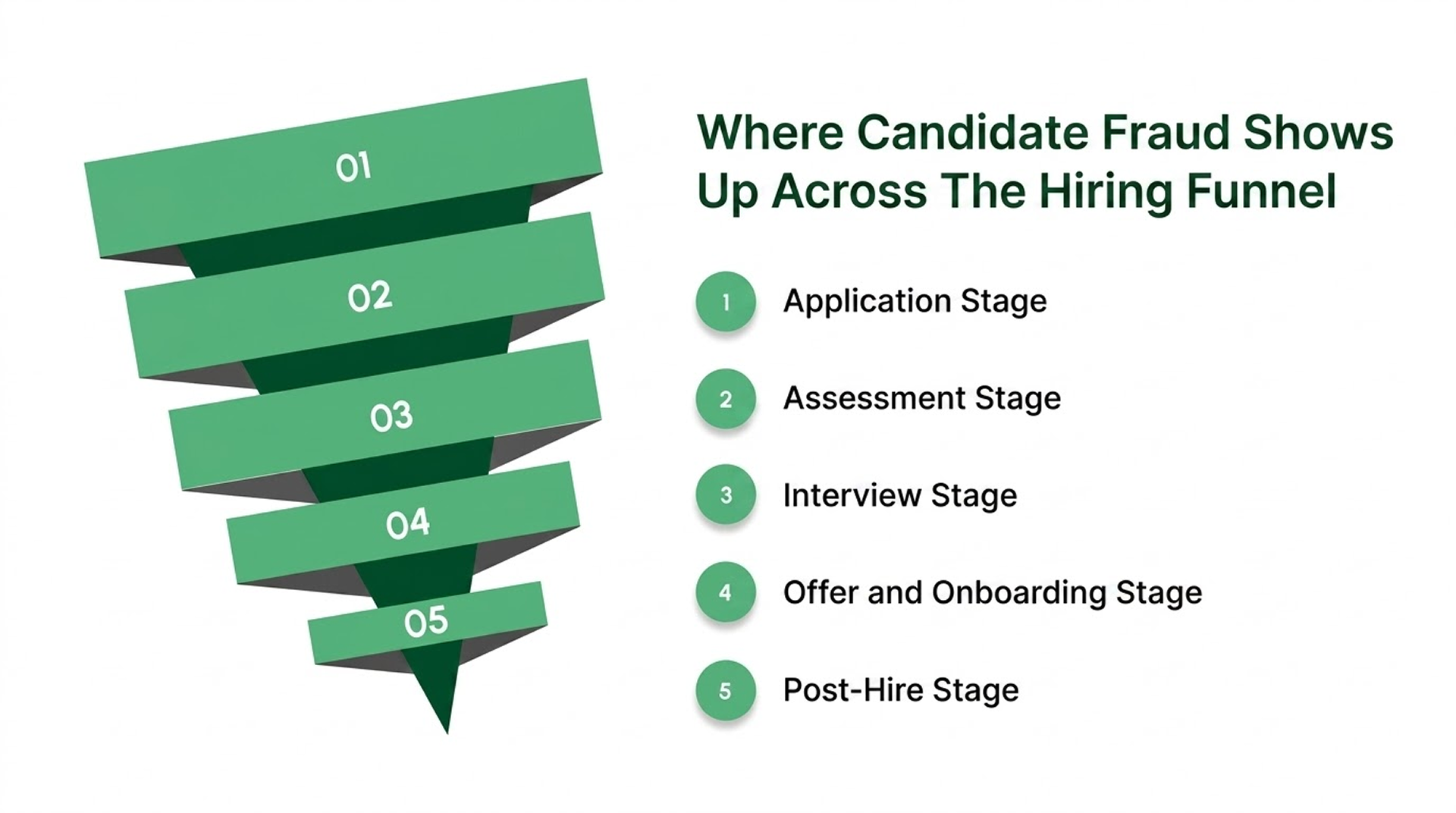
1. Application Stage
At the application stage, hiring teams may see resumes that look polished but lack verifiable detail. Signals worth noting include:
- Work histories that are difficult to verify
- Profiles created recently with little activity
- Portfolio links that do not prove authorship
- Email domains that do not match the claimed professional identity
- Repeated resume formats across applicants
- Generic project descriptions that fail under follow-up questions
The recruiter does not need to prove fraud at this stage. They need to document gaps that may require later verification.
2. Assessment Stage
At the assessment stage, candidate fraud often appears as a gap between submitted work and live explanation.
A take-home assignment may look well-prepared, but the candidate may struggle to explain how they approached it. The work may also seem stronger than their resume, screening call, or interview answers suggest.
For technical, security, or finance roles, the assessment is often treated as proof of skill. When the candidate cannot explain the reasoning behind the work, the submission may raise new questions instead of confirming ability.
3. Interview Stage
This stage can reveal issues such as proxy interviews, AI-assisted responses, voice spoofing, or possible deepfake use. Similar voice-cloning tactics also appear in deepfake vishing, where attackers use synthetic audio to impersonate a trusted person.
But interviewers should not treat one odd moment, such as a short audio delay or camera issue, as proof of fraud. A stronger concern appears when several inconsistencies show up together, such as a thin profile, repeated camera refusal, scripted answers, weak live exercise, and identity details that do not match the rest of the hiring record.
4. Offer and Onboarding Stage
At offer and onboarding, candidate fraud can start to affect payroll, devices, and system access.
The signals are easier to check at this stage. A claimed location may not match payroll details. A device shipping address may not fit the candidate’s stated work location. Access requests may seem too broad for the role.
These details may look routine on their own. They matter more if earlier stages already raised questions. For sensitive roles, this stage is important because the company is close to giving the candidate access to internal systems. If the record still has gaps, those gaps should be reviewed before access is granted.
5. Post-Hire Stage
Some patterns appear after the person starts.
Examples may include unusual login locations, unexpected use of remote access tools, work patterns that do not match the claimed location, or account behavior that does not fit the employee’s role.
Post-hire review should not replace hiring verification. It should close the loop. If security sees suspicious account activity after day one, the hiring record should already contain recruiter notes, interview indicators, verification outcomes, and meeting evidence.
4 Interview Red Flags That Deserve A Closer Look
Use interview red flags to decide whether to ask for clarification, run a second check, or escalate through the agreed process.
1. Resume and Conversation Do Not Match
A candidate may list complex projects but struggle to explain basic decisions from that work. That gap deserves follow-up because it can show that the resume does not reflect the candidate’s own experience.
Useful questions include:
- What problem did the project solve?
- What part did you personally own?
- What trade-off did you make?
- What failed during the project?
- What would you change now?
2. Answers Sound Scripted or Delayed
Some candidates may use outside help during interviews. Indicators can include long pauses before simple answers, unusually polished responses, or answers that do not change much when the question becomes more specific.
A useful sign is to ask one unexpected follow-up question based on the candidate’s last answer. Real experience can usually adapt to a follow-up question. Scripted answers often become weaker when the conversation moves away from the expected path.
3. Video or Audio Feels Inconsistent
Video and audio concerns may include mismatched lip movement, unusual audio delay, unstable facial edges, a voice that does not match the visible person, or repeated camera-off explanations.
These signals do not confirm fraud on their own. Network issues, device quality, lighting, and accessibility needs can all affect a remote interview. It becomes concerning when it appears with other issues, such as weak skill ownership or identity details that do not match the rest of the record.
Also Read: How To Identify AI-Generated Videos And Detect Fake Content
4. The Candidate Avoids Reasonable Live Checks
For some roles, a camera-on follow-up, identity check, or role-specific review may be a normal part of the hiring path.
Repeatedly avoiding these checks without a clear reason may deserve closer review. Hiring teams should still allow alternate paths for accessibility, privacy, or technical constraints.
6 Best Practices for Detecting Candidate Fraud in Remote Hiring
An effective candidate fraud process should reduce risk without making legitimate applicants feel accused.
1. Use a Risk-Based Verification Policy
Not every candidate needs the same checks. Set verification depth based on the risk created by the role.
Factors to consider include:
- Role access level
- Data sensitivity
- Financial permissions
- System administration rights
- Contract or vendor status
- Geographic or work eligibility requirements
- Whether the role is fully remote
A standard support role with limited system access may need a lighter path. A remote engineer with code access or an IT administrator with privileged access needs stronger review.
2. Build a Same-Person Continuity Check
Same-person continuity means checking whether the same person appears across the application, assessment, interview, offer, and onboarding stages.
A practical continuity workflow can include:
- Confirming that the profile and resume match public or professional records, where appropriate
- Using structured interviews tied to the candidate’s stated experience
- Running live work samples for roles where skill ownership matters
- Adding identity verification before offer or onboarding for higher-risk roles
- Reviewing device, payroll, and access details before issuing credentials
- Keeping recruiter notes, interview observations, verification outcomes, and security signals in one review path
This gives HR, IT, and security enough context to compare inconsistencies when risk is high.
3. Use Structured Interviews
Structured interviews make it harder for a candidate to pass through a vague conversation alone. Use the same core questions for the same role. Ask follow-ups. Test for ownership, decision-making, and practical skill.
For technical roles, ask the candidate to explain the “why” behind a decision. For finance, security, or operations roles, ask how they would handle a role-specific scenario.
4. Use Live Work Samples for High-Risk Roles
Take-home work can still be useful, but it should not be the only proof of skill for roles with sensitive access.
For high-risk roles, add a short live exercise where the candidate explains their approach while working. The task does not need to be long or difficult. It should be specific enough to test whether the candidate can think through the work in real time.
For example, you can ask the candidate to walk through a past decision, revise a small part of their submission, explain a trade-off, or respond to a role-specific scenario. This helps you compare their skills, explanations, and resume claims before the hiring process moves to offer or onboarding.
5. Cross-Check References Through Reliable Paths
References should not rely only on contact details supplied by the candidate.
Where possible, confirm references through company domains, known professional networks, or verified business records. Watch for references that use free email accounts, refuse basic context, repeat the same language, or cannot speak clearly about the candidate’s actual work.
6. Train Recruiters To Escalate Patterns
Recruiters should not be asked to act as fraud investigators. Give them a clear escalation path.
They need to know:
- Which signals to document
- Which roles require deeper review
- When to involve HR
- When to involve IT or security
- What evidence to preserve
- How to avoid unsupported accusations
A good escalation path protects the company and the candidate. It makes the process more consistent and easier to audit.
What To Do When A Candidate Looks Suspicious
When a concern comes up, pause before moving the candidate to the next stage. Review what was observed, compare it with the rest of the hiring record, and choose a neutral follow-up step if the concern still needs review.
Step 1: Document The Signal
Record what happened, when it happened, and who observed it. Keep notes factual.
Useful details include:
- The stage of the process
- The concern observed
- The role being hired for
- The access level tied to the role
- The next check requested
- The final review outcome
Avoid language that assumes intent. Write what was observed, not what you think it proves.
Step 2: Ask for a Second Data Point
Add one follow-up check according to the concern. Do not accuse the candidate.
Examples include:
- A follow-up call with the same interviewer and one new reviewer
- A live walkthrough of a submitted work sample
- A shorter role-specific exercise
- A second reference check through a verified path
- Identity verification at the next risk-based stage
Step 3: Compare Inconsistencies Across the Funnel
Check whether the same concern shows up elsewhere in the hiring record. A thin profile, vague project ownership, video anomalies, inconsistent assessment performance, and unusual onboarding details create a stronger case for escalation.
Step 4: Bring in the Right Team
HR owns candidate communication and process. Legal can advise on policy and employment risk. IT can review device, account, and access details. Security can assess identity and access risk.
For suspected remote IT worker risk, coordinate with insider risk teams to review vetting, monitor anomalous user activity, preserve evidence, and make risk-based investigative decisions.
Step 5: Hold Sensitive Access Until Review Ends
For roles with sensitive access, avoid issuing credentials, devices, admin rights, or production access while a fraud review is open.
A short delay is easier to manage than recovering from a fraudulent hire who already has access to internal systems.
How Resemble AI Helps With Deepfake Interview Risk
Manual review still matters, but recruiters and hiring managers are not expected to analyze synthetic voice, face swaps, or AI filters during a live call.
Resemble AI adds a live detection layer to high-trust meetings, including remote interviews. It supports multimodal deepfake detection by analyzing live audio and video during calls on Zoom, Microsoft Teams, Google Meet, and Webex and flagging signs of face swaps, voice clones, or synthetic personas.
If a high-risk interview may involve a deepfake candidate or voice clone, the result is more useful before the candidate advances to the next stage.
The output needs to answer four practical questions:
- Was the call flagged?
- How confident is the result?
- Why was it flagged?
- Who should review it next?
Resemble AI returns detection outputs, including a verdict, confidence score, and forensic report. The detection bot appears as a named participant by default. The product also supports calendar sync, Active Directory, SSO/SAML, email, Slack, or SMS alerts, as well as cloud, on-prem, or air-gapped deployment options.
For candidate fraud review, this detection signal is useful because it can be reviewed alongside recruiter notes, identity checks, assessment results, and access decisions. It should not replace HR judgment. It gives hiring and security teams another point of evidence when the interview itself may not be authentic.
How To Evaluate A Live Interview Detection Layer
Use this checklist before adding deepfake detection to remote interviews:
A live detection layer is most useful when it produces a reviewable result that can sit beside recruiter notes, identity checks, work-sample results, and onboarding review.
Also Read: 4 Ways to Detect and Verify AI-generated Deepfake Audio
Conclusion
Candidate fraud in remote hiring is easiest to manage before access is granted.
Build checks across the funnel, train recruiters to document patterns, use live work samples for sensitive roles, and connect hiring evidence with security review. For interviews where synthetic video or voice risk matters, add live detection before the candidate moves to the next stage.
The strongest process is not the most suspicious one. It is the most consistent one: proportional checks, factual documentation, clear escalation, and access decisions grounded in the full hiring record.
If your team is reviewing high-risk remote interview workflows, explore how Resemble AI's platform can help evaluate the authenticity of live audio and video before a candidate moves forward. Book a demo to get started.
Also Read: What is Deepfake Vishing: Strategies for Prevention and Response
FAQs About Detecting Candidate Fraud In Remote Hiring
- How Do You Detect Candidate Fraud In Remote Hiring?
The best way to detect candidate fraud in remote hiring is to layer checks across the hiring funnel. Start with profile and resume review. Add structured interviews, live work samples, verified references, risk-based identity checks, and onboarding review.
For high-risk roles, live meeting protection can add another signal by reviewing whether audio or video manipulation may be present during interviews. No single indicator should decide the case. Look for repeated mismatches across stages.
- Can Deepfakes Be Used In Remote Interviews?
Yes. The FBI’s 2025 IC3 Annual Report describes employment scams involving voice spoofing or possible voice deepfakes during online interviews. The report also notes examples where lip movement and audio did not fully match. A suspicious call does not prove deepfake use. Poor bandwidth, camera quality, device issues, and lighting can create strange effects.
Hiring teams should combine live meeting review with role-specific checks and identity review.
- Can ATS or Background Check Tools Detect Deepfake Interviews?
ATS tools and background checks serve different parts of the hiring process. An ATS helps manage applications and candidate workflows. A background check verifies certain records tied to an identity. Neither is the same as analyzing live audio and video during an interview. For deepfake interview risk, teams may need a live meeting protection layer that can review video and voice signals during the call.
- When Should a Company Verify Candidate Identity?
Use risk-based timing. Early identity verification may make sense for sensitive roles, but applying heavy checks to every applicant can add friction and privacy concerns. A practical model is to use lighter checks early, then add stronger identity review before offer, onboarding, or access provisioning for higher-risk roles. The key is to apply the same policy consistently across similar roles.
- How Can Teams Reduce Fraud Without Hurting Candidate Experience?
Use clear policies, explain why certain checks exist, and apply them fairly across similar roles. Avoid surprise requests that feel personal or arbitrary. Keep checks proportional to role risk. Give candidates a path to explain technical issues, accessibility needs, or privacy concerns. Escalate based on patterns, not isolated behavior.
- What Is A Proxy Interview?
A proxy interview occurs when someone other than the real applicant participates in the interview or provides answers for the applicant. This may involve a stand-in joining the call, someone feeding answers off-screen, or a candidate relying on external help without disclosure. For high-risk roles, structured follow-up questions and live work samples can help test whether the candidate owns the experience they claim.
- What Is The Difference Between Resume Embellishment And Candidate Fraud?
Resume embellishment overstates real experience. Candidate fraud raises questions about identity, eligibility, skill ownership, interview authenticity, or who will actually perform the work after hiring. That difference matters because fraud can create access risk. If the person evaluated is not the person receiving credentials, the issue moves beyond hiring quality and into identity and access governance.
- What Should Recruiters Do If A Candidate Seems Suspicious?
Recruiters should document the concern and escalate through the agreed process. They should avoid making accusations based on one indicator. A better response is to request a second data point, such as a follow-up interview, live work walkthrough, verified reference, or identity check. For high-risk roles, HR, legal, IT, and security may need to review the pattern together.
- How Does Resemble Meetings Help With Candidate Fraud Detection?
Resemble Meetings adds a live-call detection signal to interviews and other high-trust meetings. The detection bot can join Zoom, Teams, Google Meet, and Webex calls to analyze live audio and video for signs of face swaps, voice clones, or synthetic personas. It should be used alongside recruiter notes, identity checks, work samples, and access review rather than as the only decision point.
- Does Resemble Meetings Store Interview Content?
Resemble Meetings analyzes live audio and video and returns outputs such as a verdict, confidence score, and forensic report. Storage and retention settings should be evaluated against the organization’s deployment configuration, compliance requirements, and internal policies. Teams should also confirm consent, notice, and disclosure requirements before using any meeting analysis tool in interviews. For regulated or security-sensitive teams, clarifying these details early can reduce review friction.
- Which Roles Need Stronger Candidate Fraud Checks?
Stronger checks make the most sense for roles with sensitive access. Examples include engineering, IT administration, cybersecurity, finance, executive support, infrastructure, customer-data access, contractor access, and roles with production credentials. Lower-risk roles may not need the same depth. The key is to match verification to the risk created if the wrong person receives access.
- What Should A Team Do After Confirming Candidate Fraud?
Follow internal HR, legal, IT, and security processes. Preserve evidence, pause hiring or onboarding, review access status, and check whether any systems or data were exposed. If the candidate already received credentials, treat it as an access review, not only a hiring issue. Use the case to update the hiring workflow based on where the concern first appeared.