



The Deepfake Watchlist is Resemble AI's weekly surveillance of synthetic media incidents, ongoing cases, and disputed content shaping the news cycle. Each week we track confirmed incidents, emerging attack vectors, and claims under investigation, alongside the provenance, detection, and policy threads running underneath them.
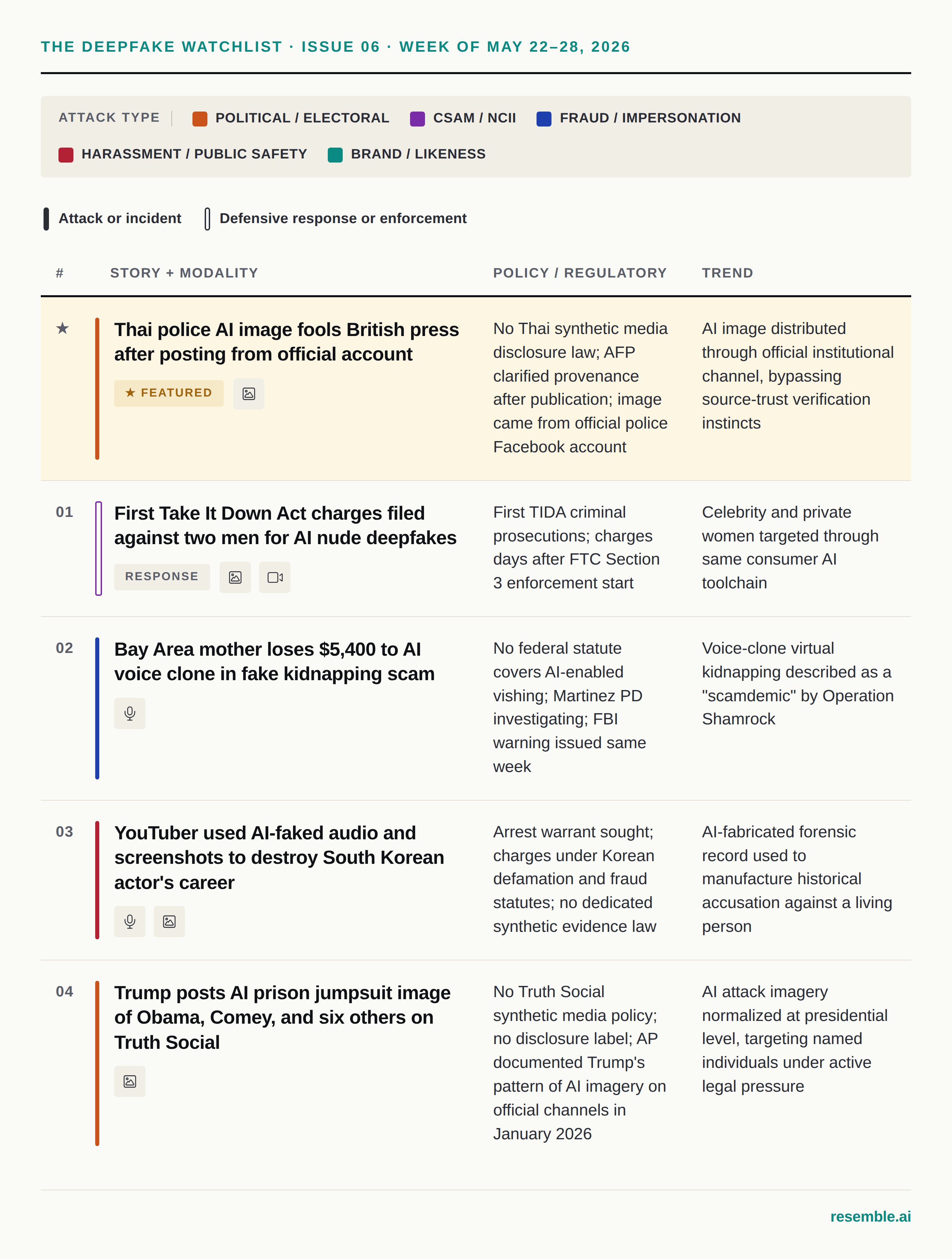
★ Featured: The Thai police photo that fooled the press
The Guardian's Image of Thai police in sparkly dresses with handcuffed suspect turns out to be AI fake, published May 28, reports that an image of Thai police officers in elaborate sequined festival dresses surrounding a drug suspect, released on an official police station Facebook account, was AI-generated by the station's own social media administrator, and was published as real by the Daily Star, the Telegraph, the Sun, and the New York Post before being debunked.
- Category: Political / Electoral
- Type: Attack
- Modality: Image
- Policy / Regulatory: No Thai or international platform enforcement action has been reported; AFP, which distributed the image, has since clarified its provenance; no synthetic media disclosure law covers official government social media accounts in Thailand.
- Trend: AI-generated imagery distributed through apparently official institutional channels, bypassing the source-trust instincts that editors and readers rely on as a verification proxy.
- Attack vector: AI-generated image posted to an official police station Facebook page by the station's own administrator, picked up and published by major news outlets in the UK and US on the assumption that an official source implies authentic content.
- What we saw in the content: The image carries the forensic signatures we train DETECT-3B Omni to flag, for example:
- The female officer's face shows the over-smoothed skin texture and soft halo at the hairline consistent with portrait diffusion model outputs, while the male officers' faces show sharper, more varied skin texture suggesting they were composited from or conditioned on real photographs.
- The sequined fabric renders with the luminance-uniformity artifact typical of diffusion models handling reflective materials: highlights repeat at implausibly regular intervals rather than varying with the light source's angle.
- Shadow directions on the foreground figures are inconsistent with those on the background suspect and wall, a common artifact when generative models construct multi-person scenes from independently conditioned elements.
- The original real image, now posted by the station, shows five male officers in regular clothes with no female officer present — confirming the entire female figure was synthesized rather than swapped.
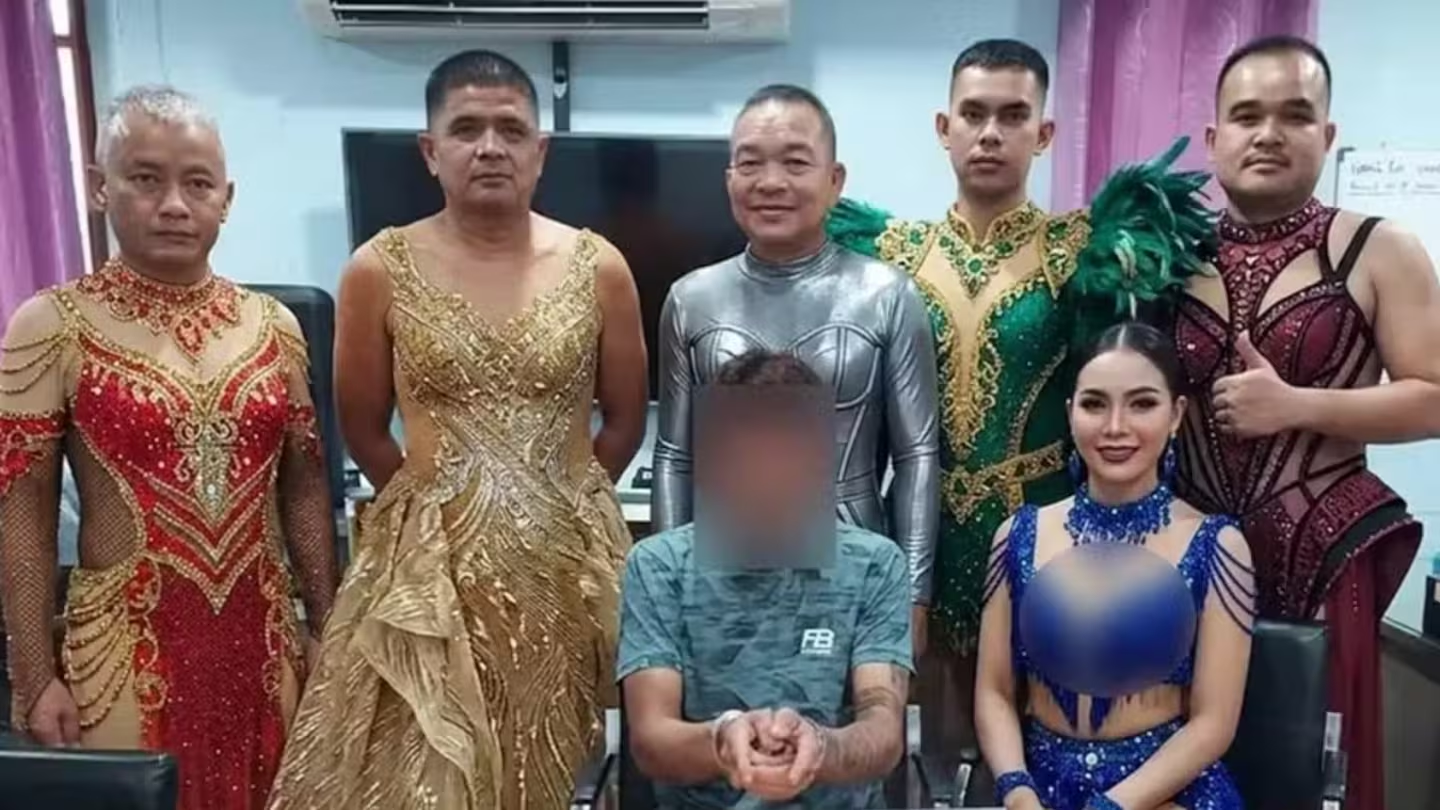
This case is a clean illustration of the source-trust attack. The Daily Star wrote about the "burly crew of five men and one woman" in sequins as though describing a real event. The Sun reported on the "covert mission" as fact. Neither publication had any particular reason to question the image because it came from an official police account, and official sources are where verification instincts typically stop. The administrator who generated it said they wanted to create "a friendlier image" and show "a cute and humorous side" not to deceive anyone. The deception was a side effect of the tool, the channel, and the absence of any provenance signal distinguishing the synthetic image from a photograph.
That is the structural problem this case illustrates better than almost any other this week. The image was not designed to fool journalists but rather to be charming. But the same absence of provenance that lets a well-meaning police administrator dress officers in sparkly dresses without any label is the same absence of provenance that lets a malicious actor do something considerably worse through the same channel. Detection after distribution is too late. A watermark embedded at generation, carried through the Facebook post, and readable by a browser or news wire system would have flagged this before a single headline was written.
1. First federal charges under the Take It Down Act target two men for AI-generated nude deepfakes
The Associated Press's Two men charged with creating AI-generated porn under new law targeting 'deepfakes' reports that federal prosecutors charged two men with using AI tools to create and publish nude images and videos of female celebrities, politicians, musicians, singers, and private women, marking the first criminal prosecutions under the Take It Down Act since the law took effect.
- Category: CSAM / NCII
- Type: Response
- Modality: Image, Video
- Policy / Regulatory: First prosecutions under the Take It Down Act; charges filed under the statute's criminal provisions covering AI-generated nonconsensual intimate imagery of both public figures and private individuals.
- Trend: Federal enforcement of synthetic NCII law moves from regulatory warning letters to criminal charges within days of the FTC's Section 3 enforcement start date.
- Attack vector: Consumer AI image and video generation tools used to produce nonconsensual intimate imagery at scale, targeting both public figures and private individuals through the same toolchain.
Last week's issue covered the FTC's May 19 enforcement start date for TIDA Section 3 and noted the gap between what the law requires and what platforms can detect at upload. This week closed the loop on the criminal side: the DOJ moved within days of the FTC's enforcement milestone to bring the first charges under the law's criminal provisions. The speed matters, because one of the recurring criticisms of TIDA has been that its penalties are real but its enforcement is reactive rather than preventive.
Celebrities and politicians together with women the defendants personally knew, run through the same AI toolchain. The technology does not distinguish between a public figure and a private person, and neither did these defendants. That is the commodity-tier NCII model in its simplest form.
2. Bay Area mother loses $5,400 to AI voice clone of her daughter in fake kidnapping scam
ABC7 San Francisco's Bay Area mom out thousands after scammers use AI to mimic daughter's voice in fake kidnapping, published May 24, reports that Deborah Del Mastro of Martinez, California was deceived by a phone call in which scammers played AI-cloned audio of her 37-year-old daughter Sarah in apparent distress, claiming she had been kidnapped by a Mexican drug cartel, then kept Del Mastro on the line for five hours while she wired $5,400 to Mexico from multiple locations.
- Category: Fraud / Impersonation
- Type: Attack
- Modality: Audio
- Policy / Regulatory: Martinez police are investigating; no specific federal statute targets AI-enabled vishing at the consumer level; the FBI issued warnings about the same tactic the same week.
- Trend: Voice-clone virtual kidnapping scams escalating in scale, with Erin West of Operation Shamrock describing the pattern as a "scamdemic" that will only intensify as cloning tools become cheaper.
- Attack vector: Voice audio cloned from publicly available social media content, used in a real-time phone call to simulate a distressed family member and override the victim's judgment through sustained emotional pressure over five hours.
The technical threshold for this attack is now effectively zero. Erin West told ABC7 that a few seconds of audio from social media is enough to produce a clone convincing enough to fool a parent. Del Mastro followed the caller's instructions for five hours because the voice was her daughter's voice, and no amount of skepticism about scams prepares you for the specific emotional experience of hearing what sounds like your child terrified and asking for help.
West's recommendation, a family code word known only to people in the household, is a provenance solution at the personal level: it creates a signal synthetic audio cannot replicate because it was never captured. That is the same logic as watermarking at the point of creation, applied to human relationships rather than media files.
3. South Korean police seek arrest of YouTuber who used AI to fabricate evidence that ended an actor's career
The BBC's AI used to fake evidence that ended Korean actor's career, say police, published May 22, reports that South Korean police are seeking an arrest warrant for YouTuber Kim Se-ui, who allegedly used AI to generate a voice recording and manipulated screenshots of text messages to falsely implicate actor Kim Soo-hyun in a relationship with the late actress Kim Sae-ron when she was a minor, a fabrication that destroyed the actor's career and was motivated, police say, by financial gain.
- Category: Harassment / Public Safety
- Type: Attack
- Modality: Audio, Image
- Policy / Regulatory: South Korean police have filed for an arrest warrant; the actor filed criminal complaints and lawsuits in March 2025; charges are likely brought under defamation and fraud provisions as no dedicated Korean synthetic evidence statute exists.
- Trend: AI-fabricated forensic evidence used to manufacture a credible accusation in a high-attention media environment, amplified by a grieving family's public backing of false claims.
- Attack vector: AI-generated voice recording combined with manipulated screenshots of authentic messages, presented as firsthand evidence on a platform with nearly one million subscribers.
This case sits at a specific intersection: synthetic media used not to impersonate a living person in real time, but to fabricate the historical record of a relationship that never happened. The actress had died by suicide, meaning she could not dispute the claims, and her family publicly backed the fabrications in grief. The actor's agency acknowledged a real adult relationship in an attempt to defend against the more serious allegation, which gave the false narrative partial confirmation and made the correction harder to land.
The economic motive is documented in the police filing: Kim Se-ui allegedly spread the false claims for financial gain, the same platform-pays-for-engagement logic as the overseas influence operations in last week's BBC investigation, operating at a single-person scale. Kim Soo-hyun has not made a public appearance since March 2025 and his Disney+ series remains postponed.
4. Trump posts AI image of Obama, Comey, and six others in prison jumpsuits on Truth Social
HuffPost's Trump Attacks Obama, Comey, Others With AI Images Of Them In Prison Jumpsuits, published May 24, reports that Donald Trump shared an AI-generated "Brady Bunch"-style image on Truth Social depicting Barack Obama, James Comey, Samantha Power, Susan Rice, Valerie Jarrett, James Clapper, John Brennan, and Ben Rhodes in prison jumpsuits, captioned with the claim that the group was "bad" and "destructive," posting it shortly after Comey's April indictment over an Instagram post officials characterized as a threat against Trump.
- Category: Political / Electoral
- Type: Attack
- Modality: Image
- Policy / Regulatory: No platform enforcement action taken; Truth Social has no enforced synthetic media disclosure policy; the post follows Trump's established pattern of sharing AI-generated political imagery from official and personal accounts documented by AP in January 2026.
- Trend: AI-generated political attack imagery normalized at the presidential level, with the sitting president using synthetic content to depict named political opponents in carceral scenarios during an active legal campaign against them.
- Attack vector: AI-generated image shared directly by a head of state on his own platform, using the presidency's amplification infrastructure to distribute politically targeted synthetic content without disclosure.
Comey had been indicted in late April over an Instagram photo of seashells that prosecutors argued constituted a veiled threat against Trump. Posting an AI image of Comey in a prison jumpsuit the same month, alongside six other named political opponents, is not a neutral meme: it is synthetic media deployed as part of an active legal and political pressure campaign against specific named individuals. AP documented in January that the Trump administration had already normalized AI imagery across official White House channels. This is the same pattern operating at a more pointed target set.
The signal for Resemble's enterprise customers is the combination: a sitting head of state, his own social platform, a set of named individuals under active legal pressure, and no disclosure requirement. Every enterprise security team managing executive communications now operates in an environment where synthetic attack imagery targeting named individuals can originate from the highest levels of government and reach millions of people without any label. That is a threat model that did not exist three years ago.
Honorable mentions
Australia and the UK signed an AI safety memorandum of understanding on May 25, pairing the Australian AI Safety Institute with the UK AI Security Institute on joint research, risk information sharing, and contribution to the International Network for Advanced AI Measurement, Evaluation and Science. The MoU is as much about building institutional muscle memory as operational collaboration today, but the timing matters: anglophone democracies are building the bilateral relationships that could support coordinated synthetic media standards ahead of the EU AI Act's Article 50 deadline in August.
Paris Hilton's 11:11 Media debuted Searching for Mr. Deepfakes on TikTok on May 27, a multipart documentary by journalist Laurie Segall following a three-year investigation into the anonymous operator of a deepfake platform that drew 17 million monthly visitors before being shut down. Whether long-form investigative journalism on synthetic media finds reach in a vertical-video format is worth watching as the installments roll out.
A deepfake video of Canadian Prime Minister Mark Carney appeared in scam ads on Truth Social this week, according to a CBC fact-check, directing viewers toward a fraudulent investment scheme — on the same platform and in the same week as Trump's AI prison jumpsuit posts, making Truth Social's synthetic media moderation posture a recurring thread.
The pattern
- The source-trust attack is now the dominant vector. The Thai police image worked because it came from an official account. The Kim Soo-hyun fabrication worked because it was presented as a recording the victim herself had made. Trump's prison jumpsuit image circulates without pushback because it comes from the president's own account. In each case, the synthetic content bypasses scrutiny not by being technically perfect but by arriving through a channel the audience already trusts. Detection after distribution does not address this. Provenance at the point of generation, a signal that travels with the content regardless of the channel it moves through, is the only intervention that works at the right layer.
- Enforcement and attack volume are both accelerating, but on different timelines. The TIDA first charges landed days after the FTC's Section 3 enforcement start date, which is genuinely fast by regulatory standards. The same week produced the Thai police media hoax, a $5,400 voice-clone kidnapping, AI-fabricated forensic evidence that ended a career, and AI attack imagery shared by a sitting president. Laws and prosecutions operate on quarterly or annual timescales. The attacks operate on daily ones. Closing that gap requires detection infrastructure embedded at the point of creation, not just enforcement action after harm has already spread.
- August is still the date to watch. The Australia-UK MoU, the TIDA charges, and continuing international enforcement actions all represent governments building the institutional infrastructure to respond to synthetic media harm. The EU AI Act's Article 50 transparency obligations take effect in August, requiring AI-generated content to carry disclosure labels in EU jurisdictions. The Thai police case makes the stakes concrete: a label embedded at generation would have flagged that image before the Daily Star ran it on the front page.
Watching next week
- TIDA prosecution details. As the first Take It Down Act cases proceed, watch for whether charges include distribution counts or only creation, which will shape how the law is interpreted going forward.
- Kim Se-ui arrest warrant. South Korean courts will decide whether to grant the warrant; the outcome tests whether defamation and fraud statutes can adequately cover AI-fabricated forensic evidence.
- Truth Social moderation posture. The Carney deepfake scam ad and Trump's AI prison jumpsuit post appeared on the same platform the same week; watch for any advertiser or platform response.
- Searching for Mr. Deepfakes rollout. The first installments of Paris Hilton's TikTok documentary series are live; watch for whether vertical-format investigative journalism on synthetic media finds the reach the format promises.
The Deepfake Watchlist publishes every Friday. Subscribe to receive it in your inbox, or follow Zohaib Ahmed on LinkedIn for the weekly social companion. Track every documented incident in the Resemble Deepfake Incident Database, and read the full methodology in our 2025 Deepfake Threat Report.