



The Deepfake Watchlist is Resemble AI's weekly surveillance of synthetic media incidents, ongoing cases, and disputed content shaping the news cycle. Each week we track confirmed incidents, emerging attack vectors, and claims under investigation, alongside the provenance, detection, and policy threads running underneath them.
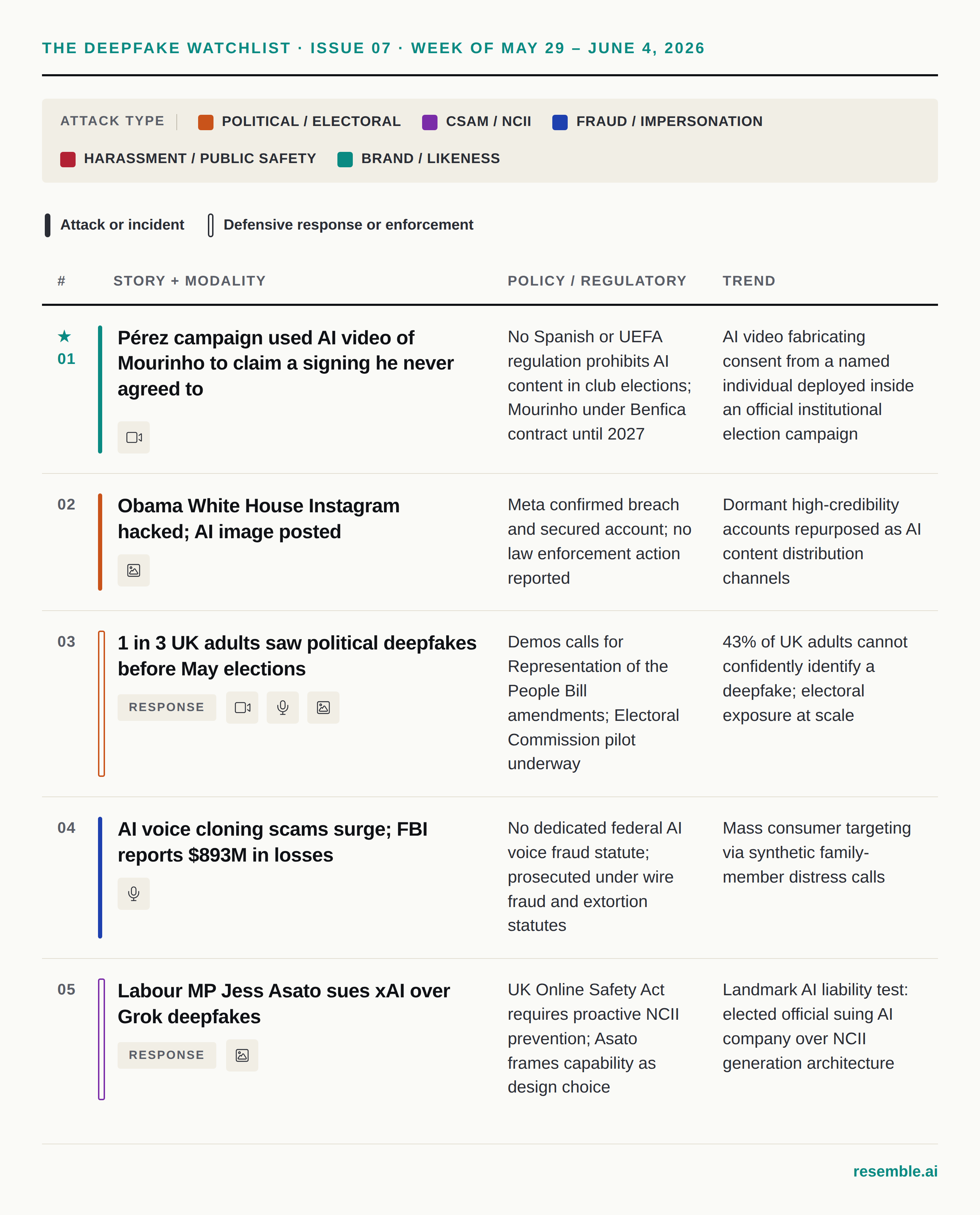
★ Featured: Florentino Pérez used an AI video of Mourinho to claim a signing he never agreed to
Goal.com's Jose Mourinho says 'yes' to Real Madrid in controversial Florentino Perez election video, published June 4, reports that the Florentino 2026 re-election campaign for the Real Madrid presidency released a video appearing to show Mourinho in a club shirt saying "yes" to a return as manager, with the slogan "MOUcha historia por hacer." Mourinho told Benfica the footage was generated using artificial intelligence and that he had never recorded it. The presidential vote is scheduled for June 7.
- Category: Brand / Likeness
- Type: Attack
- Modality: Video
- Policy / Regulatory: No Spanish or UEFA regulation currently prohibits the use of AI-generated content in club election campaigns; Mourinho remains under contract with Benfica until 2027, and the club reacted angrily to the footage.
- Trend: AI-generated video deployed inside an institutional election to manufacture the appearance of consent from a named individual who had not given it.
- Attack vector: A synthetic video of a real, named person placed into an official campaign channel, using the authority of the candidate's own platform to make the fabrication credible.
- What we saw in the content: Mourinho himself disputed the footage, and the visual characteristics are consistent with synthetic generation:
- The jersey and setting appear cleanly composited, without the natural creasing, lighting variation, and background occlusion present in genuine on-location recording.
- The single-word response — "yes" — is a minimal utterance that limits the temporal window in which lip-sync artifacts would be detectable, a common tactic in short-form AI video.
- No behind-the-scenes documentation, crew, or release corroborating the recording has surfaced, despite the campaign's claim that this was a planned signing announcement.
- Record (Portugal) and Cadena SER both confirmed Mourinho directly contacted Benfica to deny the footage, the kind of first-person dispute that rarely accompanies genuine recordings.
This case is a clean illustration of what AI video does to institutional trust in an election context and the subject does not need to be a head of state for the damage to be real. Florentino Pérez's campaign used a synthetic endorsement from a globally recognized figure to influence members of one of the world's most watched football clubs, in a vote scheduled for three days after the video dropped. The goal was not to deceive journalists but to move voters, and the fabrication was authoritative precisely because it came through an official campaign channel.
What makes the attack vector here structurally interesting is the consent gap. The video does not attempt to put false political words in Mourinho's mouth or fabricate a scandal, it fabricates his agreement to something that is commercially plausible and widely rumored. A watermark embedded at generation and readable by any platform carrying the video would have surfaced the provenance question before the campaign cycle ran. Instead, the correction, Mourinho telling Benfica it was AI had to travel through secondary reporting to reach the audience that had already seen and been influenced by the original.
1. Obama's White House Instagram account hacked, AI image posted
Yahoo news reported on June 1 that hackers compromised the official @obamawhitehouse Instagram account and posted an AI-generated image captioned "The White House is under Shiites' control," along with new Instagram Stories on an account that had been dormant since January 20, 2017. Meta confirmed the breach and said the account has since been secured and all unauthorized content removed. Obama's personal Instagram account was not affected.
- Category: Political / Electoral
- Type: Attack
- Modality: Image
- Policy / Regulatory: Meta confirmed remediation; no law enforcement action reported at time of publication; the incident exposes the vulnerability of high-profile dormant official accounts with no active moderation layer.
- Trend: Dormant institutional accounts with large follower bases repurposed as distribution channels for AI-generated political content, inheriting credibility from the account's historical authority.
- Attack vector: Account compromise of a verified government-adjacent profile, followed by AI-generated image posting designed to reach the account's existing audience under the cover of its established credibility.
An account that has been dormant for nine years still carries millions of followers and the verified badge of a former US presidency. The attack did not need to generate a convincing deepfake of Obama himself, it only needed to post through his official channel to reach an audience predisposed to treat the source as authoritative. The AI-generated image was a passenger: the real payload was the channel. This is the same structural logic as the Thai police photo from last week's issue, synthetic content gains its reach not from technical sophistication but from the institutional credibility of the pipe it travels through.
2. One in three UK adults saw political deepfakes before the May local elections
Cross-party think tank Demos published One in three UK adults report seeing political deepfakes in the month before local elections on May 30, reporting that 30% of UK adults encountered AI-generated political content in the weeks before the May 7 elections, with 16% seeing such content more than five times. The polling also found that 43% of adults are not confident they could identify a deepfake, compared to 38% who say they can.
- Category: Political / Electoral
- Type: Response
- Modality: Video, Audio, Image
- Policy / Regulatory: Demos calls for amendments to the Representation of the People Bill; the Electoral Commission's deepfake detection pilot is underway but results are not expected for at least six months.
- Trend: Quantitative evidence of electoral deepfake exposure at scale, arriving at a moment when legislative protections have not kept pace with the tooling.
- Attack vector: Multimodal political content distributed primarily through TikTok (35%), Facebook (34%), and Instagram (26%); Keir Starmer and Nigel Farage were the most commonly reported subjects.
The number that stands out is not 30%, it is 16%: repeated exposure is how false impressions calcify. Once a fabricated clip becomes part of someone's mental model of a politician, its provenance stops mattering to how they process subsequent coverage. The gap between exposure rate and identification confidence is where actual electoral harm happens, and the Electoral Commission's six-month evaluation timeline means it will not produce actionable guidance before the next election cycle.
3. CNN documents a surge in AI voice cloning scams, cites $893 million in losses
CNN's AI 'voice cloning' scams are on the rise. Here's how to protect yourself, published May 29, reports that a California mother lost thousands of dollars after receiving a call that sounded like her daughter in distress, one of many cases the FBI is tracking as AI tools make convincing voice replicas possible from only a few seconds of audio. Americans lost more than $893 million to AI-related scams last year, according to the FBI.
- Category: Fraud / Impersonation
- Type: Attack
- Modality: Audio
- Policy / Regulatory: No dedicated federal statute covers AI voice fraud specifically; cases are prosecuted under wire fraud and extortion statutes.
- Trend: Voice cloning scams scaling from high-value corporate targets to consumer households, targeting the parent-child relationship as a high-urgency emotional vector.
- Attack vector: A few seconds of audio from public social media generates a synthetic replica; caller ID spoofing makes the call appear to come from a trusted number; real-time voice skinning enables live back-and-forth conversation rather than a single recording.
The $893 million figure is striking, but the more telling detail is the shift in attack architecture. Earlier voice cloning fraud concentrated on corporate executives because the per-attack payoff justified the effort. The Del Mastro case shows that threshold has dropped far enough to make mass consumer targeting viable. UC Berkeley's Hany Farid noted in the CNN piece that the traditional audio tells, strange pauses and vocal fluctuations, have largely disappeared from current-generation tools, shifting the detection burden from passive artifact identification to behavioral pattern recognition under emotional stress.
4. Labour MP Jess Asato sues xAI over Grok-generated sexualized deepfakes
The Guardian and multiple UK outlets reported in the week of June 2–4 that Labour MP Jess Asato has filed a legal case against Elon Musk's xAI, alleging that the Grok chatbot generated non-consensual sexualized images of her on request. Asato described the platform's ability to produce such content as a deliberate design choice rather than a misuse of the tool.
- Category: CSAM / NCII
- Type: Response
- Modality: Image
- Policy / Regulatory: The case is proceeding in UK courts; Asato's framing could challenge the platform immunity arguments typically raised in NCII litigation and set a precedent for AI platform liability in the UK.
- Trend: A sitting elected official bringing direct legal action against an AI company over NCII generation architecture, moving enforcement from regulatory pressure to active litigation.
- Attack vector: User-prompted generation via a publicly available AI tool, with the platform's content filters either bypassed or failing to prevent sexualized images of a named real person.
The phrase Asato used publicly, that Grok's capability "is not an accident nor misuse," is the legally significant part of this story. The standard platform defense in NCII cases is that bad actors misused a neutral tool in unforeseeable ways. Asato is contesting that framing directly, arguing that a system capable of generating sexualized images of named public figures has made an architecture choice. If that argument holds in UK courts, it restructures the liability calculus for every AI platform that generates images on request.
Honorable mentions
DFRAC's May 29 fact-check of a viral video falsely depicting Shah Rukh Khan endorsing the "Cockroach Janta Party" is worth noting for one specific reason: DFRAC's investigation explicitly used Resemble AI's audio detection tool to confirm the audio layer as AI-generated, and cited that finding in their published verdict. The clip grafted fabricated AI audio onto real footage from SRK's 2023 Jawan launch event, a pattern our incident database has tracked with increasing frequency across South Asian political contexts.
AI-generated videos fabricating landmarks and Indigenous cultural history in Western Australia's Kimberley region drew criticism from local communities this week, with one video depicting a fictitious cliffside resort along Lake Argyle accumulating more than 600,000 views, according to ABC News and Happy Mag. Yawuru man Bart Pigram told ABC the content was "fake, untrue, and lacking integrity," and that AI will be "a challenge heading into the future when we're trying to preserve the authenticity of our culture and language."
Minnesota Senate candidate Peggy Flanagan publicly denounced an attack advertisement from the North Star Dawn PAC that she says featured an AI-generated version of her likeness, according to KARE11. The case adds to a pattern of super PAC synthetic media use in competitive US races running ahead of any enforcement mechanism specifically designed to address it.
The pattern
- The consent gap is the attack surface. The Mourinho video did not fabricate a scandal, it fabricated his agreement to something commercially plausible. The Obama Instagram hack did not generate a deepfake of Obama, it posted through his verified channel. In both cases, the synthetic content borrows authority from an existing institutional layer, a campaign account, a verified profile rather than earning it through technical sophistication. Detection after distribution does not address this. Provenance at the point of generation is the only mechanism that follows the content through whatever channel carries it.
- Detection is documenting the problem, not preventing it. The UK Demos polling captures exposure that had already happened. The CNN voice cloning piece describes losses that had already occurred. The DFRAC SRK fact-check ran after the clip had migrated across platforms. Each of these represents detection working as designed, and none of them stopped the harm. The 43% of UK adults who cannot confidently identify a deepfake are not going to close that gap on their own, and the Electoral Commission's six-month evaluation timeline will not help them before the next vote.
- Platform liability arguments are shifting. Jess Asato's framing of Grok's NCII capability as a design choice rather than a misuse is the most significant legal development this week. The Representation of the People Bill in the UK, Australia's incoming Scams Prevention Framework, and the ongoing xAI litigation are all converging toward the same expectation: proactive harm prevention, not reactive content removal. EU AI Act Article 50 transparency requirements come into force in August, adding mandatory disclosure obligations for synthetic media to this picture.
Watching next week
- Real Madrid presidential election (June 7). The vote takes place three days after the Mourinho AI video story broke; whether the fabrication affects the result or produces any formal challenge is worth watching.
- EU AI Act Article 50. Enforcement of transparency and labeling requirements for AI-generated content begins August 2026; we expect compliance positions to start crystallizing in the coming weeks.
- xAI/Grok NCII litigation. The Asato case and ongoing US class actions are likely to produce procedural developments in June.
- South Korean deepfake election case. With 30+ videos documented in the Kim Kyoung-soo gubernatorial race, the case could produce the first criminal referral under South Korea's deepfake election statute.
The Deepfake Watchlist publishes every Friday. Subscribe to receive it in your inbox, or follow Zohaib Ahmed on LinkedIn for the weekly social companion. Track every documented incident in the Resemble Deepfake Incident Database, and read the full methodology in our 2025 Deepfake Threat Report.