Generative AI isn’t just speeding up creation. It’s changing what creation means. According to a survey by Salesforce, 51% of marketers are using generative AI tools to optimize content today, with another 22% planning to adopt soon.
Yet for developers, content creators, and enterprise teams in sectors such as customer service, gaming, entertainment, and cybersecurity, the challenge goes beyond adoption. It’s about ensuring that rapid content production doesn’t erode brand authenticity, voice consistency, or operational control.
This blog covers how generative AI is transforming content creation, discovers the practical benefits and risks, and explores how voice-first platforms are turning scale and speed into genuinely controllable, brand-safe creative assets.
Quick Snapshot
- AI-driven content creation accelerates production, allowing enterprises to generate text, audio, and multimedia at scale without sacrificing quality.
- Maintaining brand voice, authenticity, and accuracy remains critical, even with advanced generative AI tools.
- Modern strategies combine human oversight with AI-generated drafts to enhance creativity and efficiency.
- Tools like voice cloning, text-to-speech, and speech-to-speech can personalize audio content, improving engagement and creating unique audience experiences.
How Does Generative AI Power Modern Content Creation?
Generative AI refers to algorithms that create original content like text, images, video, or audio, based on patterns learned from large datasets. Unlike traditional tools that only analyze or replicate content, generative AI produces entirely new outputs guided by user prompts.
Key approaches in generative AI content creation include:
- Neural Networks and Large Language Models (LLMs): These models understand context, grammar, and style to generate coherent text or dialogue for blogs, social media posts, or scripts.
- Diffusion Models for Visuals: Used by tools like Midjourney and DALL·E, these models build images by iteratively removing noise from random pixels, producing lifelike visuals from simple prompts.
- Text-to-Speech and Speech-to-Speech Models: These transform written words or recorded voices into natural speech. Platforms like Resemble AI extend this by letting creators clone or translate voices across 60+ languages, keeping emotional tone and pronunciation intact.
- Multimodal Architectures: The future lies in unified systems that understand both language and sound. A single model can now read a script, match its tone to a cloned voice, and generate synchronized audio or video content end-to-end.
For your teams, this means faster pipelines, but it also introduces new decisions: what should be automated, and what still requires human control?
Knowing how these models function sets the stage for their true impact. The next question isn’t what they can generate but how they’re transforming creative workflows inside modern enterprises.
Also Read: Rapid Voice Cloning 2.0: New Voice Cloning Model with Unmatched Accuracy
5 Ways Generative AI Is Reshaping Content Workflows

Generative AI is rapidly becoming central to enterprise content strategy. According to a Grand View Research market report, the global generative AI content creation market size was estimated at USD 14.84 billion in 2024 and is projected to reach USD 80.12 billion by 2030.
For developers, content creators, and enterprise teams, this means more than faster production. It means scaling creativity while preserving brand identity, authenticity, and operational control.
Here are five concrete ways this transformation is unfolding across enterprise content workflows:
1. Optimizing Content Workflows Through Model Integration
Modern enterprises are integrating generative AI directly into content management and design systems, from CMS platforms to creative automation pipelines.
Instead of replacing human creators, AI now serves as a first-pass generator, producing scripts, storyboards, and outlines that teams refine collaboratively.
Platforms like Adobe Firefly and OpenAI’s GPT-4 API integrations with Notion and Canva illustrate this shift, moving content ideation, drafting, and editing into a single, unified environment.
2. Personalization With Predictive Content Models
Generative AI tools powered by behavioral and sentiment data are enabling real-time audience segmentation and content variation.
AI dynamically rewrites tone, timing, and channel format based on live audience signals, allowing brands to sound human at scale without fragmenting voice consistency.
3. Continuous Creativity Through Human–AI Collaboration
Generative AI doesn’t eliminate creative roles; it amplifies them. Teams are using AI to generate idea variations, explore new narrative structures, and test creative directions faster than ever before.
Creative teams adopting hybrid AI workflows with measurable gains in innovation output. This “co-creation” model is shifting AI from a passive assistant to an active creative collaborator, one that helps teams think divergently without losing human intuition.
4. Multimedia Content Capabilities
Beyond text, AI can produce voiceovers, images, and short video clips, enabling enterprises to deliver richer content experiences without increasing headcount. It also supports experimentation with new content formats and interactive experiences.
Integrating generative AI into workflows ensures consistent output, quick response to trends, and frees creative teams to focus on strategy and storytelling.
5. Authenticity & Governance as Strategic Differentiators
As AI-generated content floods digital channels, authenticity is now the metric of trust.
Enterprises are adopting governance frameworks that track authorship, versioning, and content provenance using AI watermarking and source verification tools.
This not only protects brand credibility but also ensures compliance with evolving transparency standards, such as the EU AI Act and U.S. AI-generated content disclosure policies.
But even with these advances, implementing generative AI at scale isn’t without friction. Maintaining quality, consistency, and compliance remains a top concern.
Also Read: Voice Design: Transforming Text into Unlimited AI Voices
4 Biggest Challenges in Generative AI Content Creation
According to PwC’s 2024 US Responsible AI Survey, only 58% of executives say their organizations have completed a preliminary AI-risk assessment, highlighting how governance and accuracy gaps can turn AI from an accelerator into a liability.
Here are the four most pressing challenges enterprises face in generative AI content creation and how leading teams are overcoming them.
1. Maintaining Brand Voice and Consistency
AI-generated content can sometimes deviate from a company’s tone or style, affecting brand perception.
- Regularly train AI models using company-specific examples to reinforce tone, phrasing, and messaging.
- Incorporate human oversight for final approvals, especially for external communications or high-stakes content.
- Use Resemble’s voice cloning and text-to-speech tools to maintain consistent auditory branding across campaigns and channels.
2. Ensuring Factual Accuracy and Regulatory Compliance
AI can produce outputs that include errors, misleading information, or “hallucinations.”
- Establish fact-checking workflows for all AI-generated content before publishing.
- Cross-reference AI outputs with verified sources or internal data repositories.
- Use multi-layer validation: integrate AI-generated content checks with internal knowledge bases or APIs connected to verified data.
- For voice or multimedia content, build automated compliance gates; only verified scripts get converted to audio or video.
- For audio outputs, pair Resemble’s text-to-speech or speech-to-speech tools with human verification for accuracy in messaging.
3. Ethical and Legal Considerations
Content created with AI may raise copyright, privacy, or regulatory concerns.
- Use AI responsibly, ensuring outputs don’t infringe on intellectual property or misrepresent individuals.
- Clearly label AI-generated content when necessary to maintain transparency.
- Develop internal policies for AI use in marketing, communications, and training content.
4. Balancing Automation and Human Creativity
Over-reliance on AI can lead to generic or repetitive content that lacks human nuance.
- Use AI for ideation, first drafts, or repetitive tasks, while reserving creative judgment for humans.
- Encourage teams to iterate on AI outputs, adding originality and emotional resonance.
Resemble AI’s multilingual capabilities can help you to customize audio content for specific audiences, combining AI efficiency with creative control.
These challenges highlight a clear truth: success with AI depends on using the right tools the right way. Let’s explore the systems and frameworks enabling teams to create efficiently while maintaining accuracy and control.
Also Read: Introducing ‘Edit’ by Resemble AI: Say No More Beeps

Tools and Approaches for Generative AI Content Creation

Enterprises get the best results when they blend speed, creativity, and governance, automating the routine, but keeping control of voice, accuracy, and provenance.
1. Text Generation Tools
LLM-powered writers are ideal as first-pass generators for scripts, captions, outlines, and FAQs. The win comes when you plug these drafts into downstream voice and media systems so the same text becomes high-quality audio or mixed-media assets without rework.
With Resemble AI, Feed approved scripts into Text-to-Speech to instantly generate narration in multiple languages and regional dialects; keep authenticity with accent control and natural prosody.
2. Audio & Voice Tools
Voice is now a core brand asset. Beyond TTS, speech-to-speech and voice cloning unlock consistent, multilingual audio at scale while preserving tone and emotional delivery.
- Voice cloning for brand-consistent voices. Resemble can clone a voice with as little as ~3 minutes of audio (or a quick free trial with 25 recorded sentences). Their newer Rapid Voice Clone 2.0 model enables high-quality cloning with ~20 seconds of audio.
- Text-to-Speech (TTS). Generate natural narration in 142+ languages & dialects, with regional accent options for localization.
- Speech-to-Speech (real-time). Convert your live or recorded speech into another voice while preserving emotion and style, and deploy across 149+ languages.
- Localization at scale. Resemble Localize dubs a native voice to up to ~100 languages for global distribution from one source performance.
- Open-source for developers. Chatterbox (open-source, multilingual) supports zero-shot cloning, expressive control, and real-time generation for hands-on pipelines.
Proof of scale (case studies):
- Zomato × TrueFan (Mother’s Day). Delivered 354,000 personalized celebrity-voice videos with ~90% voice match accuracy, driving 7× revenue impact and 70× content creation uplift. Read the full case study here.
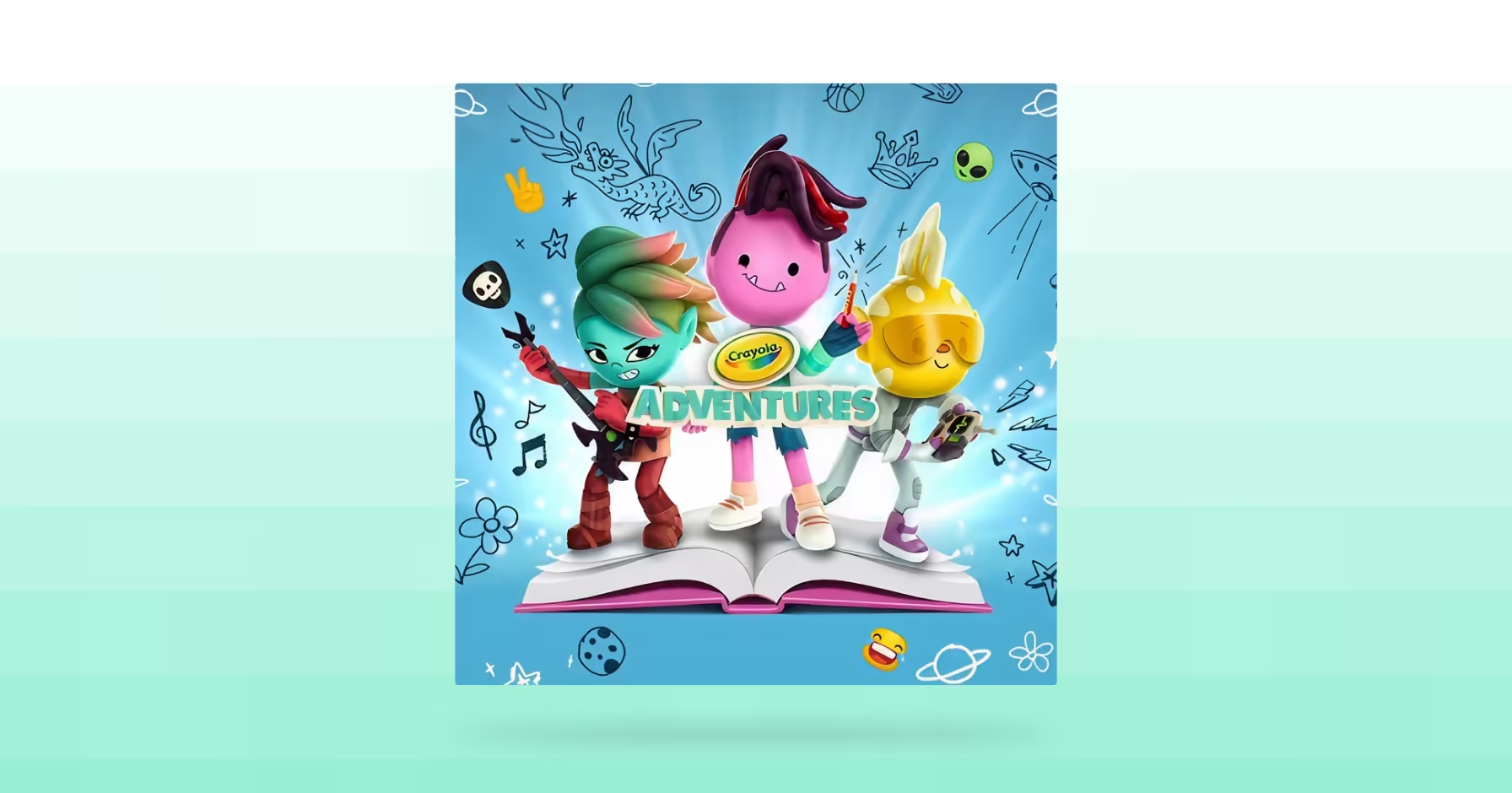
- Red Games (Crayola Adventures). Real-time, interactive AI voices in a 2024 Apple Design Award-winning title; dynamic narration adapted to player input. Read the full case study here.
3. Visual & Video Creation Tools
Image and video generators accelerate art direction, storyboarding, and micro-video assets. The trick in enterprise workflows is keeping the soundtrack aligned, the right voice, language, and timing across renders and platforms.
Pair your visuals with consistent audio using TTS (142+ languages), Speech-to-Speech (149+ languages), or Voice Cloning for branded narration; keep edits nimble with audio editing and prompt-to-voice (Voice Design) to match visual variants without re-recording.
4. Integrative Workflows (Speed + Control)
Moving from pilots to production means governance and verification: identity consent, authenticity markers, and real-time defense against synthetic abuse, especially for voice content that bears your brand.
- Identity & consent. Resemble Identity supports speaker enrollment (as little as ~5 seconds of audio) to establish voice profiles and enforce consent before cloning or use.
- Invisible provenance. The PerTh neural watermarker embeds an imperceptible watermark into generated audio so downstream systems can verify origin even after compression or editing.
- Explainable audio analytics. Audio Intelligence provides multi-dimensional analysis (language, dialect signals, anomalies/misinfo cues) to interpret audio, not just generate it, which is useful for QA and brand-safety review.
- Real-time detection & defense. DETECT-2B flags synthetic audio in ~200 ms with >94% accuracy across 30+ languages, enabling pre-publication and live-workflow checks.
- Human resilience training. Security Awareness Training runs realistic simulations (phone/WhatsApp/email) and reports up to ~90% reduction in successful attacks among early adopters, useful when voice content is customer-facing.
What Does This Give to Your Team
- Scale: Clone once, localize broadly (100–149+ languages depending on product).
- Consistency: The same brand voice across channels, accents, and markets.
- Authenticity & safety: Identity enrollment, invisible watermarking, explainable analysis, and instant deepfake detection to keep outputs verifiably yours.
Once the right tools are in place, the next step is sustainability, building repeatable, ethical, and transparent content systems. That’s where governance and best practices come in.
Best Practices for Scaling Content With AI Responsibly

Enterprises can maximize the impact of generative AI by combining technology with strategy and human oversight. Proper adoption ensures efficiency without compromising quality or authenticity.
1. Combine AI with Human Review
Even the most advanced AI tools need human supervision:
- Review AI-generated content for tone, accuracy, and alignment with brand messaging.
- Edit outputs to remove factual inaccuracies, optimize flow, and maintain authenticity.
- Encourage collaborative review cycles where AI drafts and humans refine.
2. Use Voice Cloning, Multilingual TTS, and AI Audio Tools
Audio content is increasingly critical for engagement:
- Use voice cloning to create personalized messages for customers or internal communications.
- Multilingual text-to-speech ensures consistent global messaging.
- Speech-to-speech conversion can make localized campaigns faster and more immersive.
3. Create Repeatable Workflows
Efficiency scales when workflows are standardized:
- Develop templates for recurring content tasks, integrating AI tools for drafting, editing, and publishing.
- Maintain clear protocols for approvals and quality checks.
- Track performance metrics to refine AI-assisted processes over time.
4. Educate and Upskill Creative Teams in AI Collaboration
AI proficiency is now part of creative literacy. Invest in regular training programs that teach teams how to prompt effectively, validate outputs, and identify bias or fabrication.
Implementing these practices allows teams to utilize AI’s speed and personalization capabilities while maintaining complete control in content creation workflows.

Conclusion
Generative AI is changing how developers, creators, and enterprises build and deliver content. From faster production to personalized experiences, it’s helping teams work more efficiently while keeping creative intent intact.
As adoption grows, the challenge isn’t just creating more; it’s creating responsibly. Blending human oversight with transparent, verifiable AI systems ensures every piece of content remains accurate, ethical, and authentic.
Tools like Resemble AI support that shift. With features like voice cloning, consent verification, and real-time deepfake detection, they help organizations innovate confidently, scaling creativity while safeguarding trust.
Explore Resemble’s AI solutions to create scalable, personalized, and authentic audio content that enhances engagement and maintains brand consistency. Request a demo today!
FAQs
1. What types of content can generative AI create beyond text?
Generative AI can produce a wide range of content, including images, audio, video, interactive experiences, and synthetic voices. This allows enterprises to deliver immersive campaigns, personalized audio messaging, and multimedia content at scale.
2. How can AI improve content personalization at scale?
AI analyzes audience behavior and preferences to generate tailored content automatically. Enterprises can leverage AI voices, multilingual text-to-speech, and speech-to-speech tools to deliver individualized messages efficiently across multiple channels.
3. What role do AI voices play in modern content creation?
AI voices enable scalable, engaging audio experiences for marketing campaigns, learning platforms, virtual assistants, and storytelling. They allow enterprises to maintain brand tone consistently while reaching audiences in multiple languages.
4. How can enterprises ensure AI-generated content aligns with brand voice?
Using AI models trained on brand-specific guidelines, style preferences, and approved messaging ensures content stays on-brand. Human review combined with AI tools helps maintain authenticity, accuracy, and compliance with enterprise standards.
5. What are the best practices for integrating AI content tools into workflows?
Enterprises should combine AI with human oversight, implement repeatable workflows, and use multimodal tools for consistency. Integrating AI-generated content seamlessly into existing systems ensures efficiency, scalability, and high-quality output.