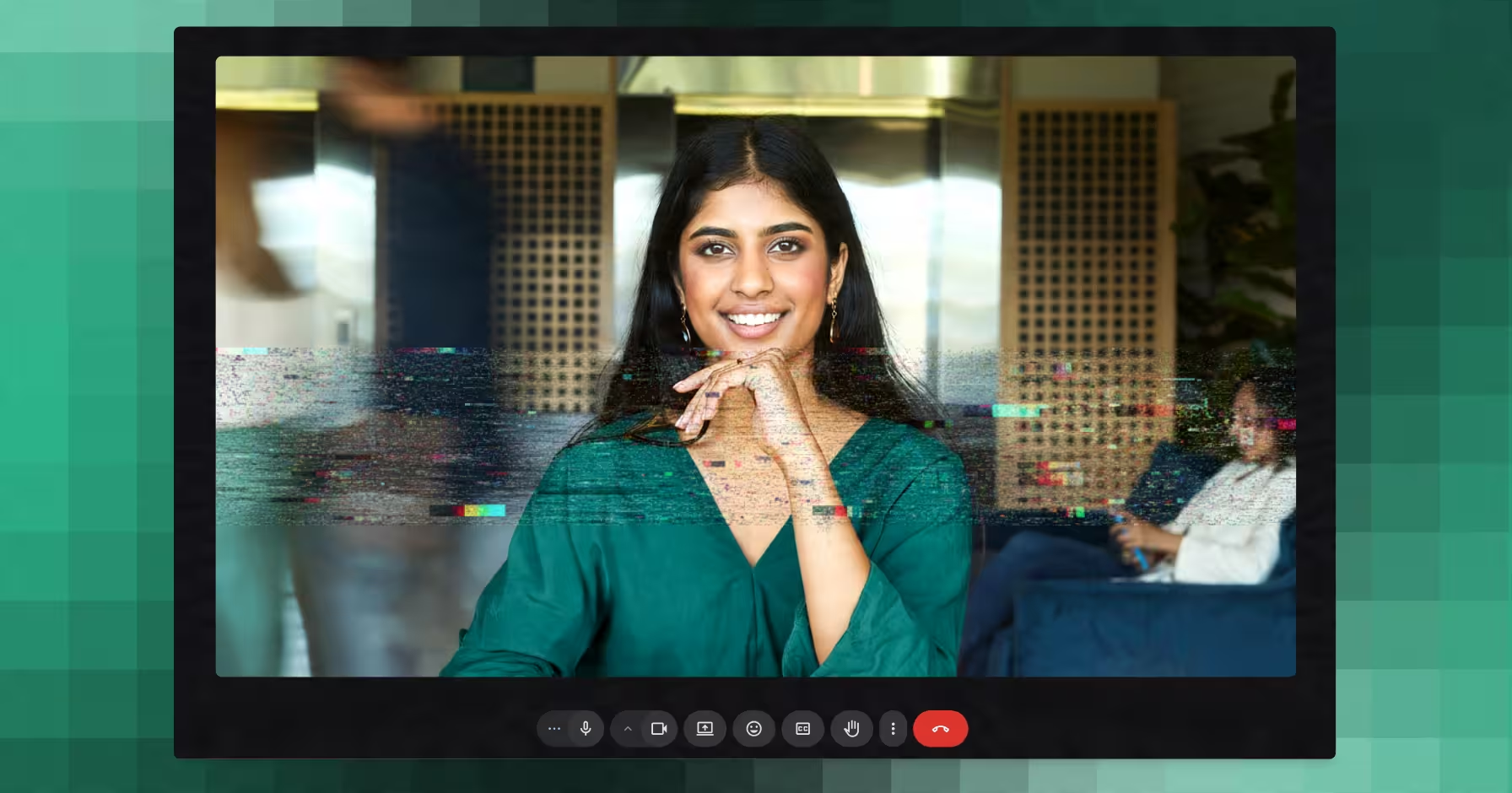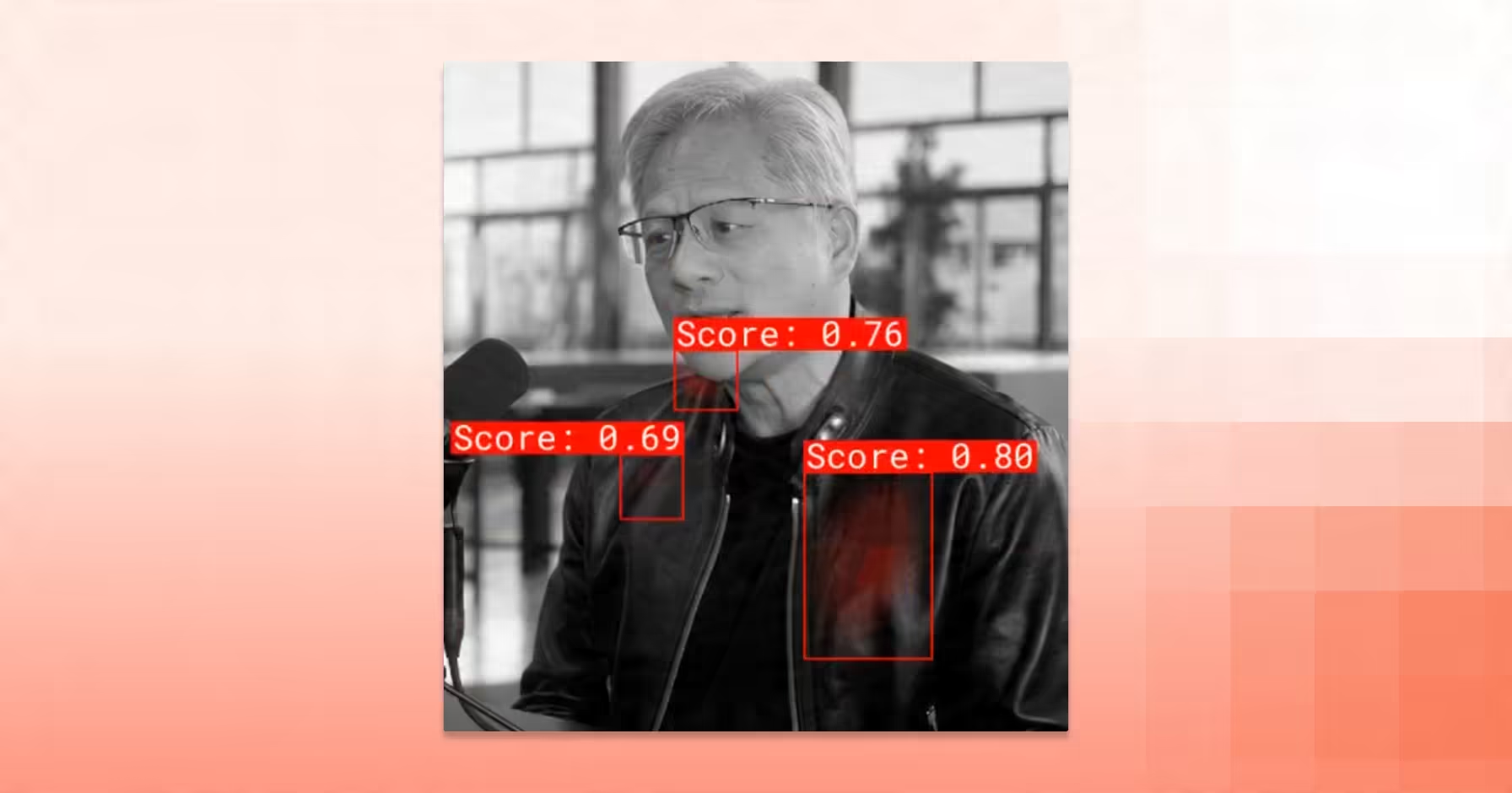
As deepfake technology advances, real-time video calls are increasingly at risk of being compromised by cybercriminals. There was a recent case, where executives at a multinational firm were tricked into transferring millions during a live video conference, where attackers used deepfake avatars and voice cloning to impersonate leadership. 

Such incidents highlight the urgent need for live deepfake detection tools that can flag manipulated audio or visuals instantly, protecting businesses and individuals from costly deception.

This blog explores how live deepfake detection works, why it’s critical for safeguarding digital trust, and how tools like Resemble AI can help.

Overview:

  • Real-Time Protection is Essential: Top tools like Resemble AI, McAfee Deepfake Detector, Norton Genie, and Reality Defender ensure real-time security.
  • Multimodal AI Analysis Enhances Accuracy: Combining visual, audio, and contextual cues ensures that even sophisticated deepfakes are identified.
  • Integration Across Platforms Matters: Tools like Resemble AI work seamlessly with Zoom, Teams, Google Meet, and Webex, allowing enterprise-wide protection.
  • Provenance and Watermarking Build Trust: AI watermarking and cryptographic verification provide transparent evidence of authenticity.
  • Applications Span Multiple Industries: Live deepfake detection protects sensitive information, maintains compliance, and preserves digital trust.

Why Live Deepfake Detection Matters for Secure Video Calls?

The rise of deepfakes means video calls can no longer be taken at face value. From corporate boardrooms to telehealth consultations, real-time detection is essential to ensure that participants are who they claim to be and that conversations remain trustworthy.

Top Reasons for Live Deepfake Detection:

Top Reasons for Live Deepfake Detection:
  • Preserving Authenticity: Without real-time detection safeguards, deepfakes can manipulate live conversations, spread misinformation instantly, or fabricate commitments made during calls. For example, a malicious actor could mimic a CFO during a board meeting to approve unauthorized transactions.
  • Maintaining Trust: Virtual meetings are the default for professional and personal communication. Detecting synthetic content protects the reputations of executives, employees, and public figures. For example, a politician’s deepfake speech in a live press call could be flagged instantly to prevent public panic or misinterpretation.
  • Ensuring Security: Deepfake detection mitigates risks of identity theft, impersonation, and unauthorized actions in sensitive discussions. For example, cybercriminals could pose as a doctor in a telehealth session to gain patient information; detection tools block such attempts in real time.
  • Compliance in Regulated Industries: In sectors like finance, healthcare, and government, verifying participant identity is a legal requirement; detection tools help meet these standards. For example, banks can detect synthetic voices attempting to authorize wire transfers, ensuring adherence to Know Your Customer (KYC) regulations.
  • Protecting Sensitive Information: By identifying manipulated audio and video in real time, organizations prevent unauthorized disclosures and maintain confidentiality in high-stakes meetings. For example, a product development team discussing unreleased features can avoid leaks caused by AI-generated impersonators.

Integrating live detection into video communication platforms allows businesses and individuals to confidently engage in virtual conversations without the constant threat of deception.

Also Read: Introducing Deepfake Security Awareness Training Platform to Reduce Gen AI-Based Threats

The Hidden Challenges of Spotting Deepfakes in Real Time

While live detection is critical, the process itself is fraught with technical and computational hurdles. Modern deepfake models use advanced generative adversarial networks (GANs) and diffusion models that can replicate facial micro-movements, lighting variations, and even subtle audio-visual synchronization in real time. 

Detection systems must analyze multiple data layers simultaneously, including pixel-level artifacts, speech patterns, and metadata at high frame rates. 

This ‘arms race’ between generation and detection means that as synthesis models improve, detection tools must continuously retrain on new datasets, making it a constant technical battle to stay ahead.

Primary Challenges in Live Meeting Detection:

Primary Challenges in Live Meeting Detection
  • Sophistication and rapid evolution: Deepfakes are becoming increasingly realistic, with AI models capable of capturing micro-expressions, lip-syncing, and even subtle vocal tones. This makes real-time detection harder as manipulations grow nearly indistinguishable from authentic video.
  • Resource-intensive detection: Running detection algorithms on live video streams requires significant computing power and low latency. For enterprise-scale platforms with thousands of concurrent meetings, ensuring speed and scalability without disruption is a major hurdle.
  • Accuracy concerns: Even the best tools can struggle with false positives (flagging real content as fake) or false negatives (missing actual deepfakes). These inaccuracies can undermine trust in the detection system itself and disrupt natural communication flow.

Overcoming these challenges requires not only smarter AI models but also practical integration into platforms, balancing precision, performance, and user experience.

Also Read: Replay Attacks: The Blind Spot in Audio Deepfake Detection

Top 5 Tools Shaping the Fight Against Live Video Deepfakes

As deepfakes grow more advanced, detection technologies are forced to evolve at the same pace. Modern approaches increasingly combine cryptographic verification, distributed consensus models, and multimodal AI analysis to ensure authenticity in live video communication. 

Instead of relying on visual cues alone, detection systems now assess micro-expressions, eye movement dynamics, voice spectrograms, and temporal inconsistencies across frames. Distributed verification frameworks, such as blockchain-based provenance tracking, add another layer of trust by embedding cryptographic hashes at the point of video capture, making any alteration instantly traceable. 

Here are some innovative tools to detect deepfakes in live meetings:

1. Resemble AI: Realtime Deepfake Detection

Resemble AI: Realtime Deepfake Detection

Resemble AI offers a comprehensive solution for detecting deepfakes in live video meetings. Its AI-driven system monitors audio, video, and contextual signals in real time to identify synthetic content with high accuracy. 

The platform also provides provenance verification through watermarking and integrates smoothly with major conferencing tools like Zoom, Teams, Meet, and Webex. With open-source components for experimentation and customization, Resemble AI is designed to help organizations maintain security, authenticity, and trust in virtual interactions.

Best for: Real-time protection across enterprise video platforms

Key Features to Detect Deepfakes in Live Meetings:

  • DETECT-2B Automated Bot: Resemble’s flagship detection system joins Zoom, Teams, Meet, and Webex calls automatically, syncing with your calendar. Acting as a silent participant, it continuously monitors audio, video, and images with up to 99.9% accuracy, spotting deepfakes frame-by-frame in real time.
  • AI Watermarking (PerTH + C2PA): Neural watermarking combined with industry standards embeds cryptographic provenance markers at content creation. During a live call, this makes authenticity instantly verifiable, protecting against manipulation or replay attacks.
  • Multimodal Real-Time Analysis: Advanced deep learning models analyze voice cadence, facial micro-movements, and contextual interaction cues. This multimodal approach ensures even the most sophisticated impersonators are flagged without disrupting the flow of meetings.
  • Instant Security Alerts + Forensic Reports: When a deepfake is detected, security teams are notified immediately via Slack, SMS, or email. Detailed forensic reports provide evidence trails for compliance and investigations, minimizing financial and reputational risk.
  • Cross-Platform Compatibility: Works seamlessly across major video platforms (Zoom, Teams, Google Meet, Webex) and integrates with enterprise security workflows, ensuring continuous protection without manual setup.
  • Deepfake Detection for Meetings: Monitors live video and audio streams in conferencing platforms to prevent AI-generated impersonation and secure real-time communication.
  • Security Awareness Training: Offers tools and simulations to train employees on identifying deepfakes and understanding potential risks, enhancing organizational cyber resilience.
  • Open-Source Transparency (Chatterbox & Resemblyzer): Resemble supports community-driven safeguards by offering open-source frameworks. Chatterbox lets developers customize ethical guardrails, while Resemblyzer extracts high-level voice embeddings, strengthening detection pipelines.

Practical Use: Ideal for finance, healthcare, government, and corporate environments to prevent fraud and maintain trust in live meetings.

2. McAfee Deepfake Detector

McAfee Deepfake Detector

McAfee’s solution is a browser-based, real-time deepfake detector that uses transformer-based neural networks to scan media without disrupting workflows. It runs on-device, enhancing privacy and speed, and is currently optimized for Lenovo AI-enabled PCs. 

This tool is suitable for professionals who need immediate verification during web-based interactions, providing quick detection for individual or small-scale organizational use.

Best for: Browser-based, real-time deepfake detection

Key Features:

  • Runs directly in the browser for immediate analysis.
  • Transformer-based neural networks scan video and audio content in real time.
  • Minimal disruption to workflows.

Limitations: Currently optimized for Lenovo AI-enabled PCs; limited format coverage.

Practical Use: Suitable for professionals needing quick, on-device verification during web-based meetings.

3. Intel FakeCatcher

Intel FakeCatcher

Intel FakeCatcher specializes in detecting deepfake videos in real time by analyzing subtle physiological signals, such as heartbeat-induced changes in facial color, that are difficult to replicate in synthetic content. It is particularly suited for media verification, corporate communications, and high-stakes content validation.

Best for: Real-time deepfake video detection and content verification

Key Features:

  • Physiological Signal Analysis: Detects deepfakes by monitoring heartbeat and micro-expression inconsistencies in video.
  • High Accuracy Verification: Provides reliable detection across diverse video sources and quality levels.
  • Enterprise & Media Applications: Ideal for verifying corporate video content, news broadcasts, and educational media.

Limitations: Primarily focused on video; does not cover deepfake audio detection or multi-channel monitoring.

Practical Use: Best for organizations that need real-time verification of video content to maintain credibility, trust, and security in corporate communications and media distribution.

4. Reality Defender

Reality Defender is a leading deepfake detection platform designed for enterprises, governments, and media organizations

Reality Defender is a high-scale platform for enterprise deepfake detection across video, audio, images, and text. Its explainable AI supports forensic transparency, while APIs and dashboards provide real-time monitoring. 

Trusted by Fortune 500 companies and government agencies, it is best suited for organizations requiring comprehensive, multi-format detection and detailed threat reporting.

Best for: Enterprise-scale detection across video, audio, image, and text

Key Features:

  • Explainable AI provides transparency for forensic analysis.
  • Real-time dashboard and API for monitoring multiple media formats.
  • Trusted by large enterprises and government agencies.

Limitations: Overkill for small businesses; more suitable for high-scale operations.

Practical Use: Ideal for media companies, regulatory bodies, and large enterprises that need comprehensive monitoring.

5. Sensity

Sensity

Sensity specializes in visual deepfake threat monitoring and forensic investigation. Continuously scanning global media for manipulated images and videos, it provides advanced metadata analysis and investigative tools. 

Used by law enforcement, journalists, and regulators, it is designed for high-stakes environments requiring proactive surveillance of visual deepfake content.

Best for: Visual deepfake threat monitoring and forensic investigation

Key Features:

  • Continuous global monitoring for image and video manipulation.
  • Advanced forensic metadata analysis.
  • Used by law enforcement, journalists, and regulatory agencies.

Limitations: Not consumer-focused; primarily for public-facing or high-stakes applications.

Practical Use: Best for organizations that need proactive surveillance of visual deepfake threats across the internet.

By adopting these solutions, businesses can ensure that their online communications remain credible, secure, and resilient against evolving deepfake threats.

Also Read: Introducing State-of-the-Art in Multimodal Deepfake Detection

Best Practices for Securing Live Video Meetings

As deepfake technology becomes increasingly sophisticated, protecting live meetings calls for proactive strategies. By combining advanced detection tools like Resemble AI with practical security measures, organizations can safeguard trust, maintain privacy, and stay compliant, all while keeping virtual interactions seamless and professional.

Here are some best practices you can follow:

Best Practices for Securing Live Video Meetings
  • Deploy Real-Time Detection Tools: Integrate AI-powered solutions such as Resemble Detect to automatically identify synthetic audio and video during meetings. For example, DETECT-2B can analyze multiple cues in real time to flag potential deepfakes.
  • Use Watermarking and Provenance: Embed imperceptible markers (e.g., PerTH watermarks) in internal communications to verify authenticity and trace content origins.
  • Enable Multi-Factor Authentication for Participants: Strengthen identity verification by requiring secure logins and, where feasible, biometric or token-based validation to prevent impersonation.
  • Educate Teams on Deepfake Risks: Provide training sessions for employees to recognize suspicious behavior and understand how detection tools integrate into daily workflows.
  • Regularly Audit and Update Security Protocols: Continuously monitor detection system performance, update AI models, and integrate new best practices to stay ahead of evolving deepfake techniques.

This combination of technical safeguards, procedural controls, and awareness ensures that organizations can protect sensitive communications while leveraging virtual meetings confidently.

Conclusion

Live video deepfakes are not a distant threat anymore. They’re already disrupting business meetings, virtual healthcare, and online collaboration. While the technology behind them grows more sophisticated, so do the risks of fraud, misinformation, and reputational damage. Protecting authenticity in real time is now mission-critical.

Resemble AI provides a responsible path forward, with tools like DETECT-2B automated meeting bots, AI watermarking, and multimodal detection systems. By embedding security and provenance checks directly into video platforms, Resemble ensures that organizations can embrace virtual interactions with confidence.

Ready to secure your meetings with real-time deepfake detection? Book a demo to get started today!

FAQs

1. How does real-time detection differ from post-meeting analysis?
Real-time detection alerts participants instantly when a synthetic impersonator is present, preventing fraud or misinformation as it happens, whereas post-meeting analysis only flags issues after the damage may already be done.

2. Can deepfake detection work alongside existing enterprise security systems?
Yes. Resemble AI’s APIs and automated bots integrate seamlessly with enterprise security stacks, complementing identity verification, fraud detection, and compliance monitoring tools.

3. Is deepfake detection limited to video, or does it also cover audio manipulation?
Resemble AI provides multimodal detection, covering not just visual cues but also voice cadence, acoustic signatures, and cross-channel signals for a more accurate defense.

4. Does real-time detection require additional hardware or infrastructure?
No. Resemble AI’s solution runs as a cloud-native service that integrates directly into platforms like Zoom, Teams, Meet, and Webex without extra on-premise hardware.

5. Who benefits most from live deepfake detection in meetings?
Industries handling sensitive or high-stakes interactions such as finance, healthcare, government, and education gain the most by ensuring conversations remain authentic, private, and compliant.