AI voice cloning has rapidly shifted from a cutting-edge experiment to a widely adopted technology. At its core, it allows machines to generate speech that closely mirrors a real person’s voice, often using only brief audio samples to reproduce tone, cadence, and emotion with striking accuracy.
This realism is fueling rapid adoption. The AI voice cloning market surpassed $2.1 billion in 2023 and continues to grow at an annual rate of over 28.4%, driven by demand in entertainment, customer service, accessibility, and digital products.
At the same time, highly convincing synthetic voices have contributed to a sharp rise in voice-based fraud, impersonation, and misinformation, creating real-world harm.
As these risks escalate, the U.S. legal system is racing to respond. Regulators and lawmakers are increasingly applying and expanding laws around fraud, privacy, and biometric data to address the unique challenges posed by AI-generated voices.
Key Highlights
- AI voice cloning is growing fast, and so are risks: The $2.1B+ market is driving adoption across media, CX, and accessibility, while increasing fraud and impersonation threats.
- Voice deepfakes cause real-world harm: Executive scams, family emergency fraud, and political spoof calls exploit trust more effectively than text-based scams.
- U.S. regulation is tightening without a single AI law: Enforcement relies on the FTC, DOJ, FCC, and state biometric laws like BIPA and CCPA/CPRA.
- Consent and transparency are the biggest legal risks: Missing explicit consent, deceptive use, and undisclosed AI audio can trigger privacy, fraud, and publicity violations.
- Compliance-first voice AI is emerging as best practice: Platforms like Resemble AI embed consent, safeguards, and traceability to align with evolving U.S. regulations.
What Is AI Voice Cloning?
AI voice cloning refers to the use of machine learning models to generate synthetic speech that closely replicates a human voice. Unlike traditional text-to-speech systems that produce generic outputs, voice cloning is designed to reproduce a specific speaker’s vocal identity, including tone, pitch, accent, and emotional expression.
How the Technology Works
AI voice cloning typically relies on deep learning models trained on voice data. Key technical components include:
- Speech Modeling: Neural networks analyze vocal characteristics such as pitch, rhythm, pronunciation, and prosody to create a digital representation of a speaker’s voice.
- Text-to-Speech (TTS): Once a voice model is trained, written text can be converted into spoken audio that sounds like the target speaker.
- Speech-to-Speech Conversion: This approach transforms one person’s spoken input into another person’s cloned voice in near real time, preserving the original speech content while changing the vocal identity.
Advances in model efficiency now allow high-quality cloning with relatively small audio samples, significantly lowering the barrier to entry.
Real-World Misuse and Legal Triggers
As AI voice cloning has become more realistic and accessible, misuse has moved beyond isolated experiments into high-impact, real-world incidents. These cases are a major reason U.S. regulators are accelerating legal and policy responses.
High-Profile Misuse Incidents
Several forms of abuse have drawn national attention:
- Government impersonation: In 2025, an AI-generated voice impersonated Marco Rubio and contacted senior U.S. and foreign officials. The incident demonstrated that even high-level government communications can be convincingly forged using synthetic voice alone.
- Federal law enforcement warning: The Federal Bureau of Investigation has formally warned that AI voice impersonation attacks are increasing, with criminals exploiting realistic synthetic speech to pose as trusted authorities and insiders.
- Family emergency scams: U.S. victims have lost money after receiving calls that used AI-cloned voices of family members pleading for urgent help, showing how voice cloning enables emotionally coercive fraud that bypasses traditional skepticism.
- Corporate voice phishing: Businesses and public institutions have been targeted by “vishing” attacks in which AI-generated voices mimic executives or supervisors to obtain credentials, sensitive data, or financial transfers.
- Election interference: In 2024, robocalls using a cloned voice of Joe Biden were distributed to voters in New Hampshire, prompting state investigations and underscoring the technology’s potential to undermine democratic processes.
These incidents highlight how synthetic audio can exploit trust more effectively than text-based deepfakes.
Why Regulators Are Alarmed
U.S. regulators are concerned because voice deepfakes:
- Enable identity theft by replicating a person’s biometric traits
- Undermine confidence in audio as reliable evidence.
- Create new vectors for election interference and voter manipulation.
- Scale rapidly with minimal technical skill.
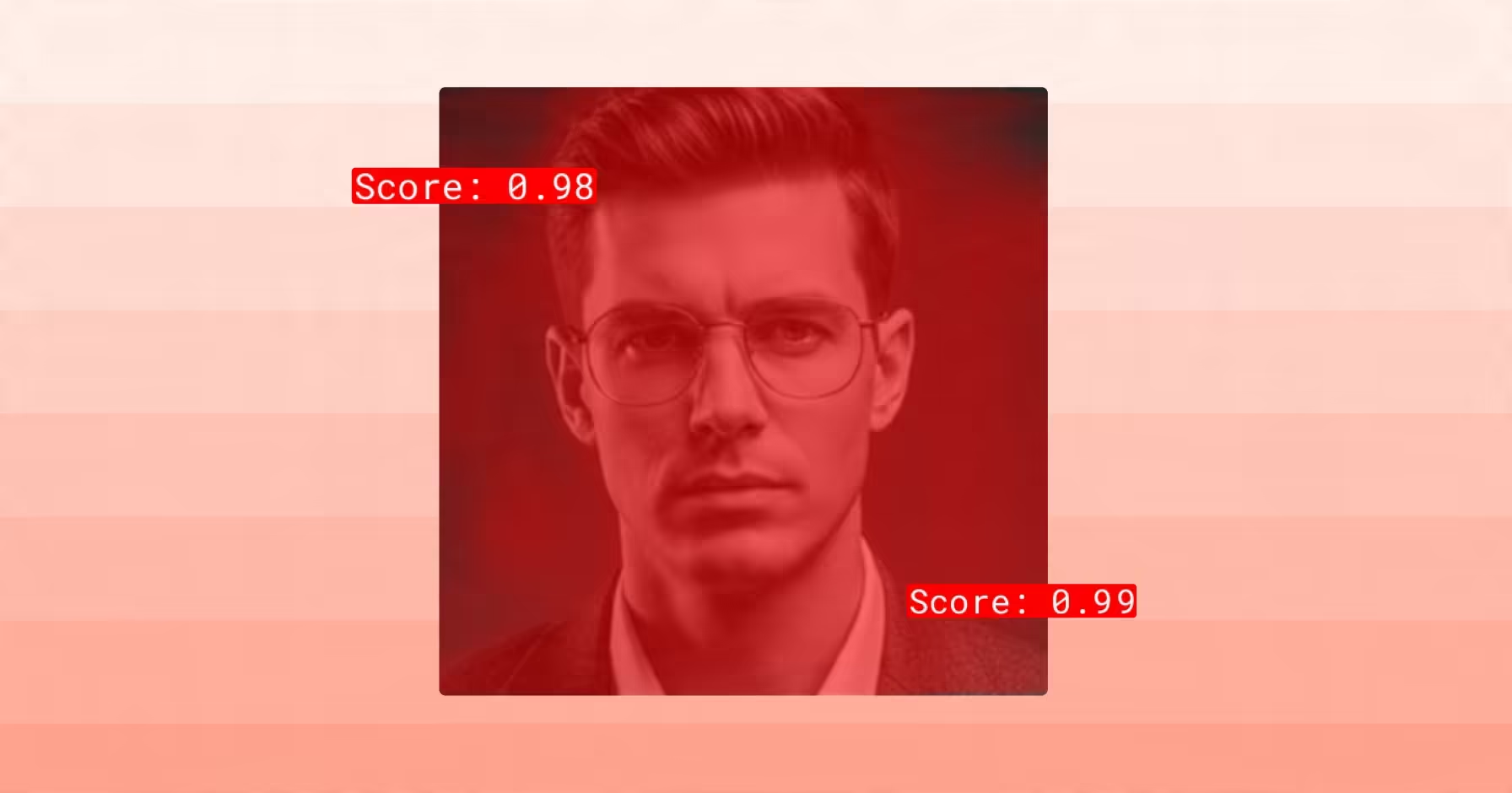
As voice deepfakes become harder to detect by humans alone, technical safeguards are essential. Tools like Resemble AI’s Detect-3B-Omni are designed to identify AI-generated and manipulated audio at scale, helping governments, enterprises, and platforms restore trust in voice communications. Take action now to strengthen your organization’s audio security and protect your business with the latest detection tools.
Also Read: Replay Attacks: The Blind Spot in Audio Deepfake Detection
Current U.S. Regulatory Framework
The United States does not yet have a single, comprehensive federal law specifically regulating AI voice cloning. Instead, enforcement currently relies on existing federal and state laws covering fraud, consumer protection, privacy, biometric data, and identity misuse.
A. Federal Laws
Federal regulations play a foundational role in defining consent, data protection, and accountability for AI-driven voice solutions.
1. Consumer Protection and Deceptive Practices (FTC)
The Federal Trade Commission (FTC) plays a central role in regulating AI voice cloning when it is used deceptively or causes consumer harm. Under Section 5 of the FTC Act, unfair or deceptive acts or practices are unlawful. The FTC has made clear that deceptive uses of AI, including voice cloning, fall within its enforcement authority.
Notably, the FTC has:
- Recognized voice and voiceprints as biometric information.
- Warned that the misuse of biometric data can constitute an unfair practice
- Highlighted voice cloning risks through public initiatives and enforcement guidance.
2. Wire Fraud, Identity Theft, and Telecom Enforcement
Federal criminal statutes already apply when AI-generated voices are used for fraud or impersonation. These include:
- Wire fraud laws, enforced by the Department of Justice (DOJ)
- Identity theft statutes, covering misuse of identifying information for unlawful gain
The FBI and DOJ have publicly warned about the rise of AI-powered “vishing” (voice phishing) schemes targeting businesses and individuals.
In addition, the Federal Communications Commission (FCC) has clarified that AI-generated voices used in robocalls are subject to theTelephone Consumer Protection Act (TCPA). Most synthetic voice calls require prior express consent, and violations may result in substantial penalties.
3. Copyright and Persona (Right of Publicity) Issues
At the federal level, there is no single statute explicitly protecting a person’s voice. However:
- Copyright law may apply if protected audio recordings are used to train or reproduce voices without authorization.
- Right of publicity principles, while primarily governed by state law, are increasingly implicated when AI-generated voices are used commercially in ways that suggest endorsement or identity misuse.
Enforcement in this area remains evolving, with courts still defining how voice cloning fits within existing intellectual property frameworks.
B. State Laws
Beyond federal rules, state laws introduce varying consent, privacy, and enforcement standards that organizations must carefully navigate.
1. Illinois – Biometric Information Privacy Act (BIPA)
Illinois’s Biometric Information Privacy Act (BIPA) is the most influential state law affecting AI voice cloning. It regulates the collection, storage, and use of biometric identifiers, explicitly including voiceprints.
Key BIPA requirements:
- Prior written notice and consent before collecting biometric data
- Publicly available retention and deletion policies
- A private right of action, allowing individuals to sue directly
Because voice cloning relies on biometric voice data, BIPA presents significant compliance risks for companies operating in or affecting Illinois residents.
2. California and Other State Privacy Laws
California’s Consumer Privacy Act (CCPA) and Privacy Rights Act (CPRA) extend protections to biometric information, including voice data used for identification. These laws grant consumers rights to:
- Know how their data is collected and used
- Opt out of certain data uses
- Request deletion of personal information
The California Privacy Protection Agency (CPPA) is responsible for enforcement and has the authority to issue fines for noncompliance.
3. The State Patchwork Challenge
Beyond Illinois and California, multiple states regulate voice cloning indirectly through:
- Consumer protection laws
- Data privacy statutes
- Targeted legislation protecting performers and public figures
The absence of a unified federal standard has created a patchwork regulatory environment, making nationwide compliance complex and increasing pressure for federal legislation.
Companies using voice cloning technology must navigate overlapping federal authority and diverse state-level requirements, with biometric consent and fraud prevention at the center of compliance.
Recent U.S. Legal Updates (2024–2025)
Between 2024 and 2025, U.S. lawmakers significantly increased their focus on deepfakes and AI-generated media, signaling a shift from observation to active regulation.
A. Congressional Bills Addressing Deepfakes and Voice Cloning
Congress has introduced and advanced multiple bills aimed at limiting the misuse of AI-generated media and impersonation technologies.
Key legislative developments include:
- TAKE IT DOWN Act (2025 – 2026)
- Criminalizes the knowing distribution of non-consensual deepfake content
- Requires online platforms to remove reported material within mandated timeframes
- Passed with strong bipartisan support, signaling urgency around AI-enabled impersonation
- Although focused on explicit imagery, the law reflects broader concern about synthetic media abuse, including audio deepfakes
- Content Origin Protection and Integrity from Edited and Deepfaked Media Act (Introduced)
- Encourages standards for content provenance, authenticity, and labeling
- Signals growing federal interest in watermarking and verification technologies.
B. Federal Hearings and Testimony on Voice AI Risks
Congressional hearings have been central to defining how AI voice cloning is understood and regulated at the federal level.
Recent hearings emphasized:
- Rising risks of voice-based fraud and impersonation
- Threats to election integrity from synthetic audio
- Erosion of trust in audio recordings as evidence
Key developments from hearings include:
- Hearings held by the Senate Judiciary Committee and its Subcommittee on Privacy, Technology, and the Law
- Testimony from:
- AI researchers
- Consumer protection advocates
- Voice AI industry leaders
- Repeated emphasis on:
- Ethical AI deployment
- Consent-based voice cloning
- Technical safeguards such as watermarking and detection tools
These hearings framed voice cloning not just as a technical issue, but as a consumer protection, privacy, and public safety concern.
C. Growing Momentum Toward Federal Deepfake Regulation
Together, recent bills and hearings point to increasing momentum for federal oversight of AI-generated media.
Clear signals from lawmakers include:
- Bipartisan agreement that deepfake harms require legislative action
- Shift from voluntary guidelines toward enforceable standards
- Focus on:
- Consent
- Authenticity of digital content
While the U.S. has not yet enacted a single law governing AI voice cloning, these developments suggest that future federal regulation is likely and may formalize safeguards already being discussed today.
Also Read: Rapid Voice Cloning 2.0: New Voice Cloning Model with Unmatched Accuracy
Core Legal Risks of AI Voice Cloning
AI voice cloning introduces significant legal risks tied to how voices are collected, replicated, and used. These risks extend beyond malicious actors and can affect creators, businesses, and platforms that fail to implement proper safeguards.
1. Consent Failures
Consent is the foundation of lawful voice cloning.
- What “Explicit Consent” Means: Explicit consent generally requires clear, informed, and verifiable permission from the individual whose voice is being cloned, including disclosure of intended use. In some states, biometric laws require written consent obtained before any voice data is collected or processed.
- Risks of Implied Consent: Publicly available audio does not grant permission to clone a voice. Relying on implied or assumed consent creates legal exposure under privacy, biometric, and publicity laws.
2. Misrepresentation and Fraud
Voice cloning has amplified impersonation and social engineering scams.
- Financial Scam Risks: Cloned voices are used to impersonate executives, relatives, or officials, often leading to rapid financial loss.
- Liability Exposure: Legal risk may extend to users and platforms if safeguards are inadequate, misuse is foreseeable, or deceptive use benefits commercially.
3. Intellectual Property and Persona Rights
Voice cloning challenges traditional ownership rules.
- Who Owns a Voice Model?: While voices are not copyrighted, rights may arise from contracts, licensing agreements, and state right-of-publicity laws.
- Risks for Brands and Public Figures: Unauthorized voice use can imply false endorsement, violate publicity rights, and cause reputational harm.
4. Transparency and Disclosure
Transparency is increasingly a compliance expectation.
- Labeling Expectations: Regulators favor clear disclosure when synthetic voices are used, especially in consumer-facing contexts.
- Trust Implications: Failure to disclose AI-generated audio can be seen as deceptive and may undermine consumer trust and invite enforcement.
Resemble AI: A Compliance-First Blueprint for Voice Cloning Regulation
Resemble AI positions itself as a voice AI platform built around consent, ethical safeguards, and misuse prevention rather than unrestricted voice replication. Its product design and policies closely reflect the regulatory direction emerging in the United States for AI-generated audio.
- Consent-first voice AI tools: Provide AI voice generation, cloning, and real-time conversational voice bots designed strictly for authorized, consent-based enterprise and interactive use.
- Controlled and verifiable deployment: Supports API-based integrations with access controls, speaker identity verification, and requirements that users confirm they have legal rights to any voice they upload or clone.
- Built-in safeguards against misuse: Includes deepfake detection, audio watermarking, and traceability features to identify synthetic speech and reduce impersonation or unauthorized use.
- Strong ethical governance framework: Enforces onboarding through clear terms, ethics policies, and usage rules, explicitly prohibiting deceptive, harmful, or non-consensual voice cloning.
- Transparency, accountability, and data protection: Emphasizes transparent voice AI deployments, outlines data handling and privacy commitments, and clearly assigns responsibility, platform safeguards paired with user legal accountability.
- Alignment with evolving regulation and self-regulation: Participates in voluntary AI codes of conduct and reflects broader regulatory trends like consent-by-design and proactive compliance, anticipating future mandatory U.S. regulations.
Prepare for what’s next in AI compliance. Deploy voice AI that meets today’s ethical expectations and tomorrow’s legal requirements.
Conclusion
AI voice cloning is no longer a legal gray area. As misuse increases, U.S. regulators are actively enforcing existing laws around fraud, privacy, and biometric data, even ahead of comprehensive AI-specific legislation.
The direction is clear: compliance expectations are rising. Platforms like Resemble AI demonstrate that voice AI can scale responsibly by embedding consent, ethical safeguards, and misuse prevention into its design.
Businesses that act early, by choosing compliance-first tools and establishing clear governance, can reduce legal risk while continuing to innovate.
Request a demo of Resemble AI to see how compliant, consent-driven voice AI can work in practice.
FAQ
1. Is a person’s voice protected by copyright law?
A voice itself is not copyrighted, but legal protection may arise through contracts, licensing agreements, or state right-of-publicity laws that protect a person’s likeness and identity.
2. Are companies liable if their voice AI tools are misused?
Potentially. Liability may arise if companies fail to implement reasonable safeguards, ignore misuse risks, or benefit from deceptive use. Responsibility often depends on the facts and applicable laws.
3. Do businesses need consent to clone a voice?
Yes. Explicit, informed consent is a key legal requirement, especially where biometric or publicity rights apply. Using publicly available audio does not automatically grant permission to clone a voice.
4. What counts as “explicit consent” for voice cloning?
Explicit consent generally means clear, documented permission that explains how the voice will be used, stored, and shared. In some states, written consent is required before collecting voice data.
5. Can AI voice cloning be used for fraud?
Yes. Cloned voices have been used in financial scams, executive impersonation, and social engineering attacks. These uses are illegal and fall under existing fraud and identity theft laws.