Voice Cloning Licensing: Who Can Use AI Voices and Under What Terms

Feb 10, 2026

AI voice cloning is quickly moving into real-world, commercial use. As that happens, questions about who can legally use a voice, and under what terms, are becoming unavoidable.

The legal stakes are no longer theoretical. The SAG-AFTRA strike involved roughly 160,000 actors, with AI voice and likeness rights emerging as a central point of dispute. The outcome underscored a clear reality: commercial voice cloning without explicit licensing and consent creates material legal risk.

This is why voice cloning licensing now plays a critical role in AI voice deployment. Licensing defines consent, scope, duration, and commercial rights, and often determines whether a project can scale safely or face challenges after launch.

This guide explains how voice cloning licensing works, the legal foundations behind it, and what organizations need to understand before deploying AI voices in real-world, commercial environments.

At a Glance:

  • Voice cloning licensing determines whether AI voices can be used legally and at scale: It governs consent, scope, duration, and commercial rights, not just technical capability.
  • Access to recordings does not equal permission to clone a voice: Licensing authority rests with the voice owner or authorized rights holder.
  • Legal requirements vary by use case, geography, and duration: Contracts, not copyright alone, define how AI voices can be deployed.
  • Unlicensed voice cloning creates operational and reputational risk after launch: Disputes, takedowns, and loss of trust often emerge once voices are reused or scaled.
  • Treat licensing as infrastructure, not a one-time approval: Clear, enforceable licenses enable responsible voice AI deployment over time.

What Is Voice Cloning Licensing?

Voice cloning licensing defines the legal permission to create, use, and deploy a synthetic version of a person’s voice. It establishes who authorizes the voice, how it can be used, and under what conditions.

Unlike traditional software licenses, voice cloning licensing is not about access to a tool. It governs the use of a personal or identifiable voice across specific contexts, timeframes, and commercial activities.

At a practical level, voice cloning licensing typically covers:

  • Authorization: who has granted permission for the voice to be cloned
  • Scope of use: where and how the cloned voice can be used
  • Duration: how long the license remains valid
  • Commercial rights: whether the voice can be used for revenue-generating activities
  • Modification and reuse: whether the voice can be adapted, localized, or repurposed

It is also important to distinguish between related but separate rights:

  • Voice ownership vs. usage rights: owning recordings does not automatically grant the right to clone a voice
  • Training vs. output rights: permission to train a model does not always equal permission to deploy its outputs commercially

Voice cloning licensing exists to make these boundaries explicit. Without it, even technically successful voice AI projects can face legal uncertainty once they move into production.

Must Read: How to Clone AI Voice Models for Free with Easy Steps

cta

Why Voice Cloning Licensing Matters

Voice cloning licensing matters because voices are not neutral assets. They are tied to identity, reputation, and commercial value. When licensing is unclear or missing, even well-intentioned AI voice deployments can create legal and operational risk.

Why Voice Cloning Licensing Matters

Legal Exposure Increases Without Clear Licensing

Using a cloned voice without proper authorization can trigger claims related to personality rights, misappropriation, or deceptive use. These risks grow once voice cloning moves beyond internal testing into public or commercial-facing applications.

Commercial Use Changes the Risk Profile

Many voice cloning projects begin as pilots or internal tools, then expand into customer-facing or revenue-generating use cases. Without a license that explicitly covers commercial deployment, organizations may unintentionally exceed what was originally permitted.

Licensing helps ensure that scale does not outpace legal coverage.

Long-Term Deployments Require Ongoing Rights

Unlike one-off recordings, AI voices are often reused, updated, and redeployed over time. Call center agents, virtual characters, and branded voices may remain active for years.

Licensing clarifies:

  • how long a voice can be used
  • whether it can be reused across products or regions
  • what happens if consent is withdrawn

Reputational Trust Is at Stake

Voices are deeply personal. Misuse, ambiguity, or lack of transparency can damage trust with talent, customers, and the public. Clear licensing signals responsible use and respect for voice owners.

For organizations deploying voice AI at scale, licensing is not a formality. It is a prerequisite for sustainable, compliant, and trustworthy voice cloning.

Also Read: How to Clone Yourself in a Video Tutorial: A Step-by-Step Guide

Legal Foundations of Voice Cloning Licensing

Voice cloning licensing is shaped by a combination of legal doctrines rather than a single, unified law. Understanding these foundations helps explain why licensing requirements vary by region, use case, and type of voice.

Right of Publicity and Personality Rights

In many jurisdictions, a person’s voice is protected as part of their identity. These protections are commonly referred to as the right of publicity or personality rights.

They generally give individuals control over how identifiable aspects of their persona, including their voice, are used commercially. This means that even if a voice is technically recreated by an AI system, its commercial use may still require authorization from the individual or their estate.

The scope and duration of these rights vary by jurisdiction, which is why licensing terms often need to account for geography.

Copyright Does Not Usually Protect a Voice Itself

One of the most common misconceptions is that voices are protected by copyright in the same way as music or recordings.

In most cases:

  • Recordings can be copyrighted
  • The underlying voice usually is not

This distinction is why owning audio files does not automatically grant the right to clone or commercially deploy a voice. Licensing fills the gap where copyright law does not apply.

Consent as a Legal and Contractual Requirement

Because voices are tied to identity rather than ownership of content, consent becomes the primary legal mechanism that enables voice cloning.

Licensing agreements typically formalize:

  • explicit permission to create a cloned voice
  • limits on how that voice can be used
  • conditions under which permission can be revoked

Without clear consent documented in a contract, voice cloning deployments may lack a defensible legal basis.

Contract Law Governs Practical Use

In practice, most voice cloning licensing is enforced through contracts rather than statutes. These agreements define the boundaries of acceptable use, responsibility, and liability between parties.

This is why voice cloning licensing is highly contextual. Two projects using the same voice technology may face very different legal requirements depending on their contractual arrangements.

Also Read: AI Voice Generator: Realistic Text-to-Speech Online

Who Can Legally License a Voice?

Who Can Legally License a Voice?

Licensing authority does not automatically belong to whoever has access to voice recordings or technical control over a model. In voice cloning, the right to license a voice depends on who holds legal authority over that identity.

The Individual Voice Owner

In most cases, the person whose voice is being cloned is the primary party who can grant a license. This includes performers, employees, creators, and private individuals.

Licensing typically requires:

  • explicit consent from the individual
  • agreement on scope, duration, and use
  • clarity on whether the license is exclusive or non-exclusive

Estates and Posthumous Rights

For deceased individuals, licensing authority may transfer to an estate, heirs, or rights holders. Posthumous voice use is especially sensitive and often subject to additional legal and ethical scrutiny.

Whether posthumous licensing is allowed, and for how long, depends on jurisdiction and the terms of estate management.

Companies and Brand Voices

In some cases, a voice may be closely tied to a brand rather than an individual. Companies may license voices created specifically for corporate use, such as synthetic brand narrators or voices developed under work-for-hire agreements.

Even in these cases, contracts must clearly define ownership and ongoing rights.

What Does Not Grant Licensing Authority

Certain forms of access do not grant the right to license a voice:

  • possession of audio recordings
  • publicly available speech or media
  • technical ability to recreate a voice

Without explicit authorization, these sources do not confer licensing rights.

Understanding who can legally license a voice helps organizations avoid assuming permissions that do not exist, especially when scaling voice cloning into commercial or public-facing deployments.

Also Read: Resemble Localize: AI Voices With Multilingual Accents

Common Voice Cloning Licensing Models

Voice cloning licensing is typically structured around how a voice will be used over time, rather than a one-time grant of permission. The model chosen determines cost, flexibility, and long-term risk.

Per-Voice Licensing

This model grants rights to use a specific cloned voice under defined conditions.

It is commonly used for:

  • talent-driven projects
  • branded or character voices
  • single-voice deployments

Licenses usually specify scope, duration, and approved use cases for that voice.

Usage-Based Licensing

Usage-based licenses tie permission to measurable activity, such as:

  • number of generated minutes
  • number of deployments or channels
  • audience reach or impressions

This model is often favored for scalable or variable workloads where usage may fluctuate.

Time-Bound Licensing

Time-bound licenses grant usage rights for a fixed period.

They are frequently used when:

  • projects have a defined lifespan
  • voices are tied to campaigns or seasons
  • organizations want renewal checkpoints

At expiration, rights must be renewed, modified, or discontinued.

Territory-Based Licensing

Territory-based licenses limit where a cloned voice can be used geographically.

This is especially relevant for:

  • global brands
  • localized content
  • region-specific legal requirements

Licenses may permit use in certain countries while restricting others.

Exclusive vs. Non-Exclusive Licensing

Exclusive licenses grant sole usage rights to one party, while non-exclusive licenses allow the same voice to be licensed to multiple users.

Exclusivity typically increases cost but reduces the risk of voice overlap across brands or products.

Each licensing model carries different trade-offs between flexibility, cost, and control. Selecting the right structure depends on how broadly and how long a voice will be deployed.

Also Read: Understanding How Deepfake Detection Works

cta

Risks of Using Voice Cloning Without Proper Licensing

When voice cloning is deployed without clear licensing, the risks tend to surface after launch, not during development. These risks are often operational, contractual, and reputational rather than purely technical.

Risks of Using Voice Cloning Without Proper Licensing

Contractual and Commercial Disputes

Unlicensed or poorly licensed voice use can trigger disputes with:

  • voice talent or their representatives
  • agencies or production partners
  • clients or distributors

These disputes often arise when a voice is reused beyond its original context, such as expanding from internal use to public-facing or commercial deployment.

Platform and Distribution Takedowns

Platforms, publishers, and app marketplaces increasingly require proof of rights for synthetic media. If licensing cannot be demonstrated, content may be removed or blocked regardless of intent.

This can disrupt:

  • live customer service systems
  • published media or campaigns
  • long-running products that rely on voice continuity

Loss of Control Over Voice Use

Without a clearly defined license, organizations may lack enforceable limits on:

  • how long a voice can remain in use
  • whether it can be reused across products
  • who is responsible for misuse or overreach

This can create long-term ambiguity once voices are embedded into core workflows.

Regulatory and Policy Scrutiny

As AI regulation evolves, voice cloning is increasingly examined through the lens of consumer protection, impersonation, and disclosure. Deployments that lack documented licensing may struggle to demonstrate responsible use during audits or investigations. Regulatory penalties are also becoming explicit. Under the EU AI Act, non-compliance related to unlawful or unauthorized AI use can result in fines of up to 7% of global annual revenue or €35 million, whichever is higher. This raises the cost of unclear licensing when deploying AI voices in commercial environments.

Damage to Talent and Brand Relationships

Even when legal action does not occur, unclear licensing can erode trust with voice talent, partners, and audiences. Voices are closely tied to identity, and misuse can carry reputational consequences that outlast any single project.

These risks illustrate why licensing is not just a legal safeguard. It is a practical requirement for maintaining stability, continuity, and trust as voice cloning moves into production environments.

Watch our YT video on how to clone your voice by uploading audio

Voice Cloning Licensing for Enterprise and Commercial Use

Voice cloning licensing becomes more complex once AI voices are embedded into real business operations. Enterprise and commercial use introduces scale, longevity, and multiple stakeholders, all of which place additional pressure on licensing clarity.

Customer Service and Call Centers

In customer service environments, AI voices may interact with thousands of users daily and evolve over time. Licensing must account for:

  • continuous, automated use
  • updates to scripts or tone
  • deployment across regions and channels

Because these systems are persistent, unclear licensing can create exposure long after initial rollout.

Media, Entertainment, and Interactive Content

In media and entertainment, voices are often tied to characters, franchises, or recognizable personalities. Licensing considerations frequently extend to:

  • reuse across episodes, seasons, or titles
  • adaptation into new formats or languages
  • long-term association between a voice and a brand

Here, licensing decisions can affect creative continuity as well as legal compliance.

Games and Virtual Experiences

Games and interactive platforms often combine dynamic dialogue, user-driven outcomes, and live updates. Licensing must support:

  • non-linear voice usage
  • future content expansions
  • interaction at scale

This makes rigid or narrowly scoped licenses difficult to manage.

Marketing, Advertising, and Brand Voices

When AI voices represent a brand, misuse or ambiguity can directly affect public perception. Licensing must clearly define:

  • campaign boundaries
  • exclusivity expectations
  • duration of brand association

Short-term marketing use can easily drift into long-term brand identity if limits are not defined upfront.

Localization and Global Deployment

Commercial voice cloning is often used to localize content across languages and regions. Licensing must align with:

  • territorial restrictions
  • language adaptations
  • region-specific regulations

What is permitted in one market may not be allowed in another.

In enterprise and commercial contexts, voice cloning licensing is not a one-time decision. It is an ongoing operational constraint that shapes how voices can be deployed, updated, and scaled over time.

Also Read: Understanding AI Voice Cloning

How Resemble AI Supports Licensed Voice Cloning

Voice cloning licensing does not end at consent or contracts. It must be enforced consistently as voices move from creation into production, updates, and long-term use. Resemble AI is designed to support licensed voice cloning as an operational workflow, not a one-time setup.

How Resemble AI Supports Licensed Voice Cloning

Consent-First Voice Creation With Built-In Controls

Resemble AI requires explicit authorization before a voice can be cloned. Voices are created intentionally for defined, licensed use cases, reducing ambiguity around ownership, scope, and implied rights from the outset.

This consent-first approach helps organizations avoid accidental overreach as voice usage expands.

License-Aware Deployment Across Commercial Use Cases

Licensed voices are often reused across customer service, localization, media production, and interactive applications. Resemble AI supports these deployments while helping teams stay aligned with the original licensing terms, including scope, duration, and commercial boundaries.

This allows organizations to scale voice usage without losing visibility or control over how licensed voices are applied.

AI Watermarking for Traceability and Accountability

To support responsible use after deployment, Resemble AI embeds neural audio watermarks into synthetic speech at generation time. These watermarks persist through common audio transformations and help identify AI-generated voice output later.

Watermarking does not replace licensing or legal enforcement, but it strengthens traceability and accountability when licensed voices are reviewed, audited, or investigated.

Verification Support With Resemble Detect (DETECT-3B)

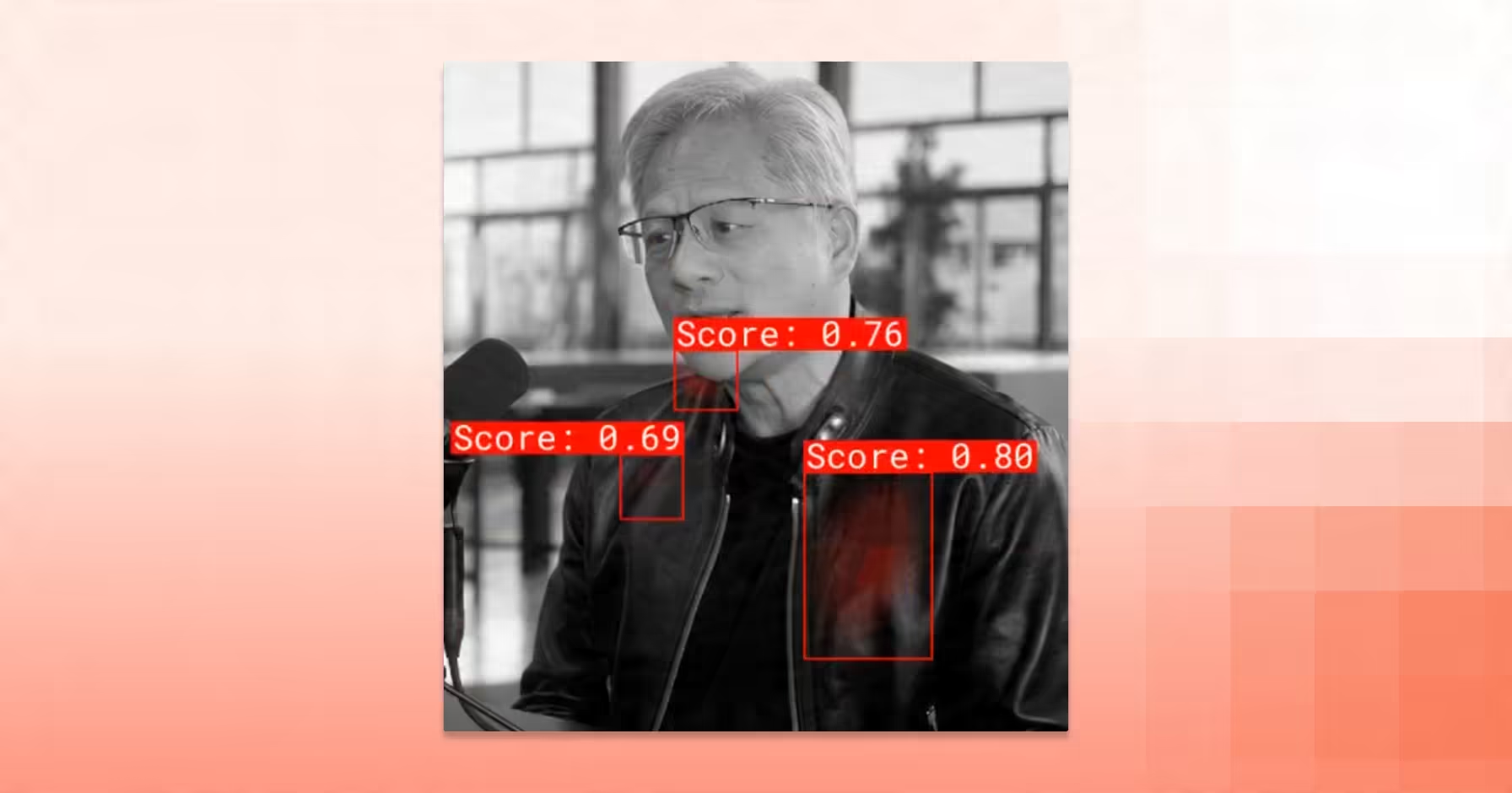
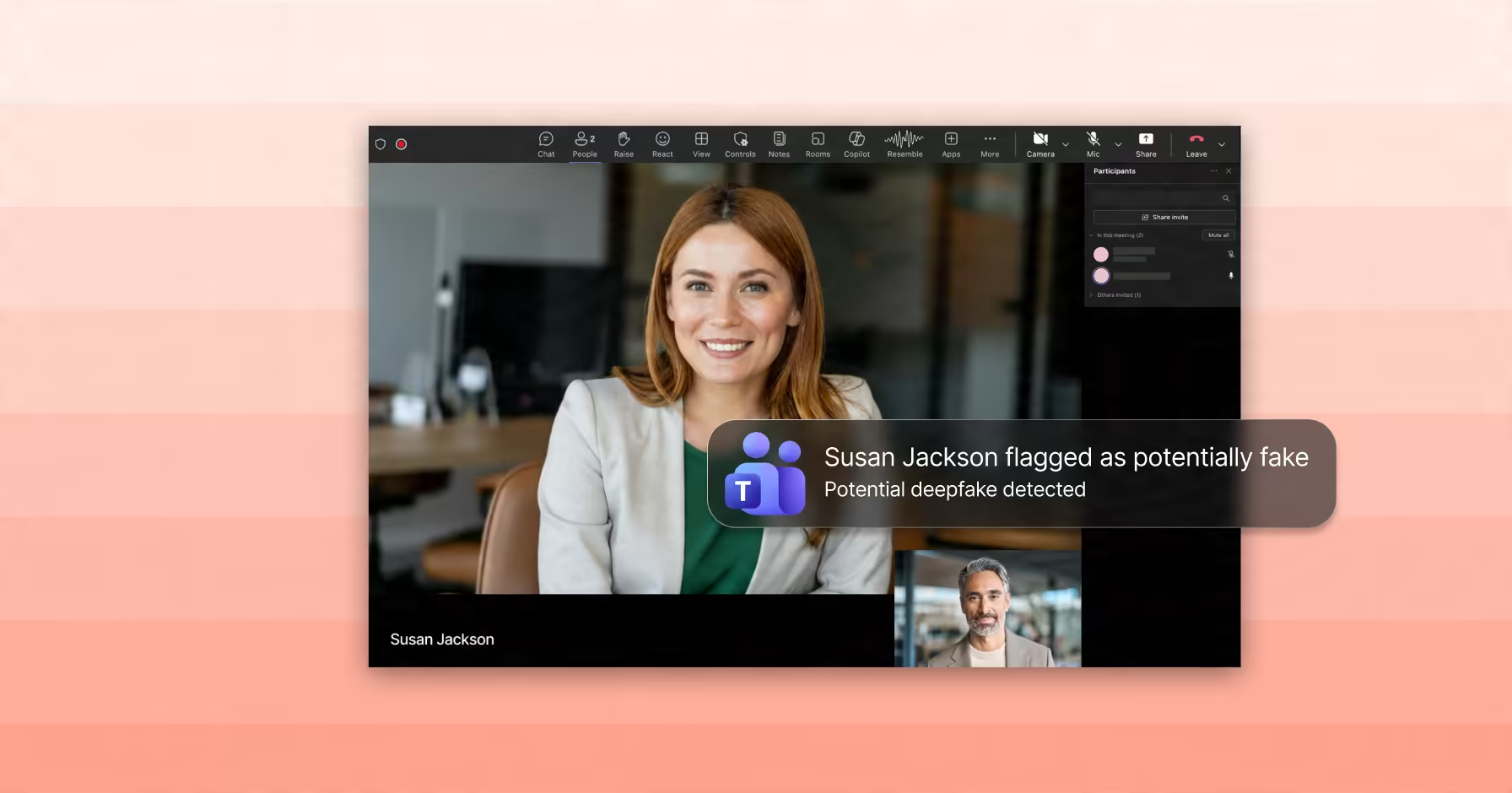
When questions arise about how a voice is being used, verification should focus on confirming authorized generation rather than guessing authorship. Resemble Detect, powered by DETECT-3B, supports review workflows by flagging potentially synthetic audio across real-world formats and conditions.

This helps enterprises assess risk and compliance without relying solely on probabilistic voice classification.

Built for Enterprise Review and Compliance

Resemble AI’s licensed voice cloning workflows are designed to integrate into enterprise environments where auditability, review processes, and compliance oversight already exist. This keeps legal, product, and operations teams aligned as voice deployments evolve over time.

If you’re exploring how to deploy licensed voice cloning in production, request a demo to see how Resemble AI supports consent-first voice creation and enterprise-ready workflows built for commercial use.

cta

FAQs

A: Voice cloning can be legal, but only when it is done with proper authorization. Legality depends on consent, jurisdiction, and how the cloned voice is used commercially.

Q: Do you need permission to clone someone’s voice?

A: Yes. In most cases, explicit permission from the voice owner is required. Having access to recordings does not grant the right to clone or deploy a voice.

Q: Who owns the rights to an AI-generated voice?

A: The individual whose voice is cloned typically retains identity-related rights. Usage and ownership of AI-generated audio depend on licensing agreements and contracts.

Q: Can you legally clone a public figure’s voice?

A: Cloning a public figure’s voice without permission is high risk, especially for commercial use. Public availability of speech does not remove licensing requirements.

A: Usually not. While recordings can be copyrighted, the voice itself is generally protected under personality or publicity rights rather than copyright law.

More From This Category