Deepfake audio has quickly evolved from a niche AI capability into a serious cybersecurity threat for businesses worldwide. With modern voice cloning tools requiring only a few seconds of audio to replicate a person's voice, cybercriminals can impersonate executives, employees, customers, and business partners with alarming accuracy. The impact is already visible across industries.
A recent Gartner report found that 62% of organizations have experienced a deepfake attack, while 32% have faced attacks targeting AI applications. The threat is also accelerating at the enterprise level. Deloitte predicts that AI-generated fraud losses could reach $40 billion in the U.S. by 2027, driven in part by increasingly convincing voice and identity impersonation.
As these threats continue to grow, businesses are increasingly investing in advanced tools for corporate deepfake audio detection to identify synthetic speech, prevent fraud, and protect critical communications.
TL;DR
- Tools for corporate deepfake audio detection identify AI-generated or cloned voices using voice biometrics, audio forensics, and machine learning.
- Enterprises deploy them in contact centers, financial institutions, healthcare organizations, government agencies, and executive communications.
- Deepfake audio can enable executive impersonation, payment fraud, account takeovers, and large-scale social engineering attacks.
- Detection accuracy varies, false positives can occur, and rapidly evolving voice-cloning technology continues to challenge existing solutions.
- Prioritize real-time detection, voice verification, integration capabilities, scalability, compliance support, and proven detection performance.
Understanding Deepfake Audio and Video Threats in Corporate Meetings
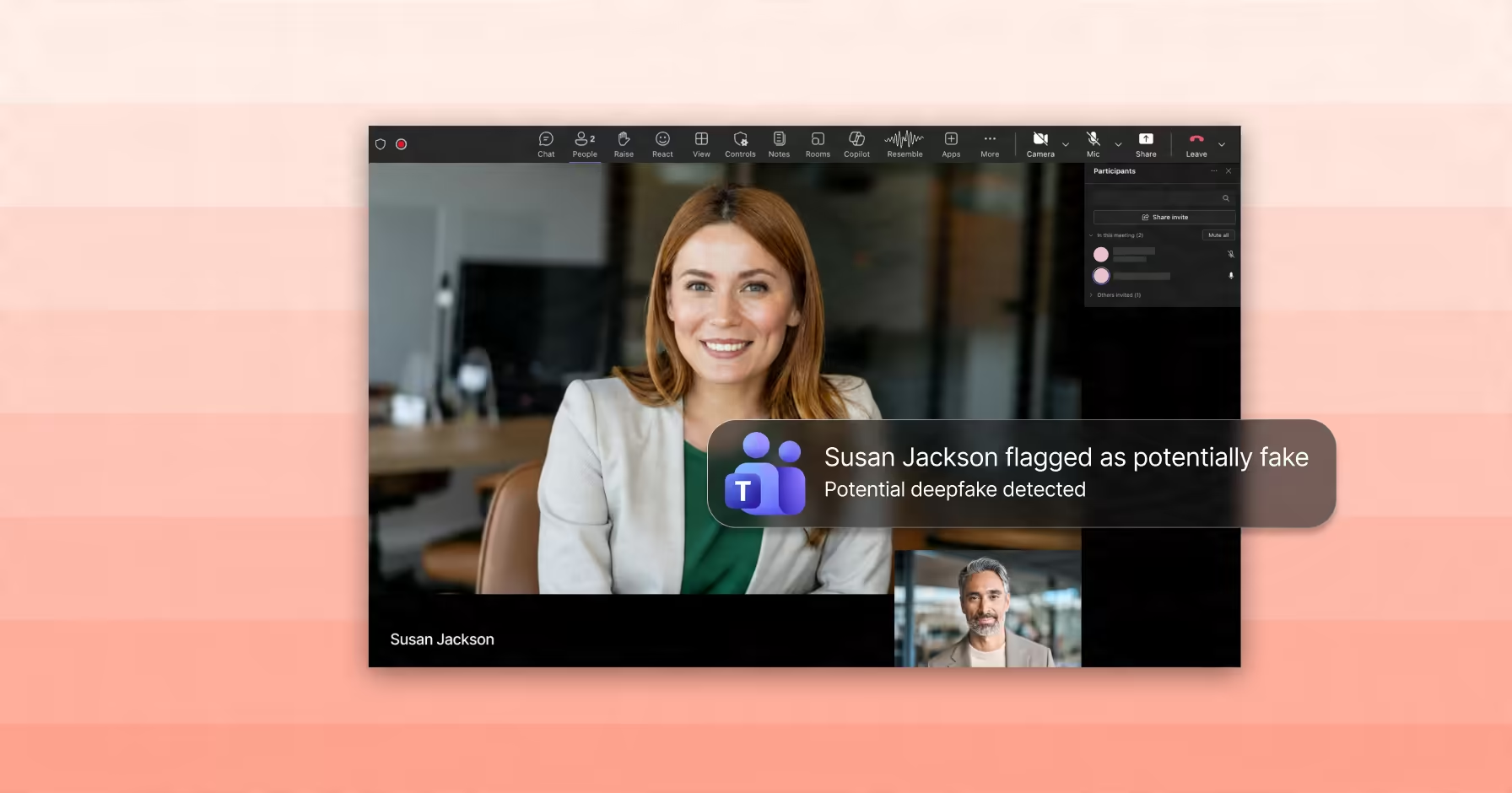
Deepfake audio and video threats in corporate video environments typically fall into two categories: voice cloning and face manipulation. Voice cloning involves training generative AI models on a target's speech patterns to produce synthetic audio that mimics their tone, cadence, and pronunciation. Face-swap attacks use real-time rendering to overlay a synthetic likeness onto a live video feed, allowing an attacker to visually impersonate someone on a call. In both cases, the goal is the same: to manipulate trust to trigger an action.
Detecting deepfakes during live meetings presents a fundamentally different challenge from analyzing uploaded media after the fact. Instead of reviewing a static recording, security teams must identify manipulated audio or video while the conversation is still in progress—often within seconds and without interrupting the meeting.
As real-time voice synthesis continues to improve, organizations need continuous monitoring that can identify suspicious activity during live communications rather than relying solely on post-incident forensic analysis.
Why Businesses Need Deepfake Audio Detection Tools
Organizations rarely deploy detection systems because of technology trends alone. They typically adopt them to reduce operational, security, and reputational risks associated with synthetic media.
Key business drivers include:
- Financial fraud prevention: Wire transfer fraud initiated through impersonated executives over video is a documented and growing attack vector in corporate environments.
- Brand trust protection: Public-facing organizations may need mechanisms to assess suspicious recordings that could impact customer trust or corporate reputation.
- Regulatory compliance: Industries such as healthcare and financial services face growing pressure to demonstrate that identity verification in digital interactions meets audit and compliance standards.
- Contact center security: Synthetic voice attacks are increasingly used to bypass IVR authentication and social-engineer live agents, as seen in Zoom Contact Center deployments.
- Reputational risk management: Executives and public-facing employees are high-value impersonation targets. A successful deepfake attack can cause downstream reputational damage beyond the initial financial loss.
Deepfake detection should be viewed as one layer within a broader verification strategy. Organizations often combine technical detection with identity verification controls, escalation procedures, and employee training to reduce risk exposure.
Key Features to Look for in Deepfake Audio Detection Tools
Choosing a detection tool without a clear feature checklist often leads to one of two problems: either the tool is accurate in demos but underperforms in real deployment conditions, or it generates enough false positives to disrupt legitimate operations.
The features below are the ones that most directly determine whether a tool holds up in production, not just in a demo.
- Real-time detection capability: Can the system analyze audio as a live call or meeting unfolds, or does it require post-call batch analysis? For contact centers and live meetings, real-time detection is typically necessary.
- Zero-day attack coverage: Most pattern-matching detection systems are trained on known generative models. A tool that only recognizes previously cataloged attacks will miss audio created by new or modified models.
- Multimodal support: Audio-only detection is insufficient in environments where video deepfakes are also a risk. Tools that analyze voice, video, and image together reduce the chance of a composite attack slipping through.
- False positive rate: A high false positive rate means legitimate callers get flagged. This erodes trust in the system and creates operational overhead. Ask vendors for independently validated false positive data, not just accuracy figures from internal testing.
- API and workflow integration: Detection tools that require a separate interface or manual upload step add friction. API-first tools that embed into existing telephony systems, video conferencing platforms, or onboarding pipelines offer more practical deployment.
- Cross-language support: Enterprises operating across multiple markets need detection that performs consistently across languages, not just English.
- Data handling and retention policies: For regulated industries or organizations with strict data governance requirements, it is important to understand whether submitted audio is stored by the vendor and for how long. Some tools offer zero-retention modes.
The weight you assign to each of these depends on your use case. A contact center focused on fraud prevention will prioritize real-time detection and low false-positive rates. A media company verifying submitted content may prioritize batch processing throughput and explainability.
Also Read: 4 Ways to Detect and Verify AI-generated Deepfake Audio
Leading Tools for Corporate Deepfake Audio Detection
Several platforms now offer deepfake detection specifically designed for corporate video meeting environments. Each takes a different approach to detection coverage, deployment model, and enterprise integration.
1. Resemble AI
Resemble AI combines real-time deepfake detection, identity enrollment, AI watermarking, and multilingual voice intelligence into a single platform.
Unlike systems that primarily rely on recognizing previously seen deepfake patterns, DETECT-3B Omni is designed to identify underlying synthesis artifacts produced by generative models, allowing it to detect audio generated by previously unseen systems. Independent benchmarking conducted by Podonos in 2026 also ranked DETECT-3B Omni among the highest-performing commercial audio deepfake detection systems.
Key capabilities:
- AI Watermarking: Resemble AI embeds robust, cryptographically verifiable watermarks into AI-generated speech without noticeably affecting audio quality. These watermarks remain detectable after common transformations such as compression or format conversion, enabling organizations to verify provenance and distinguish authentic AI-generated content from manipulated media.
- Audio Intelligence: Provides capabilities such as speaker recognition, identity verification, and conversation analysis using short audio samples to support security, customer experience, and operational workflows.
- Identity Enrollment & Voice Verification: Organizations can securely enroll trusted speakers and verify future recordings or live interactions against enrolled voiceprints. This strengthens identity verification workflows for executive communications, customer authentication, and fraud prevention.
- Industry-Leading Detection Performance: Independent Podonos benchmark testing evaluated multiple commercial detection systems against modern synthetic speech models, with DETECT-3B Omni achieving one of the highest reported detection accuracies while maintaining strong performance across previously unseen generation models.
Best fit: Organizations that need a unified platform combining multimodal deepfake detection, AI watermarking, identity enrollment, multilingual support across more than 54 languages, and enterprise deployment options for fraud prevention, compliance, and secure communications.
2. Pindrop – Pulse
Pindrop has focused on voice security and fraud prevention for contact centers. Pulse is built specifically for telephony environments, helping organizations identify synthetic voices and impersonation attempts during live calls. The platform integrates directly into existing call center workflows and authentication systems, making it a practical option for enterprises that view voice fraud as a major security risk.
Key capabilities:
- Real-time deepfake detection and liveness analysis that analyzes acoustic signatures and call behavior as calls happen, without a stated independent latency benchmark.
- Purpose-built integration with IVR, authentication, and fraud prevention systems used by contact centers.
Best fit: Organizations primarily focused on protecting voice-based customer interactions and telephony workflows from synthetic voice fraud.
Limitation to note: Organizations gain the most value when Pulse is deployed alongside Pindrop's broader authentication and fraud prevention ecosystem. Pindrop's accuracy claims are self-reported rather than validated on an independent, private-label benchmark, and Pindrop has not submitted to the Podonos test. Coverage also does not extend to Google Meet, and there is no provenance or watermarking layer.
3. Reality Defender
Reality Defender provides multimodal deepfake detection across audio, video, images, and live communications. Its platform uses an ensemble-of-models architecture, analyzing content through multiple detection methods simultaneously rather than relying on a single classifier.
Key capabilities:
- An ensemble detection architecture designed to improve resilience against evolving deepfake generation techniques.
- Real Suite products cover call centers, video meetings, uploaded media, and developer APIs.
Best fit: Enterprises seeking upload screening with human review, such as content intake, forensic triage, and moderation queues where every flag lands in front of a reviewer.
Limitation to note: On the Podonos benchmark, Reality Defender measured 71.3% accuracy with a 53.7% false positive rate on audio, meaning more than half of real audio was flagged as fake, and ran at a real-time factor of 1.52, slower than real time. Those figures describe audio at default thresholds; video performance may differ. Organizations with live or audio-heavy workloads should validate on their own traffic before deployment.
4. Hive AI
Hive AI offers deepfake detection through large-scale machine learning models trained on vast collections of labeled media. The platform is widely used in content moderation, trust and safety operations, and identity verification workflows. Its strength lies in processing large volumes of content efficiently while supporting both audio and video analysis.
Key capabilities:
- High-throughput APIs designed for large-scale content moderation and verification workflows.
- Detection models are trained across extensive datasets containing synthetic audio, image, and video content.
- Integration support for social platforms, identity verification systems, and enterprise moderation pipelines.
- Submitted to the Podonos benchmark, earning transparency credit that several competitors don't.
Best fit: Organizations that need to analyze large volumes of user-generated content at scale.
Limitation to note: While Hive AI performs well in large-scale content moderation workflows, its Podonos benchmark result landed mid-field, roughly 13 points behind the two leading systems on audio accuracy. Its scale-first architecture is also batch-oriented rather than built for live call or meeting protection, and there is no provenance layer.
Also Read: AI Audio Editing Online for Professional Sound
Side-by-Side Comparison of Leading Deepfake Audio Detection Solutions
Note: Detection performance is based on publicly available vendor information and, where available, independent benchmark testing. Results may vary depending on deployment conditions and evaluation methodology.
Deepfake Detection Evaluation Checklist
Before selecting any platform, verify:
- Does it support your communication channels?
- Can it analyze live and recorded audio?
- Does it provide API access?
- Can it fit existing fraud-review workflows?
- Does it support audit and investigation processes?
- Can security teams interpret results easily?
- Does it provide explainable outputs?
- Are deployment options aligned with compliance requirements?
Best Practices for Implementing Deepfake Audio Detection
Organizations that deploy detection tools without a defined implementation framework often encounter high false-positive rates that disrupt legitimate operations. Additionally, they may lack an escalation process when a potential deepfake is identified because detection is limited to certain channels.
The practices below are drawn from how enterprise security teams approach deployment in production environments:
- Define the attack scenarios you are protecting against first: Real-time call fraud, video meeting impersonation, KYC submission fraud, and media verification have different latency, coverage, and integration requirements.
- Run a controlled pilot before full deployment: Test the tool against real call traffic or content submissions in your environment. Pay attention to the false positive rate under real conditions, not just vendor-reported benchmarks.
- Set a clear escalation path for flagged detections: A detection event is not a final verdict. Agents, security analysts, or compliance reviewers need a defined workflow for what to do when audio is flagged as potentially synthetic.
- Plan for model updates: Generative AI models are released frequently. A detection system that is not updated to account for new synthetic audio architectures will lose effectiveness over time. Confirm the vendor's update cadence before deployment.
Skipping any one of these four steps shows up the same way: a tool that looked strong in procurement and quietly stops catching what it was bought to catch. The scenario definition, the pilot, the escalation path, and the update cadence are what turn a detection tool into a detection program.
Also Read: Real-Time Deepfake Detection: How Live Audio Verification Works
Final Thoughts
As deepfake audio attacks become more sophisticated, investing in the right tools for corporate deepfake audio detection is no longer optional. The best solution depends on your risk exposure, communication channels, and operational requirements.
Whether your focus is on contact centers, executive communications, or identity verification, effective detection must fit seamlessly into existing workflows. Start with a defined threat model, evaluate performance through controlled testing, and choose a platform that can adapt as synthetic voice technologies continue to evolve.
If your organization is assessing deepfake detection strategies, explore Resemble AI’s detection capabilities to see how real-time analysis, audio verification, and AI watermarking can help strengthen trust in voice-based communications.
FAQs
1. What are corporate deepfake audio detection tools?
Corporate deepfake audio detection tools analyze speech recordings for signs of synthetic generation. They help security teams investigate suspicious communications and reduce impersonation-related risks.
2. How do deepfake audio detection systems work?
Detection systems analyze audio characteristics that may indicate synthetic generation or manipulation. Different vendors use different models, signals, and analysis techniques.
3. Can deepfake detection tools guarantee authenticity?
No detection system can guarantee authenticity under every possible condition. Performance often depends on audio quality, context, and attack sophistication.
4. Which industries use deepfake audio detection most often?
Financial services, telecommunications, media organizations, and enterprise security teams frequently evaluate these solutions. Identity-sensitive workflows often create stronger demand for verification technologies.
5. Why are contact centers evaluating deepfake detection?
Contact centers increasingly handle sensitive customer information and authentication requests. Synthetic voice attacks may increase risks within voice-based verification processes.
6. What should organizations test before deployment?
Teams should test performance using realistic audio conditions and operational workflows. Latency, reporting quality, and integration capabilities also deserve evaluation.
7. Is deepfake detection useful for media organizations?
Yes, media teams may use detection systems to evaluate suspicious recordings. Verification workflows can support editorial review and content authenticity assessments.
8. Can deepfake detection prevent fraud on its own?
No. Detection tools flag risk; they don't stop a transaction. The safeguards that actually prevent fraud sit around the detection signal, not inside it: a callback to a verified number before acting on any voice instruction, dual approval on wire transfers above a set threshold, and a documented escalation path for flagged calls. Detection tells you when to trigger those steps; it doesn't replace them.
9. What is a common mistake when selecting a detection platform?
Accepting a vendor's accuracy number without asking how it was measured. A 98% figure from a curated internal test set means something different from the same number on live, compressed, multi-accent call traffic. A useful red flag: if a vendor won't share their false-positive rate under real conditions, or can't explain what their test set looked like, treat the headline accuracy figure with caution.
10. How does deepfake detection fit into security operations?
Detection systems can complement existing fraud prevention and threat investigation processes. Alerts may become part of broader security monitoring and response workflows.
11. What role does API integration play in detection systems?
API access can help organizations connect detection tools with existing platforms. Integration often improves operational efficiency and automation opportunities.
12. Should businesses evaluate generation and detection together?
Organizations adopting voice AI may benefit from understanding both capabilities simultaneously. Generation creates opportunities, while detection helps address associated risks.