RAD-S1 • REsemble Research

The world's first System One model for AI agent detection

RAD-S1 analyzes how visitors move, click, scroll and type to determine whether a web session is controlled by a person or an AI agent. It powers Resemble Agent Detection, helping identify agents that traditional bot detection can miss.

Trusted partners include
THE PROBLEM

AI agents browse like people, and traditional bot detection can't see the ones that hide

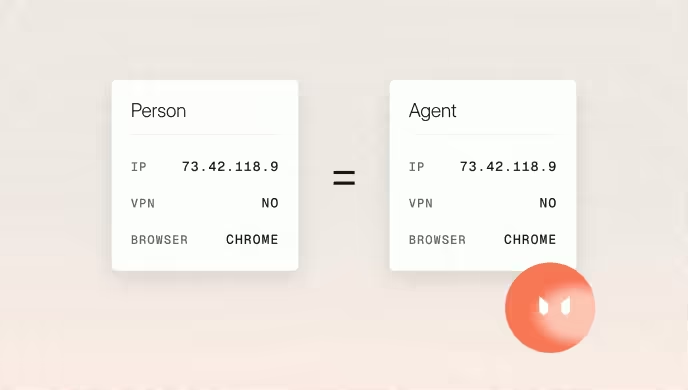
Traditional bot detection relies on signals such as browser details, IP addresses and known automation patterns. RAD-S1 (Resemble Agent Detection - System One) analyzes how visitors interact with a website to identify AI agents, even when they use real browsers or hide their automation.
‍

STEP 1 • OBSERVE VISITOR BEHAVIOR

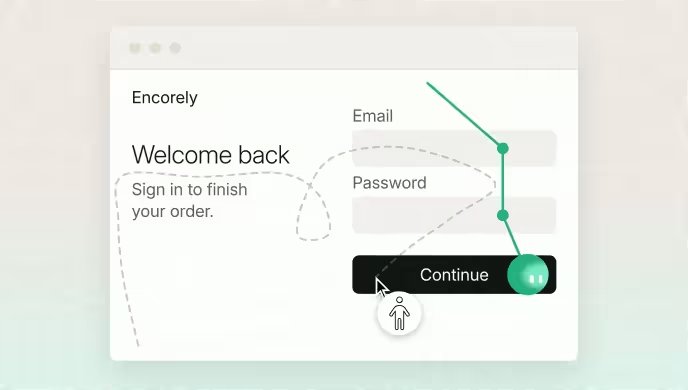
A lightweight, 25 KB script collects interaction signals such as pointer movement, clicks, scrolling, touch activity and typing timing and sends small batches of signals every 1.2 seconds.

STEP 2 • ANALYZE THE SIGNALS

After about five actions or 50 pointer movements, RAD-S1 runs its first check on Resemble's servers. The median response time is about 120ms, with 95% of checks responding within 200ms.

STEP 3 • RETURN A VERDICT

RAD-S1 repeats its checks until two consecutive reads agree. It then classifies the session as Person or AI agent for the rest of the visit.
WHAT SYSTEM ONE DOES

Find AI agents that try to look human

Reads behavior first
RAD-S1 analyzes how visitors interact with a website, helping identify agents even when they disguise their browser identity.
Catches disguised agents
 Identifies AI agents that use real browsers or stealth techniques to hide their automation.
Explains every decision
Each verdict includes the type of visitor and how likely it is that a person is present, so your team can review any call.
Returns verdicts quickly
The first check runs after about five actions or 50 pointer movements. A verdict is finalized once two reads agree.
Let's you choose next steps
RAD-S1 classifies a visit but doesn't block it automatically. You decide whether to allow the session to continue, redirect the visitor or display a message.
Adds no friction
There are no puzzles or challenges to complete, and the script loads asynchronously.
HOW THE MODEL WORKS

Behavioral analysis, backed by additional signals

RAD-S1 combines a behavioral model with a set of rules. All scoring happens on Resemble's servers, while a lightweight browser script collects the signals used to assess each visit.
Behavioral signals
The model analyzes pointer movement, click timing, scrolling, touch activity and typing rhythm to help distinguish human interactions from automated ones.
Browser and device signals
Browser details, request headers and automation flags provide additional context for the model.
Training and updates
The model is trained on sessions from AI agents and automation tools, including Claude, Codex, Grok, ChatGPT, OpenAI Dot, Browser Use, Playwright and Muse. Each release is versioned, and the model is updated as new agents and stealth techniques emerge.
BENCHMARKS

RAD-S1 catches the agents other tools miss.

We tested RAD-S1 against six widely used bot detection tools using the same agent visits across eight website stacks. All seven performed well when agents left signs of automation. When agents hid those signs, RAD-S1 continued to identify them.
>98.8%
of agents that hide identified.
Other tools: under 15%
INTERNAL TESTING RESULTS - OCTOBER 2026

Agents that don’t disguise themselves

Share of sessions each tool correctly classified as an agent. Higher is better.

RAD-S1≥98.7%
Cloudflare Turnstile97.6%
BotD≥99.3%
F598.4%
Google reCAPTCHA96.9%
Akamai99.1%
Vercel BotID94.8%
Source: Resemble AI internal benchmark, October 2026

Agents that disguise themselves

Share of sessions each tool correctly classified as an agent. Higher is better.

RAD-S1≥98.8%
Cloudflare Turnstile4.6%
BotD14.8%
F56.8%
Google reCAPTCHA3.6%
Akamai8.7%
Vercel BotID3.1%
Source: Resemble AI internal benchmark, October 2026

RAD-S1 vs six bot detection tools, by hiding technique

Share of agent visits identified as an agent for each technique. Higher is better.

CamoufoxModified Firefox 0.0%–6.6% for the six other tools ≥96.8%
PatchrightModified Chromium 0.0%–5.9% for the six other tools ≥92.6%
Stealth PlaywrightHidden automation fingerprints 0.0%–10.2% for the six other tools ≥92.7%
Session takeoverClean browser, then a bot 4.0%–50.2% for the six other tools ≥96.7%
Source: Resemble AI internal benchmark, October 2026
BUILT ON RESEMBLE AI

RAD-S1 is on layer of the broader security stack

AI agents can interact with websites, calls and files. Resemble helps security teams assess these different points of contact, from identifying AI agents browsing a website to detecting AI-generated audio, images and video.
product
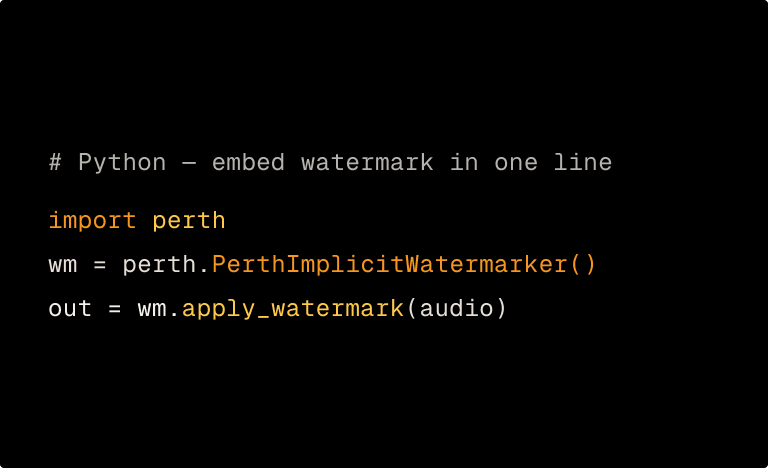
Multimodal Watermarking
Ship the watermark as part of your production pipeline. Watermark generated content and verify it later via API.
EXPLORE RESEMBLE WATERMARKER
product
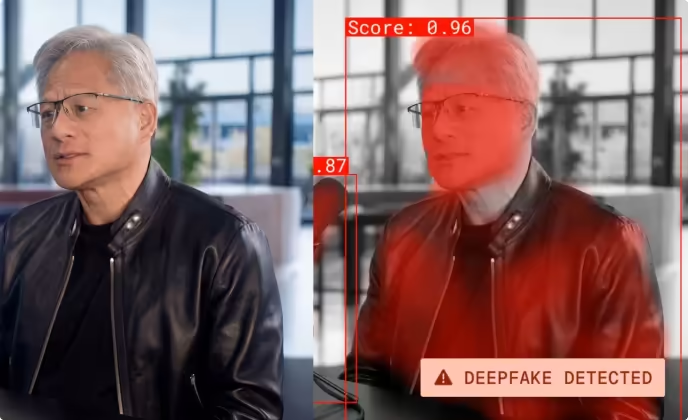
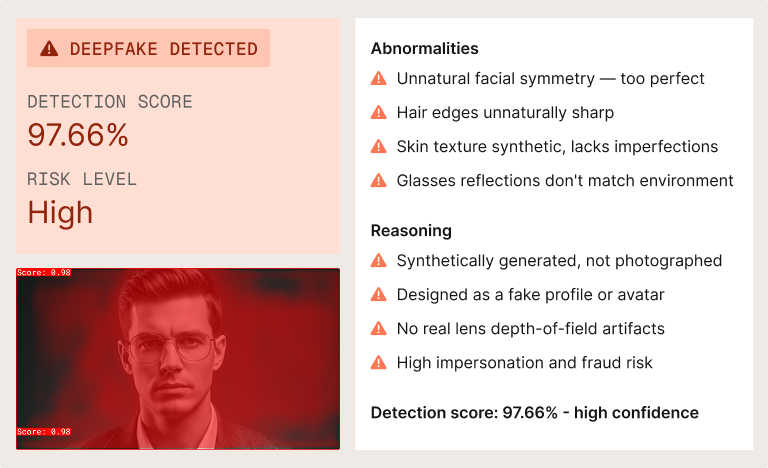
Deepfake Detection
Real-time, multimodal detection across audio, video, and image. The complement to watermarking for content you didn’t generate.
Explore resemble Detect
PRODUCT
Human-readable Reports
Explains what triggered a flag, and why, in plain language. The context layer that pairs with Resemble Detect on every result..
EXPLORE RESEMBLE INTELLIGENCE
Frequently asked questions
What is RAD-S1, and how does it relate to Agent Detection?
RAD-S1 is the model that powers Resemble Agent Detection. The product includes the website script, dashboard, verdict events and billing.
What does RAD-S1 detect?
It classifies each session as Person or AI agent, and marks it Undecided when there isn't enough interaction to call. AI agent visits include computer-use agents, browser automation and scripted clients.
How is RAD-S1 different from traditional bot detection?
Traditional bot detection often relies on IP addresses, browser identifiers and known automation patterns.RAD-S1 analyzes visitor behavior to help identify agents that operate in real browsers or hide their automation.

In internal benchmarks, RAD-S1 identified at least 98.8% of disguised agent visits. The other tools tested identified 14.8% or fewer.
Does RAD-S1 block AI agents?
No. RAD-S1 returns a verdict, and you decide what to do with it. You can take no action, redirect the visitor or display a message. You can also use the verdict in your own application to reroute, restrict or block a session.
Can AI agents learn to evade RAD-S1?
No behavioral detection method is impossible to evade. RAD-S1 is tested against agents designed to imitate human behavior, stealth browsers and session takeover techniques. Its scoring runs on Resemble's servers.

We recommend using its verdicts alongside your other security controls rather than treating any single detection method as a guarantee.
Where does RAD-S1 work?
RAD-S1 works on websites and web applications that run in a browser. Native mobile apps aren't currently supported.
How do I integrate RAD-S1?
Create a free Resemble AI account and add one script tag to your website to get started.
Know what's real — and what's a real threat.
Join thousands of developers and enterprises detecting AI fraud and protecting their content with Resemble AI