fraud + identity teams

Catch document fraud that identity verification misses

Edited IDs, receipts and claim photos get through the checks you run today. Resemble looks at whether the image was generated or altered, before you approve an account or release a payout.

FRAUD AUDIT RESULTS

A recent fraud audit at a large gig economy platform revealed that over 1 in 10 identity documents that passed their verification had been generated with AI.

Over 10%
of accepted ID's were fraudulent

How it works

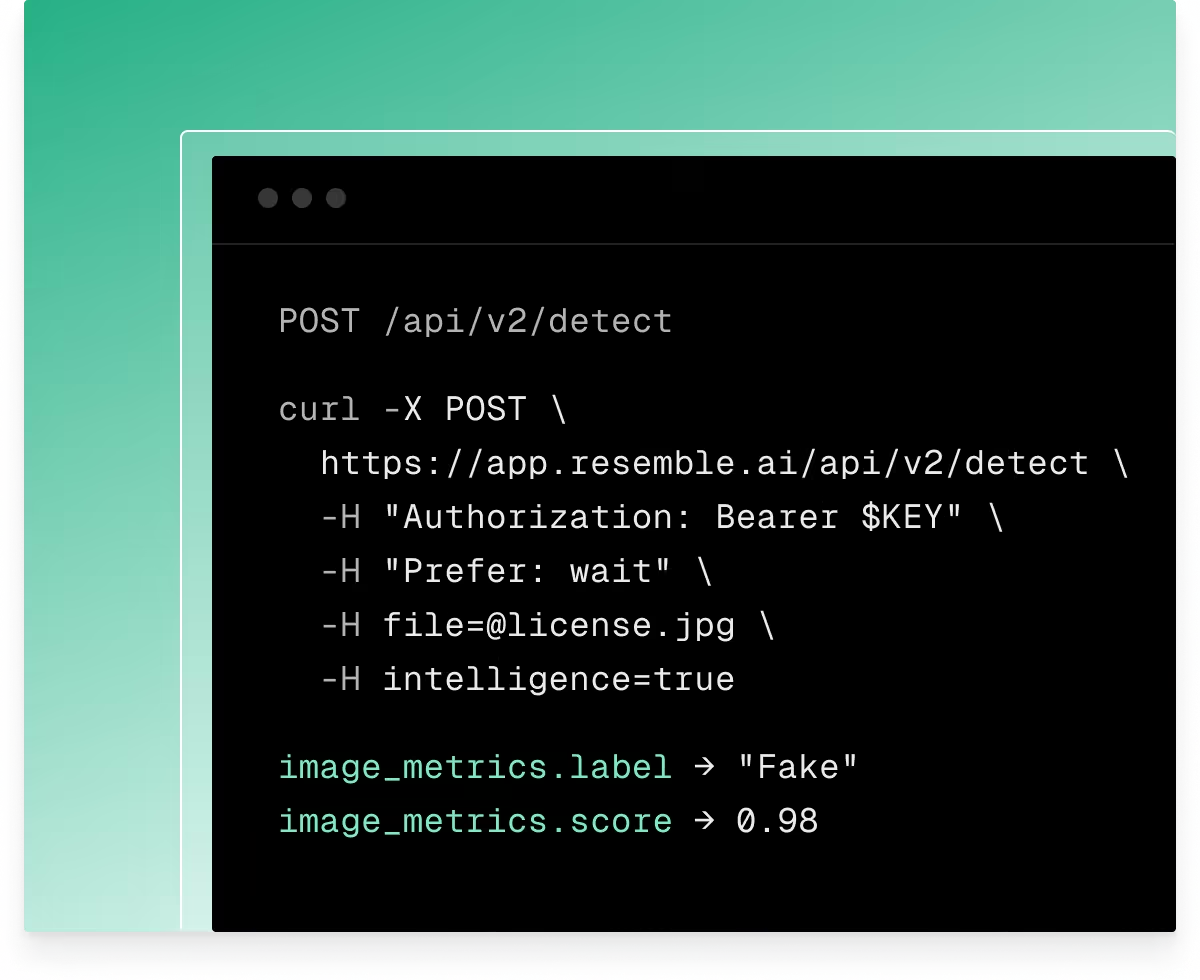
Document fraud detection runs inside the tools you already use, through a REST API with no SDK to install.
You send the file: Your upload step passes it to the API.
You get a verdict back: AI or not, a confidence score, and the regions that triggered it.
You decide what happens: Resemble never approves or declines anything.

Where fake documents and IDs get past your checks

Oboarding fraud detection

A real, stolen ID with a swapped photo clears document checks, liveness detection, and background screening. It then passes every future check, because the face and credential now match each other. That's how account opening fraud and synthetic identity fraud usually start.

Claims, refunds, and payouts

Receipts, damage photos, and proof of delivery get edited in seconds with a consumer image model and attached to a refund or a claim. This creates the same problem for insurance claim fraud detection and payment fraud detection: an edited image can be accepted as real, leading to a refund, claim approval, or payout.

Proof of income and address

Account takeover fraud often starts with one of these: payslips, bank statments and utility bills, edited to clear an income threshold or place someone at an address they have never lived at.

Repeat use fraud rings

Rings reuse one document template and one background, swapping only the face, so any single upload can look reasonable while the batch gives them away. Fake ID detection only helps here if it can see across submissions.

What your current checks catch, and what they miss

Your identity checks confirm who someone is, and your fraud rules assess whether a request looks legitimate. But neither tells you whether the audio, video or image supporting that request was generated or manipulated by AI.
The question The check you run today ✦Resemble
Is this a valid identity? Document format, database match, watchlist and liveness detection, the standard KYC checks.
Is this claim or refund request genuine? Rules, thresholds, and a reviewer on a sample of cases. The photo attached to the request is taken at face value.
Was this file generated or edited? Not assessed. The check runs on the identity, not on the pixels.
Is this the same person who onboarded? Verified once, at onboarding. Later submissions are not compared back to it.
Does it survive a screenshot or a re-photographed print? Degrades. Generating an image, printing it and photographing the print is a known way through.
Can you defend the decline to a regulator? A pass or fail result, with limited reasoning.

What Resemble AI sends back

One API call returns the detection and the report together
Result and risk level
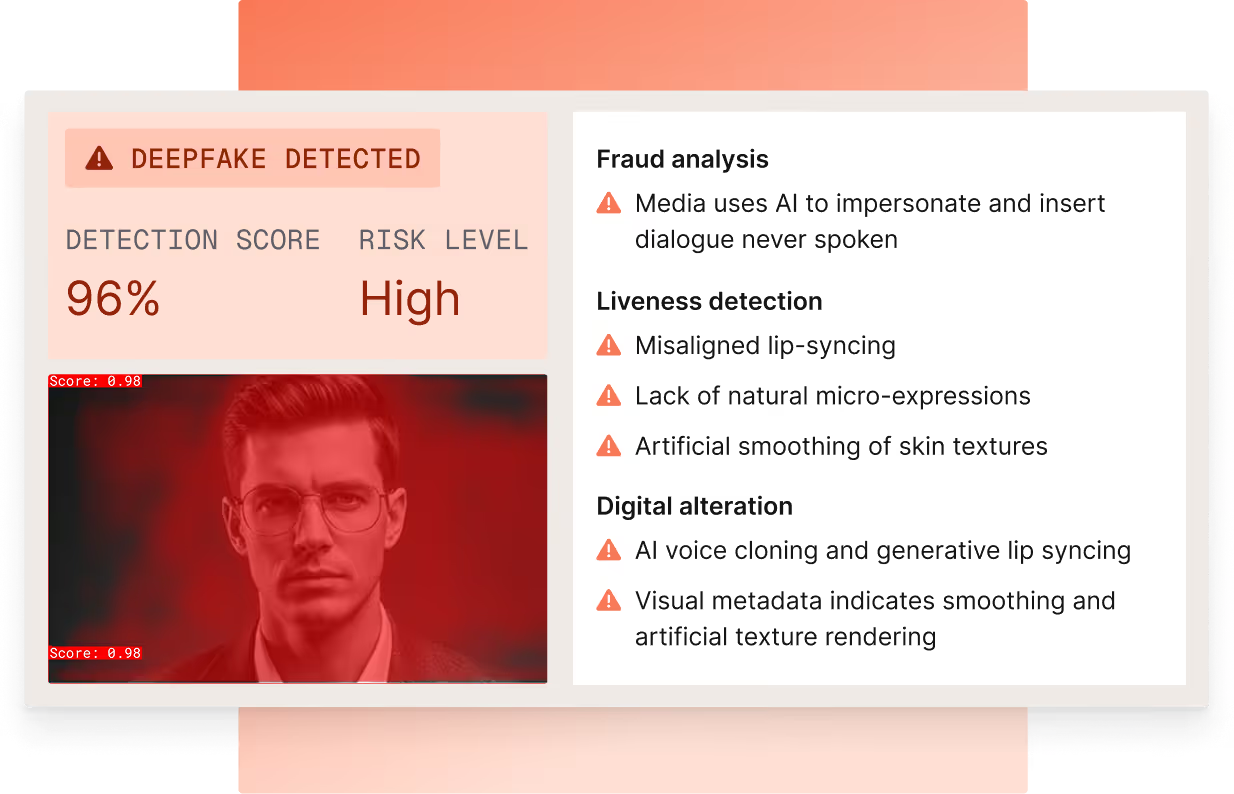
Deepfake or authentic, with a confidence score and a risk level.
Abnormalities
The specific artifacts that triggered the flag, such as distorted features, lighting that does not match, over-smoothed skin, or gibberish text on a document.
Digital alteration
Editing, splicing, and tampering after capture, flagged even when noting was AI-generated, which is how most Photoshpped ID's get through.

5 questions to take to your next fraud review

Most teams already suspect files are getting through, but very few can put a number on it. These five questions are the fastest way to get one.
How many documents, IDs, receipts, and claim photos do you accept each month, and what share does a person ever actually look at?
Of the fraud you caught last quarter, how much was caught at submission, and how much only after you had paid?
When a reviewer declines a file today, what evidence goes in the case record?
When did anyone last try to push a manipulated ID through your own onboarding on purpose, to see what happens?
Who owns this: the team that verifies identity, or the team that pays the claim?

Where it runs, and what happens to your data

Where it runs
Cloud, your own VPC, or fully on-prem. Air-gapped deployments are already in production with goveernment agencies.
What we keep
In memory processing is available, so a file is analyzed without being stored. Everything is encrypted at rest and in transit.
Certification
ISO/IEC 27001:2022 certified, and GDPR and HIPAA compliant. Full detail is in our trust center.
95.8%
Accuracy on images, across 1,000 test files
250+
Generative models tested against
0.12
Real-time factor, fast enough to run inline
Frequently asked questions
How does Resemble detect AI-generated voice fraud in real time?
Resemble analyzes the characteristics of a voice to determine whether it was AI-generated, rather than analyzing what the speaker says. It returns a deepfake confidence score in under 300 milliseconds, without requiring transcription or recording. Detection works across 54 validated languages, and because it doesn't require recording the conversation, it can support deployments where recording consent is a concern.
Does deepfake detection replace voice biometrics?
No. Voice biometrics verifies who is speaking, while deepfake detection checks whether the voice itself is genuine. Resemble adds another layer of protection alongside your existing biometric solution, helping detect cloned voices that might pass standard identity checks. It can also detect AI-generated voices streamed in real time, going beyond what traditional voice liveness checks are designed to catch.
How does Resemble compare to Pindrop for contact center fraud?
Pindrop combines voice analysis with device, carrier, and behavioral signals for fraud risk scoring. Resemble answers the question that comes first: is this voice real? On the Podonos benchmark (August 2026), Resemble scored 99.47% accuracy (0.4% FNR) vs Pindrop at 95.05% (3.7% FNR). The two are complementary.
How does Resemble compare to Reality Defender?
On the Podonos benchmark (August 2026), Reality Defender scored 71.27% accuracy with a 53.7% false-positive rate, flagging more than half of real audio as fake. It was the only system slower than real time. Resemble scored 99.47% with both error rates under 1%.
How accurate is detection on compressed telephony audio?
A: 99.47% on the Podonos benchmark, holding 99.2%–99.7% across all six formats. Podonos has introduced telephony-grade tracks using G.711, AMR-NB, G.729, and EVS-WB codecs to measure detection under real contact center conditions.
Can I deploy on-premise? Does it work with Genesys, Five9, or Microsoft Teams?
Yes to both. Every model deploys as a container in GCP, AWS, Azure, or on-premise infrastructure, so audio never leaves your environment. Integrates with Genesys Cloud, Five9, 8x8, Microsoft Teams, and Zoom via SIPREC, SIP trunk, or direct API. Voice AI platforms like VAPI also supported.
What else can Resemble detect beyond voice?
‍Resemble functions as a full AI authenticity layer across audio, video, images, and documents. Beyond voice fraud detection in the contact center, it covers synthetic identity detection for KYC, deepfake video for executive impersonation, and AI agent authentication via Resemble Watermarker.
Know what's real — and what's a real threat.
Join thousands of developers and enterprises detecting AI fraud and protecting their content with Resemble AI