Voice cloning has crossed an uncomfortable line. It no longer sounds artificial, experimental, or easy to spot. In many cases, AI-generated voices are now indistinguishable from real speakers.
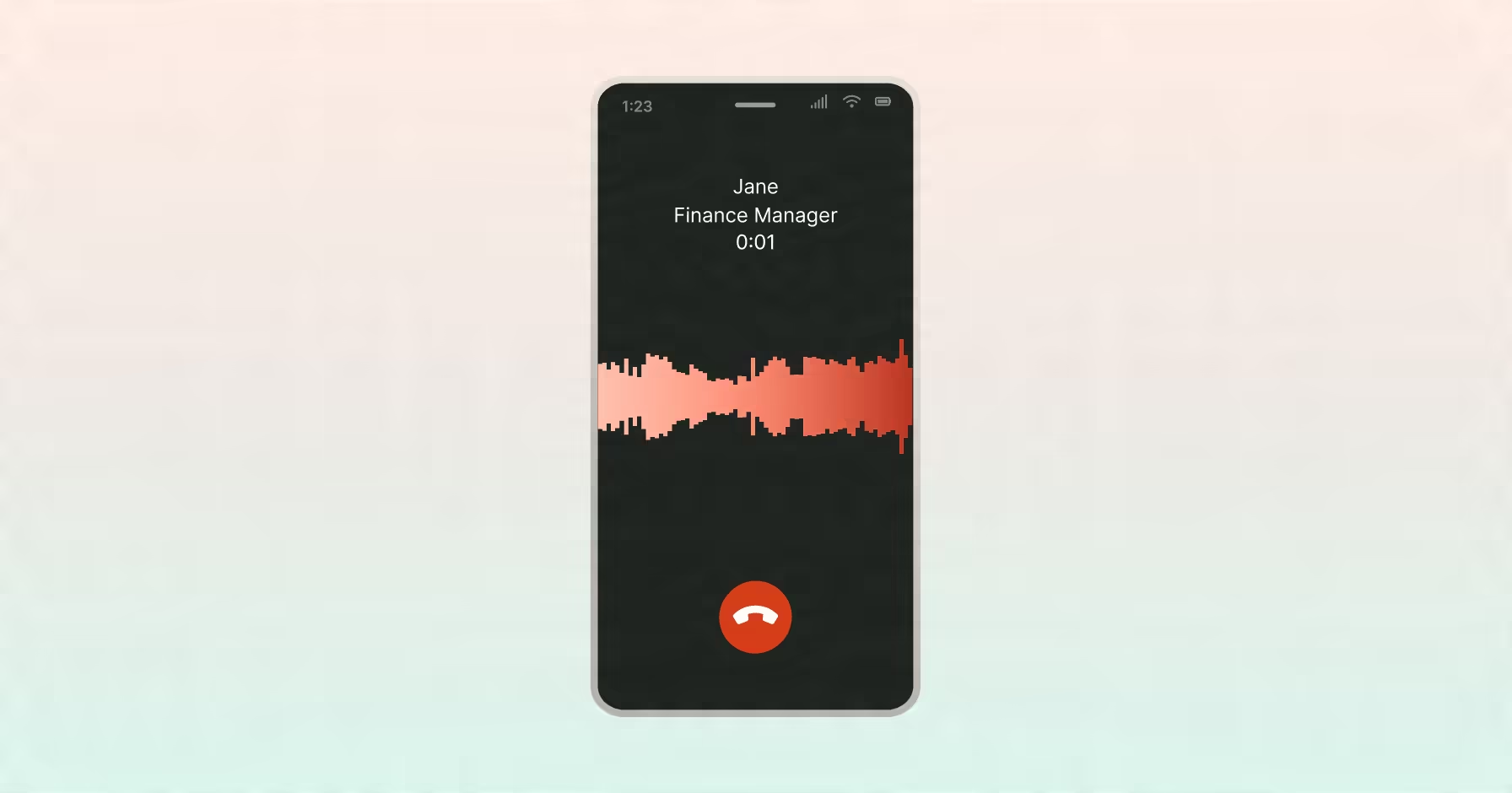
That shift has real consequences. In the U.S. alone, consumers lost $2.7 billion to impersonation scams, with regulators increasingly pointing to AI-generated voice and audio as a contributing factor. As cloned speech becomes easier to create and harder to verify, trust breaks the moment audio leaves its point of origin.
Once cloned audio is edited, shared, or redistributed, traditional voice detection struggles to answer a basic question: where did this come from? That’s why attention is shifting toward watermarking voice cloning output, where verifiable signals are embedded at generation time instead of guessed after the fact.
This guide explains how watermarking works for voice cloning, how detection changes when trust is built in at the source, and how teams can verify AI-generated speech responsibly.
At a Glance:
- Traditional voice detection breaks down in real-world audio workflows. Editing, compression, and redistribution weaken post-hoc inference.
- Watermarking voice cloning output enables verification at the source. Inaudible signals embedded at generation time provide traceable origin.
- Generation-time trust signals are more reliable than pattern analysis. Watermarks are designed to survive common audio transformations.
- Detection works best as verification when watermarking is present. Checking for embedded signals is more defensible than guessing authorship.
- Watermarking should be treated as infrastructure, not a feature. It supports scalable, compliant, and responsible voice AI deployment.
Why Voice Cloning Needs a Different Trust Model

Voice cloning operates in conditions that make traditional AI detection unreliable by default. Audio rarely remains in its original form once it leaves the generation environment.
Audio Is Constantly Transformed
In real workflows, voice cloning output is routinely:
- compressed and re-encoded
- mixed with music or background audio
- normalized for different platforms
- redistributed across multiple channels
Each transformation alters the acoustic signal and weakens post-hoc detection methods that rely on pattern analysis.
Voice Workflows Are Often Hybrid
Many use cases combine human and synthetic speech within the same file. Examples include:
- partially automated call center interactions
- dubbed or localized media
- voice conversion layered onto human recordings
In these scenarios, the question is rarely whether an entire file is AI-generated. It is whether specific segments can be verified.
Human and Synthetic Speech Are Converging
Modern voice models are designed to sound natural. They introduce variation, emotion, and pacing that closely resemble human speech. At the same time, professionally produced human audio is often clean, consistent, and highly structured. This convergence is happening at scale. The World Economic Forum estimates that up to 8 million deepfakes will be circulating online by 2025, dramatically increasing the volume of synthetic media that must be verified across real-world audio workflows.
As these characteristics overlap, inference-based detection loses clear separation between human and AI speech.
Why This Breaks Post-Hoc Detection
Because audio is transformed, mixed, and hybridized, detection systems that attempt to infer origin after distribution face structural limits. Confidence drops quickly, and results become inconsistent across platforms and formats.
For voice cloning, trust cannot depend on reconstruction alone. This is why generation-time approaches like watermarking provide a more reliable foundation.
Also Read: Understanding How Deepfake Detection Works

What Is Watermarking Voice Cloning Output?
Watermarking voice cloning output is a generation-time approach to trust. Instead of analyzing audio after it has been shared or modified, watermarking embeds a verifiable signal directly into synthetic speech as it is created.
This signal travels with the audio itself and allows systems to verify AI origin later, even after the file has passed through real-world audio pipelines.
Voice watermarking embeds an identifiable signal into the audio waveform that:
- is inaudible to listeners
- does not affect voice quality or expressiveness
- can be detected later for verification
Because the watermark is part of the waveform, it cannot be removed without significantly degrading the audio.
What Voice Watermarking Is Not
Watermarking is often misunderstood. It is not:
- an audible tone or spoken marker
- a visible label attached to an audio file
- metadata that can be stripped or edited
- a post-processing step applied after generation
Effective watermarking is integrated directly into the voice generation pipeline.
Verification Instead of Inference
Traditional voice detection attempts to infer origin by analyzing acoustic patterns and estimating similarity to known AI-generated speech. This produces likelihood scores rather than confirmation.
Watermarking enables verification:
- If the watermark is present, AI origin can be confirmed
- If the watermark is absent, the result is uncertainty, not proof of human authorship
This distinction is critical in environments where audio is edited, mixed, or redistributed.
Why Generation-Time Signals Matter
This shift is also reflected at the policy level. In 2025, the United Nations’ International Telecommunication Union warned that the rapid spread of convincing AI-generated media is eroding trust and emphasized the need for provenance and watermarking systems to support verification at scale.
Must Read: What Is AI Watermarking and Why It Matters in 2026?
How to Detect Watermarked Voice Cloning Output

Once watermarking is embedded at generation time, detection becomes a verification task. The goal is to determine whether a known watermark signal is present, not to estimate whether audio sounds synthetic.
Automated Watermark Detection
Detection systems scan audio files for embedded watermark signals using models aligned with the watermarking method used during generation. This process can be applied across:
- uploaded audio files
- live or recorded streams
- large audio libraries
Because the detector searches for a specific signal, results remain stable even when audio quality varies.
Interpreting Detection Confidence
Watermark detection outputs confidence scores that reflect signal integrity, not authorship probability.
- High confidence indicates a strong, intact watermark
- Lower confidence typically reflects signal degradation from heavy editing or partial clips
Low confidence does not imply human origin. It indicates uncertainty in signal recovery.
Integration Into Operational Workflows
Detection of watermarked voice cloning output is typically integrated into moderation, compliance, or audit pipelines.
Watermark presence can trigger actions such as:
- logging and provenance checks
- human review
- policy enforcement or escalation
This allows teams to manage risk without relying on binary labels or post-hoc inference.
By focusing on verification rather than classification, watermark detection provides clearer and more defensible signals in environments where audio is frequently edited, reused, and redistributed.
Ensure your AI content is responsibly marked. Explore how Resemble AI can embed secure watermarks in generated audio.
What Happens When Voice Cloning Output Is Not Watermarked
When voice cloning output is not watermarked, systems are forced to rely entirely on inference. In real-world audio environments, this leads to predictable breakdowns in reliability.
Edited and Remixed Audio
Voice content is often trimmed, mixed with music, or layered with sound effects. These edits alter the acoustic signal and reduce the effectiveness of pattern-based detection.
Without watermarking, detection confidence drops quickly once audio is modified.
Platform Processing and Redistribution
Audio shared across platforms undergoes automatic processing such as compression and normalization. Each transformation introduces small changes that compound over time.
As audio moves between platforms, detection outcomes can vary even for the same clip.
Hybrid Human and AI Speech
Many use cases combine human speech with cloned voices in a single recording. In these hybrid scenarios:
- AI-generated segments may be too short to detect reliably
- Human speech can mask synthetic patterns
Detection tools struggle to attribute origin accurately without embedded signals.
False Positives on Clean Human Audio
Professionally recorded human speech often has characteristics similar to synthetic audio, such as consistent pacing and low noise.
Without watermarking, detection systems may flag high-quality human recordings as AI-generated, creating unnecessary risk.
These failure cases highlight why watermarking is not a nice-to-have feature. Without generation-time trust signals, uncertainty increases and attribution becomes unreliable.

Best Practices for Watermarking Voice Cloning Output
Watermarking is most effective when treated as part of the voice generation infrastructure rather than a downstream enforcement tool. Teams that apply it consistently and transparently reduce both technical and reputational risk.

Embed Watermarking by Default
Watermarking should be applied automatically at generation time, not selectively or retroactively.
Consistent embedding ensures that voice cloning output remains verifiable throughout its lifecycle, regardless of where or how the audio is later used.
Design for Real-World Audio Use
Watermarking systems should be evaluated under realistic conditions, including:
- compression and re-encoding
- background noise and mixing
- partial clips and short segments
Testing only on clean, original audio creates false confidence and limits real-world reliability.
Treat Detection Results as Signals, Not Proof
Watermark detection should support review and investigation, not act as a final verdict.
Verification results are strongest when combined with context such as usage logs, timestamps, and generation records. Binary labels increase risk when uncertainty exists.
Avoid Overreach When Signals Are Absent
The absence of a watermark does not prove that audio is human-generated. It indicates that verification is not possible.
Responsible use avoids making claims based solely on missing signals and accounts for legacy content, third-party audio, and non-watermarked sources.
Document Limitations Clearly
Teams should clearly communicate what watermarking can and cannot confirm. Transparency around failure cases and confidence thresholds builds trust with users, partners, and regulators.
When implemented responsibly, watermarking strengthens voice cloning systems without restricting legitimate use or innovation.
How Resemble AI Applies These Techniques in Production
Resemble AI operationalizes watermarking and detection as part of its end-to-end voice generation stack, aligning generation, verification, and review within a single workflow.

Watermarking Embedded in Voice Generation
Watermarking is applied directly within Resemble AI’s voice cloning and text-to-speech systems. This ensures that synthetic audio is generated with built-in traceability, rather than relying on downstream analysis to infer origin later.
Because watermarking is part of the generation process, no additional post-processing or external tagging is required.
Detection Focused on Verification
Resemble Detect is used to verify the presence of embedded watermark signals in audio. Its role is limited and intentional: confirm origin when a signal exists, and surface uncertainty when it does not.
This avoids reclassifying audio based on acoustic similarity and supports clearer moderation and compliance decisions.
Clear Product Roles in the Workflow
In practice, responsibilities are separated cleanly:
- Voice generation products embed watermark signals at creation
- Resemble Detect verifies those signals during review or investigation
This separation reduces ambiguity and avoids coupling enforcement decisions to probabilistic inference.
Designed for Enterprise Review and Compliance
Resemble AI’s watermarking and detection capabilities are designed to integrate into existing enterprise workflows, including content moderation, audit trails, and compliance review, without disrupting production pipelines.
By aligning generation and verification within the same system, Resemble AI minimizes gaps that typically emerge when detection is applied after distribution.
Learn how Resemble AI supports responsible content generation with watermarking and detection workflows built for modern teams.
Conclusion
As voice cloning becomes more realistic and more widely deployed, the challenge is no longer generating convincing speech. It is maintaining trust once that speech moves through real-world workflows.
Watermarking voice cloning output shifts verification upstream. By embedding trust signals at generation time, teams reduce reliance on fragile post-hoc detection and gain clearer, more defensible ways to verify AI-generated audio in production environments.
For organizations deploying voice AI at scale, watermarking is not just a technical safeguard. It is infrastructure that supports compliance, moderation, and responsible use without slowing down legitimate workflows. Platforms like Resemble AI integrate these capabilities directly into voice generation and verification systems.
If you’re exploring how to implement watermarking and verification for voice cloning in production, request a demo to see how generation-time trust signals and detection workflows can be applied in real-world use cases.

FAQs
Q: How does audio watermarking work?
A: Audio watermarking works by embedding an inaudible signal directly into the audio waveform during generation. This signal can later be detected to verify the origin of the audio, even after compression, editing, or redistribution.
Q: How does watermarking work for voice cloning?
A: For voice cloning, watermarking is applied at generation time inside the synthesis model. The watermark becomes part of the synthetic speech itself, enabling verification without relying on post-hoc pattern analysis.
Q: How can you detect an audio watermark?
A: Audio watermarks are detected using specialized detection models that scan audio for known embedded signals. Detection checks for signal presence and integrity rather than estimating whether the audio “sounds” AI-generated.
Q: Is audio watermarking detectable by humans?
A: No. Properly implemented audio watermarking is designed to be completely inaudible and does not affect voice quality, tone, or expressiveness.
Q: Do all AI voice tools use watermarking?
A: No. Many voice cloning tools still rely solely on post-hoc detection or provide no verification mechanism at all. Watermarking adoption is increasing as enterprises prioritize traceability and compliance.