
AI is advancing at remarkable speed, reshaping how we create and consume digital content. While much of the conversation has centered on text and images, audio is now under the spotlight. The rise of high-fidelity synthetic speech, often called audio deepfakes, has made it alarmingly easy to mimic voices with near-perfect accuracy.
These tools, once experimental, are now widely accessible and have already been misused in CEO fraud schemes, voice scams, and even political disinformation campaigns. The dark side of this technology poses urgent challenges, and growing misuse highlights why detection tools are becoming critical for businesses.
This article explores the rise of malicious audio deepfakes and highlights the top detection tools of 2025 that use AI, GANs, and biometrics to combat them.
Key Takeaways:
- Rising Threat: Audio deepfakes are increasingly sophisticated, making detection critical for business security and brand trust.
- Advanced Detection Tools: Platforms like Resemble AI and Sensity AI use AI, ML, and watermarking to identify synthetic audio with high accuracy.
- Integration Matters: Effective tools can seamlessly connect with call centers, media systems, and enterprise workflows for real-time monitoring.
- Privacy and Scalability: On-device processing, multilingual support, and API-driven deployment ensure secure, scalable detection across large datasets.
- Strategic Investment: Adopting AI-powered deepfake detection not only prevents fraud but also strengthens operational resilience and customer confidence.
What Makes Audio Deepfake Detection Essential for Security Strategies in 2025?
Audio deepfakes have become a core cybersecurity concern. With generative AI tools now capable of producing hyper-realistic synthetic voices in seconds, businesses face new vulnerabilities in fraud, data breaches, and brand trust. The cost of ignoring audio deepfake risks is far greater than investing in robust detection systems.
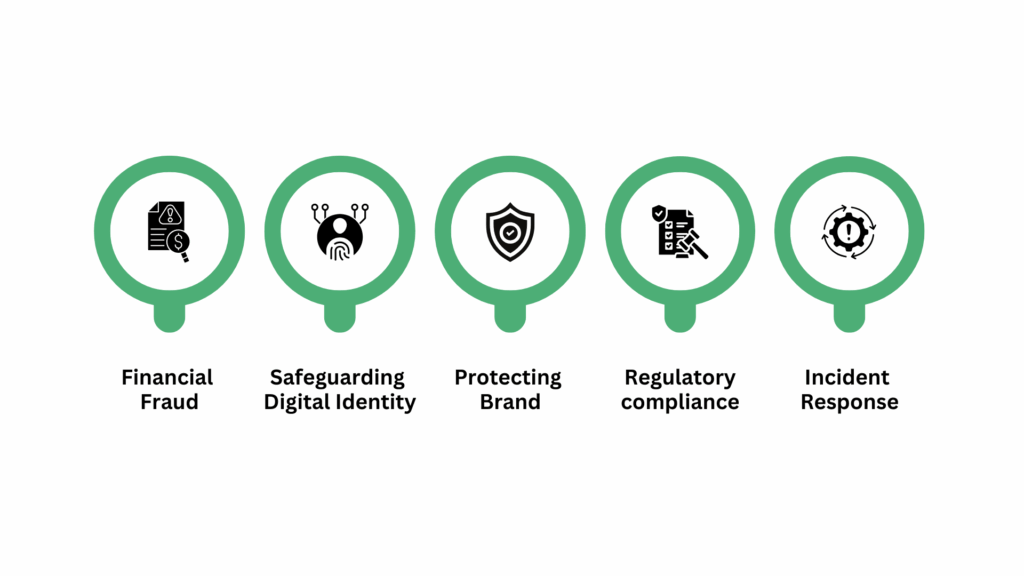
Here are the top five reasons businesses must integrate audio deepfake detection into their security strategy:
- Financial fraud prevention: Attackers use synthetic voices to trick staff into authorizing transfers or revealing confidential data. Deepfake detection tools can analyze spectral inconsistencies and playback artifacts to spot fake commands before money moves.
- Safeguarding digital identity: Many businesses rely on voice biometrics for authentication. Without detection, synthetic audio can bypass security checks. Advanced anti-spoofing systems are now essential to defend customer and employee accounts.
- Protecting brand reputation: A falsified recording of a CEO or executive can go viral in minutes, damaging trust and share prices. Detection systems allow businesses to verify authenticity and respond quickly before misinformation spreads.
- Regulatory compliance and risk management: Industries bound by laws like HIPAA, PCI DSS, or GDPR face penalties if synthetic identity fraud slips through. Deepfake detection demonstrates proactive risk management and strengthens compliance reporting.
- Improving incident response: Audio monitoring integrated into SOC workflows helps security teams flag and isolate threats in real time. Faster detection means breaches are contained before they escalate into full-scale crises.
Businesses can’t treat audio deepfakes as hypothetical risks. They’re an active, evolving threat that targets money, data, and trust. By embedding detection technologies into their broader security strategy, companies not only safeguard assets but also future-proof themselves against an adversary that’s only getting smarter.
Also Read: 4 Ways to Detect and Verify AI-generated Deepfake Audio
The Hidden Hurdles of Deepfake Audio Detection
Detecting deepfake audio is far more complex than spotting manipulated images or videos. Modern generative models can replicate subtle acoustic cues like pitch, prosody, breathing, and emotional tone with near-human accuracy.
What makes the problem even harder is that these fakes often bypass the human ear entirely. Only advanced signal analysis and machine learning models can detect the anomalies.
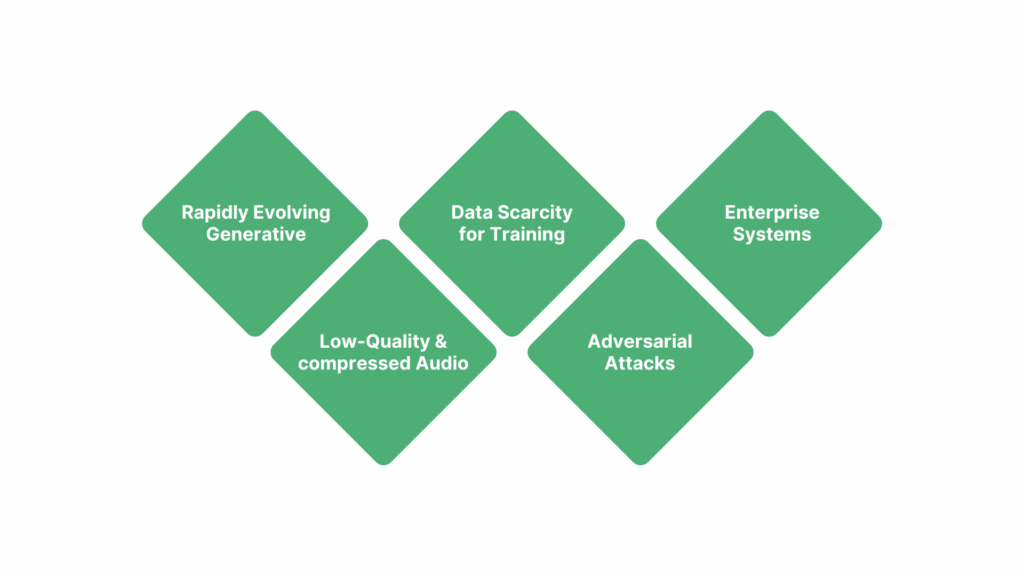
But even the best systems face technical and operational challenges that businesses need to be aware of:
- Rapidly evolving generative models: Deepfake creation tools are improving faster than detection models, using GANs, diffusion models, and transformer-based synthesis. Each new iteration reduces the detectable “fingerprints” in audio, leaving detection systems in a constant race to catch up.
- Low-quality and compressed audio: In practice, most audio is transmitted via VoIP, call centers, or messaging apps, all of which use compression codecs. This strips out high-frequency details that detection algorithms rely on, significantly lowering accuracy in real-world conditions.
- Data scarcity for training: Detection models need massive, diverse datasets of both authentic and synthetic voices across languages, accents, and environments. These datasets are difficult to collect, and synthetic audio evolves so quickly that training data becomes outdated fast.
- Adversarial attacks: Attackers can now embed imperceptible perturbations or noise patterns into synthetic voices that exploit weaknesses in detection algorithms. These adversarial techniques make an audio clip sound real to both humans and machines, bypassing current safeguards.
- Integration with enterprise systems: Beyond technical accuracy, deploying detection into workflows is a challenge. Enterprise SOCs, fraud detection, and call center software all have unique architectures. Achieving seamless integration without latency or high resource consumption requires custom engineering.
Audio deepfake detection has come a long way, but it’s still a cat-and-mouse game with attackers. Businesses must recognize that detection works best as one layer in a multi-factor defense strategy, supported by biometrics, authentication controls, and employee awareness.
Also Read: Creating Deepfake Voice Cloning with Python - No Code Needed
Top 10 Deepfake Audio Detection Tools for Businesses in 2025
Deepfake audio has advanced to a stage where voices generated by GANs and neural speech synthesis models (like WaveNet or Tacotron 2) are nearly indistinguishable from human speech, replicating tone, pitch, and even emotion with alarming precision.
This sophistication makes traditional defenses such as caller ID or simple authentication ineffective, leaving businesses and individuals exposed to CEO fraud, financial scams, and identity theft. To counter this, modern detection tools use acoustic signal analysis, biometric voiceprints, and deep learning classifiers to uncover subtle anomalies in frequency, cadence, and waveform structure.
In 2025, these tools are becoming essential safeguards against synthetic voice threats:
1. Resemble AI
Resemble AI is a cutting-edge voice platform that blends advanced synthesis capabilities with robust deepfake detection safeguards. Unlike traditional text-to-speech systems, it emphasizes both the realism of synthetic voices and the authenticity of content, using built-in watermarking and verification models to curb misuse.
This makes it highly relevant for enterprises, media outlets, and developers working with sensitive communications.
Key Features:
- Neural Voice Cloning with Watermarking: Generates natural-sounding synthetic voices while embedding imperceptible watermarks (PerTH) for authenticity verification and fraud prevention.
- Synthetic Voice Detection (DETECT-2B): A detection model based on Mamba-SSM that identifies AI-generated audio with 94–98% accuracy across 30+ languages, even in noisy or compressed conditions.
- Chatterbox (Open Source): A zero-shot, production-grade cloning model under MIT license that supports emotional modulation and real-time generation—useful for developers experimenting with secure synthesis.
- Multilingual Capabilities: Supports voice detection and localization across 120+ languages, enabling truly global coverage.
- Voice Design: Builds unique AI voices from text descriptions, with safeguards that prevent unauthorized replication.
- Speech-to-Speech Conversion: Transforms one voice into another while retaining emotional nuance, with verification layers to prevent abuse.
- Audio Intelligence: Provides speaker recognition, identity verification, and conversation analysis from short audio samples.
Why it matters for security strategies: Resemble AI stands out as more than a synthesis tool. It is a security-first platform. By combining watermarking, detection, and identity verification, it provides organizations with layered defense against voice spoofing, impersonation fraud, and manipulated audio. Its multilingual detection capabilities make it particularly critical for global businesses, while its real-time verification ensures that deepfake threats can be countered before damage occurs.
For any company that handles sensitive communications or operates in high-risk industries, Resemble AI offers both innovation and protection in one package.
2. Sensity AI
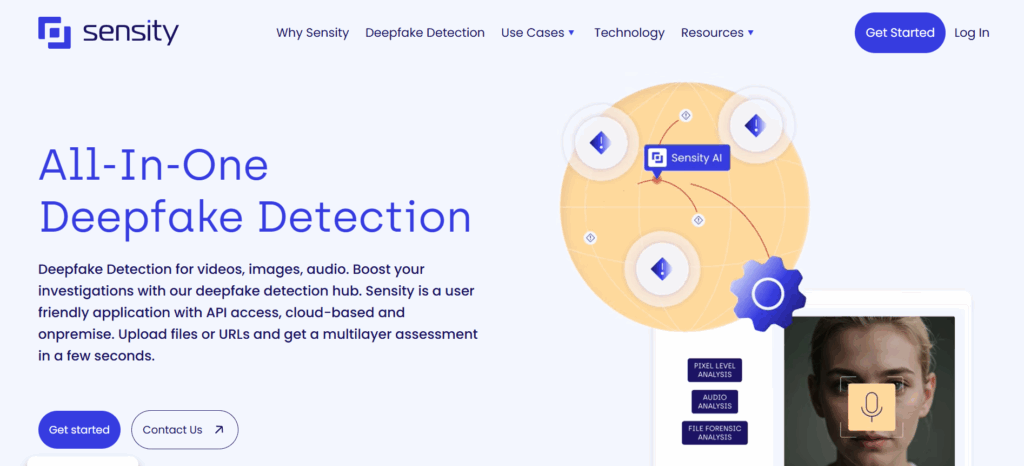
Sensity AI is a multimodal deepfake detection platform that specializes in monitoring and analyzing manipulated media across audio, video, and images. Built with advanced neural network ensembles and forensic analysis, it enables organizations to detect subtle anomalies such as lip-sync mismatches, unnatural prosody in speech, and pixel-level inconsistencies in video streams.
Its technology is widely used by enterprises, government agencies, and law enforcement to prevent fraud, misinformation, and digital impersonation at scale.
Key Features:
- Multimodal detection: Integrates audio, video, and image analysis to detect cross-modal inconsistencies, such as when synthetic audio doesn’t align with lip movements.
- Real-time monitoring: Provides continuous scanning of live streams, calls, and uploaded media for deepfake signatures, enabling instant alerts before threats escalate.
- Forensic-grade reporting: Generates detailed reports with probability scores, metadata analysis, and timestamps, ensuring evidence is admissible in compliance and legal contexts.
Differentiating Factor: Unlike single-modality solutions, Sensity AI’s strength lies in its holistic, multimodal approach, which makes it particularly effective in scenarios where attackers combine fake voices with synthetic visuals. This cross-verification ensures higher detection accuracy and makes it indispensable for organizations facing complex threat landscapes.
3. Reality Defender

Reality Defender is an enterprise-grade platform for detecting manipulated media, covering audio, video, image, and even text-based deepfakes. Built for large-scale business environments, it integrates directly into content management systems (CMS) and communication platforms, allowing organizations to proactively verify content before it reaches customers or the public.
Its architecture supports both batch analysis of massive datasets and real-time detection pipelines, making it suitable for industries like banking, media, and government where information integrity is critical.
Key Features:
- Cross-modal detection: Analyzes audio, video, and images in parallel to spot subtle synthetic artifacts across multiple formats.
- CMS & enterprise integration: Seamlessly plugs into publishing workflows, enabling automatic verification of media before distribution.
- Scalable dashboards: Provides real-time analytics, alerts, and visualization tools for security teams managing high volumes of data.
Differentiating Factor: Reality Defender sets itself apart with its proactive verification at scale, instead of just flagging suspicious content post-exposure, it empowers enterprises to embed authenticity checks directly into their operational workflows, significantly reducing the risk of reputational damage and fraud.
4. OpenAI Deepfake Detector
The OpenAI Deepfake Detector is an AI-powered system developed by OpenAI to identify synthetic images created by generative models. It uses tamper-resistant metadata embedded during image generation and advanced computer vision techniques to classify content as AI-generated or human-made.
This enables researchers, social media platforms, and content moderators to verify the authenticity of visual media at scale, reducing the spread of manipulated or deceptive content.
Key Features:
- High-accuracy classification: Achieves up to 98.8% accuracy in detecting images generated by DALL·E 3.
- Binary authenticity scoring: Provides clear AI-generated vs. real classifications for rapid moderation decisions.
- Metadata-based provenance: Uses embedded “nutrition label” metadata to verify media origin and prevent tampering.
Differentiating Factor: Unlike traditional detectors that rely solely on visual pattern analysis, the OpenAI Deepfake Detector integrates embedded provenance data for verifiable content tracing. This dual-layer approach, metadata plus visual analysis, offers stronger resistance to adversarial attacks and makes it particularly effective for platforms seeking reliable, scalable deepfake detection and content authenticity assurance.
5. Pindrop

Pindrop is a voice authentication and deepfake detection platform primarily used in financial services and high-security environments. It analyzes incoming calls in real time to identify synthetic voices, spoofed caller IDs, and other audio-based fraud attempts.
Using acoustic fingerprinting, behavioral voice biometrics, and deep learning models, Pindrop has enabled institutions to scale detection from rare incidents to daily monitoring, effectively preventing fraudulent transactions before they occur.
Key Features:
- Voice authentication: Confirms caller identity using unique vocal characteristics and behavioral patterns.
- Real-time fraud detection: Flags suspicious calls or synthetic voices instantly during customer interactions.
- Scalable analytics: Processes high volumes of calls without degradation in accuracy, supporting enterprise-level deployment.
Differentiating Factor: Pindrop excels in real-time, behavior-based verification. By combining biometric voiceprints with anomaly detection, it identifies deepfake or spoofed calls before any transaction occurs, giving financial institutions proactive defense against evolving audio fraud.
6. Hive AI Deepfake Detection

The Hive AI Deepfake Detection system, developed by Hive AI, is a robust platform built to identify deepfake images and videos using large-scale computer vision and deep learning models. Trained on billions of labeled media samples, it can detect synthetic manipulations in facial features, lip-sync, lighting, and motion patterns with high accuracy.
This makes it ideal for social media platforms, newsrooms, and enterprises that need real-time content moderation to combat misinformation and fraud.
Key Features:
- Comprehensive media analysis: Detects tampering in both video and still images using frame-by-frame forensic evaluation.
- High detection accuracy: Achieves industry-leading precision by leveraging Hive’s massive training dataset of authentic and synthetic media.
- Real-time API access: Offers low-latency API integration for automated moderation and live content screening.
Differentiating Factor: What sets Hive AI Deepfake Detection apart is its training foundation, massive, continuously updated datasets of real and fake content from across the internet.
This allows the system to detect even the latest generation of deepfakes that often evade conventional detectors. Its combination of real-time performance, API-driven deployment, and proven scalability makes it a go-to solution for organizations needing continuous and proactive defense against synthetic media threats.
7. Truepic

Truepic is a leading authenticity platform that verifies the integrity of photos and videos using cryptographic provenance technology and advanced forensic analysis. It ensures that visual content has not been manipulated by capturing and sealing images or videos with secure metadata such as geolocation, timestamps, device details, and tamper-evident hashes at the moment of capture.
Key Features:
- Cryptographic content signing: Embeds tamper-proof metadata and digital signatures at the point of capture to guarantee authenticity.
- Forensic integrity checks: Analyzes visual media for traces of editing, compression artifacts, or manipulation attempts.
- C2PA compliance: Supports Coalition for Content Provenance and Authenticity (C2PA) standards, enabling traceable media provenance.
Differentiating Factor: Truepic stands out for its proactive approach, ensuring content authenticity at the moment of capture rather than attempting to detect tampering after the fact. This “content provenance first” model significantly reduces the risk of deepfake infiltration, giving organizations cryptographically verifiable proof that their media is original and unaltered.
8. Intel FakeCatcher
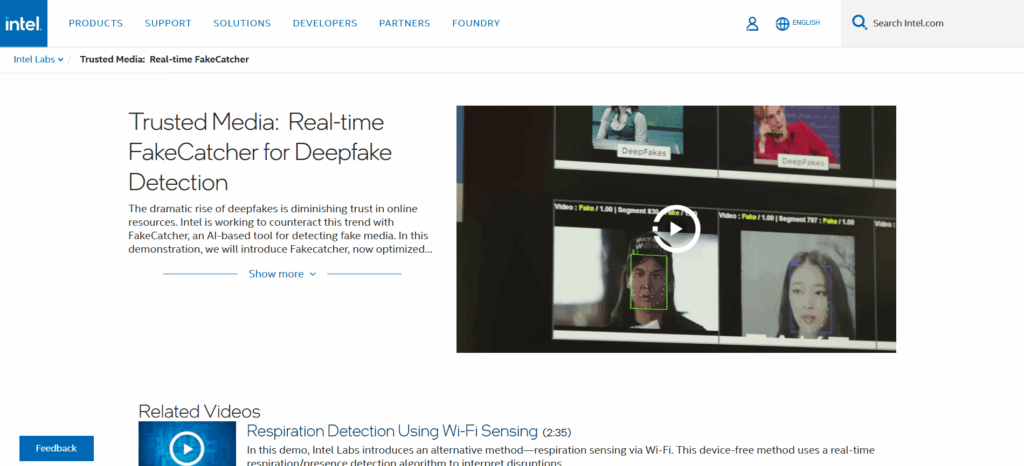
Intel’s FakeCatcher is a cutting-edge real-time deepfake detection platform that leverages biological signal analysis to identify synthetic content in video and audio streams. Rather than relying solely on pixel-level anomalies or AI-generated artifacts, it examines subtle changes in blood flow and micro-expressions within the video, which are extremely difficult for deepfake algorithms to replicate accurately.
With a high detection accuracy, FakeCatcher delivers fast and reliable verification, making it suitable for enterprise, media, and security applications where authenticity is critical.
Key Features:
- Real-time analysis: Uses advanced algorithms to scan incoming media streams instantly, enabling immediate flagging of deepfake content.
- Biological signal detection: Tracks micro-changes in blood flow, facial capillary patterns, and involuntary physiological signals.
- High accuracy rate: Maintains a 96% success rate even in high-resolution video, compressed streams, or noisy environments.
Differentiating Factor: Unlike traditional deepfake detection tools that focus on spectral anomalies or inconsistencies in pixels, FakeCatcher leverages human physiological markers as a verification layer.
By analyzing natural blood flow and micro-expressions, it provides an extra layer of security that is extremely difficult to spoof, reducing false positives and making it particularly effective for real-world applications where both video and associated audio may be manipulated.
9. McAfee Deepfake Detector

McAfee’s Deepfake Detector is a desktop-based solution designed to identify AI-generated audio with high precision. Unlike cloud-dependent detection systems, it operates locally on the user’s device, ensuring that sensitive media never leaves the system, which is crucial for privacy-conscious individuals and organizations.
Using machine learning algorithms trained on vast audio datasets, the tool analyzes spectral, temporal, and voice biometrics to detect synthetic manipulations across diverse formats, including compressed files and live audio streams.
Key Features:
- Local operation: Processes audio entirely on-device, minimizing data exposure and enhancing privacy compliance.
- Audio-focused detection: Uses advanced ML models to analyze pitch, tone, prosody, and spectral artifacts for accurate identification of synthetic voices.
- User-friendly interface: Offers an intuitive dashboard for monitoring, scanning, and verifying audio content without technical expertise.
Differentiating Factor: McAfee stands out with its on-device, privacy-first approach. By combining advanced audio forensics with local processing, it allows organizations and individuals to detect deepfake audio without sending sensitive data to external servers, reducing risk while maintaining real-time responsiveness and accuracy.
10. Deepware Scanner

Deepware Scanner is a deepfake detection tool that analyzes video content for synthetic manipulation using advanced computer vision and forensic algorithms. It flags anomalies like unnatural facial expressions, inconsistent eye blinks, irregular head movements, and lighting mismatches.
Designed for rapid video scanning, it serves journalists, legal teams, media platforms, and cybersecurity professionals by providing tamper-likelihood scores and anomaly heatmaps to quickly verify content authenticity.
Key Features:
- Visual forensic analysis: Detects pixel-level inconsistencies in facial movement, lighting, and textures that often signal synthetic manipulation.
- Anomaly heatmaps: Highlights regions of a video most likely to be tampered with, enabling targeted manual verification.
- Cross-format support: Works with common video formats (MP4, MOV, AVI) and varying resolutions without preprocessing requirements.
Differentiating Factor: Deepware Scanner stands out for its ease of use and targeted focus on visual deepfake detection. Unlike generalized media forensics tools, it specializes in facial and motion-based anomaly detection, making it highly effective for organizations that need fast, visual-first verification of potentially manipulated video content without extensive technical setup.
Also Read: AI Audio Editing Online for Professional Sound
How to Choose the Right Deepfake Audio Detection Tools for Your Requirements?
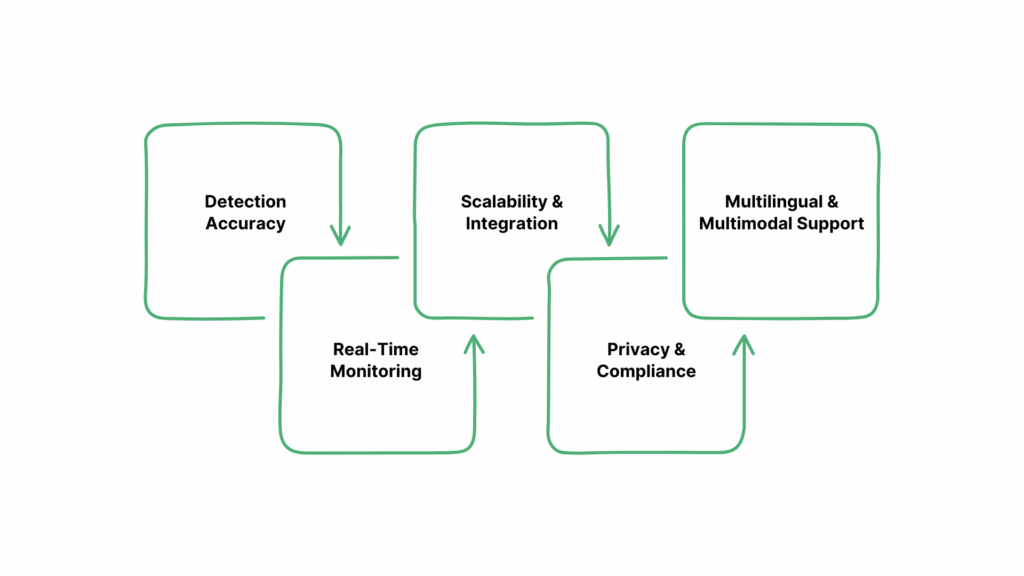
Selecting the right deepfake audio detection tool requires balancing technical capability, scalability, and integration flexibility with your business needs. Companies must consider several critical factors to ensure they invest in a solution that effectively protects digital assets and customer interactions.
Key Considerations:
- Detection accuracy: Look for solutions with high precision and low false positives across diverse audio formats and compression levels.
- Real-time monitoring: For enterprises handling high volumes of calls or media, the ability to detect deepfakes instantly is essential.
- Scalability and integration: Ensure the tool can handle growing workloads and integrate with existing communication, CRM, or content management systems.
- Privacy and compliance: On-device or secure cloud processing helps protect sensitive audio data while meeting regulatory requirements.
- Multilingual and multimodal support: Tools that handle multiple languages and can detect both audio and video deepfakes offer broader coverage and future-proofing.
Choosing a solution that balances these factors can be complex, but enterprises that prioritize accuracy, real-time capabilities, and robust integration are positioned for stronger security and operational resilience.
Why Resemble AI fits the bill:Resemble AI excels across these dimensions. Its highly accurate DETECT-2B model, real-time synthesis and detection, multilingual capabilities, and seamless integration into enterprise workflows make it a standout choice.
Businesses seeking to enhance their security strategy can rely on Resemble not only to identify potential audio deepfakes but also to embed authenticity verification directly into their communications, ensuring comprehensive protection and peace of mind.
Also Read: AI-Powered Audio Detection and Analysis
Wrapping Up
Detecting deepfake audio is a critical component of any modern security strategy. Tools like Resemble AI don’t just identify synthetic voices, they embed verification, ensure authenticity, and integrate seamlessly with enterprise workflows, from call centers to media platforms. For businesses, the real advantage lies in treating AI-powered detection as a strategic asset, enhancing trust, protecting brand reputation, and reducing the risk of fraud.
Organizations that implement Resemble AI today gain a proactive defense against audio-based attacks, improve operational resilience, and secure communications across all touchpoints.
Schedule a demo with Resemble AI and start building a stronger security strategy.
FAQs
1. Can deepfake audio detection tools work with encrypted or compressed audio files?
Yes. Advanced detection platforms, like Resemble AI, use robust algorithms that analyze spectral and acoustic patterns even in compressed or encrypted audio, maintaining high accuracy without needing original uncompressed files.
2. How often should enterprises update their deepfake detection models?
To stay ahead of evolving AI threats, models should be retrained regularly with new datasets, including recent deepfake examples, emerging voice synthesis methods, and diverse language samples. Continuous learning ensures detection remains effective.
3. Can detection tools differentiate between synthetic voices and heavily modified human recordings?
Yes. Sophisticated solutions leverage neural network models and voice biometrics to distinguish between genuine human speech altered by filters/effects and fully synthetic deepfake voices, reducing false positives.
4. How do these tools integrate with existing security infrastructure?
Most enterprise-grade platforms offer API or SDK-based integration, allowing deepfake detection to plug directly into call centers, media verification systems, content management platforms, or fraud prevention workflows for seamless monitoring.
5. Are deepfake audio detection tools capable of multilingual support?
Yes. Leading solutions support multiple languages and dialects, analyzing prosody, phonetics, and speech patterns across languages to detect synthetic content accurately, making them suitable for global organizations.