



The Deepfake Watchlist is Resemble AI's weekly surveillance of synthetic media incidents, ongoing cases, and disputed content shaping the news cycle. Each week we track confirmed incidents, emerging attack vectors, and claims under investigation, alongside the provenance, detection, and policy threads running underneath them. New to the world of deepfakes? Read the Deepfake 101 Guide to learn more about how to protect yourself and your company from threats.
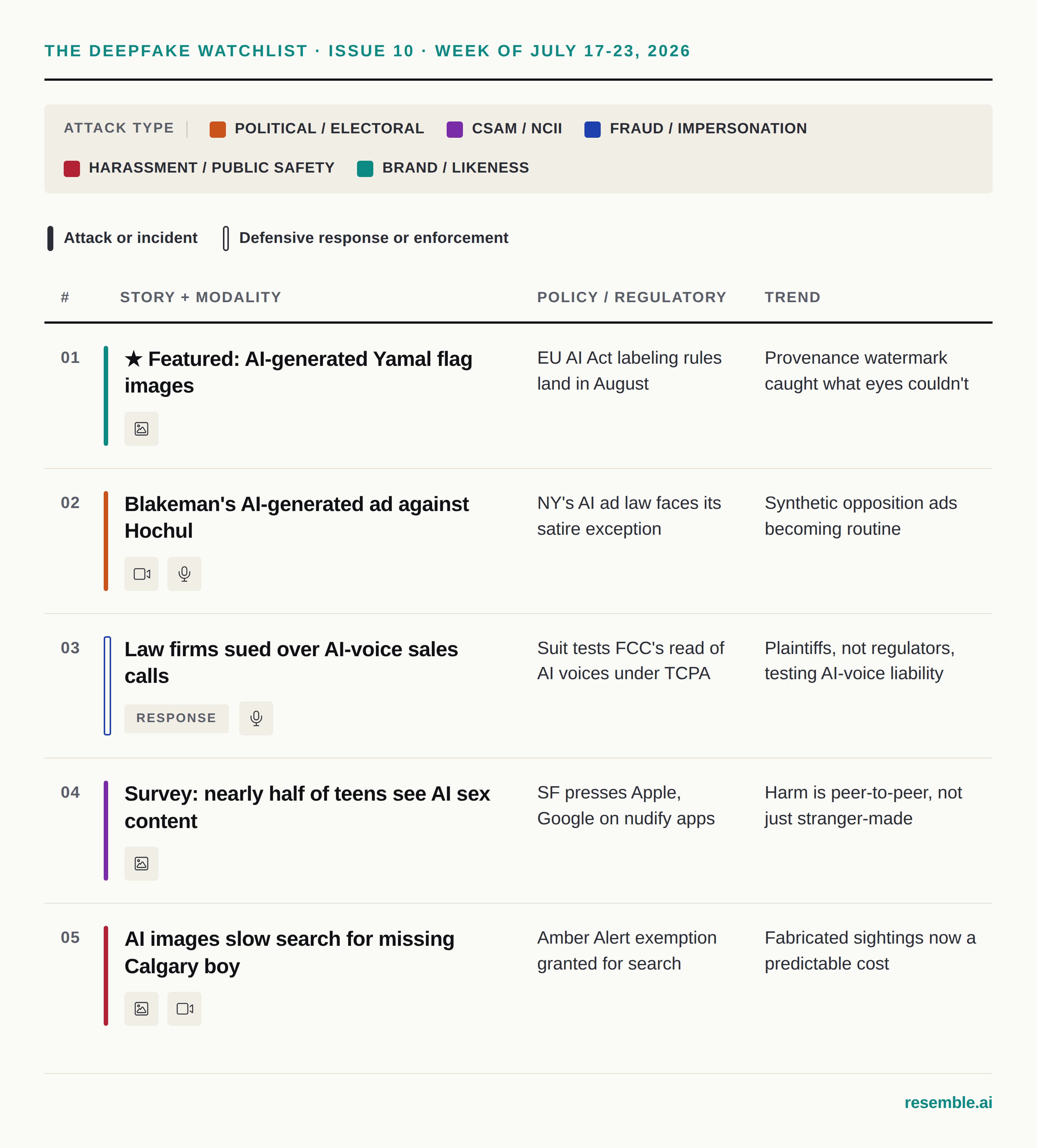
★ Featured: The AI-generated Lamine Yamal flag images that spread after the World Cup final
AFP's fact-check, Image of Yamal with Palestinian flag after World Cup is AI-generated, confirmed that a photo showing Spain's Lamine Yamal draped in a Palestinian flag after the July 19 World Cup final was fabricated, one of at least two separate AI-generated Yamal images that AFP and Full Fact caught circulating the same week, one of them viewed more than 1.9 million times on a single post.
- Category: Brand/Likeness
- Type: Attack
- Modality: Image
- Policy / Regulatory: The EU AI Act's disclosure rules for synthetic content take effect across the bloc in August, and neither Yamal image carried a label of any kind before it was debunked.
- Trend: Provenance watermarking embedded at the point of generation is increasingly the thing that catches a fake, not anything visible to the eye.
- Attack vector: A real wire photo from the World Cup final, altered by an AI image generator and recirculated with a politically charged caption during one of the most-watched sporting moments of the year.
- What we saw in the content: The images carry the forensic signatures we'd expect from a wire photo run through a modern image generator, for example:
- A reverse image search surfaced the original, unaltered photo, taken by Getty and carried by outlets including The Denver Post, showing Yamal in a shirt reading "Campeones" with no flag in sight.
- Yamal's pose, his grip on the trophy, and his headband all match the real photo exactly, consistent with an edited still rather than an independently captured moment.
- An invisible provenance watermark check flagged the images as generated with a mainstream AI image tool, a signal no amount of visual scrutiny would have surfaced.
- A second, independent verification pass landed on the same generator family, corroborating the watermark rather than contradicting it.

One of the most-viewed sports moments of the year got a fake attached to it within a day, and it worked because it borrowed almost everything real: the pose, the trophy, the headband, all lifted from a photo taken seconds apart from the moment that got altered. What caught it wasn't a sharp eye. It was a watermark built into the image the moment it was generated, readable by a tool built for exactly that purpose.
That's the case for provenance over detection in one incident. The same week, CBS News tested ordinary viewers on real-versus-fake images and found their odds close to a coin flip. Watermarking doesn't ask anyone to look more carefully. It answers the question before a viewer ever has to.
1. Bruce Blakeman's AI-generated Hochul ad tests New York's deepfake disclosure law
ABC7 New York's report, Nassau County Executive Bruce Blakeman defends use of AI-generated campaign ads; Gov. Hochul calls it lying, reported that Blakeman released a new AI-generated ad depicting a synthetic Governor Kathy Hochul delivering fabricated policy statements, defending it as satire while Hochul's campaign called it straight up lying.
- Category: Political/Electoral
- Type: Attack
- Modality: Video, Audio
- Policy / Regulatory: New York's 2024 AI-disclaimer law carries a satire exception, and campaigns are testing how far it stretches in real time.
- Trend: Synthetic opposition ads are becoming a routine part of the campaign toolkit rather than a one-off stunt.
- Attack vector: A synthetic likeness and cloned voice of a sitting governor delivering fabricated policy statements in a paid campaign ad.
Blakeman's campaign has now run several of these ads, each leaning on the same defense: a small disclaimer at the end of a minute of fabricated statements. Election law attorneys quoted alongside the ad's release have pointed out that a label a voter has to look for isn't the same thing as a label a voter actually sees, and New York won't be the only state working out where a satire exception ends before November.
2. Mass-tort law firms sued over AI-voice sales calls, as AI scam losses top $890 million
Law360's report, Mass Tort Firms Hit With Suit Over AI Solicitation Calls, found that a Texas federal class action accuses three affiliated law firms of using an AI-generated voice to solicit mass-tort clients without consent, in violation of the TCPA and multiple Texas statutes.
- Category: Fraud/Impersonation
- Type: Response
- Modality: Audio
- Policy / Regulatory: The suit tests whether the FCC's position that AI-cloned voices count as "artificial voices" under the TCPA holds against a firm calling residents who never consented.
- Trend: Consumer plaintiffs are filing the earliest cases testing AI-voice liability, ahead of regulators.
- Attack vector: An automated calling platform using an AI-generated voice to solicit clients from people who never gave consent, and who, in the plaintiff's account, kept getting called after saying no.
The complaint reaches for four separate statutes at once, federal TCPA, Texas's mini-TCPA, a telephone-solicitor registration rule, and a bar on lawyers soliciting business by phone, because none of them were written with a synthetic voice in mind. The suit lands the same week the FBI reported nearly $893 million in AI-enabled scam losses nationwide last year, including an $800,000 cloned-voice crypto scam that hit one Georgia couple, prompting the state's consumer protection office to start telling families to set a private code word for emergencies, a cheap defense that also concedes a voice alone can no longer confirm who's calling.
3. New survey: nearly half of teens have seen AI-generated sexual content, most by accident
Futurism's report, The Proliferation of Deepfakes Is Profoundly Changing the Way Teenagers Use the Internet, covered a new Common Sense Media survey finding that nearly half of teens aged 13 to 17 have encountered what they believe is AI-generated sexual content, with about a quarter of those saying it depicted someone they know personally, or themselves, rather than a celebrity.
- Category: CSAM/NCII
- Type: Attack
- Modality: Image
- Policy / Regulatory: San Francisco's city attorney has already moved on the app-store side of this problem, demanding Apple and Google pull nudify apps.
- Trend: The harm the survey describes is peer-to-peer as often as it's stranger-generated, teens making this content of classmates and each other.
- Attack vector: Widely available nudify apps and general-purpose chatbots used by minors to generate sexual imagery of other minors, sometimes of people they know personally.
Roughly 8% of teens said they'd created this kind of content themselves, and more than 60% of that group said it depicted people they know. Only one in five surveyed had ever talked to a trusted adult about any of it, even though a third said they wanted to, which is the part Common Sense Media's lead researcher called out: teens are absorbing the burden of policing this while the tools that made it possible reached them almost overnight.
4. AI-generated images are slowing the search for a missing 11-year-old in Calgary
The Globe and Mail's report, Search for missing Calgary boy hampered by misinformation spreading online, documented that Calgary police say AI-altered images and videos falsely claiming to show 11-year-old Parker, a non-verbal autistic boy missing since July 16, are diverting search resources, including one false report that he had been found dead.
- Category: Harassment/Public Safety
- Type: Attack
- Modality: Image, Video
- Policy / Regulatory: Alberta granted an Amber Alert exemption for Parker's case, since disappearances don't typically meet the legal criteria on their own.
- Trend: Fabricated sighting and status reports are becoming a predictable feature of any high-attention missing-person case, not a rare complication.
- Attack vector: AI-altered images and videos falsely claiming to show a missing child's location or condition, spreading faster than police can issue corrections.
Officers are spending investigative time running down tips generated by fabricated content instead of the credible leads that might actually bring Parker home, and police say they're continuing the search as though he's alive despite the false death report. A family is waiting for their son, search teams have covered thousands of kilometres, and the content diverting them was made by someone who was never anywhere near Calgary. Police have asked the public to stop generating and sharing altered material and to rely only on official channels.
Honorable mentions
WEAR TV, Niceville Police debunk 'immigration checkpoint' image made with AI, July 22. A fabricated photo of a Florida immigration checkpoint spread fast enough that other agencies started calling Niceville's police chief to ask if it was real. It's a smaller-scale version of the Calgary problem above, a fake image outrunning any single department's ability to correct it.
Deseret News, AI-generated experts sell supplements on social media, July 22. NYU psychologist Dr. Rachel Goldman is still fighting deepfake ads that put fabricated health claims in her mouth to sell a weight-loss product, months after the videos first surfaced, and says her own relatives have messaged her having fallen for it.
The pattern
- Provenance watermarking did its job this week. The Yamal images weren't caught by a sharp eye, they were caught by a signal built into the file at the moment it was made, and that's still the exception rather than something platforms check by default.
- When that layer isn't there, the burden shifts straight to people, and people aren't equipped for it. CBS News's own test put human accuracy at spotting AI images close to a coin flip, families are being told to set code words, and teenagers are being left to manage a problem adults barely understand.
- The EU's AI Act disclosure requirements take effect across the bloc in August, the next real test of whether labeling gets built in at the point of generation, the way the Yamal watermark was, rather than argued about after the fact in a satire exception or a lawsuit.
Watching next week
- EU AI Act Article 50 enforcement. Disclosure obligations for AI-generated content take effect across the EU in August, the clearest test yet of whether labeling gets built in at the source.
- The search for Parker in Calgary. We'll be watching for updates on the search itself and any guidance police issue on how the public can help without adding to the misinformation problem.
- New York's AI disclaimer law and its satire exception. Whether Blakeman's latest ad, or the next one, prompts an actual enforcement test.
- Common Sense Media's fuller report. More findings from the teen survey are expected in the coming weeks, and we'll track how schools and platforms respond.
The Deepfake Watchlist publishes every Friday. Subscribe to receive it in your inbox, or follow Zohaib Ahmed on LinkedIn for the weekly social companion. Track every documented incident in the Resemble Deepfake Incident Database, and read the full methodology in our 2025 Deepfake Threat Report.