



The Deepfake Watchlist is Resemble AI's weekly surveillance of synthetic media incidents, ongoing cases, and disputed content shaping the news cycle. Each week we track confirmed incidents, emerging attack vectors, and claims under investigation, alongside the provenance, detection, and policy threads running underneath them. New to the world of deepfakes? Read the Deepfake 101 GuideThe Deepfake Watchlist: Special Edition — Deepfakes and the 2026 Midterms
★ Featured: Russia, Iran, and China are using AI to industrialize election disinformation — and it's working
Bloomberg reported on October 14 that all three state actors are using generative AI to amplify disinformation ahead of November 3. On October 8, OpenAI banned Russian and Iranian accounts it caught using ChatGPT for coordinated influence operations, the same day Bloomberg published its investigation into the scale of what those operations are actually doing.
- Category: Political / Electoral
- Type: Attack
- Modality: Video, Text, Audio
- Policy / Regulatory: OpenAI banned the accounts on October 8; no US enforcement action has been taken against the foreign networks described; Congress has not passed a federal standard for AI use in foreign election influence operations.
- Trend: State-sponsored influence operations industrializing disinformation production using mainstream AI tools, at a quality and scale that makes their output indistinguishable from legitimate domestic political commentary.
- Attack vector: AI-generated fake journalists, fabricated broadcast-style video clips, and synthetic social media personas producing content designed to look like domestic reporting, placed in legitimate outlets and amplified once it lands.
- What we saw in the content: The operations described in the Bloomberg reporting follow distinct but related architectures across all three actors:
- Russia's Matryoshka network, also tracked as Storm-1679, has spread AI-manipulated videos since early September including deepfakes of American celebrities criticizing Democratic candidates and fabricated clips styled as CNN newscasts, complete with AI voice-cloned anchors
- Iran's networks deployed AI-generated personas posing as American activists, producing anti-Republican commentary that was placed in publications including Daily Kos, which ran some of the posts before reviewing them for authenticity
- In at least one documented case, a fabricated narrative seeded in a legitimate outlet prompted a public response from a sitting MEP meaning the operation achieved its goal not by reaching a mass audience directly but by getting one credible outlet to publish the content and letting the media ecosystem do the rest
- OpenAI's October 8 account noted that the banned networks were using ChatGPT for tasks including drafting social content, translating between languages to reach different domestic audiences, and generating "authentic-sounding" biographies for synthetic personas
The traditional threat model for state influence operations assumed scale: flood the zone with enough synthetic content that some of it sticks with ordinary voters. What Bloomberg is documenting is something more targeted and, in some ways, harder to counter. If you can get a credible outlet to treat your fabrication as a real news event, even briefly, the downstream amplification happens through normal political media dynamics, not through bot networks. The AI-generated content is the means; placing it in a trusted outlet is the mechanism; and the target is never the outlet's general readership. It's whoever inside a political system is watching for news that confirms what they already believe.
That's a harder problem than content moderation at the platform layer. And three weeks out, the operations described here are not ramping down.
1. Steve Hilton's AI-generated Becerra ad puts fabricated words in Spanish before Latino voters
Republican California gubernatorial candidate Steve Hilton released an AI-generated Spanish-language campaign ad depicting his Democratic opponent Xavier Becerra claiming he "fought for boys to play in girls' sports" — a statement Becerra has never made according to LGBTQ Nation's "AI slop": GOP ad uses fake footage of opponent saying he supports men beating girls in sports.
- Category: Political / Electoral
- Type: Attack
- Modality: Video, Audio
- Policy / Regulatory: California requires disclosure of AI-generated content in campaign ads; the Hilton campaign included a label, but it appears in small print for approximately three seconds. No California law prohibits putting fabricated statements in an opponent's mouth.
- Trend: AI-generated political ads moving from satirical caricature toward demographic-targeted disinformation, with Spanish-language versions produced to reach voters who are less likely to encounter English-language fact-checks of the same content.
- Attack vector: AI-generated likeness and voice of the opposing candidate delivering a fabricated policy position, disclosed in near-illegible fine print, distributed as a paid political ad in Spanish.
Hilton is down more than 15 points in every published poll. The audience for this ad isn't the general electorate, it's specifically Spanish-speaking Latino voters who may not have encountered the English-language conversation about what California's trans student sports laws actually say. Becerra's real position that he opposes anti-trans discrimination is not the same as endorsing boys playing in girls' sports, and the ad collapses that distinction deliberately, then attributes the collapsed version to the man who opposed it.
This is also the second time Hilton's campaign has run AI-generated content of Becerra this cycle; in July, it released an ensemble deepfake of Harris, Newsom, and Becerra together. The escalation from satirical ensemble to targeted, single-opponent, Spanish-language disinformation follows a pattern visible across the other stories this week: early-cycle AI parody ads gave campaigns cover to test what lands, and now those campaigns are running what worked at the voters least likely to see a correction before Election Day.
2. AI agents are texting voters directly as candidates with no disclosure required
Political campaigns are deploying AI agents to run live, two-way text conversations with voters in the candidate's voice and federal law doesn't require them to say it's not a human, according to a Center for Democracy and Technology analysis of regulatory gaps in AI-powered voter outreach.
- Category: Political / Electoral
- Type: Attack vector / Infrastructure
- Modality: Text (conversational AI)
- Policy / Regulatory: TCPA (1991) was written for prerecorded calls and mass robotexts, it doesn't clearly govern live, adaptive AI conversations. The FCC ruled in 2024 that AI-generated voices count as "artificial" for robocalls requiring prior consent, but has not clarified whether AI-generated texts fall under the same rule. No federal law requires campaigns to disclose that a voter is talking to an AI agent.
- Trend: Agentic AI systems moving from content generation into direct voter contact, with campaigns using them to hold thousands of simultaneous personalized conversations at near-zero marginal cost.
- Attack vector: AI agents trained on candidate profiles and messaging, deployed to initiate and sustain personalized conversations with voters at scale, with each exchange feeding into individual voter files held by the vendor.
aKillion's IONCandidate product runs live, two-way texts in the candidate's persona, built from their voting record, platform, and approved talking points and says it can "manage thousands of simultaneous conversations," each exchange logged and added to individual voter profiles. Convos trains an AI agent on candidate bios and policy positions, then uses it to text voters directly; the product encourages but does not require disclosure that the sender isn't human. Vector Political runs similarly personalized adaptive conversations. North Dakota now requires disclosure when AI-generated political texts are sent. California's BOT Act covers public-facing chatbots, but whether it reaches SMS is a live legal question. The FCC could rule on a pending Club for Growth petition to exempt political AI-voice calls from prior consent as soon as late October, potentially before November 3.
These systems aren't creating fabricated media of real people but they're creating a synthetic version of the candidate themselves: a persona that sounds like the candidate, responds from the candidate's platform, and holds conversations that a voter plausibly experiences as a direct text from someone they're voting on. The boundary between that and impersonation at least from a voter's point of view is thinner than the technology vendors would like you to think.
3. AI deepfake ads are a standard midterm campaign tool and most voters can't spot them
Campaigns across both parties used AI-generated video, audio, and image ads throughout the 2026 cycle, with both attack ads and promotional content produced at a scale and speed that blurs the line between synthetic and authentic political content, according to Al Jazeera's investigation into midterm AI ad use and TrueScreen's analysis of disclosed AI campaign content.
- Category: Political / Electoral
- Type: Attack / Promotional
- Modality: Video, Audio, Image
- Policy / Regulatory: Twenty-five states require some form of disclosure on AI-generated political ads; no federal standard exists for disclosure, authenticity, or prohibition. The FEC has a pending rulemaking on AI in campaign finance disclosures.
- Trend: AI ad production moving from a novel tactic to standard campaign infrastructure, with both parties using it for attack and promotional content at every level of the ballot.
- Attack vector: AI-generated campaign content distributed as paid political advertising across broadcast, cable, and social platforms; the disclosure requirement (where it exists) applies at the state level and varies in specificity.
TrueScreen's analysis found that the share of AI-generated political ads that include any form of authentic disclosure has actually declined since 2024, even as the number of states with disclosure laws has grown. The gap between legal requirement and compliance is widening. Al Jazeera's reporting finds campaigns have rationalized the use of AI-generated attack content because the production speed advantage is too significant to give up unilaterally, even in states where the law requires disclosure. The candidate who discloses, the logic goes, gives their opponent a story. The candidate who doesn't comply with a law that rarely triggers enforcement doesn't.
4. Dan Patrick's AI attack ad on his November opponent backfires into Texas's first deepfake criminal complaint
Three weeks before Texas voters choose between incumbent Lt. Gov. Dan Patrick and Democratic challenger Vikki Goodwin, Patrick's campaign ran AI-generated videos falsely showing Goodwin at a football game in a shirt reading "taxes" instead of "Texas." Goodwin filed a police report, the first criminal complaint under Texas's election deepfake law according to Fox4 News and Axios's investigation into the broader wave of complaints filed across races this month.
- Category: Political / Electoral
- Type: Attack
- Modality: Video
- Policy / Regulatory: Texas Election Code § 255.004 bars AI-generated ads within 30 days of an election if intended to influence the outcome; Patrick's campaign removed the ads after the complaint and called them "obvious parody." Thirty-one states now regulate election deepfakes; no federal standard exists.
- Trend: Election deepfake laws functioning as a post-hoc removal mechanism rather than a deterrent, with campaigns running AI attack ads and removing them only after the content has already reached its intended audience.
- Attack vector: AI-generated video depicting the opposing candidate in a false context, distributed on social media, removed only after a formal complaint was filed.
The "parody" defense is doing a lot of work across this week's stories. The distinction between parody and targeted disinformation isn't a technical one as both can be produced with the same AI workflow. The difference is whether the content is recognizably satirical to the audience it's designed to reach, and an ad showing an opponent wearing a word that directly inverts her actual political position doesn't read as parody to someone encountering it without prior skepticism. The Axios investigation finds the same dynamic in Wisconsin and North Carolina simultaneously: the cease-and-desist letter arrives, the ad comes down, and the voters who saw it already saw it.
Honorable mentions
Colorado Sen. Cathy Kipp files first complaint under state's deepfake disclosure law. Colorado Politics reports that Kipp filed a complaint after the Independence Institute published an AI-generated video showing her pocketing change at a grocery register as a metaphor for her support of Proposition NN. The video included a near-end acknowledgment of AI use but lacked the required formal disclaimer. Colorado's Secretary of State Elections Division is investigating; the Independence Institute argues the video qualifies as satire under the law's First Amendment exemption.
The pattern
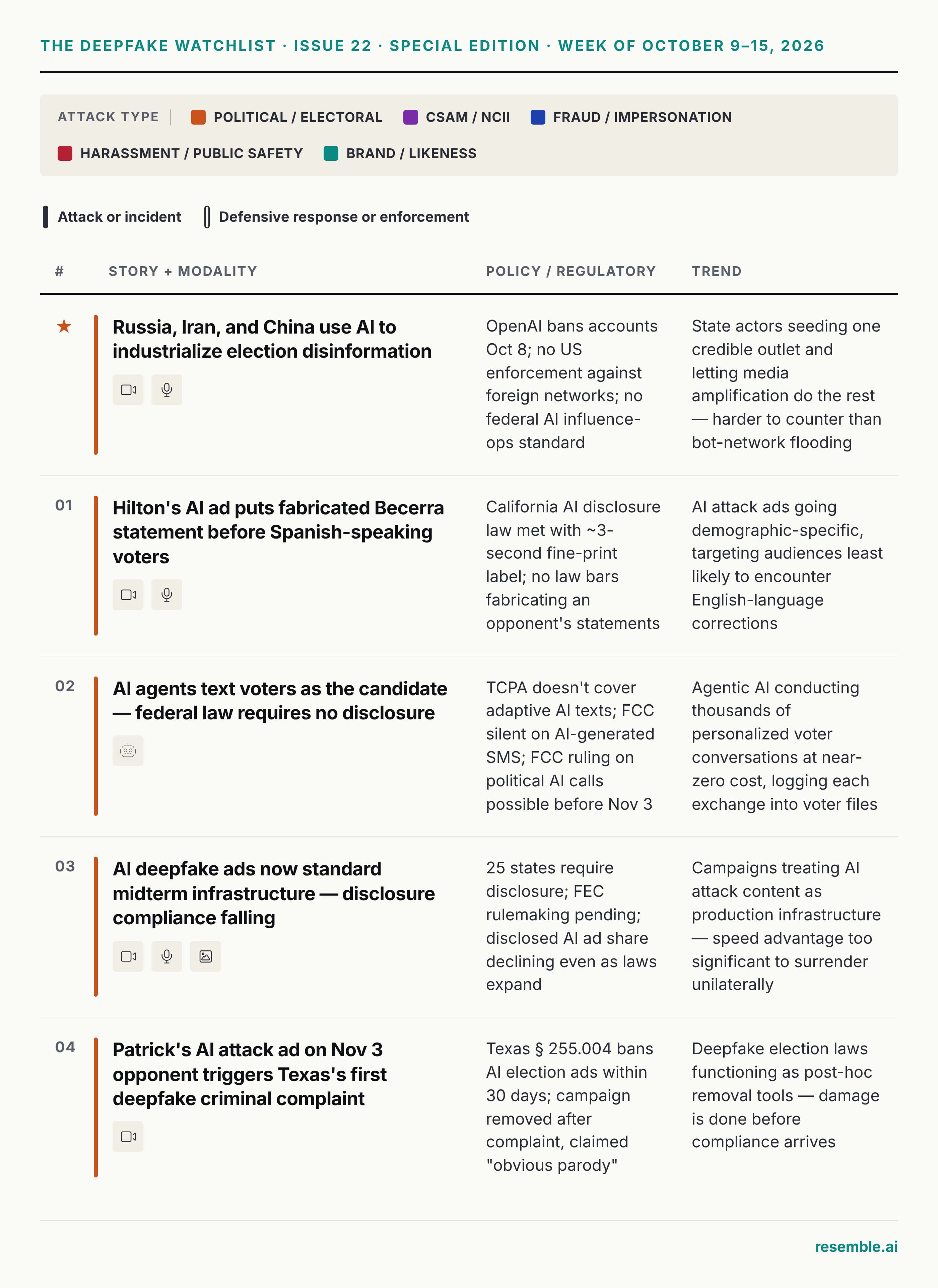
- Every major incident this week targets a specific audience before a correction can reach them. Hilton's Spanish-language ad reaches voters unlikely to encounter English fact-checks. Patrick's football ad ran and came down after the complaint. Russia's Matryoshka network placed fabrications in legitimate outlets and let media amplification do the work. The agentic AI voter outreach systems contact individual voters in private text threads where no third-party fact-check is even possible. The targeting architecture is what makes each of these work.
- Thirty-one states have deepfake election laws. Texas has a criminal statute. The FCC ruled AI voices require consent for robocalls. In every case this week, enforcement either hasn't arrived yet or arrived after the content had already completed its distribution cycle and the AI voter outreach story reveals a category of political AI use that existing law doesn't clearly reach at all. Frameworks written before agentic AI existed are not keeping pace with the systems campaigns are deploying right now.
- The Russia/Iran/China case makes the hardest problem concrete: the most effective influence operation this week didn't rely on scale. It seeded one credible outlet, triggered a political reaction, and let normal media dynamics do the rest. That's not a platform moderation problem. Three weeks out, it's also not a problem with an obvious solution before November 3.
Watching next week
- Early voting in multiple states. The first real test of whether agentic AI voter outreach and demographically targeted deepfake ads drive measurable persuasion effects inside the legal windows those states have defined.
- Platform moderation ahead of November 3. Meta and X have reduced professional fact-checking this cycle; whether community notes are keeping pace with the volume of AI political content is an open question with a hard deadline.
- OpenAI and Anthropic pre-election reports. Both companies have committed to additional takedown reports before Election Day; whether October 8 was the peak or an early wave will start to become clear.
- FCC ruling on political AI-voice calls. The Club for Growth petition to exempt political AI-voice robocalls from prior consent could drop before Election Day — which would directly affect what the voter-outreach AI platforms described in Story 3 are allowed to do.
The Deepfake Watchlist publishes every Thursday. Subscribe to receive it in your inbox, or follow Zohaib Ahmed on LinkedIn for the weekly social companion. Track every documented incident in the Resemble Deepfake Incident Database, and read the full methodology in our 2026 Midyear Deepfake Threat Report.