



The Deepfake Watchlist is Resemble AI's weekly surveillance of synthetic media incidents, ongoing cases, and disputed content shaping the news cycle. Each week we track confirmed incidents, emerging attack vectors, and claims under investigation, alongside the provenance, detection, and policy threads running underneath them. New to the world of deepfakes? Read the Deepfake 101 Guide.
★ Featured: Russia's Storm-1516 used a deepfake sexual abuse accusation to target a Senate candidate built around a real person who never said a word of it
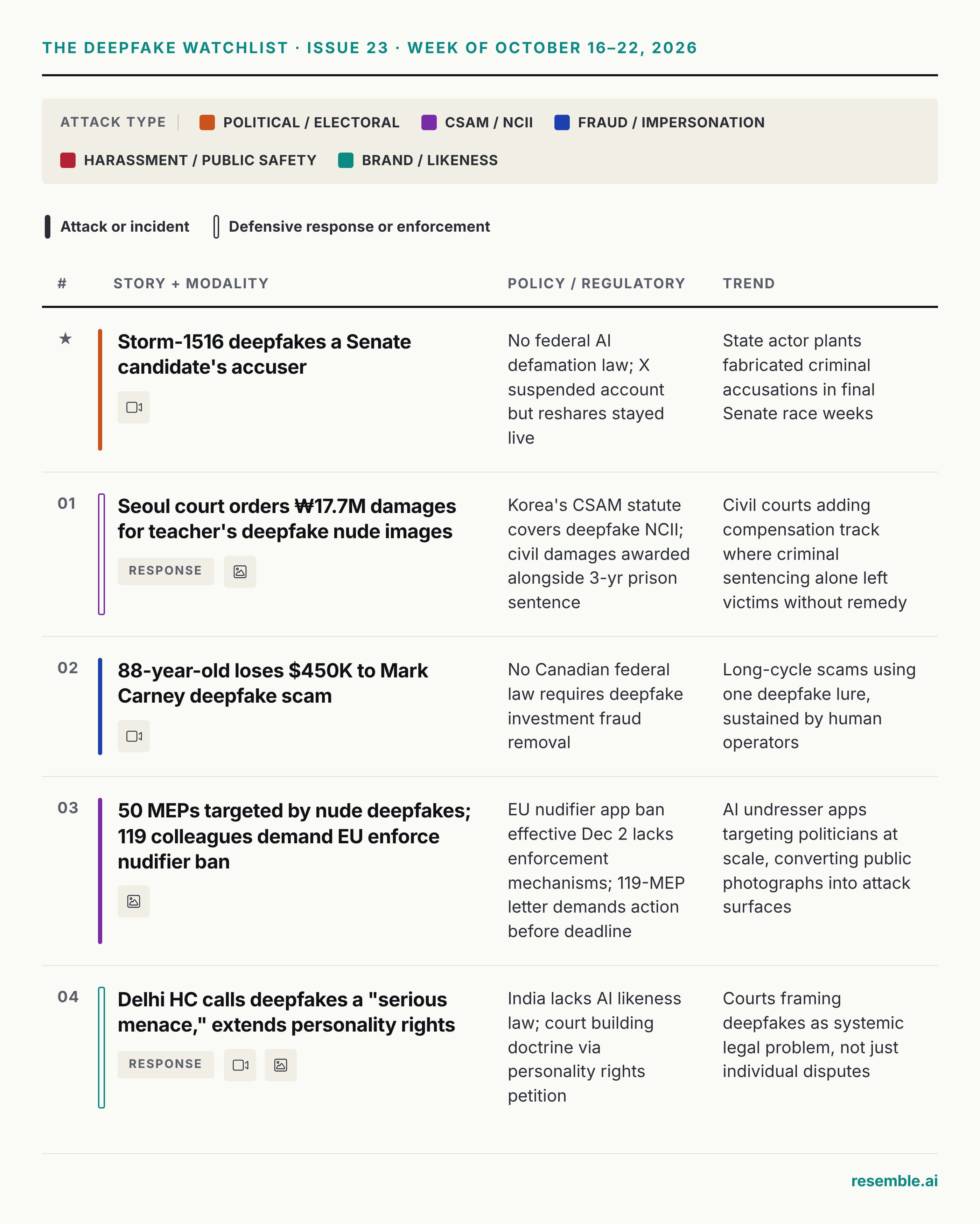
PolitiFact's fact-check confirmed on October 22 that two videos posted to X on October 20 showing a former student accusing Texas Democratic Senate candidate James Talarico of sexual abuse were AI deepfakes tied to the Russian influence network Storm-1516. Darren Linvill at Clemson University's Media Forensics Hub confirmed the attribution; Graphika found the posting account "very likely" impersonated a real Facebook user. The real person the video claimed to depict, Zyon Lewis, told Lead Stories the video is not him and that he has made no such accusation. X suspended the account by October 22, but reshares of the video remained live.
- Category: Political / Electoral
- Type: Attack
- Modality: Video
- Policy / Regulatory: No federal law specifically criminalizes AI-generated political defamation; X suspended the originating account but reshares remained active as of October 22.
- Trend: State-actor campaigns seeding fabricated criminal accusations calibrated to the final weeks of a Senate race, using a real person's identity as the delivery vehicle.
- Attack vector: AI-generated personal testimony video built around the real name and public profile of an actual person, posted from a freshly created account (signed up September 2026, Romania) timed to the closing weeks of a competitive Senate race.
- What we saw in the content: Fact-checkers and researchers identified the following forensic signatures in the videos:
- Unnatural eye movement and blinking patterns inconsistent with live human speech
- Stiff, repetitive facial expressions that don't track naturally with the emotional content
- A 98% AI-likelihood score from an AI detection tool
- Teeth that differ from the real Zyon Lewis's Facebook photographs, indicating a composite face built from publicly available images
- An audible African accent, incongruous with a person who attended a Texas school in 2012
- British spellings in the on-screen caption, a signature artifact of AI text-generation pipelines trained on non-US corpora
Storm-1516 didn't fabricate a stranger: it built a deepfake around a real, identifiable person, someone whose name and photographs exist online and framed him as the source of a criminal accusation he never made. The real Lewis had to go on record to deny it. That's an escalation from the synthetic celebrity clips or anonymous testimonies this network has used before, and it creates a harm that outlasts the content's removal: the real person's name is now attached, via search, to an accusation he didn't make.
The forensic tells were accessible without specialized tools. The teeth discrepancy came from comparing the video against Lewis's existing Facebook photographs, the accent was audible on first listen and the account metadata was public. What made this effective was not the sophistication of the synthetic content, it was the use of a real person's identity to anchor the fabrication and the timing, two weeks before Election Day in a race Storm-1516 has an obvious interest in. Linvill noted Russia likely aims to deepen partisan division and encourage turnout for Talarico's opponent. The video didn't need mass reach to accomplish that; it needed to reach the right fraction of the right audience at the right moment.
1. A South Korean court awarded civil damages for deepfake nude images distributed by a former student, the first civil judgment establishing a dual compensation track under Korea's reinforced CSAM statute
Seoul Economic Daily reported on October 22 that Incheon District Court Judge Lee Sang-eon ordered defendant B, a man in his twenties, to pay ₩17.7 million (approximately $12,700) in damages to teacher A. Defendant B had superimposed the faces of his former teachers onto nude images and distributed them on social media while he was still in high school. A criminal judgment finalized by an appeals court in December 2025 had already sentenced B to three years in prison; the civil ruling now establishes a parallel compensation track for NCII victims under Korea's Act on Special Cases Concerning the Punishment of Sexual Crimes.
- Category: CSAM / NCII
- Type: Response
- Modality: Image
- Policy / Regulatory: Korea's Act on Special Cases Concerning the Punishment of Sexual Crimes explicitly covers deepfake NCII; the December 2025 criminal conviction and the October 2026 civil judgment together establish a full dual-track enforcement picture. No equivalent civil damages framework yet exists for NCII victims in most US states.
- Trend: Civil courts filling the deterrence gap left when criminal conviction alone doesn't compensate victims — demonstrating that a NCII victim can pursue both tracks simultaneously.
- Attack vector: AI face-swap applied to pornographic images, distributed on social media from a personal device during high school; victim learned of the content after it had already spread.
The court's ruling is a useful marker for where deepfake NCII law has arrived in Korea relative to other jurisdictions. The criminal pathway which is three years' imprisonment was already among the toughest available anywhere for this class of offense. The civil damages track, now confirmed in this judgment, means victims can pursue economic compensation as well. That dual-track model is what advocates in the UK, the US, and elsewhere have been pushing for, and South Korea has now demonstrated it working in a real case. The ₩17.7 million figure translates to roughly a year's average salary for a public-school teacher in Korea, a number that functions as both compensation and a deterrent signal.
2. An 88-year-old lost $450,000 to a Mark Carney deepfake investment scam — TD Bank flagged it repeatedly and couldn't stop it
CBC Go Public reported on Ralph Moore, a Qualicum Beach, BC resident who sent $450,000 over ten months after seeing an AI-generated video of Prime Minister Mark Carney promoting a fraudulent investment platform. TD Bank questioned transactions, warned Moore and his wife, flagged the account internally, and temporarily restricted it. Moore's account was eventually closed in February. The bank has not reimbursed him.
- Category: Fraud / Impersonation
- Type: Attack
- Modality: Video
- Policy / Regulatory: No Canadian federal law requires platforms to proactively remove deepfake investment fraud content; TD Bank's fraud intervention protocols did not prevent the loss.
- Trend: Long-cycle investment scams using a single deepfake as the initial lure, with human operators sustaining the fraud across months of escalating transfers.
- Attack vector: AI-generated video of a trusted political figure endorsing an investment platform, used to establish initial credibility, with ongoing human contact maintaining the relationship through ten months of transactions.
Moore's daughter, Leslie Herrndorf, asked the operational question directly: why didn't the bank freeze the account, contact relatives, or notify police? The gap she's describing is the gap between a bank having the authority to warn and a bank having clear legal authority to freeze a competent adult's account without their consent. These scams are specifically engineered to operate in that gap, and the Carney deepfake ecosystem, which Canadian regulators have been warning about since late 2025, appears to have understood it well.
3. Fifty members of the European Parliament have been targeted by deepfakes and 119 of their colleagues are demanding the EU enforce its December nudifier ban
International Business Times UK reported on October 21 that Austrian Green MEP Lena Schilling revealed nude deepfakes of her circulating online, created from real press conference photographs using an AI undresser application. A report by Agora Digitale Transformation found that at least 50 MEPs (46 of them women) have been targeted by similar AI-generated content. Schilling and MEP Terry Reintke co-led a letter signed by 119 members of the European Parliament calling on the EU to enforce the December 2 ban on nudifier applications before it takes effect.
- Category: CSAM / NCII
- Type: Attack
- Modality: Image
- Policy / Regulatory: The EU's Digital Services Act and AI Act together create a framework that would prohibit nudifier apps; the December 2 effective date gives platforms until then to comply. The 119-MEP letter specifically demands enforcement mechanisms before that date, arguing the ban without enforcement infrastructure is symbolic.
- Trend: AI undresser applications scaling from individual targets to systematic campaigns against political figures, converting public-facing photographs — press events, campaign materials, official headshots — into attack surfaces.
- Attack vector: AI undresser application processing publicly available professional photographs of political figures, with results distributed across social media platforms with no access barrier; Agora's analysis found the targeting was systematic rather than opportunistic.
AI undresser applications have dropped the cost and skill requirement for creating non-consensual intimate imagery to nearly zero — any public photograph is now potential source material. The targeting of 50 MEPs, 46 of them women, is not random. Political visibility, which women in elected office disproportionately have, has become a liability in an era of cheap NCII generation. The December 2 ban is real policy movement whether it is followed by enforcement architecture, or remains a symbolic prohibition that tools and platforms can ignore in practice, is the question the 119-MEP letter is asking.
4. Delhi's High Court called deepfake technology a "serious menace" and said personality rights extend to AI-generated likeness content
Gulf News reported on October 16 that Justice Purushaindra Kumar Kaurav of the Delhi High Court called deepfake technology "going to be a serious menace" while hearing a petition from actor Kriti Sanon, who is seeking legal protection of her name, image, and likeness against unauthorized AI-generated content. The court asked her counsel to submit relevant judgments and research papers before issuing a "comprehensive order" on how personality and publicity rights extend to AI-generated likeness content. The next hearing is October 29.
- Category: Brand / Likeness
- Type: Response
- Modality: Video, Image
- Policy / Regulatory: India has no dedicated AI likeness law; the petition relies on personality and publicity rights doctrine, which Indian courts have applied unevenly; the Delhi HC's comprehensive order could establish binding precedent for how those rights extend to AI-generated content.
- Trend: Celebrities in markets without explicit AI likeness statutes turning to personality rights doctrine as the available legal vehicle, pushing courts to extend existing frameworks rather than waiting for legislation.
- Attack vector: Unauthorized AI-generated content using a named public figure's identity and likeness, distributed without consent or compensation across digital platforms.
India's courts have seen a growing wave of similar petitions, with the Delhi HC becoming a de facto venue for AI likeness disputes in the absence of dedicated legislation. A sitting High Court judge calling deepfakes a "serious menace" on the record is a signal about how the judiciary is framing this technology, and framing shapes doctrine. The October 29 hearing, when the court is expected to issue its comprehensive order, could produce the clearest statement yet from an Indian court on whether personality rights extend to AI-generated likeness content.
Honorable mentions
Bay Area AI images of fake ICE raids spread through immigrant group chats. AI-generated images depicting fictional enforcement scenes circulated in immigrant community group chats on October 17, generating real fear with no immediate way for communities to verify whether the content was synthetic.
India welfare scheme deepfakes of Modi, Sitharaman, and state chief ministers. Indian authorities warned on October 19 of a coordinated wave of deepfake videos depicting national and state officials endorsing fraudulent government welfare programs, directing citizens to fake registration portals across multiple states simultaneously.
The pattern
- Two of this week's stories demonstrate the same structural gap: institutional systems that can detect wrongdoing but lack the authority to act on it. X suspended the Talarico deepfake account, but reshares remained live and the real Zyon Lewis's name was already attached to an accusation he never made. TD Bank flagged Moore's transactions ten times over ten months and couldn't prevent the loss. The EU has passed a nudifier app ban effective December 2 with no enforcement infrastructure yet attached to it which is why 119 MEPs are writing letters rather than filing complaints. Detection without escalation authority is not prevention, and these attacks are specifically engineered around that gap.
- State-actor operations are converging on a consistent insight: the softest targets right now are not skeptical humans but the institutional systems those humans rely on for verification. Financial fraud review processes and social media platforms carry implicit trust assumptions that were designed before synthetic media was cheap and convincing. The Talarico case exploits this directly: content seeded inside X got into a trusted distribution channel and let the channel's own credibility do the amplification work. The real Zyon Lewis's name is now attached, via search, to an accusation he never made and removing the originating account didn't fix that.
- The Seoul civil judgment and the Kriti Sanon petition both point to the same pattern: courts are moving faster than their legislative counterparts on deepfake accountability. Korea's Incheon District Court added civil damages to what was already a criminal sentence, establishing a dual-track enforcement model that advocates in the US and UK have been arguing for. India's Delhi High Court is building personality rights doctrine in the absence of dedicated legislation. The October 29 Delhi hearing when the court is expected to issue its comprehensive order is important to watch as one of the clearest signals yet of how common law jurisdictions will govern AI likeness without waiting for statutes.
Watching next week
- Reshare cleanup on X. Whether the platform proactively removes the remaining reshares of the Talarico deepfake before November 3 — not just the originating account — is a concrete and testable question.
- EU nudifier enforcement timeline. Whether the European Commission commits enforcement mechanisms before the December 2 nudifier app ban takes effect is the question 119 MEPs are now formally asking. The gap between the ban's effective date and the existence of actual enforcement infrastructure will determine whether it functions as policy or performance.
- Canadian bank liability. Whether Moore's family pursues a complaint under Canada's Financial Consumer Agency Act will test whether consumer protection frameworks can address sustained deepfake-enabled fraud.
- Seoul dual-track model. Whether Korea's confirmation that criminal sentencing and civil damages can run simultaneously in the same NCII case draws attention from advocacy groups in the UK, Australia, and US states currently pushing for equivalent civil remedies.
The Deepfake Watchlist publishes every Thursday. Subscribe to receive it in your inbox, or follow Zohaib Ahmed on LinkedIn for the weekly social companion. Track every documented incident in the Resemble Deepfake Incident Database, and read the full methodology in our 2026 Midyear Deepfake Threat Report.