



The Deepfake Watchlist is Resemble AI's weekly surveillance of synthetic media incidents, ongoing cases, and disputed content shaping the news cycle. Each week we track confirmed incidents, emerging attack vectors, and claims under investigation, alongside the provenance, detection, and policy threads running underneath them. New to the world of deepfakes? Read the Deepfake 101 Guide to learn more about how to protect yourself and your company from threats.
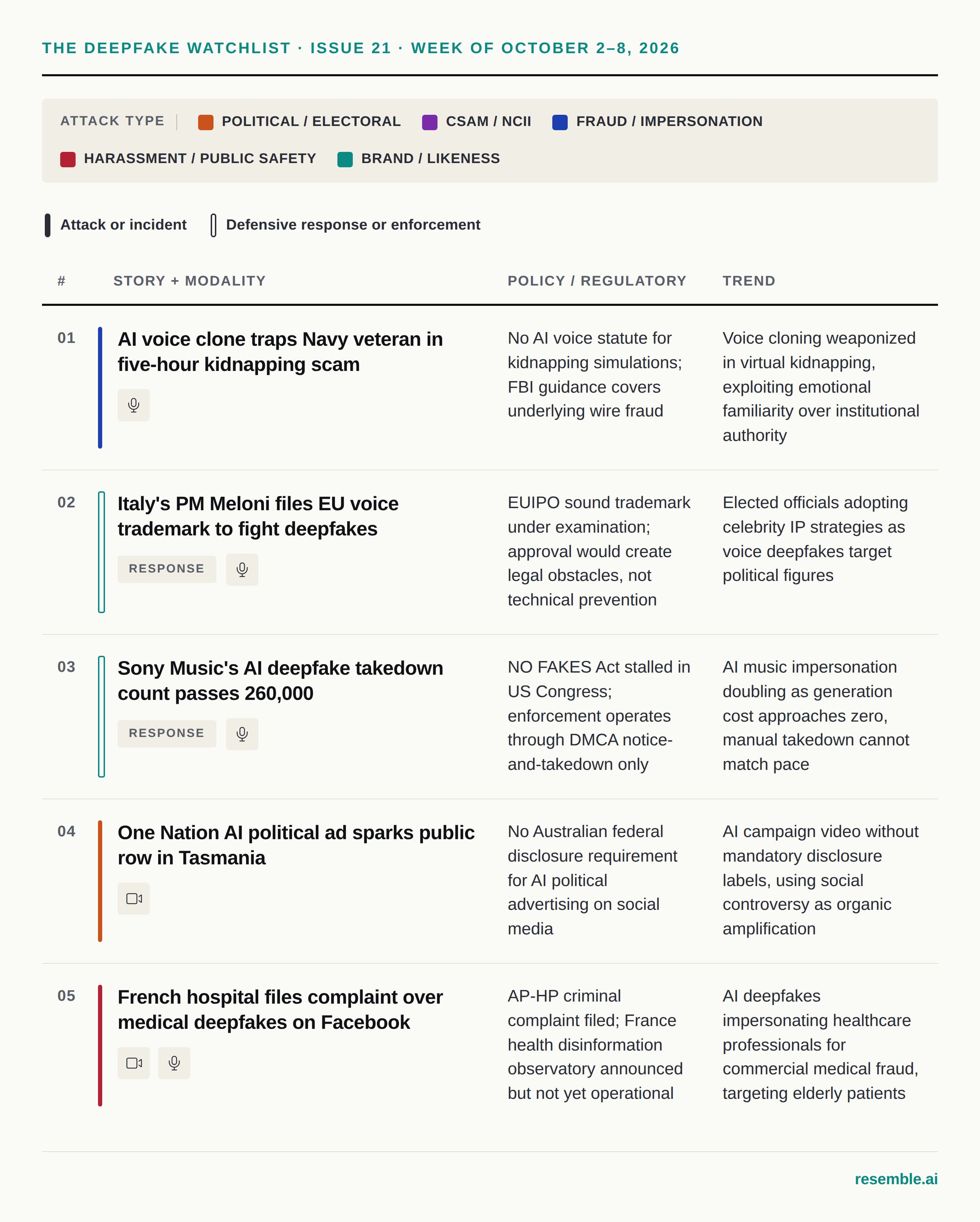
1. AI voice clone traps Navy veteran mom in five-hour kidnapping nightmare
Fox News's AI voice scam traps mom in 5-hour kidnapping nightmare, published October 7, reports that Deborah Del Mastro, a Navy veteran and California mother, lost $5,400 after fraudsters used an AI-cloned version of her daughter Sarah's voice to simulate a kidnapping, keeping her on the phone for five and a half hours across multiple wire transfer locations before she discovered Sarah was at work the entire time.
- Category: Fraud / Impersonation
- Type: Attack
- Modality: Audio
- Policy / Regulatory: No federal statute specifically covers AI voice used to simulate kidnapping; the FBI has issued guidance on "virtual kidnapping" schemes, but existing law addresses underlying wire fraud rather than the synthetic voice component.
- Trend: AI voice cloning weaponized in virtual kidnapping fraud, using intimate vocal familiarity rather than institutional authority to disable a victim's skepticism and emotional defenses simultaneously.
- Attack vector: AI-cloned voice of a known family member deployed in a simulated hostage call, with the caller controlling movement, preventing independent verification, and coordinating payment across four MoneyGram and Western Union transactions over five and a half hours.
The cloned voice sounded exactly like Sarah mid-panic-attack, matching a state Deborah had heard just days earlier after a breakup. Deborah is a Navy veteran who describes herself as someone who runs toward crises, and she still lost $5,400 to a phone call. She later told a US Senate committee she remained "completely traumatized" months afterward.
The difficult problem is that the clone arrives at the moment of maximum fear, and "check your daughter's location app" is not a thought that runs through a parent's mind while hearing their child scream. The ideal solution is provenance infrastructure that makes the fake identifiable before it reaches the ear.
2. Italy's Meloni files EU voice trademark in fight against deepfakes
POLITICO, reporting October 5, confirm that Italian Prime Minister Giorgia Meloni has filed an application with the European Union Intellectual Property Office to trademark her voice, submitting a four-second audio clip of herself repeating "Io sono Giorgia Meloni" twice, in what Italian media describe as the first such filing by a sitting head of government.
- Category: Brand / Likeness
- Type: Response
- Modality: Audio
- Policy / Regulatory: The EUIPO application is under examination and, if approved, would create additional legal obstacles for unauthorized voice replication but would not automatically prevent AI-generated imitations or mandate platform-level disclosure.
- Trend: Individual likeness protection moving from celebrities and entertainers into elected office, as political figures with recognizable voices face escalating deepfake targeting ahead of Italy's 2027 general elections.
- Attack vector: AI voice cloning of public figures for political disinformation and fabricated endorsements, alongside sexual deepfakes that Meloni has been fighting through civil litigation since 2024.
The phrase she submitted, "I am Giorgia Meloni," echoes a 2019 political rally declaration that became a national slogan and inspired a disco remix, so the clip is both legally functional and culturally specific to her. Italian media were quick to note the practical limit: a sound trademark creates legal recourse after unauthorized use is detected, not a barrier to the clone itself. The generation still happens; the law catches up afterward, assuming the cloning is discovered and the responsible party can be found.
This is the same structural gap that made the Del Mastro scam possible. Voice cloning is instantaneous, legal response is sequential, and the harm accumulates in the interval between them. What a trademark cannot do is stop generated audio at the moment of creation. That requires something embedded in the generation pipeline, a provenance signal that identifies AI-synthesized audio before it reaches anyone's ear.
3. Sony Music's AI deepfake takedown count passes 260,000, nearly doubling in six months
Billboard and the Financial Times, reporting October 5 on figures through the end of September, document that Sony Music had issued more than 260,000 takedown requests for AI-generated tracks impersonating its artists, almost double the 135,000 requests filed by the end of March, averaging more than 20,000 requests per month across Q2 and Q3 of 2026.
- Category: Brand / Likeness
- Type: Response
- Modality: Audio
- Policy / Regulatory: The US NO FAKES Act, which would give individuals enforceable rights over unauthorized AI replicas of their voices and likenesses, remains in the legislative process; Sony's enforcement campaign operates under existing DMCA notice-and-takedown frameworks.
- Trend: AI voice cloning of musical artists scaled to production volume, with streaming platforms serving as distribution infrastructure for fraudulent tracks that divert royalties from impersonated artists and their songwriters.
- Attack vector: AI-generated tracks impersonating Harry Styles, Adele, Britney Spears, Queen, and Michael Jackson uploaded to streaming platforms, promoted through bot-driven fraudulent plays that generate royalty payments to fraudsters rather than the originals.
A Sony spokesperson told Billboard that every fraudulent stream takes money directly from the artists and songwriters whose work is being imitated. The fraudulent tracks do not need to be popular, they only need to persist in a catalog and collect plays continuously, diverting micropayments across hundreds of thousands of fake uploads.
Sony is running a labor-intensive legal pipeline against an automated generation pipeline, and that asymmetry does not resolve through more takedowns. The 20,000-requests-per-month pace is a ceiling set by how fast a legal team can file notices, not by how fast infringing content is produced. What changes the equation is provenance at the generation layer, a requirement that AI tools embed a signal in produced audio that identifies it as synthetic and attributable before it enters any distribution channel.
4. One Nation AI-generated political ad sparks public row in Tasmania
ABC News Australia's One Nation AI-generated video sparks Tasmanian cafe owner row with Lee Hanson, published October 6, reports that Australia's One Nation party released an AI-generated political video titled "It's ok to come out... as a One Nation voter," prompting a Tasmanian café owner to publicly object and donate any One Nation custom to the Greens, setting off a public exchange with candidate and Pauline Hanson's daughter, Lee Hanson.
- Category: Political / Electoral
- Type: Attack
- Modality: Video
- Policy / Regulatory: No Australian federal statute requires disclosure of AI-generated content in political advertising distributed through social media, leaving the video outside any mandatory labeling requirement despite the party acknowledging its synthetic origin.
- Trend: Domestic political parties deploying AI-generated video as standard campaign production, normalizing synthetic media in political communications without triggering disclosure obligations in the channels where voters see the content.
- Attack vector: AI-generated political video distributed through social media depicting fabricated scenarios designed to associate political opponents and social groups with party messaging, without disclosure of synthetic origin to the general viewing audience.
The One Nation video is notable less for its political argument than for what it illustrates about where AI political content sits in Australian regulatory coverage, which is effectively outside it. The party acknowledged the video was AI-generated, which removes the impersonation concern that governs prior deepfake controversies, but no Australian law requires that acknowledgment to appear as a disclosure to viewers seeing the ad in their feeds.
The café owner's response and Lee Hanson's counter-response generated more coverage than the video itself, which is roughly the outcome any political communications team would design for. Australia's disclosure rules cover broadcast advertising, not social media, and the coverage that results tends to be about the downstream social conflict rather than the absence of the label that would have prevented the ambiguity in the first place.
5. French hospital system files complaint over medical deepfakes on Facebook
Next.ink's Nouvelle alerte sur la prolifération de deepfakes nourrissant la désinformation en santé, published October 6, reports that the Assistance Publique-Hôpitaux de Paris (AP-HP) and Sorbonne University filed a criminal complaint and requested Meta remove Facebook videos that used AI to clone the voice and image of a Paris hospital physician and a TF1 news anchor to promote a fraudulent "miracle remedy," warning of direct danger to public health.
- Category: Harassment / Public Safety
- Type: Attack
- Modality: Video, Audio
- Policy / Regulatory: AP-HP has filed a formal criminal complaint and notified Meta; France's Ministry of Health announced a health disinformation observatory in January 2026 that has not yet launched; Meta removed some initial videos, but new copies subsequently reappeared.
- Trend: AI deepfakes impersonating healthcare professionals and broadcast media figures to promote fraudulent medical products, accelerating a pattern that predates generative AI and now operates at higher volume and persuasion fidelity.
- Attack vector: Fabricated broadcast-style videos mimicking TF1 news format, using AI voice cloning of AP-HP physician Dr. Renaud Piarroux alongside visual impersonation of anchor Anne-Claire Coudray to give fraudulent medical claims the appearance of verified institutional journalism.
Beyond the reputational harm to the physician and the institution, the videos "constitute a genuine danger to patient health," potentially leading elderly viewers to abandon prescribed medication in favor of an unvetted product. The institution filing the complaint is not a media organization worried about brand damage, it is a public hospital system worried about real clinical outcomes.
Dr. Piarroux is a genuine infectious disease specialist with substantial media presence from the COVID period, which is exactly why he was targeted: his voice pattern exists in sufficient volume online to generate a convincing clone, and his association with authoritative health communication gives the fake its persuasive frame. Meta removed some copies; more appeared. That cycle is where the legal complaint is pointing, and France's planned but unlaunched health disinformation observatory is the structural gap it exposes.
Honorable mentions
US midterm political deepfakes arrive in force. The Resemble AI incident database recorded at least three separate US political deepfake incidents in the October 2-8 window ahead of November's midterms: an AI-generated attack ad targeting Georgia Senator Jon Ossoff, depicting him receiving cosmetic procedures; a campaign for Mississippi Senate challenger Scott Colom using AI audio and video clips against incumbent Cindy Hyde-Smith; and a political action committee deploying fabricated AI video scenarios against Vermont State Senator Ruth Hardy. All three circulated on social media without any mandatory federal disclosure requirement. Taken together, they confirm that AI-generated political attack content is now a routine campaign production tool in competitive US races, not a one-off experiment.
Ariana Madix calls out ITV Studios for unauthorized Love Island deepfake. Reality TV personality Ariana Madix publicly criticized ITV Studios Australia this week after the production company used an AI-generated deepfake of her in a promotional video for Love Island Australia without her authorization. Madix's camp issued a cease-and-desist. The incident sits in a category that is increasingly common: not an anonymous account generating a celebrity clone, but a named commercial production company deploying synthetic likeness as a promotional shortcut, betting that the legal exposure is manageable.
The pattern
- Voice cloning is now the attack vector that cuts across every economic tier. The Del Mastro case involves a retired Navy veteran losing $5,400 from savings. Last week's Fideuram case involved a private banking chairman authorizing €95 million in transfers. The AP-HP fraud targets elderly patients being redirected toward a fraudulent product. Sony's 260,000 takedowns represent artists losing royalties to automated fakes. The same underlying capability is being deployed against all of them, and the cost of executing the clone has almost nothing to do with the amount of money at stake.
- Three of this week's stories represent legal responses to voice cloning, and all three share the same structural limit. Meloni's EUIPO trademark, Sony's takedown program, and AP-HP's criminal complaint are legitimate enforcement actions, but each responds to harm that has already been generated and distributed. The trademark creates recourse after unauthorized use. The takedown arrives after the song has played. The complaint names content that has already reached patients. Legal frameworks that operate downstream of distribution cannot match the speed of generation. Provenance at the generation layer is the piece that would change the equation.
- The One Nation ad and the three US political deepfakes in the honorable mentions share the same regulatory gap: AI-generated political content now reaches voters at scale through social media channels that existing disclosure rules simply do not cover. Broadcast disclosure requirements are where the rules live. Social media is where the content actually travels.
Watching next week
- US midterm political deepfake activity. Whether any AI political content incident ahead of November triggers federal enforcement or coordinated platform action will set a template for how future election cycles are governed.
- EUIPO examination of Meloni's voice trademark. Any preliminary ruling will clarify whether voice trademark protection for public figures is a viable template others could follow into 2027 election cycles.
- AP-HP complaint follow-up. Whether French prosecutors act on the criminal complaint, and whether Meta's subsequent video removals hold against re-uploads.
- Ariana Madix / ITV cease-and-desist. Whether the legal action produces a settlement or proceeds, which would be the first case testing commercial production company liability for unauthorized deepfake likeness in promotional content.
The Deepfake Watchlist publishes every Thursday. Subscribe to receive it in your inbox, or follow Zohaib Ahmed on LinkedIn for the weekly social companion. Track every documented incident in the Resemble Deepfake Incident Database, and read the full methodology in our 2026 Midyear Deepfake Threat Report.