
Identity verification is no longer just about passwords or a single biometric, like a fingerprint. Your team now has to account for identity factors that can be spoofed, replayed, or manipulated across voice, face, device, and behavioral channels. This makes single-factor authentication harder to rely on in high-risk workflows such as onboarding, account recovery, customer support, and remote access.
This shift is pushing banks, fintech platforms, contact centers, and enterprise security teams toward multimodal biometric authentication, where multiple identity factors, such as voice, face, fingerprints, device signals, and behavioral patterns, work together to verify a user. The global multimodal biometrics market is projected to reach USD 18.9 billion by 2030 at a CAGR of 12.4%, reflecting the growing demand for layered verification systems.
In this article, let's explore how multimodal biometric authentication is shaping identity security for fraud prevention, customer verification, remote access, and contact center workflows. You’ll also see where liveness detection, deepfake detection, and privacy-focused AI fit into a layered authentication strategy.
At a Glance:
- Multimodal biometric authentication combines multiple identity factors, such as voice, face, fingerprints, device data, and behavior, to create a more layered verification process than single-factor methods.
- A mix of core modalities, such as facial recognition, voice biometrics, fingerprints, and behavioral patterns, works together to create a stronger, layered identity verification system.
- Advancements in AI, liveness detection, deepfake detection, and real-time processing help authentication run faster, stay secure, and handle more users.
- Key trends such as continuous authentication, zero-trust security, passive biometrics, privacy-focused AI, and edge processing are shaping the evolution of identity verification.
- Despite its benefits, challenges such as privacy risks, system complexity, bias, and user trust must be carefully managed to implement solutions effectively and ethically.
What Are Multimodal Biometric Authentication Solutions?
Multimodal biometric authentication solutions use multiple biometric traits simultaneously, such as voice, face, fingerprint, and behavioral signals, to verify a user’s identity. Instead of relying on a single biometric or contextual input, multimodal systems create a layered verification process that can make spoofing or bypass attempts harder to execute.
Here’s why it matters:
- Higher Accuracy and Reliability: Combining multiple biometric inputs can reduce false positives and false negatives, enabling more consistent identity verification across environments and use cases.
- Stronger Resistance To Spoofing Attacks: Attackers may need to replicate multiple traits simultaneously, such as voice, face, and behavior, which can make bypass attempts harder than in single-factor systems.
- Improved user experience: If one modality fails due to poor conditions like low lighting or background noise, other modalities can compensate, making authentication smoother and less frustrating.
- Adaptive and flexible authentication: Systems can dynamically adjust based on risk levels, requiring fewer or more biometric signals depending on the sensitivity of the action being performed.
- Enhanced security for remote interactions: Particularly valuable for industries like customer service and fintech, where voice and behavioral biometrics help verify users without physical presence.
- Scalability Across Global Applications: Banks, fintech platforms, contact centers, and enterprise access teams can use multimodal systems across different regions, devices, and authentication conditions when the system includes flexible deployment and fallback options.
- Continuous authentication capabilities: Instead of a one-time login check, behavioral and contextual signals enable ongoing verification throughout a user session, reducing the risk of session hijacking.
Core Modalities Powering Multimodal Authentication
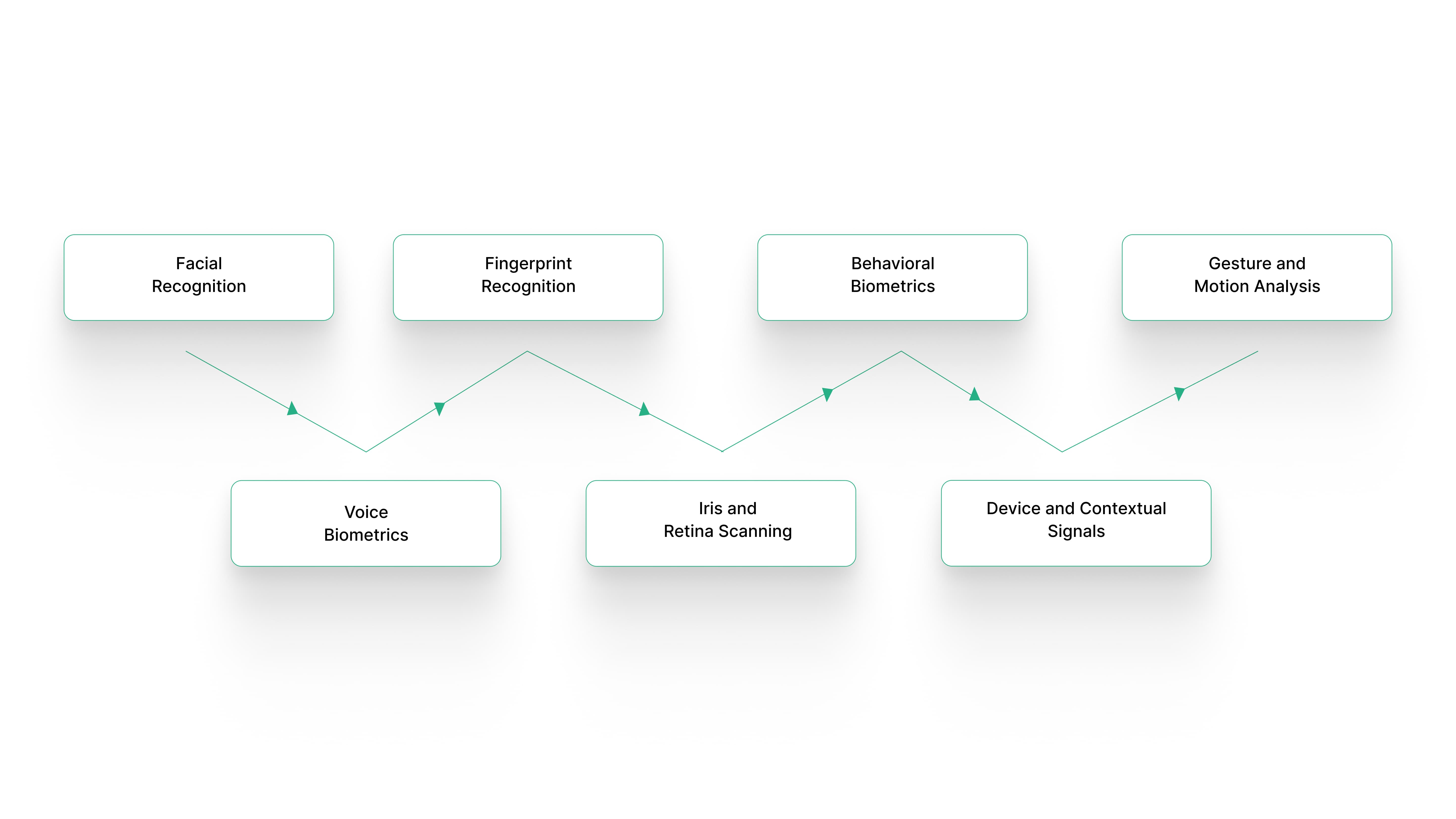
At the heart of multimodal authentication are the different biometric modalities that work together to verify identity. Each modality brings its own strengths, and combining them creates a more reliable system.
- Facial Recognition: Uses facial features and geometry to verify identity. It’s widely adopted in mobile devices and onboarding flows, especially when paired with liveness detection to prevent spoofing attempts.
- Voice Biometrics: Analyzes vocal patterns, tone, and speech characteristics to authenticate users. It is useful in customer service, IVR, and remote verification scenarios, but it should be paired with spoofing checks because deepfake vishing can target voice-based authentication workflows.
- Fingerprint Recognition: Relies on unique fingerprint patterns for quick and reliable authentication. It remains a trusted method in smartphones and secure access systems.
- Iris and Retina Scanning: Captures highly detailed patterns in the eye, offering high accuracy for high-security environments. However, it often requires specialized hardware and controlled conditions.
- Behavioral Biometrics: Monitors how users interact with devices, such as typing speed, scrolling habits, or mouse movements. This adds a passive, continuous layer of authentication.
- Device and Contextual Signals: Includes data like device ID, IP address, location, browser context, and usage patterns. These signals help your fraud or trust team assess risk in real time and make adaptive authentication decisions. If suspicious media or identity claims are reviewed in browser-based workflows, Chrome Deepfake Detection can add another verification layer before that content is trusted, escalated, or used in identity decisions.
- Gesture and Motion Analysis: Tracks how users hold or move their devices. This subtle layer strengthens continuous authentication without interrupting the user experience.
Technologies Your Team Should Evaluate For Multimodal Authentication
When evaluating multimodal authentication, your team should look at how each technology improves verification quality, reduces spoofing risk, protects biometric data, or lowers friction for legitimate users.
- Liveness Detection: Ensures that biometric inputs come from a real, live user rather than a spoofed source like a photo, recording, or deepfake. This is vital to prevent presentation attacks across face and voice modalities.
- AI-Powered Voice Analysis: Applies machine learning models to evaluate speech patterns, tone, cadence, and frequency signals. This is especially relevant when your team needs to assess AI-generated deepfake audio in voice authentication, IVR, or remote identity workflows.
- Deepfake Detection & AI Watermarking: Detects artificially generated media and verifies content authenticity through embedded signals. These technologies are becoming essential as voice cloning tools become more advanced and accessible.
- Edge Computing: Processes biometric data directly on user devices rather than centralized servers. This reduces delay, improves response times, and protects data privacy by limiting data transfer.
- Federated Learning: Enables AI models to learn from decentralized data sources without storing sensitive biometric data in one place. This supports compliance with strict privacy regulations in the United States.
- Behavioral Biometrics with AI: Continuously analyzes user behavior such as typing patterns, navigation habits, and interaction speed. This adds a passive and ongoing layer of authentication beyond initial login.
- Multimodal Fusion Algorithms: Combine multiple biometric inputs into a single authentication decision. These algorithms weigh different signals dynamically to improve accuracy and reduce false positives.
- Real-Time Processing Engines: Help evaluate multiple biometric signals quickly enough for time-sensitive workflows. This is crucial for applications like customer service IVR systems, gaming platforms, and fraud detection workflows.
- Secure Data Encryption & Tokenization: Protect biometric data during storage and transmission. These methods make it difficult for intercepted data to be misused or reverse-engineered.
- Cloud-Based AI Infrastructure: Supports fraud, identity, and access-management teams that handle high authentication volumes across regions, devices, or customer environments. Cloud infrastructure can also help teams scale verification workloads while maintaining consistent deployment controls.
These technologies can help authentication systems evaluate multiple identity factors faster, but decision quality still depends on data quality, model design, deployment context, and human review where needed.
Emerging Trends in Multimodal Biometric Authentication
Multimodal authentication is not static—it is evolving rapidly in response to changing security needs and technological advancements. Several key trends are shaping its future.
- Continuous Authentication Is Replacing One-Time Logins
Instead of verifying a user only at sign-in, systems are starting to validate identity throughout the session. This makes it harder for attackers to take over an account after the initial login.
- Behavioral signals such as typing rhythm, device handling, and navigation patterns help confirm that the same user is still active.
- Voice or face checks can be re-triggered at sensitive moments, such as large transactions or account changes.
- This approach reduces dependence on passwords while improving real-time fraud detection.
In practice, continuous authentication creates a stronger security layer without forcing users to repeat full verification steps every time they move through an app or platform.
- Zero-Trust Security Is Driving Smarter Identity Checks
Multimodal biometrics is becoming a natural fit for zero-trust environments, where no device, user, or session is trusted by default. Every access request is evaluated based on context and risk.
- High-risk actions can trigger additional biometric layers automatically.
- Authentication policies can adjust depending on location, device health, and user behavior.
- Enterprises can apply stricter checks without slowing down low-risk workflows.
This trend is especially important for businesses that handle sensitive data, financial activity, or internal systems with multiple access levels.
- Passive Biometrics Are Making Authentication Less Visible
A growing trend is the use of passive biometrics, which verify identity in the background rather than through explicit user actions. This helps create a more natural experience while still improving security.
- Voice tone, facial micro-movements, and interaction patterns can all contribute to passive verification.
- Users spend less time completing security steps, which reduces friction.
- Systems become more resilient because authentication is based on multiple, ongoing signals rather than a single event.
This is especially useful in customer service, gaming, and enterprise platforms where speed and ease of use matter as much as protection.
- Privacy-Preserving AI Is Becoming a Core Requirement
As biometric systems grow, privacy is becoming a central design priority. Fraud, identity, and security teams need stronger protection while reducing exposure of sensitive biometric and identity data.
- On-device processing helps keep biometric data closer to the user.
- Federated learning allows models to improve without moving raw data into a central store.
- Encryption and consent-based data handling are becoming standard expectations.
This trend reflects a broader shift: biometric authentication must do more than detect identity. It must also prove that identity data is being handled responsibly.
- Edge Processing Is Improving Speed and Reliability
Real-time authentication depends on fast decision-making, and edge computing is helping reduce delays. By processing data closer to the source, systems can respond faster and with less network dependency.
- Authentication decisions happen more quickly, which is critical for live environments.
- Systems remain more stable even when cloud connectivity is inconsistent.
- Local processing can reduce bandwidth usage and support better privacy control.
For applications like live support, gaming, and fraud monitoring, this makes multimodal authentication more viable at scale.
- Deepfake Detection Is Becoming Part of the Authentication Stack
As voice cloning and synthetic media improve, biometric systems are increasingly being designed to detect manipulated content, not just verify identity. This is especially important for voice-based workflows.
- Systems can inspect audio artifacts that may indicate synthetic speech.
- Deepfake detection adds another layer of protection against impersonation.
- Watermarking and authenticity checks can help confirm whether voice content is generated or human-recorded.
This trend matters because identity verification can no longer rely on appearance or sound alone. It has to account for how easily those signals can now be fabricated.
If your fraud, identity, or contact center team is evaluating multimodal deepfake detection for authentication workflows, Resemble Detect can help you review suspicious audio, video, and image signals with detection outputs, explanations, and context before those signals are used in identity decisions.
Challenges Your Team Should Plan For In Multimodal Biometric Systems
While multimodal authentication offers significant advantages, it also introduces deployment trade-offs that fraud, identity, and security teams need to evaluate before rollout.
- Data Privacy & Consent Risks: Collecting multiple biometric traits increases data sensitivity. Since biometrics cannot be reset, breaches can have long-term consequences.
- Spoofing & Deepfake Attacks: Attackers can exploit individual modalities using deepfakes or replay attacks. Strong liveness detection is essential to prevent this.
- Bias & Fairness in AI Models: Biased training data can lead to inaccurate results across different user groups, affecting reliability in critical use cases.
- Integration & System Complexity: Combining multiple biometric systems requires advanced infrastructure and can be difficult to integrate with existing workflows.
- High Computational Costs: Real-time processing of multiple signals demands significant computing power, impacting scalability.
- Environmental & Usability Issues: Factors like poor lighting or noise can affect accuracy, while multiple inputs may add friction to the user experience.
- Ethical & Surveillance Concerns: Extensive biometric tracking raises concerns around misuse and lack of user consent.
- User Trust & Adoption Barriers: Privacy concerns and lack of transparency can slow user adoption of multimodal systems.
What To Look For In A Multimodal Biometric Authentication Layer
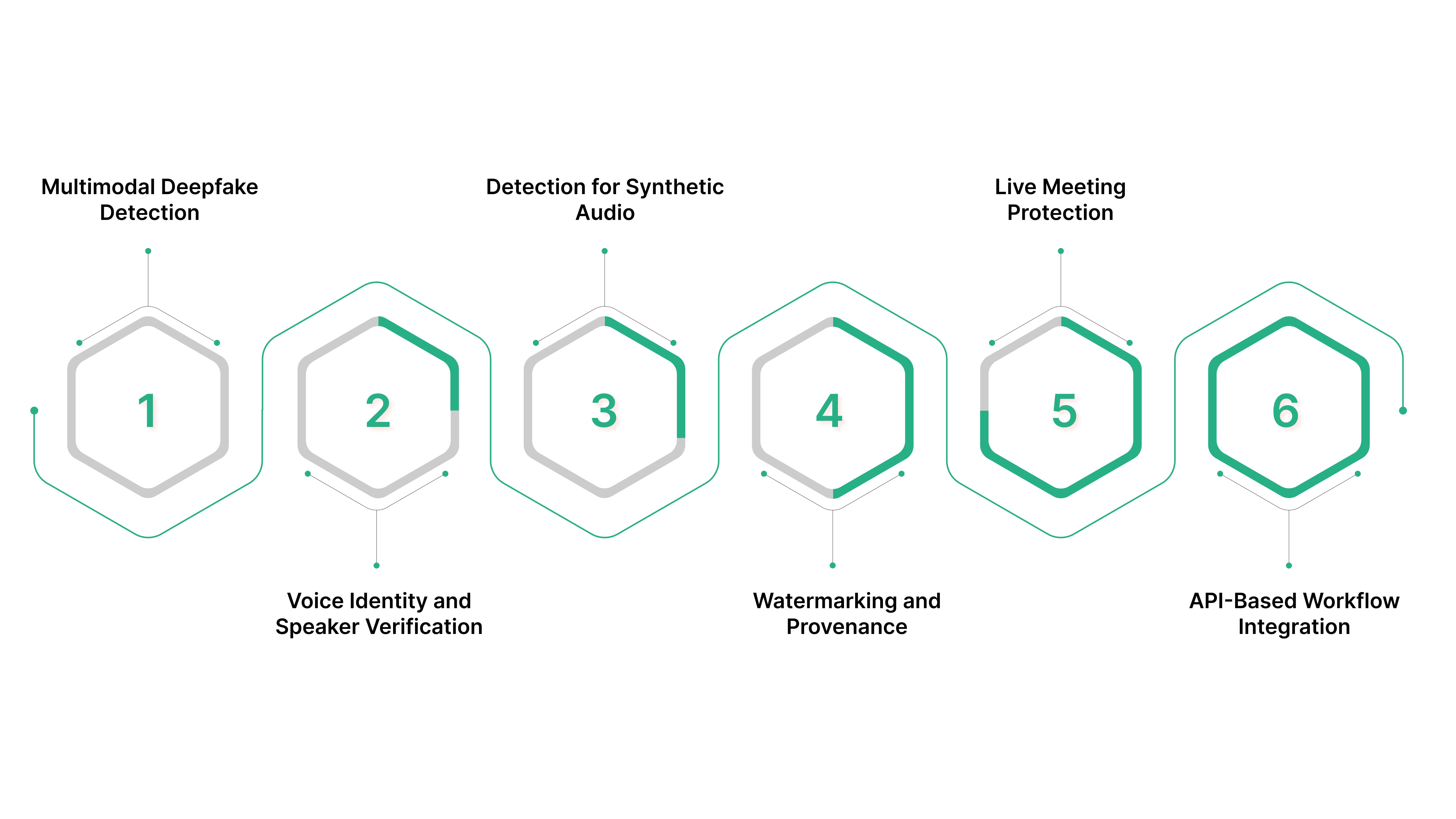
Multimodal biometric authentication works best when each identity factor is supported by detection, verification, and review context. When fraud, identity, contact center, or enterprise security teams evaluate this layer, the stronger question is not only whether a system can confirm a face, voice, or fingerprint. It is whether the system can help detect spoofed, synthetic, or manipulated identity signals before they affect an authentication decision.
Resemble AI fits into this workflow through voice and media verification capabilities that support multimodal identity security:
- Multimodal Deepfake Detection: Resemble Detect helps your team review suspicious audio, video, and image inputs as part of a broader authentication or fraud review process.
- Voice Identity and Speaker Verification: Voice-based verification can add another layer to authentication workflows, especially in IVR, contact center, and remote identity scenarios.
- Detection for Synthetic Audio: If your authentication process uses voice, your team needs ways to assess whether speech may be cloned, replayed, or generated.
- Watermarking and Provenance: Watermarking can help verify whether generated media came from a known system and whether it can be traced later.
- Live Meeting Protection: Resemble Meetings is relevant when your security or executive team needs to assess synthetic participants, face swaps, or voice clones during sensitive live calls. Resemble Meetings is designed for Zoom, Teams, Meet, and Webex workflows.
- API-Based Workflow Integration: Detection is more useful when it fits into your existing authentication, fraud review, or trust and safety systems.
Resemble AI is most useful when fraud, identity, and contact center teams treat it as part of a layered workflow: biometric verification, deepfake detection, provenance, and human review working together.
Conclusion
Multimodal biometric authentication is rapidly becoming the foundation of modern identity verification. As threats like deepfakes and synthetic identities continue to evolve, relying on a single layer of security is no longer a viable option.
By combining multiple biometric signals, fraud, identity, and security teams can create more resilient authentication workflows while managing user experience, privacy, and review accuracy. The challenge is to deploy these systems with clear governance, consent, and escalation processes.
Technologies like AI-driven voice analysis, liveness detection, and watermarking are shaping a future where authentication is continuous, intelligent, and resilient. In this evolving landscape, solutions like Resemble AI provide the tools needed to build secure and scalable systems.
If your fraud, identity, or contact center team is evaluating how multimodal biometric authentication can support voice, video, and remote verification workflows, book a demo with Resemble AI to test how detection, voice verification, watermarking, and live-call protection could fit into your authentication stack.
FAQs
1. What is multimodal biometric authentication? Multimodal biometric authentication verifies identity using more than one biometric trait or contextual factor. This may include voice, face, fingerprints, iris patterns, behavioral signals, device data, or location context. The goal is to reduce reliance on a single signal and create a more layered verification process.
2. How is multimodal biometric authentication different from single-factor biometrics? Single-factor biometrics rely on one trait, such as a fingerprint or face scan. Multimodal systems combine multiple modalities, such as voice and face, or fingerprint and behavior. This can help your fraud or identity team reduce reliance on one biometric channel, especially when one signal is weak, unavailable, or at higher risk of spoofing.
3. Why is multimodal biometric authentication important for fraud and identity teams? Multimodal biometric authentication is important because fraud and identity teams now face spoofing, replay attacks, deepfakes, and synthetic identity risks across remote workflows. A layered approach helps your team evaluate more than one identity signal before allowing access, approving transactions, or trusting a remote user.
4. Which biometric modalities work best together? The best combination depends on the use case. Face and liveness checks work well for onboarding. Voice and behavioral signals can support contact center or IVR authentication. Fingerprints and device signals are useful for mobile access. For high-risk workflows, your team should combine modalities that do not fail in the same way.
5. How does voice biometrics fit into multimodal authentication? Voice biometrics can verify users in remote, phone-based, or conversational workflows where face or fingerprint checks may not be practical. It can support IVR, customer support, account recovery, and hands-free access. Because voice can be cloned or replayed, your team should pair it with anti-spoofing and deepfake audio detection.
6. Why does deepfake detection matter in biometric authentication? Deepfake detection matters because biometric systems may otherwise treat a synthetic voice, face, or video as a trusted identity signal. For fraud and identity teams, this adds a review layer before access, account recovery, or transaction decisions are approved. It is especially useful when authentication happens remotely and the user is not physically present.
7. What is multimodal deepfake detection in authentication workflows? Multimodal deepfake detection reviews more than one media type, such as audio, video, image, and metadata. This helps your fraud or security team identify mismatches between voice, face, timing, behavior, and context. It is useful when authentication involves remote users, live calls, video onboarding, or sensitive access decisions.
8. What risks should fraud and security teams consider before using multimodal biometrics? Fraud and security teams should consider spoofing attempts, false positives, false negatives, model bias, user friction, integration complexity, and escalation gaps. These risks affect whether an authentication decision is reliable in practice. Privacy is also important, but the deeper data protection controls should be handled separately in your biometric governance process.
9. How can multimodal biometrics reduce false positives and false negatives? Multimodal biometrics can reduce error risk by giving the system more than one signal to evaluate. If one modality is weak because of lighting, noise, device quality, or user behavior, another signal may provide additional context. However, accuracy still depends on model quality, data diversity, and how the signals are fused.
10. How does liveness detection fit into multimodal authentication? Liveness detection helps confirm that a biometric input comes from a real, present person rather than a photo, recording, mask, or replayed video. In multimodal authentication, liveness can support face, voice, or fingerprint checks by reducing the risk that a spoofed biometric is accepted as genuine.
11. What should your team evaluate before adopting multimodal biometric authentication? Your team should evaluate the use case, biometric modalities, spoofing risks, privacy requirements, user friction, fallback options, deployment environment, and integration needs. You should also check whether the system explains decisions clearly and supports escalation when verification results conflict.
12. How can identity and security teams protect biometric data in multimodal systems? Identity and security teams can protect biometric data by minimizing collection, encrypting stored and transmitted data, using on-device or edge processing where appropriate, setting retention limits, and requiring user consent. Your team should also document how biometric signals are used, who can access them, and how authentication decisions are reviewed.