

As organizations deploy conversational AI and generate synthetic content, transparency is becoming a regulatory requirement rather than a best practice. Article 50 of the EU AI Act establishes disclosure obligations for specific AI use cases, requiring organizations to communicate when people are interacting with AI or consuming certain AI-generated content. Getting clarity on what the regulation demands is where practical compliance starts. We reviewed the official EU AI Act text to do the work for you.
This checklist summarizes the key requirements and practical steps teams can take to support compliance. The result is a grounded, step-by-step compliance checklist. It helps your team move from uncertainty to action with a clear framework.
Key Takeaways
- Article 50 transparency obligations apply from 2 August 2026 and cover voice AI, synthetic audio, deepfakes, and public-interest text.
- Providers and deployers carry different obligations, so confirming your role is the first step before mapping any requirements.
- Disclosure must appear at the first interaction or first exposure, not buried somewhere after users have already engaged.
- Machine-readable marking of synthetic audio is a separate requirement from user-facing disclosure, and both need to be in place.
- Evidence readiness matters as much as compliance itself, so keep system inventories, disclosure records, and exception analyzes audit-ready.
What Is Article 50 Of The EU AI Act?
Article 50 is the transparency chapter of the EU AI Act. It sets out when and how AI systems must disclose their nature to the people they interact with or to whom they produce content.
It covers AI-generated voice, synthetic audio, deepfake content, customer-facing agents, and content workflows where AI output could be mistaken for human-made media.
The European Parliament notes that the Act entered into force in August 2024, with transparency obligations under Article 50 applying from August 2026.
Who Has Obligations Under Article 50?
Article 50 covers a wider range of teams than most organizations initially expect. If your work touches AI systems that interact with people or produce synthetic content, this section of the regulation is relevant to you. Here's a quick way to self-identify.
- Providers building conversational AI systems: You build or supply AI systems that interact directly with people in real time, such as chatbots, voice agents, or virtual assistants.
- Providers generating synthetic media: You create or supply systems that produce synthetic audio, images, videos, or text at scale.
- Deployers using deepfake-capable systems: You use AI systems to generate or manipulate audio, video, or image content that depicts real or realistic people.
- Teams publishing AI-generated text on public-interest topics: You publish AI-generated or AI-manipulated text content related to elections, public health, or similar topics.
- Product, legal, compliance, trust and safety, security, and content operations teams: You own the workflows, systems, or review processes where Article 50 obligations are triggered and documented.
Important: Please note that obligations under Article 50 differ depending on whether your organization is the provider or deployer.
A provider builds or deploys an AI system to market. A deployer puts that system to use in their own workflows or products. Some organizations are both, and each role carries its own set of obligations under Article 50.
Both carry distinct responsibilities, so it is important to confirm your role before mapping obligations.
Article 50 Compliance Checklist For Providers
If your organization builds or places an AI system on the market, Article 50(1) assigns transparency obligations directly to you at the system design level.
Generative AI companies are responsible for ensuring that their systems are technically capable of meeting specific disclosure requirements before deployment. Work through each item below and confirm your position.
| Requirement | What to check | Owner | Evidence to keep |
|---|---|---|---|
| Confirm whether the AI system directly interacts with people. | Review voicebots, AI agents, IVR flows, chat systems, and autonomous support tools. |
Product
Legal
|
System inventory, workflow map, use-case notes |
| Check whether AI interaction is obvious in context. | Confirm whether a reasonable person can identify AI involvement without a separate notice. |
Legal
UX
|
Context review, screenshots, user journey notes |
| Add direct interaction disclosure where needed. | Place clear notice before or during the first meaningful user interaction. |
Product
UX
Legal
|
Disclosure copy, placement screenshots, QA notes |
| Review synthetic output types. | Identify generated audio, image, video, or text produced by the system. |
Product
Engineering
|
Output inventory, content examples, model notes |
| Check machine-readable marking requirements. | Confirm whether synthetic outputs need technical marking in a detectable format. |
Engineering
Compliance
|
Marking method, test results, technical documentation |
| Confirm technical feasibility and reliability. | Test whether marking works across expected formats, channels, and post-processing steps. |
Engineering
Security
|
Test logs, failure notes, version history |
| Document provider-side review ownership. | Assign teams for disclosure, marking, technical review, and future updates. |
Compliance
Product Ops
|
RACI, approval log, release checklist |
Article 50 Compliance Checklist For Deployers
If your organization puts an AI system to use in your own products or workflows, Article 50 places separate transparency obligations on you. Deployer duties are not limited to deepfakes or public-facing media.
Article 50 also covers emotion recognition systems, biometric categorization systems, and AI-generated text used to inform the public. Work through each item below and confirm your position.
| Requirement | What to check | Owner | Evidence to keep |
|---|---|---|---|
| Confirm whether the organization deploys AI-generated or manipulated content. | Review public campaigns, synthetic media workflows, voice content, videos, images, and customer-facing assets. |
Product
Content
Legal
|
Deployment inventory, content samples, channel list |
| Check for emotion recognition systems. | Confirm whether the system identifies, infers, or classifies emotional states from voice, face, behavior, or biometric signals. |
Product
Legal
Privacy
|
System description, vendor documentation, use-case review |
| Check for biometric categorization systems. | Review whether the system categorizes people using biometric data or biometric-based signals. |
Product
Legal
Privacy
|
Biometric assessment, data flow map, vendor notes |
| Inform exposed individuals where required. | Confirm that people exposed to emotion recognition or biometric categorization are told about the system's operation. |
Product
UX
Legal
|
Disclosure copy, placement screenshots, approval notes |
| Review personal data processing duties. | Check whether GDPR or other applicable EU data protection rules apply to the deployed workflow. |
Privacy
Legal
Security
|
DPIA, privacy notice, lawful basis review, data flow map |
| Identify possible deepfake content. | Check whether audio, image, or video could appear to show real people, places, events, or actions. |
Legal
Trust and Safety
|
Deepfake assessment, content examples, review notes |
| Add deepfake disclosure where required. | Disclose that the content has been artificially generated or manipulated before people rely on it. |
Content
Product
Legal
|
Disclosure copy, placement screenshots, approval log |
| Review artistic, creative, satirical, or fictional uses. | Check whether disclosure can be limited without harming the display or enjoyment of the work. |
Legal
Content
Editorial
|
Creative-use assessment, disclosure rationale, approval record |
| Review public-interest AI text. | Check text that informs people about civic issues, public services, health, rights, policy, or safety. |
Content
Legal
Compliance
|
Topic review, editorial notes, disclosure record |
| Confirm human review and editorial responsibility. | Check whether AI-generated public-interest text had human review and a responsible person or entity behind its publication. |
Editorial
Legal
Compliance
|
Editorial review log, owner name, approval record |
| Check whether a legal exception applies. | Review law enforcement or legally authorized uses only with careful legal confirmation. |
Legal
Compliance
|
Exception analysis, legal basis, supporting rationale |
| Confirm first exposure timing. | Place disclosure before or during the first point where people encounter the system or content. |
UX
Content
Product
|
User flow screenshots, QA notes, release checklist |
| Make disclosures clear, distinguishable, and accessible. | Review wording, visibility, contrast, screen reader access, audio access, and mobile display. |
UX
Accessibility
Legal
|
Accessibility review, test notes, screenshots |
| Keep a deployer-side evidence trail. | Store disclosure decisions, approvals, exception notes, review logs, and updated versions in one folder. |
Compliance
Product Ops
|
Audit folder, version history, ownership log |
How Article 50 Applies to AI-generated Audio
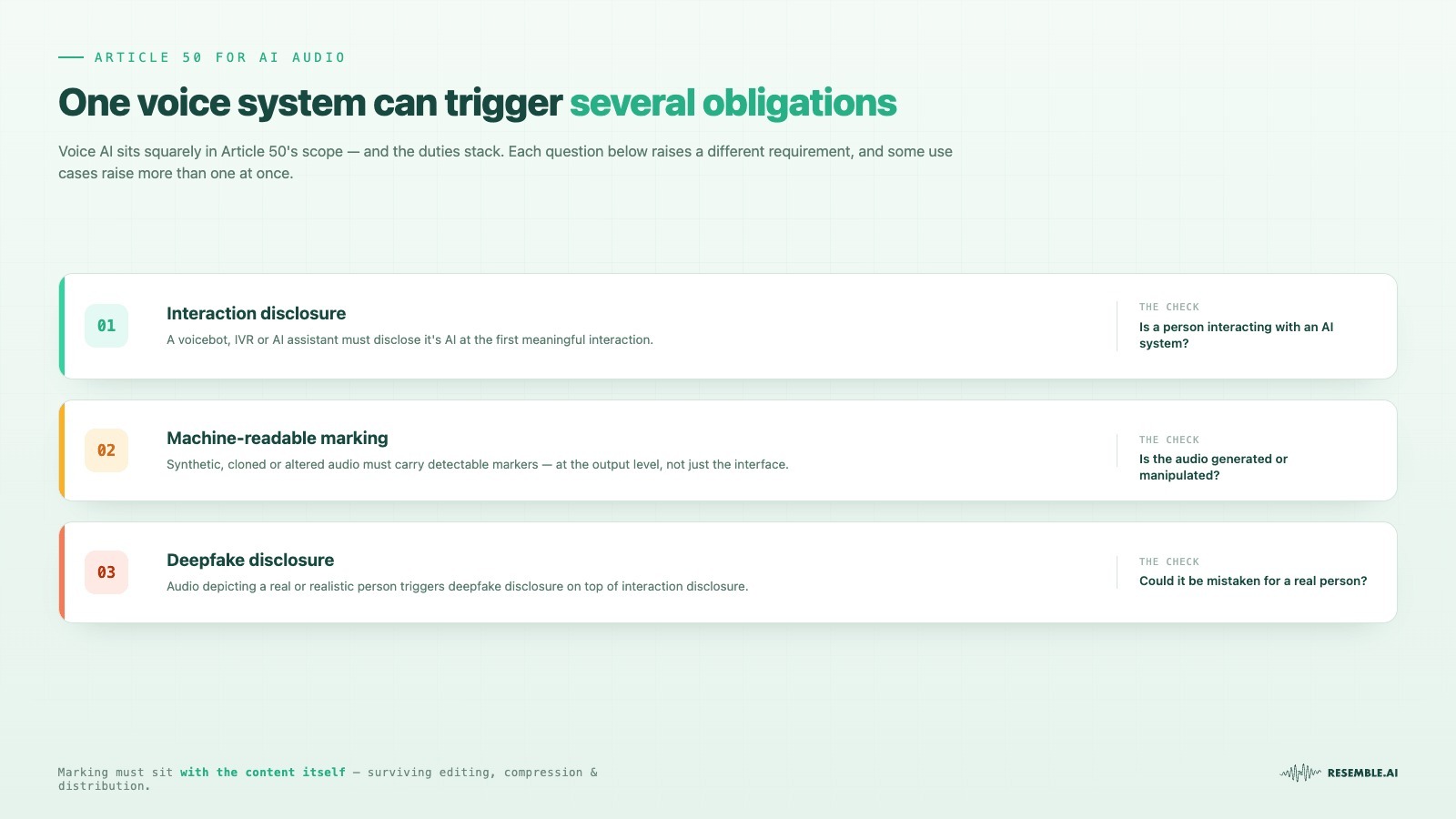
AI-generated voice sits squarely within Article 50's scope, and the obligations can stack up depending on what your system does. A voicebot triggers interaction disclosure requirements.
A cloned voice used in synthetic media may trigger deepfake disclosure requirements. A generated narration published in a public-interest context may trigger content-level disclosure requirements.
Each use case raises a different question, and some raise more than one.
Here are the practical checks your team needs to work through.
- Is a person interacting with an AI system? If a user is speaking to or receiving responses from a voice agent, IVR system, or AI assistant, disclosure is required before or at the first meaningful interaction.
- Is the audio generated or manipulated? If the output is synthetic, cloned, or significantly altered, check whether it needs to carry machine-readable markers that allow detection by other systems or platforms.
- Could the content be mistaken for a real person? If the audio depicts or replicates a real or realistic individual, assess whether deepfake disclosure obligations apply in addition to standard interaction disclosure.
- Is disclosure placed before or during the first meaningful interaction? Timing matters under Article 50. A disclosure buried after the interaction has begun may not satisfy the requirement.
- Is the system able to preserve detectable markers where technically feasible? Article 50 requires that synthetic audio, video, and image content be marked in a machine-readable format. This applies at the output level, not just the interface level.
Audio watermarking helps with the technical side of this review. It embeds a signal in synthetic audio so the file can later be checked for origin, provenance, or AI-generated content. Organizations should also document how the marking method is implemented, tested, monitored, and updated over time to demonstrate compliance during audits.
Under Article 50, this is useful because machine-readable marking needs to be embedded in the content itself, not only in a visible label or interface notice.
Build Governance Around Article 50 Compliance
Meeting Article 50 is not just about adding disclosures or applying machine-readable marking. Organizations also need governance processes that define who owns disclosure decisions, how synthetic content is reviewed before publication, how exceptions are documented, and how evidence is retained over time.
A practical governance workflow should include:
- clear ownership between product, legal, compliance, and engineering
- documented approval processes for disclosures and synthetic content releases
- periodic reviews of disclosure mechanisms and marking methods
- version-controlled records showing how compliance decisions evolved over time
For teams working with synthetic audio at scale, Resemble AI's Watermarker embeds imperceptible, persistent signals directly into generated audio. It gives your compliance and engineering teams verifiable, audit-ready evidence that synthetic content is marked at the point of creation.
Also read: Complete Guide to EU AI Act Watermarking Requirements for Generative AI
Common Mistakes Teams Make With Article 50
Most Article 50 gaps do not come from bad intent. They come from teams moving fast and making reasonable assumptions that turn out to be wrong. Here are six mistakes worth checking against your current approach.
1. Treating Article 50 as a legal-only review: Compliance teams flag it, but product and engineering never see it. Article 50 obligations are technical as much as they are legal. Pull in product, engineering, and trust and safety from the start.
2. Adding disclosure after launch instead of during product design: Retrofitting disclosure into a live system is harder than building it in from the beginning. Map your disclosure requirements during the design phase, before the system goes anywhere near users.
3. Using vague AI labels that users may miss: A small footnote or a buried banner may not satisfy the requirement for clear and distinguishable disclosure. Test whether a real user would notice and understand the disclosure on first exposure.
4. Ignoring machine-readable marking for synthetic outputs: Disclosure to users is one requirement. Machine-readable marking of synthetic audio, video, and image outputs is a separate process. Check whether your outputs carry detectable signals where technically feasible.
5. Treating voice AI, deepfake audio, and public-interest text as the same workflow: Each raises different Article 50 questions and may trigger different obligations. Map each use case separately rather than applying one blanket disclosure approach across all of them.
6. Forgetting accessibility and first-exposure requirements: Disclosure needs to reach every user, including those using assistive technology. It also needs to appear on first exposure, not later in the interaction. Check both timing and accessibility together.
What Evidence Should Teams Keep For Article 50 Compliance?
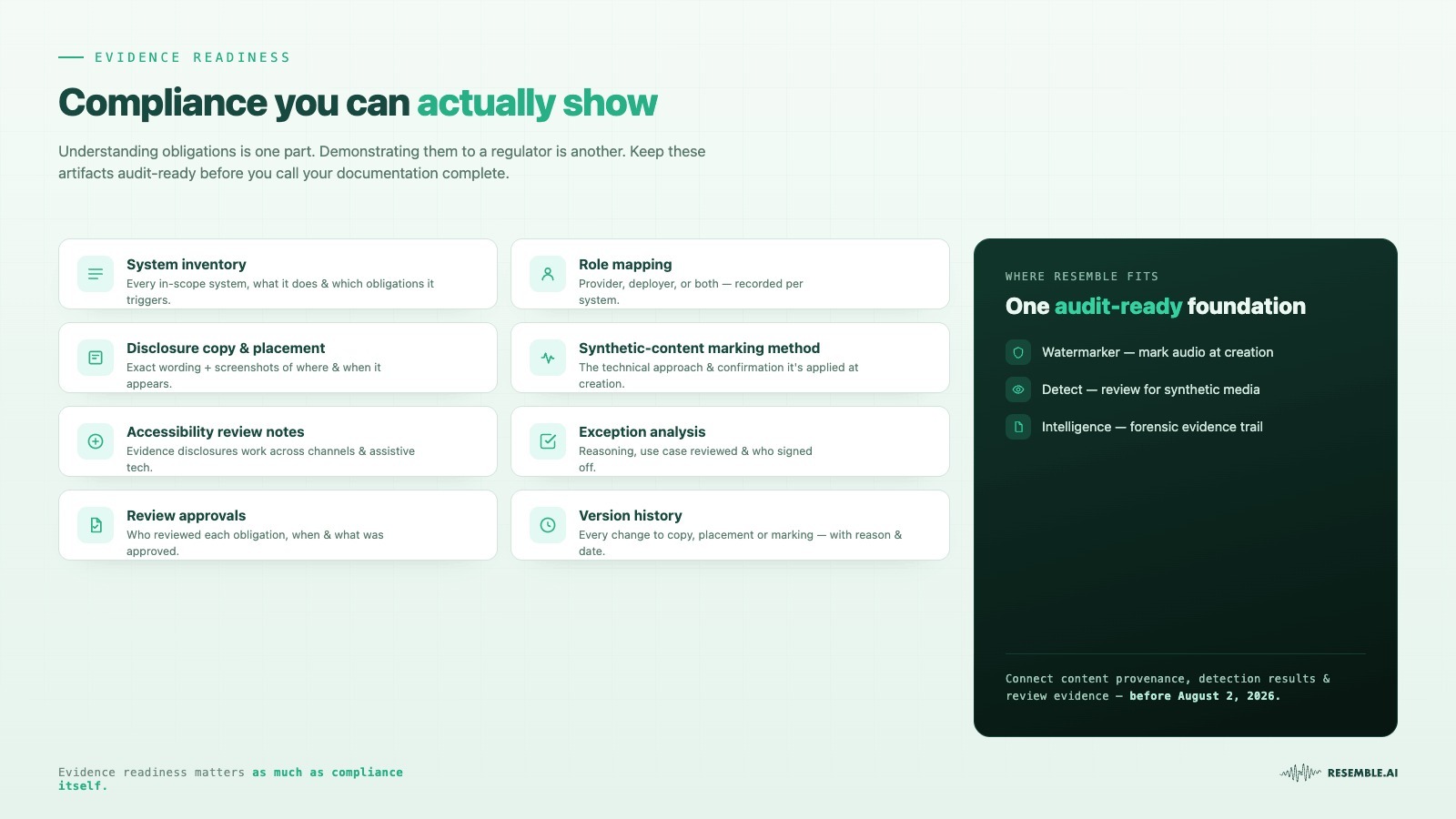
Understanding your obligations is one part of Article 50 readiness. Being able to demonstrate them to a regulator is another. Here is what your evidence log should include before you consider your compliance documentation complete.
- System inventory: A record of every AI system in scope, what it does, and which Article 50 obligations it triggers.
- Role mapping: A clear record of whether your organization is acting as a provider, a deployer, or both for each system in scope.
- Disclosure mechanism and placement screenshots: The exact wording used for each disclosure and documented evidence of where and when it appears to the user.
- Synthetic content marking method: Documentation of how synthetic audio, video, or image outputs are marked, including the technical approach used and confirmation that it is applied at the point of creation.
- Accessibility review notes: Evidence that disclosures have been reviewed for accessibility across all channels and user groups your system serves.
- Exception analysis: If your team has determined that an exception applies, document the reasoning, the use case reviewed, and who signed off on the assessment.
- Review approvals from legal, product, security, or compliance: A record of who reviewed each obligation, when the review took place, and what was approved.
- Version history for disclosure updates: A log of any changes made to disclosure copy, placement, or marking methods over time, including the reason for each change and the date it was made.
Where Resemble AI Simplifies Article 50 Readiness
Article 50 creates a practical review problem for teams working with synthetic audio. Teams need to know when content is AI-generated, whether it is marked, and how that evidence is documented before release.
Resemble AI helps with the above in three ways.
1. Mark Synthetic Audio at Creation
Article 50 asks providers to support machine-readable marking for synthetic content where required. Resemble Watermarker can help teams apply provenance signals when synthetic audio is created, instead of adding labels after distribution. This helps product and compliance teams keep marking closer to the source file. It also makes the review process easier when audio moves through editing, compression, publishing, or customer-facing channels.
2. Detect Deepfakes Before People Rely On Them
Deployers also need to review whether generated or manipulated content may require disclosure. Resemble Detect supports this by helping teams analyze audio, image, and video content for synthetic or manipulated media. This matters in voice AI workflows where cloned voices, synthetic support calls, or submitted media may reach users, agents, reviewers, or trust and safety teams.
3. Keep Evidence for Compliance Review
Article 50 readiness also depends on documentation. Teams need records showing what was generated, how it was marked, when it was reviewed, and why a disclosure decision was made. Resemble Intelligence turns detection results into forensic explanations, including artifacts, fraud type, liveness status, and audit trail details. This helps compliance, legal, and security teams document what was reviewed, why it was flagged, and how a decision was reached. When paired with Watermarker and Detect, teams can connect content provenance, detection results, and review evidence.
Start Your Article 50 Compliance Review Before August 2026
Article 50 is one of the more concrete and actionable parts of the EU AI Act. The obligations are specific, the timeline is fixed, and the evidence requirements are documented. Teams that map their systems early, confirm their role, and build disclosure into their workflows will be in a much stronger position than those treating it as a last-minute legal review. Resemble AI brings watermarking and deepfake detection into one governance view, giving your compliance, engineering, and legal teams a shared, audit-ready foundation for synthetic voice workflows. Resemble AI supports Article 50 readiness through identity enrollment, multimodal watermarking and detection, and audit-ready evidence to help organizations manage synthetic media throughout their lifecycle.
Book a demo today to see how it fits your specific deployment context.
Frequently Asked Questions
1. What is Article 50 of the EU AI Act? Article 50 of the EU AI Act concerns transparency for certain AI systems. It covers AI notices, synthetic content marking, deepfake disclosure, and public-interest text disclosure. For voice AI teams, it turns compliance into product, content, and evidence checks.
2. Does Article 50 apply to voice AI systems? Yes, Article 50 can apply when voice AI interacts with people or creates synthetic audio. A voicebot, IVR agent, cloned voice, or AI assistant may trigger different transparency duties. The first step is mapping each workflow before writing disclosure copy.
3. What counts as synthetic audio under Article 50? Synthetic audio is audio generated or meaningfully changed by an AI system. This can include cloned voices, generated narration, AI voice agents, or manipulated speech. The main question is whether people may treat the audio as real.
4. Does AI-generated audio need to be labeled? AI-generated audio may need labeling when Article 50’s transparency triggers apply. Teams need to check whether the audio is synthetic, manipulated, or used in a user-facing workflow. They also need to review whether machine-readable marking is required and technically feasible.
5. What is a deepfake under the EU AI Act? A deepfake is AI-generated or manipulated audio, image, or video resembling real people, places, or events. Under Article 50, deployers may need to disclose deepfake content to people exposed to it. For synthetic voice, this is relevant when audio could sound like a real speaker.
6. Who is responsible for Article 50 compliance, the provider or deployer? Responsibility depends on the organization’s role in the specific AI workflow. Providers usually handle system-side disclosure design and synthetic content marking duties. Deployers usually handle disclosures when using deepfakes or AI-generated public-interest content.
7. When does the AI disclosure need to appear? Article 50 points teams toward disclosure at the first interaction or first exposure. The notice needs to appear before people meaningfully engage with the AI system or content. If the notice appears too late, people may have already formed trust.
8. What does machine-readable marking mean? Machine-readable marking means synthetic content carries technical signals that systems can detect. For audio, this may involve provenance signals or watermarking that support later verification. Teams need to test whether markers survive editing, compression, and distribution.
9. Are there exceptions under Article 50? Yes, Article 50 includes exceptions for certain contexts and uses. These may involve assistive editing, human editorial control, or specific legal purposes. Each exception needs legal review because workflow details can change the answer.
10. Does human review remove all disclosure obligations? Human review does not automatically remove every Article 50 disclosure duty. The answer depends on how much AI shaped the final content and how it is used. Teams need to document review steps, editorial control, and the final disclosure decision.
11. How should teams document Article 50 compliance? Start with an inventory of AI systems, outputs, channels, and user touchpoints. Then store role mapping, disclosure copy, marking methods, screenshots, approvals, and exception notes. This gives product, legal, compliance, and security teams one reviewable evidence trail.
12. How can Resemble AI support Article 50 readiness? Resemble AI supports Article 50 readiness through identity enrollment, multimodal machine-readable marking, multimodal detection, and audit-ready evidence, helping organizations manage synthetic media throughout their lifecycle.