




AI Watermarking: Tools and Techniques Guide
AI watermarking is the process of embedding signals, identifiers, or provenance information into AI-generated content. These markers can help organizations determine whether content originated from a specific AI system or workflow. As synthetic media becomes more common across customer support, media production, and digital communications, questions about authenticity and verification are increasingly important.
This guide explains how an AI watermarking tool works, where watermarking fits into content verification workflows, what limitations exist, and what teams should evaluate before adopting watermarking technologies. It also examines how watermarking relates to broader approaches such as content provenance and deepfake detection.
TL;DR
- AI watermarking embeds identifiers or authenticity signals into generated content.
- Watermarking is used in media production, content localization, security, and synthetic media workflows.
- Watermarks can support provenance and transparency but may not guarantee authenticity.
- Content modifications, compression, and platform processing can affect some watermarking methods.
- Organizations should evaluate robustness, verification workflows, scalability, and governance requirements.
- Watermarking often works best alongside provenance systems and detection technologies.
What Is AI Watermarking?
AI watermarking refers to techniques designed to embed identifiable information into AI-generated content. The information may be visible, invisible, cryptographic, statistical, or metadata-based, depending on the implementation. Watermarking can apply to text, images, video, and audio assets.
An AI watermarking tool helps organizations create, manage, verify, or detect these embedded signals. In customer support, media production, content localization, and synthetic voice deployments, watermarking may provide additional context about content origin and generation history.
Why AI Watermarking Matters
- Contact centers deploying synthetic voice agents need a way to verify that audio in a fraud dispute originated from their licensed system, not a cloned version.
- Media production teams distributing AI-generated voiceover need traceable records to satisfy emerging disclosure regulations, including the EU AI Act.
- Security operations teams investigating potential voice fraud need forensic mechanisms that survive MP3 compression, telephony re-encoding, and downstream audio editing.
- Enterprise content governance teams need audit trails demonstrating that AI-generated assets were produced within approved pipelines.
- Governments and regulators are increasingly encouraging provenance, transparency, and disclosure mechanisms for AI-generated content. Watermarking is one technical approach organizations may adopt to support these obligations.
According to a January 2026 market report from The Business Research Company, the AI model watermarking market may reach $0.42 billion in 2025, growing from $0.33 billion in 2024, a 29.3% increase. The market could exceed $1.17 billion by 2029. (Market-size estimates vary significantly by research firm, so treat this as directional rather than precise.)
How AI Watermarking Actually Works
AI watermarking generally follows two complementary approaches. One embeds a machine-readable signal directly into the content. The other uses signed provenance information that can be verified later. Together, these approaches help establish where content came from and whether its provenance can be validated.
In watermark-based systems, the identifier becomes part of the content itself. Depending on the media type, the watermark may be embedded within audio signals, pixels, video frames, or text patterns. Verification tools can later analyze the content to determine whether the signal is present. Because the watermark is embedded in the content rather than stored only as metadata, it can be designed to remain detectable after common transformations.
Provenance-based systems work differently. They use cryptographically signed records to provide information about content origin and modification history. Standards such as C2PA Content Credentials can make this information readable by compatible platforms and verification tools.
In practice, these mechanisms serve different but complementary purposes: embedded watermarks provide a signal that travels with the content, while provenance records provide additional context about its origin and history.
Also Read: How Watermarking AI Audio News Protects Credibility in Media
The Biggest Problems With AI Watermarks
Watermarking is not a closed problem. Understanding its failure modes is as important as understanding how it works, especially for security and fraud teams making deployment decisions.
Several challenges affect how reliably watermarks survive real-world distribution, editing, and verification processes:
- Adversarial attacks: Diffusion-based image-editing and audio-manipulation tools can degrade or remove watermarks. Diffusion models effectively perform distribution-shifting perturbations that are not easily anticipated during watermark training, meaning a watermark robust to standard transformations may not withstand targeted removal attempts by sophisticated adversaries.
- The watermarking trilemma: Research published at AISTATS 2025 found that no existing watermarking scheme combines robustness, unforgeability, and public detectability. The authors show that combining all three is theoretically possible, but significant technical barriers currently make such systems difficult to implement in practice. Teams should therefore evaluate which security and verification properties matter most for their specific use case.
- Metadata fragility: Provenance standards like C2PA rely on manifest metadata attached to files. A simple screenshot eliminates any trace of provenance. An upload to a social media platform that recompresses images produces the same result. Format conversion using incompatible tools erases the manifest entirely.
- Coverage gaps: Watermarking only covers content generated by systems that implement it. Content produced by other AI systems, or content that predates watermarking implementation, carries no verifiable marker.
The practical implication for security teams: watermarking should be treated as one layer within a defense-in-depth strategy, not as a standalone solution.
Types of AI Watermarking Techniques
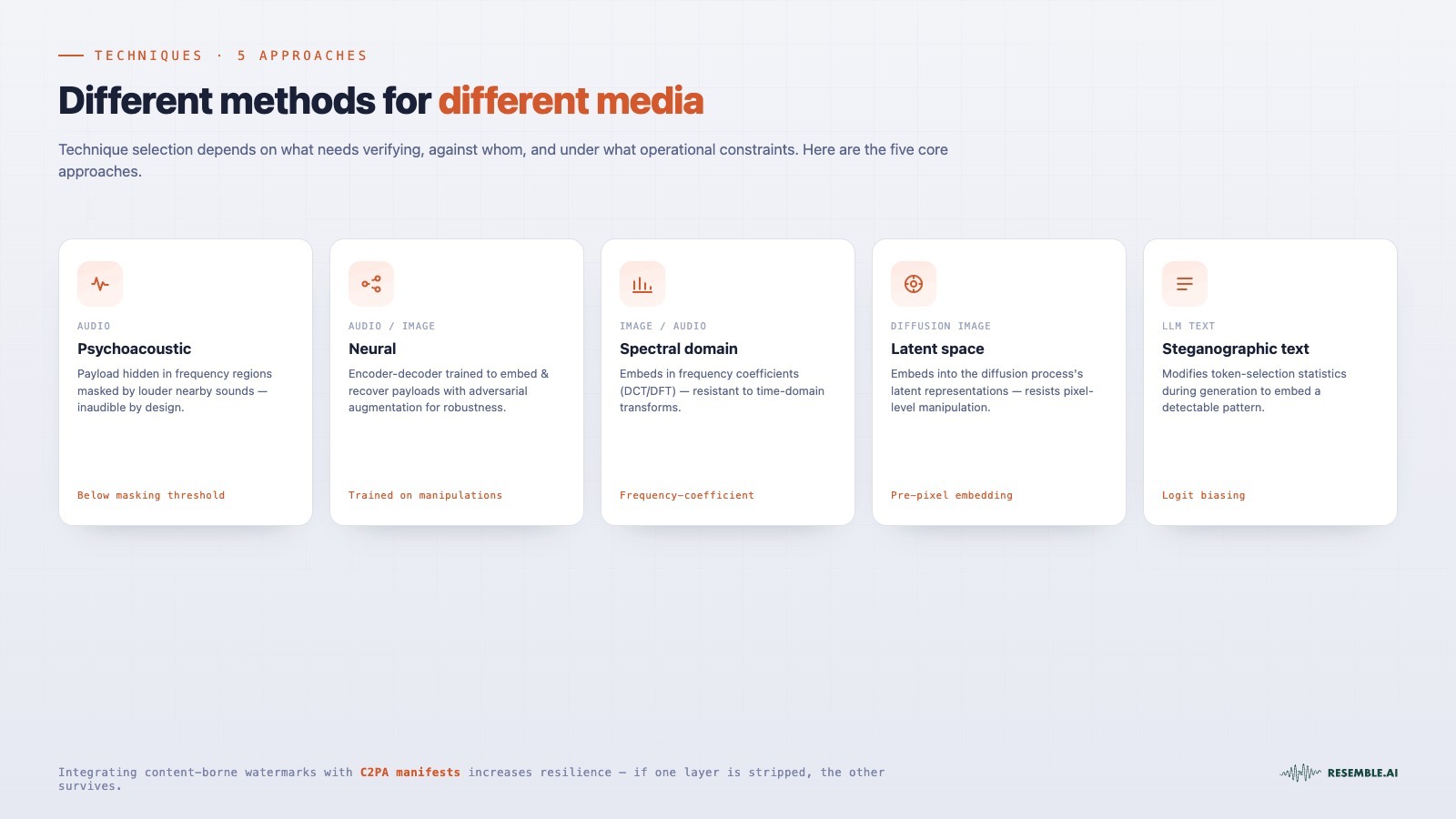
Different watermarking approaches suit different content types, threat models, and deployment conditions. The technique selection depends on what needs to be verified, against whom, and under what operational constraints.
- Psychoacoustic audio watermarking: Embeds payload into frequency regions masked by the primary audio signal. The watermark remains inaudible because the human auditory system cannot distinguish signals below the masking threshold of nearby louder sounds.
- Neural watermarking: Encoder-decoder architectures trained to embed and recover payloads while maintaining content quality. Training typically includes adversarial augmentation, such as sine injection, time-stretching, and resampling, to improve robustness.
- Spectral domain watermarking: Embeds signals in the frequency domain (e.g., DCT or DFT coefficients) rather than the raw signal. Historically used in image and audio watermarking; more resistant to time-domain transformations but potentially vulnerable to spectral attacks.
- Latent space watermarking: For diffusion-based image models, it embeds watermark signals into the diffusion process's latent representations rather than the output pixel space, offering resistance to pixel-level manipulation.
- Steganographic text watermarking: For LLM outputs, it modifies token selection statistics during generation through logit biasing or tournament sampling to embed a detectable statistical pattern without altering surface-level text quality.
Post-hoc metadata approaches, such as C2PA credentials, encode provenance externally but are fragile under metadata stripping. Integration of content-borne watermarks with C2PA manifests increases resilience: even if one layer is stripped or corrupted, the other may support verification.
Popular AI Watermarking Tools
The following tools represent the current landscape of production-grade and research-active AI watermarking options. Capabilities and limitations vary significantly.
Evaluation checklist when comparing tools:
- Does the watermark survive the transformations common in your distribution pipeline (compression, resampling, platform re-encoding)?
- What is the false positive rate at your operating threshold?
- Does the tool support C2PA manifest generation alongside embedded watermarking?
- Is detection available as a real-time API or only as a batch process?
- What is the deployment model: cloud API, on-premises, or edge?
- Is the tool EU AI Act compliant?
Best Practices for AI Watermarking in 2026
Organizations deploying AI watermarking in production environments benefit from treating it as infrastructure rather than a feature. The following practices reflect operational patterns across enterprise, media, and security deployments.
- Watermark at generation, not distribution: Embedding the watermark during content creation before any downstream processing maximizes survival probability. Post-processing watermarking introduces an additional attack surface and pipeline complexity.
- Layer neural watermarks with C2PA manifests: Neither approach fully compensates for the other's failure modes. Neural watermarks persist through format conversion that strips metadata; C2PA manifests provide richer provenance data when intact.
- Train for your threat model: A watermark robust against casual re-encoding may not survive a targeted adversarial attack. Understand the capability of likely adversaries before selecting robustness parameters.
- Separate watermark verification from deepfake detection: A verified watermark confirms provenance from a known system. Absence of a watermark does not confirm authenticity. Run deepfake detection independently for content without a verifiable marker.
- Audit watermark coverage regularly: Track the percentage of generated content that is watermarked. Gaps due to pipeline bypasses, legacy systems, or edge cases undermine the forensic value of the entire program.
- Document limitations for legal and compliance teams. Watermark evidence in a fraud or IP dispute has different legal weight than other forensic evidence. Ensure legal and compliance teams understand what a recovered watermark does and does not prove.
How Resemble AI Supports Multimodal Content Provenance
Resemble AI Watermarker is built to establish verifiable provenance across audio, images, video, and text. At its core is PerTh Multimodal, which embeds imperceptible, tamper-resistant signals directly into content rather than relying only on metadata. Organizations can apply a watermark when content is created or at another point in their workflow, then decode it later to verify the embedded signal.
Unlike a single watermarking technique applied across every file type, PerTh Multimodal uses a purpose-built approach for each modality. This allows Resemble AI to account for the different ways audio, visual, video, and text content are processed and transformed after distribution.
PerTh Multimodal: Watermarking Across Audio, Image, Video, and Text
- Covers audio, image, video, and text through a multimodal watermarking system.
- Uses modality-specific encoding methods, including spectral and psychoacoustic techniques for audio, pixel-level methods for images and video, and linguistic techniques for text.
- Embeds the watermark within the content itself so provenance does not depend solely on removable file metadata.
- Supports encoding and verification of watermarks as content moves through downstream workflows and transformations.
Resemble AI Watermarker: Adding Provenance and Verification
Resemble AI Watermarker brings these watermarking capabilities into a production system for applying and verifying provenance signals. It also works with established provenance technologies to provide additional context when content is inspected.
- Applies and verifies Resemble watermarks across supported media types.
- Reads SynthID and C2PA markers alongside Resemble watermarks.
- Can write and sign C2PA Content Credentials, adding a cryptographically signed provenance record alongside the embedded watermark.
- Supports API-based workflows for organizations that need to add provenance checks to existing content pipelines.
Final Thought
AI watermarking can help organizations establish content provenance, support transparency, and strengthen authenticity workflows. However, watermarking works best when viewed as one layer within a broader verification strategy. Metadata, provenance systems, detection technologies, and operational processes all play important roles in determining whether content can be trusted.
As synthetic media adoption expands across customer support, security operations, gaming, and media production, organizations increasingly evaluate content authenticity and provenance controls. Rather than focusing solely on watermarking features, teams should assess verification across entire workflows.
If you're evaluating watermarking, provenance, or deepfake detection strategies ahead of upcoming compliance requirements, contact us to discuss your use case and assess implementation approaches that align with your operational goals and governance needs.
Frequently Asked Questions
1. What does an AI watermarking tool actually do?
It embeds an imperceptible signal into AI-generated content at creation. This signal can later be extracted to verify whether the content came from a specific system and whether it has been altered.
2. Is AI watermarking the same as deepfake detection?
No, watermarking verifies provenance for content that was watermarked at creation. Deepfake detection analyzes any audio or media to determine whether it is synthetic, regardless of whether a watermark exists.
3. Can AI watermarks be removed?
No watermark is completely resistant to every form of manipulation. A strong watermark should remain detectable after common transformations such as compression, resizing, transcoding, or editing, while making deliberate removal difficult without significantly altering the underlying content. Its effectiveness ultimately depends on how the watermark is designed and the type of attack used against it.
4. What is C2PA, and how does it relate to watermarking?
C2PA (Coalition for Content Provenance and Authenticity) is a metadata provenance standard that attaches a signed manifest to content at creation. It is fragile under metadata stripping but provides richer chain-of-custody data when intact; it works best as a complement to embedded neural watermarks.
5. Does watermarking degrade audio quality?
A well-implemented neural watermark operating below the human perceptual threshold should not produce audible artifacts. Quality metrics like SNR and PSNR are used to verify this before deployment.
6. What is PerTh Multimodal from Resemble AI?
PerTh Multimodal is Resemble AI’s enterprise watermarking technology for audio, images, video, and text. It embeds imperceptible, tamper-resistant signatures into digital content so organizations can verify provenance and identify marked media after it has been distributed or transformed. Each modality uses a purpose-built watermarking approach, with real-time encoding and verification available through Resemble AI’s API.
7. Can watermarks survive MP3 compression?
Neural watermarks trained with adversarial augmentation, including MP3 re-encoding, can maintain high recovery rates after compression. However, recovery accuracy should be verified against the specific codec and bitrate used in each deployment environment.
8. Does watermarking work for text content?
Yes, though techniques differ. Text watermarking typically involves modifying token selection statistics during LLM generation. These methods carry different robustness trade-offs than audio or image watermarking and can be defeated by paraphrasing.
9. Is AI watermarking required under the EU AI Act?
The EU AI Act includes provisions requiring disclosure of AI-generated content. Watermarking is one technical mechanism for satisfying verifiable origin requirements, and compliance guidance is evolving. Organizations should consult current regulatory text for their specific obligations.
10. What should a fraud team verify when encountering watermarked audio?
They should verify: whether the payload matches a known system registry, whether the C2PA manifest (if present) is intact and signed correctly, whether the content has been modified since watermarking, and separately, whether the audio passes deepfake detection analysis.
11. Can watermarks survive re-recording through a speaker?
This is a known attack vector called the "analog hole." Some neural watermarks incorporate training for this scenario; recovery rates vary. Teams in telephony and contact center environments should test specifically against this transformation.
12. Should organizations watermark all AI-generated content, not just audio?
Yes, a governance framework that watermarks audio but not AI-generated images, video, or text creates gaps that can be exploited. Multimodal watermarking coverage, combined with consistent chain-of-custody logging, provides a more defensible posture for compliance and incident response.
.avif)
