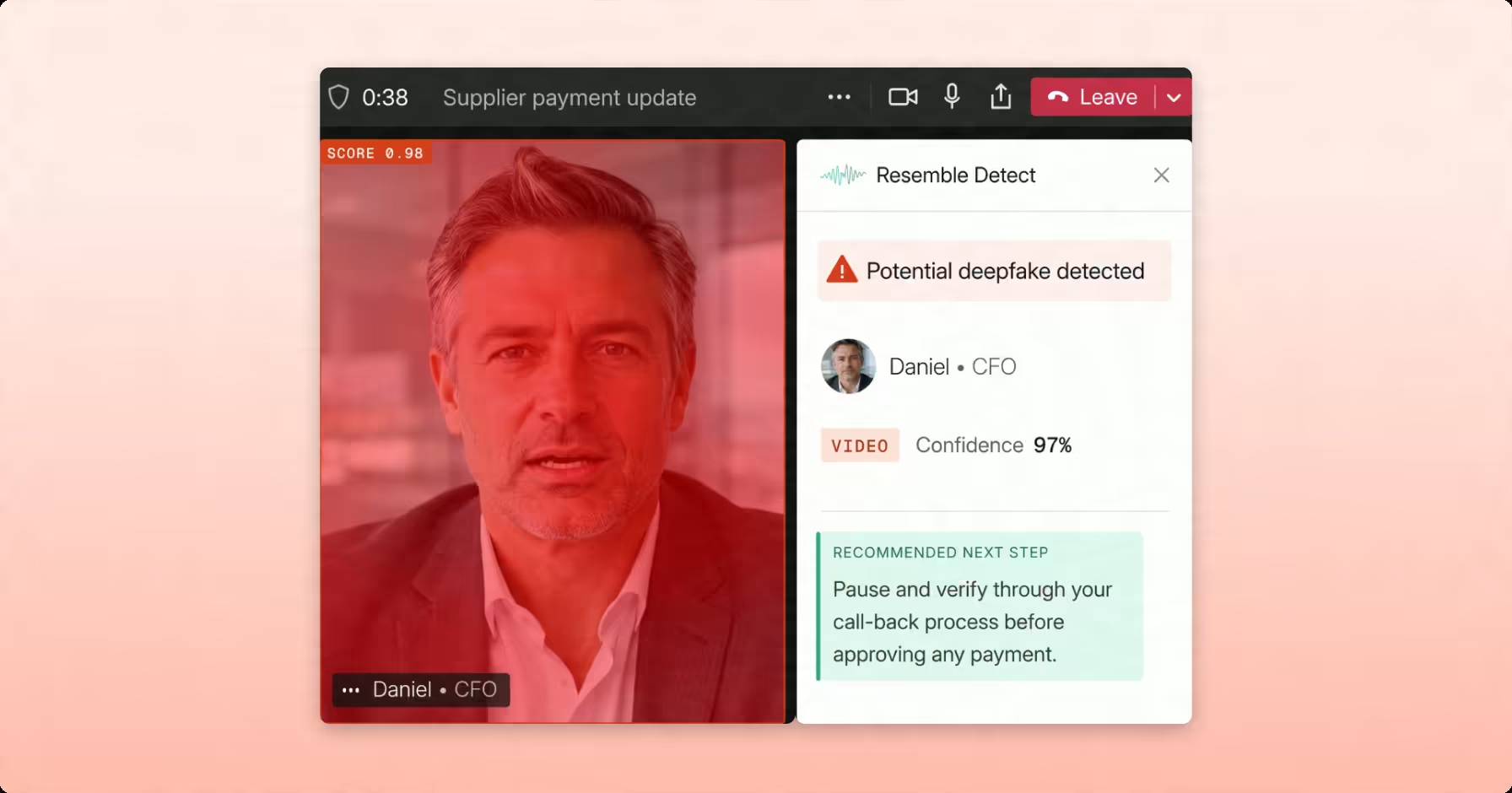
.avif)

Most enterprise leaders read about the shifting California AI Law ecosystem and assume geographic borders offer a natural shield, until a compliance fine or class-action lawsuit halts their operations.
If you think your software is exempt because your engineering team is based outside of California, you are fundamentally miscalculating how modern regulatory jurisdiction works. In 2026, the internet has no borders, and if your synthetic media, enterprise data, or consumer models touch a single California resident, you are legally exposed.
This comprehensive guide breaks down exactly what California’s new legislative framework requires, identifies the high-risk industries squarely in the regulatory crosshairs, and provides a clear, practical roadmap to future-proof your AI architecture.
Key Takeaways:
- California AI Law is not one law. It combines rules around AI transparency, synthetic media, privacy, automated decision-making, performer rights, and consumer protection that already apply to businesses using AI.
- SB 942 pushes AI-generated content toward detectable disclosures and provenance tracking, while AB 2013 increases pressure for transparency around generative AI training data.
- California’s updated CCPA/ADMT regulations became effective on January 1, 2026, adding risk assessments, cybersecurity audits for certain businesses, and consumer rights related to automated decision-making systems.
- Deepfakes are now a real compliance and fraud issue, with risks including executive impersonation, wire fraud, vishing, synthetic candidates, and manipulated audio, image, and video content.
- Healthcare, HR, fintech, media, and AI platforms face the highest scrutiny, making AI governance, audit trails, disclosure workflows, consent records, and provenance tracking critical for compliance.
What is California AI Law?
California AI Law is not one single law. It is shorthand for California laws and AI-related rules that already apply when a company builds or uses AI, especially regarding consumer protection, civil rights, competition, data privacy, and healthcare.
California’s Attorney General also said its 2025 AI advisories were not comprehensive, meaning the rules keep expanding rather than fitting into a single, neat statute.
In simple terms, it asks businesses to be ready for:
- Disclosure: Tell people when AI is being used.
- Fairness: avoid biased or discriminatory outcomes.
- Privacy and accountability: keep AI use within existing legal duties.
- Higher-risk use cases like healthcare and synthetic media.
To understand the compliance pressure around AI in 2026, businesses first need to understand the California AI laws driving it.
The California AI Laws Businesses Should Know in 2026
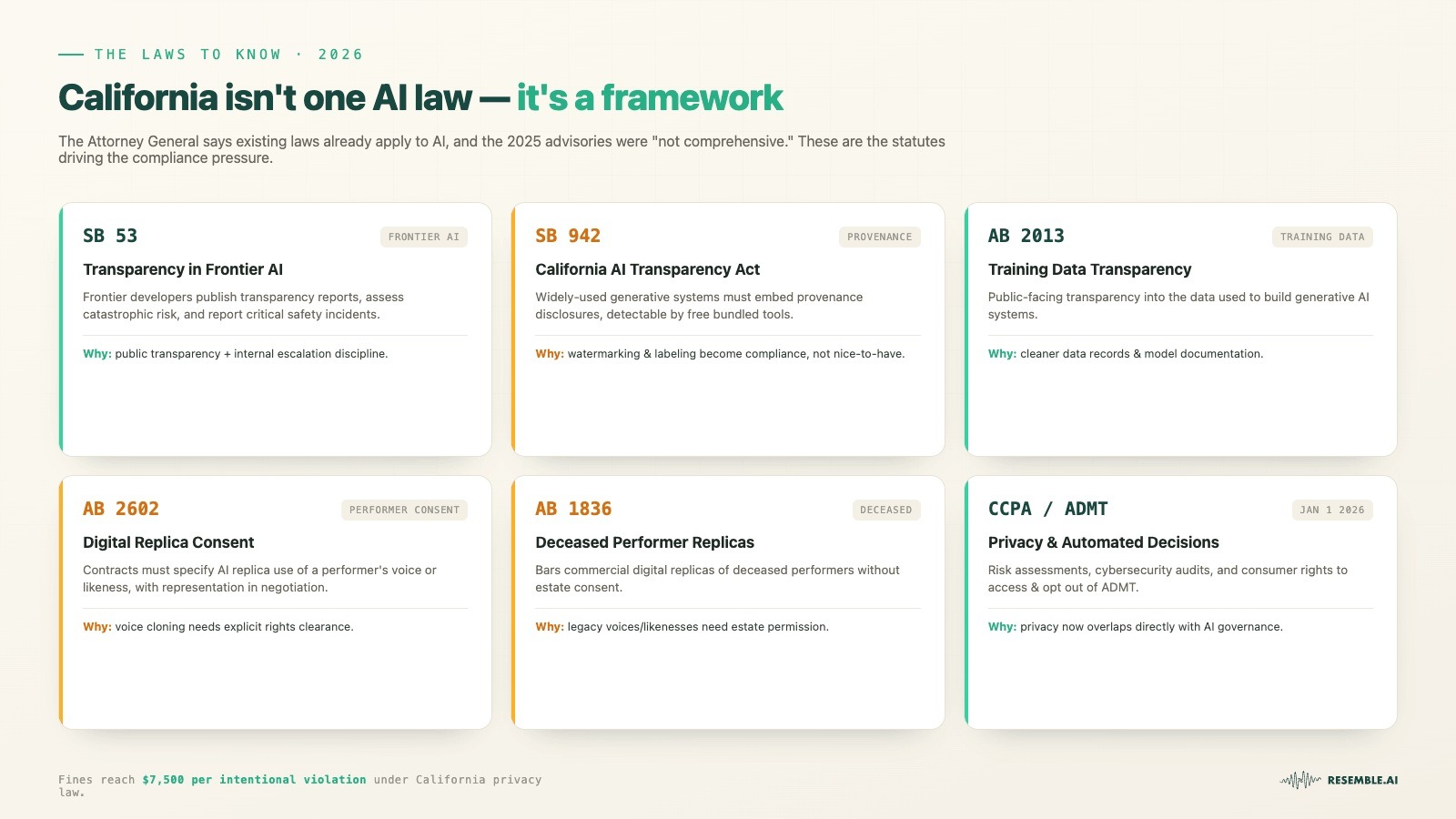
California is not regulating AI through a single statute. Its Attorney General has said existing state laws already apply to AI, including consumer protection, civil rights, competition, and data privacy laws, and the state’s 2025 AI advisories were explicitly described as not comprehensive.
- SB 53: Transparency In Frontier AI
SB 53, the Transparency in Frontier Artificial Intelligence Act, is California’s frontier-model law. It requires frontier developers to publish transparency reports before or alongside deployment, includes reporting on catastrophic-risk assessments, and creates critical-safety-incident reporting and whistleblower protections.
Why it matters: If a business builds or deploys frontier-scale AI, California now expects public-facing transparency plus internal escalation and reporting discipline.
- SB 942: California AI Transparency Act
SB 942 requires widely used generative AI systems to include provenance disclosures in the content they generate, with those disclosures detectable by free tools bundled with the system. The Governor said it is aimed at helping the public more reliably identify AI-generated content.
Why it matters: this pushes watermarking, labeling, and detection from “nice to have” into the compliance conversation for synthetic media.
Note: The operative date for SB 942's disclosure requirements was pushed to August 2, 2026 by AB 853; hosting-platform obligations follow on January 1, 2027.
- AB 2013: Generative AI Training Data Transparency
AB 2013 is the Generative Artificial Intelligence: Training Data Transparency law. California’s frontier-AI report says it requires public-facing transparency into the training data used to build generative AI systems.
Why it matters: Businesses and vendors will need cleaner training-data records, model documentation, and stronger diligence around what powers the system.
- AB 2602: Performer Digital Replica Consent
AB 2602 requires contracts to specify the use of AI-generated digital replicas of a performer’s voice or likeness, and the performer must be professionally represented in negotiations.
Why it matters: Any workflow involving voice cloning or likeness replication needs explicit rights clearance, not informal approval.
- AB 1836: Deceased Performer Replica Protections
AB 1836 prohibits commercial use of digital replicas of deceased performers in films, TV shows, video games, audiobooks, sound recordings, and similar uses without estate consent.
Why it matters: Brands and media teams using legacy voices or likenesses need estate permission before publishing.
- CCPA / ADMT Regulations: Effective January 1, 2026
California’s privacy agency adopted updated CCPA regulations in 2025, effective January 1, 2026. They add risk assessments, annual cybersecurity audits for some businesses, and consumer rights to access and opt out of businesses’ use of automated decision-making technology (ADMT).
Organizations may also face fines of up to $7,988 per intentional violation under California privacy law, which raises the stakes for businesses deploying AI systems that handle consumer data or automated decisions.
Why it matters: If AI affects hiring, pricing, ranking, eligibility, or profiling, California privacy compliance now overlaps directly with AI governance.
Note: Risk-assessment and cybersecurity-audit duties took effect January 1, 2026. ADMT-specific consumer rights — pre-use notice, opt-out, and access to decision logic — follow on January 1, 2027
The strongest compliance pressure, however, is now forming around synthetic media and deepfakes.
Why California AI Law Matters for Synthetic Media and Deepfakes
California has moved synthetic media out of the future risk bucket and into active legal scrutiny. The state has already signed measures aimed at AI watermarking, deepfake misuse, and the protection of performers’ digital likenesses, while the Attorney General has said existing California laws already apply to AI.
That matters because a voice clone, AI-generated clip, or manipulated image can now create consent, disclosure, and authenticity issues before it ever becomes a customer-facing asset. For businesses, the question is no longer just “Can we make this?” It is “Can we prove it is permitted, labeled, and traceable?”
- Provenance is becoming mandatory: SB 942 pushes AI-generated content toward detectable disclosure and watermarking.
- Voice and likeness need consent: AB 2602 and AB 1836 tighten rules around digital replicas of performers, living and deceased.
- Deepfakes are now a real legal category: California has specifically targeted sexually explicit deepfakes and election-related manipulations.
- Trust becomes infrastructure: Businesses need detection, audit trails, and rights clearance before synthetic media scales.
And for some industries, that pressure is arriving much faster than others.
As synthetic media becomes harder to identify manually, businesses are increasingly looking for ways to verify audio, image, and video content before it creates operational or legal exposure. Platforms like Resemble AI are helping teams build that verification layer directly into enterprise workflows.
Which Industries Need to Pay Attention to California AI Law?
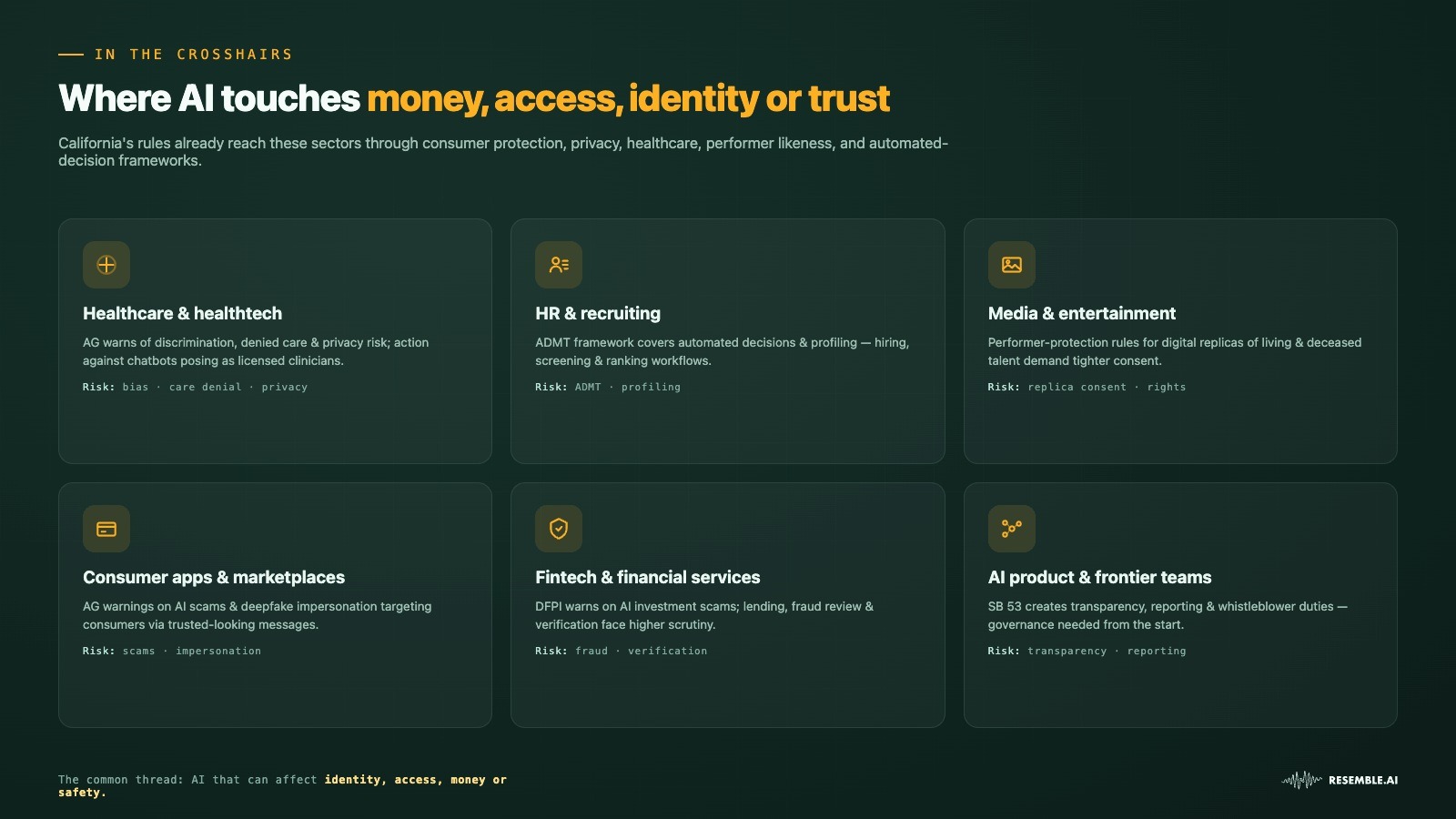
The businesses that need to care most are the ones where AI can affect money, access, identity, or trust. California’s rules are already touching those areas through consumer protection, privacy, healthcare, performer likeness, deepfakes, and automated-decision frameworks.
- Healthcare and healthtech: California’s Attorney General warned that AI in healthcare can create discrimination, denials of needed care, and privacy risks, while the state is also moving against AI chatbots that present themselves as licensed medical professionals.
- HR, recruiting, and workforce platforms: The CPPA’s ADMT framework covers automated decisions and profiling, which directly affect hiring, screening, ranking, and other employment-adjacent workflows.
- Media, entertainment, and creator platforms: California has passed performer-protection rules for digital replicas of living and deceased performers, so any business using cloned voices or likenesses needs tighter rights and consent controls.
- Consumer apps, marketplaces, and payment platforms: California has explicitly warned about AI scams and deepfake impersonation, including schemes that target consumers through trusted-looking messages and fake identities.
- Fintech and financial services: The DFPI regulates financial services and has already warned about AI investment scams, so any AI that touches lending, investing, fraud review, or customer verification should assume higher scrutiny.
- AI product teams and frontier-model developers: SB 53 creates transparency, reporting, and whistleblower obligations for frontier AI developers, so model-building and platform teams need governance, documentation, and incident handling from the start.
Even then, most businesses are still underestimating where their biggest AI compliance gaps actually sit.
Common AI Compliance Gaps Businesses Are Missing
The real gap is usually not the model itself. It is the missing process around it: what the system touches, who it affects, what gets disclosed, and what evidence the business can produce later.
- No AI inventory or use-case map: many teams cannot clearly list where AI is used, what data it touches, or which workflows count as automated decision-making technology. That becomes a problem because California’s ADMT and risk-assessment rules are built around specific uses, not vague “AI in the business” language.
- No formal risk assessments: businesses often deploy AI first and assess it later, but California now requires covered businesses to complete risk assessments for certain processing activities.
- No cybersecurity audit trail: if AI systems rely on sensitive data, model access, or large internal workflows, many businesses still lack the audit documentation California now expects from covered companies.
- No disclosure or opt-out path for ADMT: teams frequently forget that AI-driven decisions can trigger consumer rights to access and opt out, not just internal governance obligations.
- No provenance, training-data, or rights-clearance records: California’s newer AI rules are pushing transparency around training data, disclosure, and digital likeness use, so businesses need a paper trail for what was built, what was generated, and who consented to it.
- No vendor due diligence: many companies buy AI tools without checking whether the vendor can support transparency, compliance, and incident response under California’s evolving AI and privacy framework.
The challenge, then, is turning these risks into something businesses can actually operationalize.
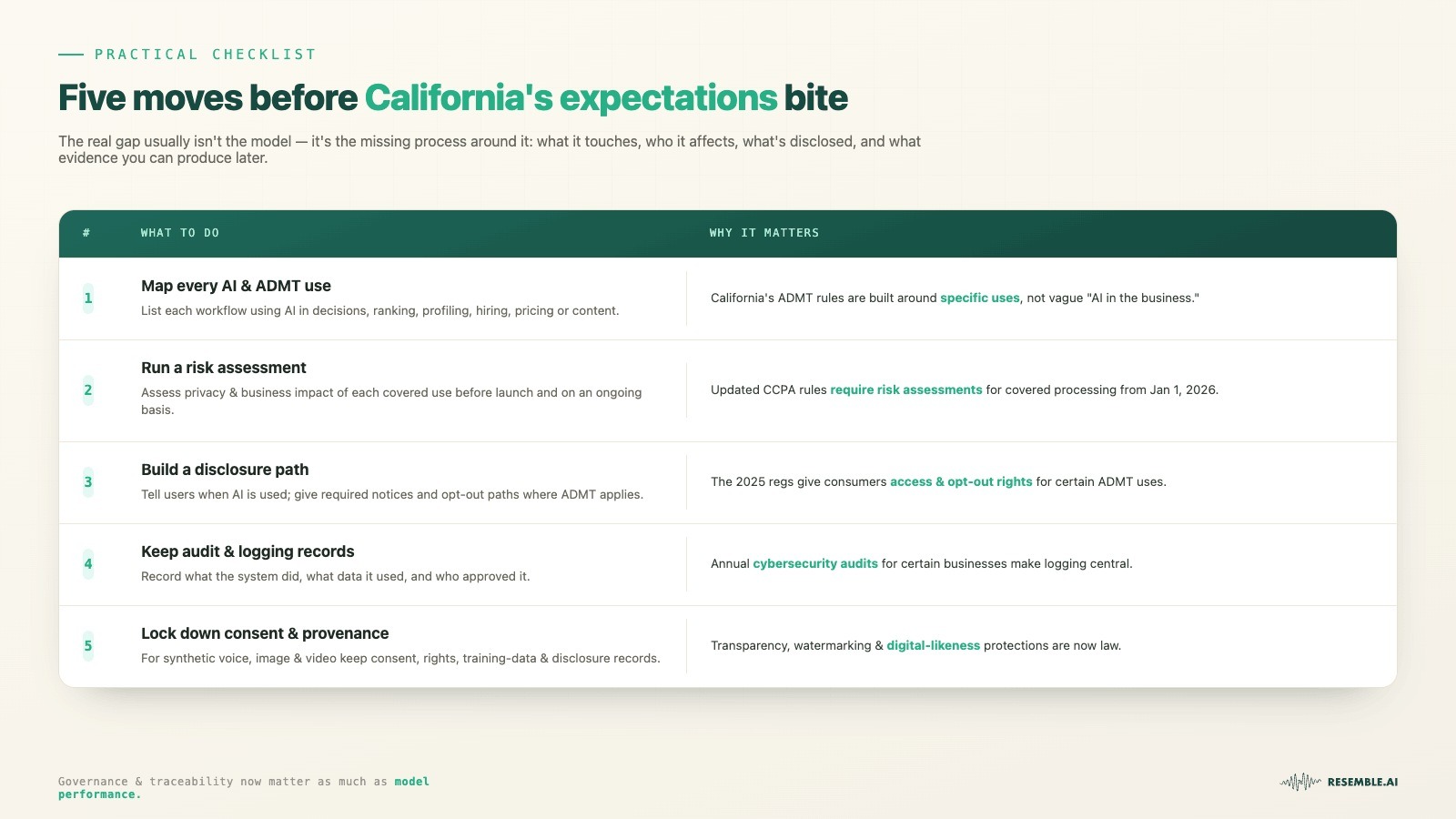
A Practical California AI Compliance Checklist
Here are some of the most important areas businesses should tighten before California’s AI and ADMT expectations become harder to ignore:
That is where platforms built around detection, verification, and provenance begin to enter the compliance conversation itself.
How Resemble AI Helps Teams Prepare for California AI Law

California’s new AI and deepfake laws are pushing companies to think beyond policy documents and focus on practical protection. The challenge is no longer just fake content online; it is live impersonation in meetings, cloned executive voices used for wire fraud, and synthetic candidates appearing in interviews.
At the same time, deepfakes are getting easier and cheaper to create across audio, image, and video.
That is where Resemble AI fits naturally into the workflow with:
- Resemble Meetings helps teams detect live impersonation during Zoom, Meet, Teams, and Webex calls. It is built for risks like executive impersonation, candidate fraud, vishing, and wire-transfer scams where a cloned voice or synthetic persona can create real operational damage in minutes.
- Resemble Detect gives teams multimodal deepfake detection across audio, image, and video. Instead of relying on separate tools for each format, security, trust, and compliance teams can review suspicious media in one place with explainable detection results and provenance support.
- For lighter-weight verification, the Chrome Deepfake Detection extension gives users a fast way to check suspicious media while browsing online. It works well as a free first layer for employees dealing with unknown clips, manipulated images, or suspicious videos shared through email and social channels.
Conclusion
California AI compliance is moving fast, and the businesses that stay ahead will be the ones that treat deepfake risk, provenance, and disclosure as part of everyday operations, not a last-minute legal check. The safest path is to build clear review processes, verify sensitive media before it spreads, and make sure your teams know where synthetic content can create real exposure.
That is exactly where Resemble AI fits in. With tools for live meeting protection, multimodal deepfake detection, and quick browser-based verification, teams can catch threats earlier and respond with more confidence across audio, image, and video workflows.
Ready to see how it works in practice? Book a demo with Resemble AI to explore how your team can strengthen deepfake defense, reduce fraud risk, and prepare for California’s evolving AI requirements.
FAQs
1. What is California AI Law?
California AI Law is a broad term used to describe California’s growing set of AI-related laws, privacy rules, transparency mandates, and enforcement actions covering artificial intelligence, automated decision-making, and synthetic media. Rather than relying on one standalone AI law, California applies AI oversight through consumer protection, privacy, civil rights, healthcare, and deepfake-related regulations.
2. Does California AI Law apply to companies outside California?
Yes. A company does not need to be physically based in California for the rules to matter. If an AI system affects California residents, processes their data, or serves California consumers, businesses can still face compliance obligations and enforcement exposure under California law.
3. Why is California focusing so heavily on AI transparency?
California regulators increasingly view AI transparency as necessary for consumer trust, fraud prevention, and accountability. Laws like SB 942 push businesses toward detectable disclosures, provenance tracking, and AI-generated content labeling so users can better identify synthetic media.
4. What are deepfakes?
Deepfakes are AI-generated or AI-manipulated audio, images, or videos designed to imitate real people, voices, or events. They can be used for entertainment and accessibility purposes, but they are also increasingly linked to impersonation scams, misinformation, fraud, and identity abuse.
5. Why are deepfakes becoming a major business risk?
Because they exploit trust at scale. Attackers now use synthetic voices, fake video calls, and manipulated media to impersonate executives, candidates, vendors, and family members in fraud schemes. The FTC has repeatedly warned that AI voice cloning is making scams significantly harder to detect.
6. How easy is it to create an AI voice clone today?
Modern AI tools can often clone a voice using only a few seconds of audio from social media videos, podcasts, voicemail recordings, or public interviews. Researchers and regulators have warned that many cloned voices are now difficult for humans to distinguish from real speech.
7. What is vishing, and why is it getting worse?
Vishing, or voice phishing, is a scam where attackers use phone calls or voice messages to trick victims into revealing information or sending money. AI-generated voice cloning has made vishing more dangerous because scammers can now imitate trusted people with realistic voices and emotional cues.
8. Which industries are most exposed to California AI compliance risk?
Healthcare, fintech, HR and recruiting, media, entertainment, consumer platforms, and AI product companies face the highest scrutiny because AI systems in these industries can directly affect identity, access, money, safety, or trust.
9. What is provenance in AI-generated content?
Provenance refers to the ability to trace where digital content came from, whether AI was involved in creating it, and whether it has been altered. California’s transparency efforts are increasing pressure on businesses to maintain records and disclosures around synthetic media.
10. Can humans reliably detect deepfake audio or cloned voices?
Not consistently. Recent research found that participants often struggled to distinguish AI-generated voices from real human speech, especially in realistic fraud or vishing scenarios. In some studies, people performed close to chance levels when identifying synthetic audio.
11. What are the most common AI-powered fraud attacks businesses face today?
The biggest attack vectors include executive impersonation, fake job candidates, vishing calls, fake vendor requests, wire-transfer fraud, deepfake video meetings, and manipulated customer-support interactions. Many of these attacks rely on urgency and trust rather than technical hacking.
12. How should businesses prepare for future AI regulations?
Businesses should start by mapping where AI is used, documenting automated decisions, improving disclosure and consent processes, maintaining audit trails, and creating verification workflows for suspicious media or high-risk communications. As AI regulation expands, governance and traceability are becoming just as important as model performance itself.