
Synthetic identity fraud has entered a new phase. Generative AI has made it possible for fraudsters to create convincing combinations of faces, voices, documents, and personal details at a scale that traditional identity checks were never designed to handle. The Federal Reserve Financial Services warned in 2026 that generative AI can be used to create synthetic identities, forged documents, and realistic deepfakes capable of challenging biometric verification and other onboarding controls.
Account opening is where these risks become especially difficult to manage. Businesses often have only a short verification window to determine whether the person, document, and biometric signals being presented belong to a genuine customer. This guide looks at how those attacks are reaching onboarding workflows, where traditional checks can fall short, and what stronger detection should account for.
TL;DR
- Account opening is the highest-risk moment for deepfake fraud because it's the one point where a business has never seen the person before and has to make a real-time trust decision.
- Presentation attacks (a spoof shown to a camera) and injection attacks (synthetic data fed directly into the verification pipeline) are different problems, and most KYC systems were only built to catch the first one.
- Liveness detection and deepfake detection answer different questions. Liveness confirms a person is physically present, deepfake detection confirms the media itself is authentic, and onboarding needs both.
- NIST's updated digital identity guidelines and existing biometric security standards are pushing organizations to evaluate presentation attacks, injection attacks, and synthetic media as separate parts of the identity fraud problem.
- Real incidents already show single-check verification failing in production, which is why layered detection (document, face, and voice checked together) is becoming the baseline rather than the exception.
Why Account Opening Is the Riskiest Moment for Deepfake Fraud
Every other point in a customer relationship benefits from history. A bank has seen a longtime customer's typical transaction patterns; a platform has months of behavioral signal on a returning user. Account opening has none of that. It's a cold start, decided almost entirely on whatever face, voice, or document shows up in that one session, which is exactly the moment generative AI is cheapest and most effective to exploit.
Presentation Attacks vs. Injection Attacks in Onboarding
These get used interchangeably, but they're mechanically different. A presentation attack is something physically shown to a camera or microphone, a mask, a printed photo, a screen replay. An injection attack skips the camera entirely: the attacker intercepts the data stream between the capture device and the verification engine and feeds it synthetic or manipulated data directly.
ISO/IEC 30107-1:2023 defines the framework for biometric presentation attack detection (PAD). Its scope covers attacks occurring at the capture device during biometric presentation and collection, while other attack types, including injection attacks that bypass the capture process, fall outside its scope.
Why Selfie-to-ID Matching Alone Isn't Enough
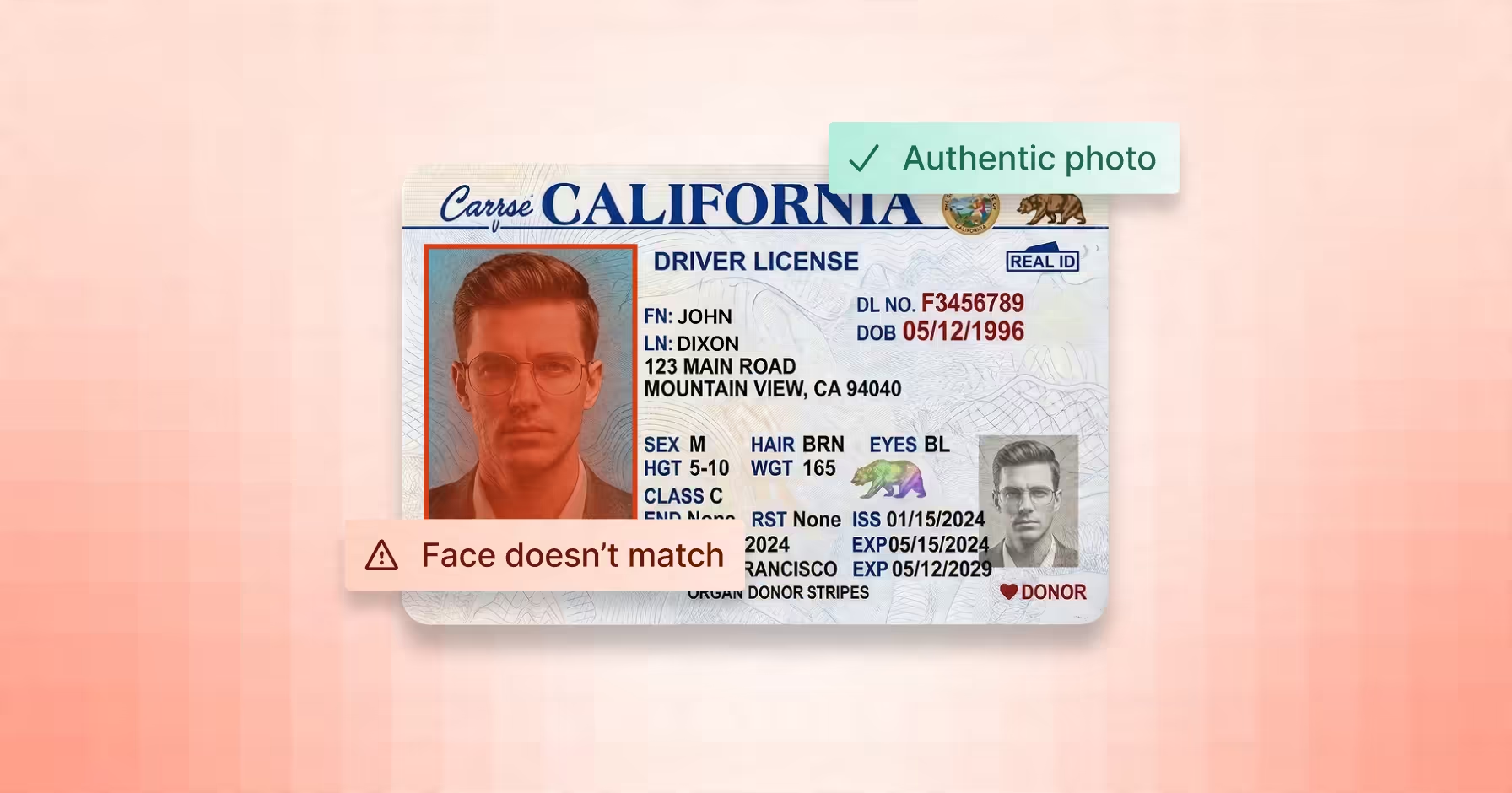
The standard KYC flow of photographing an ID, taking a selfie, and matching the two assumes both inputs are genuine captures of a real person and document. That assumption is becoming less reliable. Generative models can produce ID images with convincing fonts, lighting, and metadata that may still pass OCR because OCR validates the document text rather than determining whether the image itself was synthesized. Combined with a real-time face swap delivered through a virtual camera, an attacker can present a coordinated fake identity in which the face, voice, and document all appear consistent enough to challenge verification systems designed primarily to catch simpler mismatches and low-effort fraud.
Understanding why the old checks fail sets up the more useful question: what's actually built to catch this instead.
How AI-Powered Deepfake Detection Works During Account Opening
Detection is several distinct signals that need to work together, because no single one covers the full attack surface.
Liveness Detection vs. Deepfake Detection
These are commonly treated as the same thing but they're not. Liveness detection confirms a physical person is present in front of the camera right now, it's answering "is this a live human, not a photo or a mask?" Deepfake detection confirms something different: that the media itself hasn't been synthetically generated or manipulated, regardless of whether something physically live was captured. A sophisticated injection attack can defeat liveness checks entirely by never involving a physical presentation at all, which is precisely why relying on liveness alone leaves a gap that only dedicated deepfake detection closes.
Document and Face-Match Forensics
Effective document verification now has to look at the image itself for generation artifacts (the same kind of synthesis fingerprints that show up in any AI-generated image) rather than just validating that the printed fields look correct. The same logic applies to the selfie: frame-by-frame analysis for deepfake artifacts, plus temporal consistency checks across the video sequence, catch a face-swap that a single static frame comparison would miss entirely.
Real-Time Injection Attack Detection
Because injection attacks bypass the physical capture step, detection has to happen on the data stream itself, checking for the signs that audio or video didn't originate from an actual camera or microphone in the first place. This is the layer most legacy KYC vendors added last, largely because injection attacks are a newer, faster-moving threat than the presentation attacks the industry spent the last decade building defenses against.
That gap between what detection technically needs to cover and what most systems were built for hasn't gone unnoticed by regulators.
What Regulators and Standards Now Require
The compliance landscape has moved fast enough that "we do liveness detection" is no longer a sufficient answer to an auditor's question about deepfake risk.
NIST SP 800-63-4 and Injection Attack Detection
NIST published the final version of Special Publication 800-63-4 in July 2025, the first full revision of the U.S. government's digital identity guidelines since 2017, a gap that predates the current generation of generative AI entirely. The update adds explicit controls for injection attack detection and forged media, treating deepfakes as a distinct, named risk category rather than folding them into general spoofing guidance.
ISO/IEC 30107 and Presentation Attack Detection
On the international standards side, ISO/IEC 30107 remains the reference framework for presentation attack detection specifically. Because it doesn't cover injection attacks by design, organizations following it as their sole biometric security standard are, by definition, only covering half the current threat model, which is exactly the gap NIST's 2025 revision was built to address on the U.S. side.
What This Means for Compliance Teams
Detection controls increasingly need to show how they perform against different attack types rather than relying on a single pass-or-fail result. For onboarding and identity workflows, that means keeping evidence of what triggered the flag, which signals were evaluated, and how the system was tested against the threats it is expected to catch. These requirements reflect fraud patterns that are already appearing in real cases, not hypothetical future scenarios.
Real-World Account Opening Fraud Cases
In December 2025, Dutch authorities arrested a man who had used stolen identity documents combined with deepfake facial manipulation to open 46 fraudulent bank accounts at a major Netherlands bank. He collected passport scans from people responding to fake rental listings, then used AI tools to blend his own face onto their ID photos closely enough to clear the bank's selfie-to-ID verification step. The case only surfaced after one bank flagged unusual account activity, the verification step itself didn't catch it. That pattern, a synthetic identity clearing document and biometric checks independently because no single check saw the coordinated attack, is exactly the failure mode NIST's injection attack guidance and layered detection are built to close.
Building a Layered Deepfake Defense for Onboarding
The architecture matters because different types of deepfake attacks leave different signals behind, and no single detection method will catch all of them.
Combine Liveness, Injection Detection, and Document Forensics
Each layer catches something the others miss. Liveness confirms physical presence, injection detection catches attacks that skip the camera entirely, and document forensics catches synthetic media even when it arrives through an otherwise legitimate capture. Running them independently, rather than treating any single check as sufficient, is what actually closes the gap between presentation and injection attack coverage.
Add Biometric Verification Against a Trusted Source
Where a previous, trusted reference exists, matching new submissions against it adds a layer that doesn't depend on spotting synthetic artifacts at all, a clone that passes every visual check can still fail to match an enrolled biometric reference, because the two checks are measuring entirely different things.
Monitor Post-Onboarding, Not Just at Signup
Account creation should be evaluated in context with other recent activity. Repeated submissions that share devices, documents, identities, or other signals can reveal coordinated fraud patterns that may not look suspicious when each attempt is reviewed separately.
How Resemble AI Strengthens Account Opening Fraud Prevention
Resemble AI's identity verification and KYC solution is built directly around this layered model rather than a single check.
Resemble Detect analyzes voice, face, and document together in a single API call, so a coordinated synthetic identity package (a matching cloned voice, face-swapped selfie, and AI-generated ID) gets caught by cross-modal inconsistency even when each piece might individually pass its own check. It's evaluated against 250+ generative models and reaches 99.5% accuracy at enterprise scale, with real-time results under 300ms for live onboarding flows and asynchronous batch processing for existing document review queues.
Resemble Intelligence adds the layer compliance teams actually need: a human-readable explanation of each verdict (the specific abnormalities detected and the reasoning behind a flag) rather than just a confidence score, structured for audit and appeals review.
Because identity data may be subject to strict residency and privacy requirements, detection can be deployed on-premises or in fully air-gapped environments so sensitive PII does not need to leave the organization’s infrastructure. This can support security and compliance requirements across regulated sectors, including financial services and healthcare. Contact Resemble AI to discuss deployment options for your environment.
FAQs
Can deepfakes really bypass standard KYC verification?
Yes. Generative models now produce synthetic faces, voices, and ID documents that pass standard liveness, biometric, and OCR checks independently. A December 2025 Netherlands case saw exactly this happen against a major bank's selfie-to-ID verification before detection caught it.
What's the difference between liveness detection and deepfake detection?
Liveness detection confirms a real person is physically present during capture. Deepfake detection confirms the media itself hasn't been synthetically generated or altered. They answer different questions and are complementary, not interchangeable.
What is an injection attack in identity verification?
An injection attack feeds synthetic or manipulated data directly into a verification system's data stream, bypassing the physical camera or microphone entirely. It's distinct from a presentation attack, where a spoof is physically shown to a capture device.
Does NIST require injection attack detection now?
NIST's final SP 800-63-4, published July 2025, adds explicit controls addressing injection attacks and forged media as part of U.S. digital identity guidelines — the first major update since 2017, reflecting the current generative AI threat landscape.
Why doesn't ISO/IEC 30107-1 cover injection attacks?
ISO/IEC 30107-1:2023 focuses on presentation attacks that occur during biometric capture, such as spoofing a camera or sensor. Injection attacks operate differently by introducing manipulated data directly into the verification pipeline, which falls outside the standard's defined scope.
How do AI-generated ID documents pass verification?
Generative and inpainting tools produce documents with correct fonts, lighting, and metadata that satisfy OCR and resolution checks, because those checks evaluate the text and formatting rather than whether the image itself was synthetically created.
What industries are most exposed to account-opening deepfake fraud?
Banking, fintech, telecom, and any regulated onboarding flow involving remote identity verification, anywhere a new customer relationship is established without an in-person check are the highest-exposure categories, since there's no prior relationship history to cross-check against.
Is a single accuracy score enough to trust a detection vendor?
No. A trustworthy claim should specify what attack types and how many generative models it was tested against, since detectors trained on a narrow or outdated attack set can miss current cloning and face-swap tools entirely.
Can detection run without slowing down onboarding?
Yes, when built for it. Real-time detection under 300ms fits inside a live verification step, while asynchronous batch processing handles existing document review queues without disrupting either flow.
Does layered detection replace human review in compliance workflows?
No, it supports it. Detection systems that produce a human-readable explanation alongside a confidence score, rather than a bare number, are what allow compliance teams to make defensible, auditable decisions on flagged submissions.