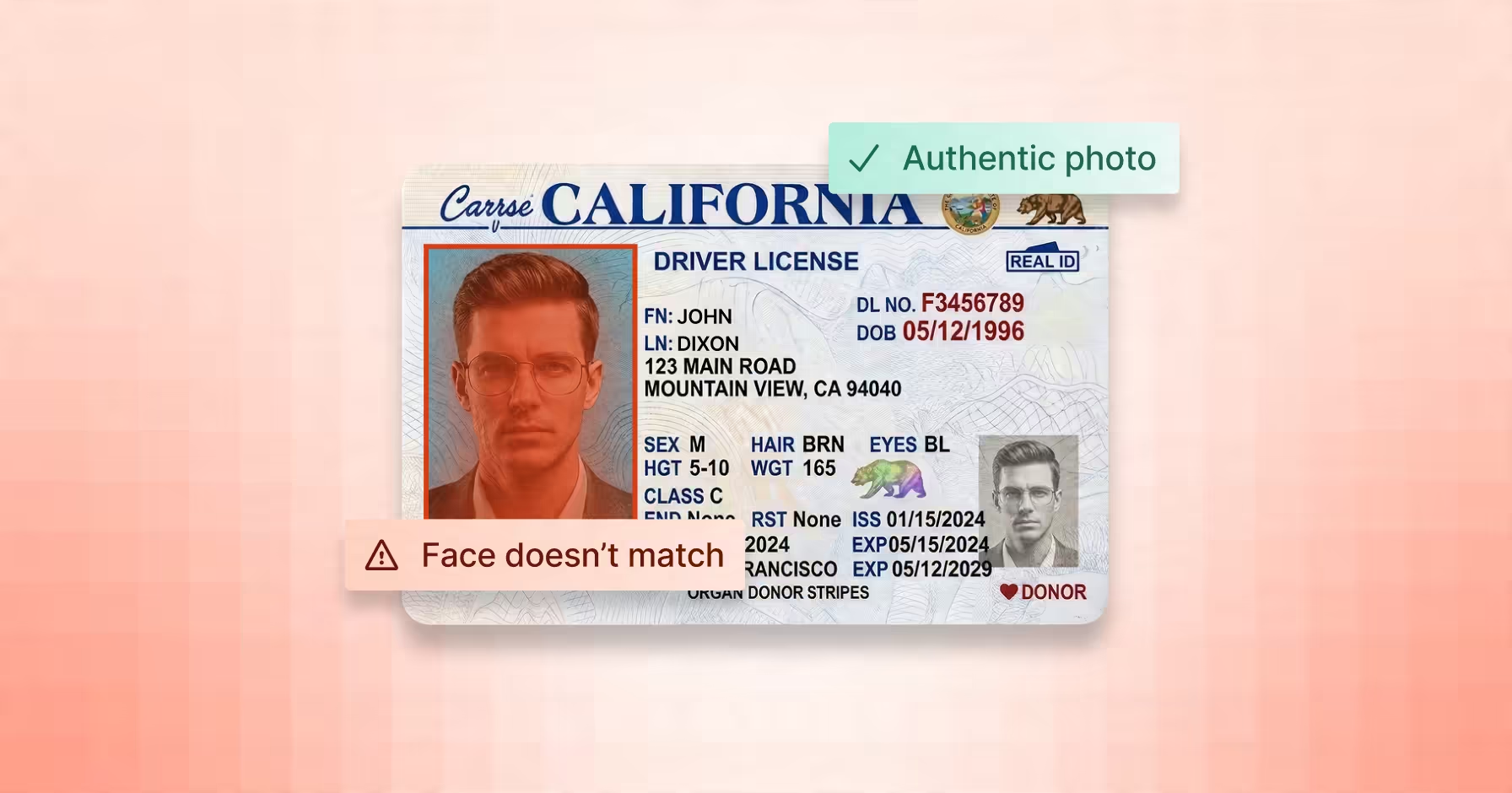

Deepfake detection for identity verification checks whether submitted media shows signs of synthetic generation or manipulation. It does not prove who a person is. Its output should be combined with document validation, biometric matching, capture integrity, and other risk signals.
According to Entrust’s 2026 identity fraud telemetry, deepfakes accounted for roughly one in five biometric fraud attempts observed in its network during 2025. Deepfake selfie attempts increased 58%, while injection attacks rose 40% year over year.
The practical response is not to replace identity verification with a deepfake detector. It is to combine media forensics with trusted capture, presentation attack detection, face matching, document checks, device intelligence, and a clear review process.
Key Takeaways
- Deepfake detection checks whether identity media appears synthetic or manipulated. It does not establish the applicant’s identity by itself.
- Face matching, liveness checks, presentation attack detection, and injection defenses answer different questions.
- A live-looking video can be injected through a virtual camera or compromised device. Liveness alone is not a complete defense.
- Detection performance depends on the attack, device, media quality, threshold, and test data. One headline accuracy percentage is not enough.
- High-risk or uncertain results should trigger step-up verification or human review, not an unexplained automatic rejection.
- Teams should test the complete identity-proofing workflow against current attacks and monitor it after deployment.
What Deepfake Detection Does in Identity Verification
Identity verification is a sequence of decisions, not one model call. A remote workflow may need to determine whether an identity exists, whether its evidence is valid, whether the applicant matches that evidence, and whether the interaction can be trusted.
Deepfake detection supports one part of that process: media authenticity.
Depending on the media type, a detector may examine spatial artifacts, temporal inconsistencies, synthesis traces, metadata, compression behavior, lip-sync anomalies, spectral patterns, or signals associated with known generation techniques.
It cannot replace the other controls in the identity-proofing workflow.
The most important design principle is to not ask one control to answer a different control’s question. Deepfake detection can strengthen identity proofing within a KYC workflow, but it does not perform KYC by itself.
Why Identity Verification Is a Target for Deepfakes
Remote onboarding turns identity evidence into digital media. An applicant may upload an ID, take a selfie, record a video, speak a phrase, or join a live call. Attackers can target any point where that media is created, transmitted, or evaluated.
In a November 2024 alert, the U.S. Financial Crimes Enforcement Network reported increased suspicious activity reporting involving deepfake media. The alert describes generated or altered identity documents, images, and videos being used to circumvent identity verification and authentication.
The U.S. Department of the Treasury's Financial Crimes Enforcement Network (FinCEN) also describes schemes in which criminals combine GenAI-generated images with stolen or fabricated personally identifiable information (PII) to create synthetic identities.
The enabling ecosystem is becoming easier to observe. In May 2026, Flashpoint recorded 1,784,716 posts advertising or discussing KYC bypass across its monitored sources. That figure counts posts. It does not represent successful attacks, unique tools, victims, financial losses, or completed identity-verification bypasses.
The attacker’s objective is usually broader than passing a selfie check. A successful onboarding attempt can lead to:
- Account takeover
- Mule-account creation
- Payments fraud
- Credit abuse
- Promotional abuse
- Fraudulent account recovery
- Money laundering
Detection results should therefore be evaluated alongside account relationships, device activity, transaction behavior, and other downstream signals.
The Main Deepfake and Injection Attacks
The term “deepfake” is frequently used for several technically different attacks. Separating them helps teams choose the correct controls and test cases.
A presentation attack places fraudulent material before the legitimate sensor. An injection attack bypasses or alters the capture path. A system can perform well against screen replays and still fail when a virtual camera inserts a clean synthetic stream.
Injected media is not necessarily a deepfake. An attacker could inject an authentic but stolen recording. A synthetic-media classifier might correctly label that recording as genuine even though the transaction is fraudulent. Capture integrity and replay defenses are therefore necessary alongside deepfake detection.
This also affects standards claims. ISO/IEC 30107-3:2023 covers testing and reporting for attacks presented at a biometric capture device. CEN/TS 18099:2024 addresses biometric data injection detection and mitigation.
Testing against presentation attacks on its own should not be described as proof that a system resists injected deepfakes.
How Deepfake Detection for Identity Verification Works
A reliable system evaluates the identity evidence, capture path, and wider session. The exact sequence varies, but six stages form a useful operating model.
1. Establish a Trusted Capture Session
The workflow first checks whether the media came from the expected camera, microphone, application, and device.
Relevant signals may include:
- Device attestation
- Application integrity
- Virtual-camera detection
- Emulator detection
- Session binding
- Capture timestamps
- Replay indicators
- Protected transport
A convincing deepfake may leave few visible signs of manipulation. If the capture data shows that the camera or microphone was bypassed, the system can still flag the submission without depending entirely on pixel-level analysis.
2. Validate the Identity Evidence
Document checks inspect format, field consistency, security features, portrait replacement, tampering, and metadata. Where supported, NFC chip reading or authoritative-source checks can provide stronger evidence than an uploaded document image alone.
Document validation and deepfake detection overlap when an attacker uses AI-generated portraits or altered document images, but the controls are not interchangeable.
A document can be structurally fraudulent without containing a deepfake. A genuine document image can also be presented by a synthetic or unauthorized person.
3. Compare the Applicant With the Reference
Face matching estimates whether the applicant resembles the portrait in trusted reference evidence. Speaker matching can perform a related comparison for voice.
Matching is useful only when the system also checks whether the media is genuine and whether it was captured through a trusted, untampered process.
A face swap created from the victim’s own photographs may resemble the victim closely. The match can be technically correct while the transaction remains fraudulent.
4. Test for Presentation Attacks and Liveness
Presentation attack detection examines whether fraudulent material is being shown to the legitimate sensor. Liveness checks are commonly used as one part of that analysis.
Passive checks inspect the normal capture without asking the applicant to complete a specific action. Active checks request a response such as a changing pose, head movement, or random phrase.
These measures can help detect prints, masks, screen replays, and prerecorded responses. Random challenges can increase the attacker’s workload, but modern real-time face swaps may respond to movement and speech.
Passing a liveness challenge strengthens the evidence that a real person is present, but it should not be treated as conclusive proof on its own.
5. Analyze the Media for Manipulation
Deepfake detectors inspect images, audio, or video for forensic signals. A multimodal system can support several media types, but each modality should return its own result because the evidence and failure modes differ.
Useful outputs include:
- A calibrated risk score
- A media-specific decision label
- Detected abnormalities
- Segment-level or frame-level findings
- The model and policy version
- The reason for escalation
- An auditable processing record
A raw “fake” label without context is difficult to investigate and risky to use as the sole basis for a consequential decision.
6. Correlate the Result With Session Risk
The final decision should consider the deepfake result alongside:
- Document confidence
- Face-match score
- Device reputation
- IP and geographic consistency
- Account relationships
- Submission velocity
- Behavioral patterns
- Previous verification attempts
- Subsequent transaction activity
FinCEN’s guidance makes the same operational point: no single indicator proves fraud.
A media anomaly becomes more meaningful when it appears with reused devices, inconsistent document data, unusual network routing, or a cluster of related accounts.
Deepfake Detection vs. Liveness Detection
Liveness checks sit within the broader presentation-attack problem. They overlap with deepfake detection, but the two terms should not be used interchangeably.
NIST SP 800-63A-4, finalized in July 2025, reflects this layered view. It requires presentation attack detection for remote biometric collection, but it also states that biometric comparison on a captured sample does not, by itself, prevent injection attacks.
For remote optical capture, NIST calls for controls that increase confidence that media came from a genuine sensor and for analysis capable of identifying manipulation, forgery, and deepfake signatures.
In practical terms:
- Presentation attack detection evaluates what is placed before the legitimate sensor.
- Liveness checks look for evidence associated with a live interaction.
- Injection defenses protect the capture pipeline from being bypassed.
- Deepfake detection analyzes whether media appears synthetic or manipulated.
- Face matching measures similarity to a reference.
A mature identity-verification workflow may need all five answers.
Detection and Provenance Solve Different Problems
Media provenance can complement deepfake detection, but it is not a substitute for it.
C2PA Content Credentials use cryptographically bound records to describe an asset’s origin and editing history. A valid credential can help verify that particular provenance statements were attached by a known signer and have not been altered.
According to the C2PA and Content Credentials Explainer, Content Credentials do not determine whether a piece of content is truthful. Their absence also does not prove that media is fake because using Content Credentials is optional, provenance can be incomplete, and provenance metadata can be removed.
Each check answers a different part of the identity-verification question:
- Detection estimates whether content appears manipulated.
- Provenance records information about where content came from and how it changed.
- Capture integrity establishes how the evidence entered the verification workflow.
- Identity proofing determines whether the accumulated evidence supports the claimed identity.
Where available, a workflow can use both provenance and forensic detection. Conflicting signals should increase scrutiny and not allow one control to overrule every other signal.
A Layered Architecture for KYC and Onboarding
Strong identity verification uses independent controls so that one failure does not determine the entire outcome.
Layer 1: Capture and Channel Integrity
Bind each media submission to its verification session. Where possible, detect software pretending to be a real device, virtual cameras, compromised devices, and replayed uploads. Use secure connections and short-lived upload credentials.
Layer 2: Document and Identity-Evidence Validation
Check document structure, portrait integrity, data consistency, expiry, machine-readable fields, NFC data, and authoritative sources according to the required assurance level.
Layer 3: Biometric Matching
Compare the applicant with trusted reference evidence using a threshold appropriate to the actual risk. Report false-match and false-non-match behavior separately from deepfake performance.
Layer 4: Presentation Attack Detection
Use active, passive, or combined checks suited to the user experience and threat model. Test difficult real-world attacks rather than limiting evaluation to printed photographs.
Layer 5: Multimodal Deepfake Detection
Analyze each submitted media type for synthetic or manipulated content. Keep audio, image, and video findings distinguishable, even when they contribute to the same risk decision.
Layer 6: Risk Orchestration and Review
Combine identity, media, device, network, behavioral, and transaction signals. Route uncertain or high-impact cases to step-up verification or trained reviewers. Record the evidence, policy version, and final disposition.
If your team is designing this stack, see how Resemble Detect supports identity verification and KYC workflows by adding synthetic-media analysis to existing controls.
Two Example Verification Decisions
These hypothetical examples show why a detector score should be interpreted in context.
Example 1: A Strong Face Match With an Injected Stream
An applicant’s video produces a high face-match score against the ID portrait. Passive liveness also returns a favorable result.
The session-integrity layer, however, detects a virtual camera. Media analysis finds temporal evidence consistent with a real-time face swap.
The correct response is not approval based on the face match. The workflow could require a new capture through a trusted mobile application, read the document’s NFC chip, or escalate the session to a trained reviewer.
Example 2: A Genuine Applicant With Compressed Video
An applicant uploads a video over a poor connection. Heavy compression removes some forensic detail, and the deepfake score falls into an uncertain range.
The document data is consistent, NFC validation succeeds, the device is trusted, and no injection indicators are present.
An automatic fraud rejection would be difficult to justify. A better response is to request a fresh capture, offer an alternative verification route, or send the case for review.
Both examples contain a useful lesson: favorable biometric evidence should not erase an attack signal, and an uncertain detector result should not erase strong genuine-user evidence.
What to Evaluate in a Deepfake Detection Provider
A product demonstration can show that an API returns a score. It cannot prove that the system will perform well in your environment.
Procurement, fraud, and security teams should ask for evidence at the level of attacks, devices, modalities, and thresholds.
Resemble publishes its current deepfake-detection benchmarks, allowing teams to review the scope of individual claims.
For example, Resemble reports 99.5% accuracy and less than 1 false-negative rate on a August 2026 Podonos benchmark containing 4,524 audio files. These results apply to that audio dataset. They do not represent image, video, or end-to-end identity-verification performance.
The same principle applies to every provider: ask which modality, dataset, date, class balance, generator families, transformations, evaluator, and decision threshold produced the number.
Which Accuracy Metrics Matter?
“Accuracy” compresses several operational tradeoffs into one percentage. It can look strong on an imbalanced dataset while concealing the error that matters most.
Evaluate:
- False-positive rate: The share of genuine samples incorrectly flagged as synthetic.
- False-negative rate: The share of synthetic or manipulated samples incorrectly accepted as genuine.
- Precision: Among flagged samples, the share that is actually synthetic or manipulated.
- Recall: Among all relevant deepfakes in the test set, the share detected.
- ROC-AUC or PR-AUC: Threshold-independent summaries that assist comparison but do not replace operating-point results.
- Calibration: Whether a stated confidence score corresponds to consistent observed risk.
- Review rate: The percentage of applicants sent to manual or step-up verification.
- Latency distribution: The p50, p95, and p99 processing time for realistic media and traffic.
Account for Base Rates
A seemingly low false-positive rate can create substantial review volume when fraud is rare.
Suppose 100,000 applicants include 500 fraudulent attempts. If a control detects 90% of those attacks but incorrectly flags 1% of the 99,500 genuine applicants, it would produce:
- 450 correctly flagged attacks
- 995 incorrectly flagged genuine applicants
- 1,445 total reviews
In that simplified example, most flagged cases would still be genuine. This does not make the detector useless. It means teams must plan review capacity, combine independent signals, and avoid presenting a score as certainty.
Keep Metric Families Separate
Face-match metrics, presentation-attack metrics, and deepfake-detection metrics measure different systems.
NIST’s face-match targets should not be presented as deepfake or liveness performance. Likewise, a strong presentation-attack result does not establish resistance to virtual-camera injection.
In NISTIR 8491, NIST evaluated 82 passive software presentation attack detectors from 45 developers against approximately 20,000 attack presentations and 21,000 bona fide presentations.
Performance varied widely, and no evaluated detector caught every attack. The study covered physical presentation attacks at the camera, not post-capture injection attacks.
How to Test Before Deployment
Evaluation should reproduce the way applicants, attackers, devices, and reviewers will use the system.
Build a Threat-Led Test Set
Start with the abuse cases that matter to the business, such as:
- Stolen identities
- Synthetic identities
- Mule accounts
- Account recovery
- High-value withdrawals
- Regulated onboarding
Include genuine samples and attacks across the devices, languages, lighting, network conditions, codecs, and accessibility paths used by customers.
Add both familiar and unfamiliar generation methods. A detector can score well when the same identities, generators, or compression patterns appear in training and testing. Where possible, holdout testing should separate people and generator families.
Test the Complete Path
Run attacks through a production-like mobile or web flow rather than submitting only clean files directly to a detector.
Test:
- Prints, masks, and screen replays
- Prerecorded and real-time face swaps
- Virtual cameras and emulators
- Authentic but stolen recordings
- Synthetic and altered ID portraits
- Face morphs
- Cloned or synthesized speech
- Recompression, resizing, cropping, and filters
- Low-bandwidth and poor-lighting conditions
- Coordinated document, face, voice, device, and profile evidence
Low-quality or heavily compressed media may remove the forensic signals a detector relies on. The system needs an explicit outcome for insufficient evidence, separate from both “genuine” and “synthetic.”
Choose Thresholds From Consequences
Approval, review, and rejection thresholds should reflect both the cost of fraud and the cost of interrupting a legitimate applicant.
A bank opening a high-limit account may choose a different threshold from a marketplace verifying a low-risk seller.
Use a review band for uncertain scores. Reserve automatic rejection for cases supported by sufficiently strong evidence and provide a route to correction or appeal.
Run a Shadow Deployment
Before allowing the detector to affect customer decisions, run it in observation mode.
Compare its output with:
- Existing identity controls
- Reviewer dispositions
- Confirmed fraud
- Applicant abandonment
- Customer-support cases
- Processing latency
- Device and demographic segments
Shadow testing can expose threshold problems, integration errors, format failures, and unexpected friction without immediately blocking customers.
Monitor Drift After Launch
Attack tools, generation models, codecs, and customer devices continue to change.
Track error rates by:
- Modality
- Device
- Application version
- Geography
- Capture route
- Media quality
- Relevant demographic group
Re-run regression and red-team suites when the model, SDK, policy, or onboarding flow changes.
Research reinforces the need for continuous testing. Deepfake-Eval-2024, published at a CVPR 2026 workshop, found large performance declines when open-source detectors were evaluated on newer, in-the-wild audio, image, and video content other than older benchmark data.
Privacy, Governance, and Current Regulation
Deepfake detection processes sensitive identity evidence, so technical performance is only one part of deployment.
A defensible program should document:
- The purpose and legal basis for processing
- What media and metadata are collected
- Where processing occurs
- Retention and deletion periods
- Whether customer media is used for model improvement
- Access controls and reviewer permissions
- How applicants receive notice
- How incorrect decisions can be challenged
- When a human can reconsider an automated outcome
On July 20, 2026, the European Commission published guidelines for the AI Act's Article 50 transparency obligations. These transparency obligations have applied since August 2, 2026. The rules address machine-readable marking by certain providers of AI-generated or manipulated content and disclosure requirements for certain deployers exposing people to deepfakes.
These are transparency and provenance obligations. They do not create a universal deepfake-detection accuracy standard, and they do not mean every identity-verification system is automatically classified as high-risk AI.
Organizations should assess the rules that apply to their specific role, use case, jurisdiction, and biometric processing activities.
Common Implementation Mistakes
Several recurring mistakes weaken otherwise credible identity-verification programs.
Treating a Face Match as Proof of Authenticity
A deepfake created from the victim’s face may produce a strong match. Evaluate media and capture integrity independently.
Using “Liveness” as an Umbrella Term
Ask whether a product detects presentation attacks, injected streams, synthetic media, or a specific combination. The test evidence should match the label.
Making One Detector the Final Decision
Use detector output as a risk signal. Combine it with other evidence and provide step-up or review paths for consequential decisions.
Quoting Accuracy Without Test Conditions
Attach every metric to its modality, dataset, date, threshold, class balance, and evaluator. Do not apply an audio result to image or video performance.
Treating Missing Forensic Evidence as Genuine
Compression, cropping, filters, and low-resolution capture may remove usable signals. An inconclusive sample is not necessarily authentic.
Testing Files but Not the Application
An attacker targets the capture and decision workflow, not an isolated model. Test uploads, live capture, virtual devices, retries, fallback routes, and failure handling.
Ignoring Genuine-User Friction
Low-end cameras, assistive technology, poor connectivity, lighting, speech differences, and older devices can affect outcomes. Measure rejection and review rates across the population served.
Leaving Retention and Redress Undefined
Identity media is sensitive. Define what is stored, where it is processed, when it is deleted, and how a legitimate applicant can contest an incorrect result.
A Practical Deployment Checklist
Before deploying deepfake detection for identity verification, confirm that your team can answer yes to the following:
- We distinguish face matching, presentation attack detection, liveness checks, injection defenses, and media forensics.
- We have mapped attacks to every capture, upload, fallback, and review path.
- We test audio, images, video, and documents only against claims made for those modalities.
- We know the false-positive and false-negative rates at our operating thresholds.
- We have calculated expected review volume using realistic fraud base rates.
- We test unfamiliar generators, real-time attacks, virtual cameras, stolen recordings, and degraded media.
- We combine detector results with document, device, network, behavioral, and transaction signals.
- We have step-up and human-review paths for uncertain or high-impact cases.
- We monitor genuine-user friction and demographic performance.
- We version models and policies and retain enough evidence for an audit.
- We have documented consent, retention, deletion, privacy, and redress policies.
Deepfakes have changed the evidence that identity teams can trust. The right response is not a single universal detector. It is a layered system that establishes where the media came from, whether it was altered, whether the applicant matches trusted evidence, and whether the complete session makes sense.
Where Resemble Detect Fits
Resemble Detect analyzes audio, images, and video for signs of synthetic manipulation through a unified API. Its API returns structured detection metrics specific to the media being analyzed, including labels and scores. For video, audio and visual components can also be analyzed separately, with each returning its own detection results.
When Resemble Intelligence is enabled, teams can add human-readable forensic reasoning and structured audit information to help analysts investigate a flag.
Detect should be integrated as the media-forensics layer in a broader identity-verification architecture. It does not replace:
- Document validation
- Face matching
- Device attestation
- Presentation attack detection
- Injection defenses
- Transaction monitoring
- Human review
For privacy-sensitive deployments, teams should verify the exact configuration before launch. Zero-retention processing is available as an option, but it should not be assumed to be the default for every customer or deployment.
Conclusion
Deepfake detection for identity verification is most useful when its role is clearly defined: determining whether identity media shows signs of synthetic generation or manipulation. It cannot establish an applicant’s identity or secure the capture process on its own. Those decisions require document validation, biometric matching, presentation attack detection, injection defenses, and wider session-risk signals.
The strongest workflows test these controls together under realistic conditions. They account for new generation methods, virtual-camera attacks, compressed media, false positives, and genuine applicants who need an alternative verification route. When the evidence is uncertain, step-up verification or human review is usually more defensible than an automatic rejection.
Resemble Detect can add audio, image, and video deepfake analysis to an existing identity-verification or KYC workflow. To evaluate it against your own media, attack scenarios, and operating requirements, contact Resemble AI.
Frequently Asked Questions
What Is Deepfake Detection for Identity Verification?
It is the analysis of identity-related images, audio, video, or document media for signs of synthetic generation or manipulation. It helps assess media authenticity but does not establish the applicant’s identity on its own.
Can Deepfakes Bypass KYC Checks?
Yes. Deepfakes can appear as synthetic selfies, face swaps, generated video, cloned speech, or altered documents. Whether an attack succeeds depends on the workflow’s capture integrity, injection defenses, presentation attack detection, media forensics, document validation, matching, and risk controls.
Is Liveness Detection the Same as Deepfake Detection?
No. Liveness checks look for evidence associated with a live interaction and are commonly used within presentation attack detection. Deepfake detection looks for synthetic or manipulated media. Some products support both functions, but neither term should be used as a substitute for the other.
What Is the Difference Between a Presentation Attack and an Injection Attack?
A presentation attack places fraudulent material before the legitimate sensor, such as a screen replay or mask. An injection attack bypasses or alters the capture pipeline so recorded or generated media is supplied directly to the application.
How Does a System Detect a Deepfake During Verification?
A system may combine device and session signals with image, video, or audio forensics. The detector can inspect spatial, temporal, spectral, metadata, provenance, and generator-related patterns before sending a score and supporting evidence to the risk engine.
Can Deepfake Detection Identify AI-Generated ID Documents?
It can help identify manipulated or generated portraits and document images, but dedicated document checks remain necessary. These may include template analysis, field consistency, security features, machine-readable zones, barcodes, NFC data, and authoritative-source verification.
Is Face Matching Enough to Stop a Deepfake?
No. Face matching measures similarity to a reference. A face swap based on the victim’s photographs may match well, so the workflow must separately evaluate capture integrity, presentation attacks, injection risk, and media authenticity.
How Accurate Is Deepfake Detection?
There is no meaningful universal rate. Performance changes by modality, attack type, generator, device, media quality, transformation, class balance, and decision threshold. Evaluate false positives and false negatives using current, production-like data.
Can Compressed Video Affect Deepfake Detection?
Yes. Compression, resizing, low resolution, frame-rate changes, and poor bandwidth can remove or distort forensic evidence. A production workflow should distinguish an inconclusive result from a confident finding that the media is genuine.
Can Deepfake Detection Run in Real Time?
Some systems can analyze short media within an interactive workflow. End-to-end latency still depends on upload time, media duration, preprocessing, model execution, orchestration, retries, and review. Test the complete workflow under realistic load.
What Should Happen When an Attempt Is Flagged?
The result should be evaluated with other risk evidence. The next step might be a fresh trusted capture, an NFC document check, an alternative factor, live-agent review, temporary hold, or rejection. The workflow should preserve a reasoned audit trail and provide redress for legitimate users.
How Often Should Detection Models Be Updated?
There is no fixed safe interval. Providers should monitor new generators and bypass methods continuously, validate updates against regression and attack suites, version models and policies, and communicate material changes. Customers should re-test whenever their capture flow or decision threshold changes.