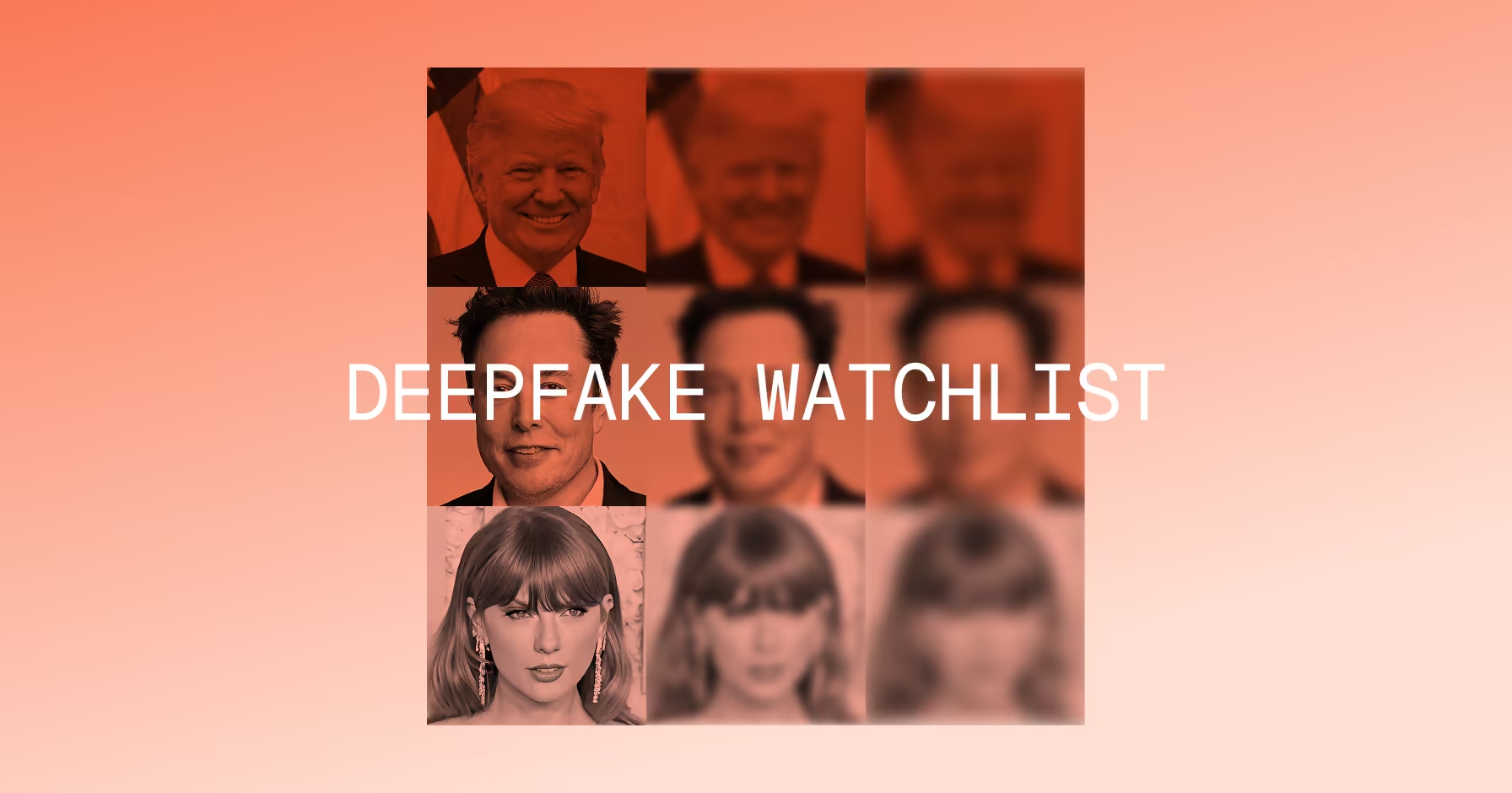
The Deepfake Watchlist is Resemble AI's weekly surveillance of synthetic media incidents, ongoing cases, and disputed content shaping the news cycle. Each week we track confirmed incidents, emerging attack vectors, and claims under investigation, alongside the provenance, detection, and policy threads running underneath them.
1. The voice behind "Mind the Gap" was cloned without his family's consent
LBC's Family of "Mind the Gap" voice Phil Sayer fight for AI Clone to be removed described how the widow of late voice actor Phil Sayer found an AI clone of his voice listed on a consumer cloning platform. It had unfortunately been uploaded without the family's permission nearly a decade after his death.
- Category: Brand / Likeness
- Type: Attack
- Modality: Audio
- Policy / Regulatory: The United Kingdom has no dedicated AI-replica statute, so the family's recourse runs through existing intellectual property and data protection law, even as the US advances the NO FAKES Act and several states pass likeness laws.
- Trend: Posthumous voice cloning is moving onto self-serve consumer platforms, where uploading a public figure's voice takes minutes and the work of removing it falls on the surviving family.
- Attack vector: Archival recordings were used to build a downloadable voice model with no consent from the estate that holds the rights to his voice.
Phil Sayer died in 2016, and his voice is still heard across London every day, telling people to mind the gap. Earlier this year his widow, Elinor Hamilton, learned that someone had taken his voice, uploaded it to a cloning platform by ticking a box, and left it there for anyone to download and make him say anything. To get it taken down the platform asked her to send his death certificate, a private document she does not want to hand to strangers. As of this week the clone is still listed, it has been generated from more than a thousand times, and anyone can make it say something new in about a minute.
A couple of years ago the family had already cloned Phil's voice the proper way, through a licensed platform, with consent, so the network could keep his announcements current as stations and warnings changed, and the estate kept the rights. That approval only lived in a contract though, it never traveled with the audio, so the authorized voice and the stolen one sound exactly alike.
Having an authorized identity is the first layer, and on its own it did nothing for Phil. The second layer is marking that authorized output when it is made, so the real audio carries a declaration of where it came from. The third is detection for everything that shows up without one. We ran the cloned voice through decoding and detection, and it carries no watermark and no content credentials, nothing on the file says where it came from, and detection still flags it as synthetic with high confidence, a call the system has to make precisely because nobody marked it.
The laws now moving are building the right to your own voice, but that right does not help the Sayers much if they cannot act on it. No single layer fixes this alone either, an identity can be ignored when nothing carries it, and a mark only helps if someone applied it at the source. Putting the three together is what moves the burden off a grieving family and onto the systems generating this content, so the people who own a voice can show what is really theirs.
2. The Senate Judiciary Committee advanced a federal right to your voice and likeness
Roll Call's AI deepfakes bill advanced by Senate Judiciary Committee reports that the committee voted unanimously by voice vote on June 18 to advance the NO FAKES Act, which would create a federal intellectual property right over a person's voice and visual likeness and now heads to the full Senate.
- Category: Brand / Likeness
- Type: Response
- Modality: Video, Image, Audio
- Policy / Regulatory: The bill would establish civil liability for unauthorized digital replicas, hold platforms liable up to $750,000 per work for knowingly hosting them, and set up a notice-and-takedown process modeled on copyright law, with carve-outs for news, commentary, and parody.
- Trend: After years of performers testifying on Capitol Hill, federal likeness protection is moving from proposal toward law, with backing from Hollywood, the recording industry, and major technology firms.
- Attack vector: The legislation targets AI-generated voice and face replicas made and distributed without the consent of the person depicted.
Performers have spent years telling Congress the same thing, that a person should have some say over whether a machine gets to wear their face and speak in their voice. This week the Senate Judiciary Committee advanced the NO FAKES Act on a unanimous voice vote, sending it to the full Senate. It would give every person a federal right over their voice and likeness. It would also make the people who produce unauthorized replicas liable, and put obligations on the platforms that host them.
Unanimous does not mean everyone was satisfied. Three Republican senators raised First Amendment concerns, and Ted Cruz pointed to satirical campaign ads that used AI images of sitting officials, arguing that kind of speech should stay protected. The sponsors agreed to keep working the text on the floor. The Electronic Frontier Foundation has warned that a broad likeness right could reach commentary and parody, and Public Knowledge has flagged that a transferable right could be stripped from someone in a bankruptcy.
A right like this is a real step, it lets you say in law that a use of your voice was never authorized. The harder part is acting on it in time, because a right you cannot enforce quickly arrives after the harm is already done. Most of this week shows the same thing, the law is building the right and the way to actually use it is still being built.
3. The bellwether voice-actor lawsuit collapsed into bankruptcy
TheStreet's AI voice-cloning firm collapses: Lovo in Chapter 7 bankruptcy reports that Lovo, the AI voice startup sued by voice actors who said it cloned their voices without consent, filed for Chapter 7 bankruptcy, and a federal judge stayed the closely watched case on June 11.
- Category: Brand / Likeness
- Type: Attack
- Modality: Audio
- Policy / Regulatory: The underlying case, Lehrman v. Lovo, was one of the first major US tests of whether cloning a working voice actor without permission violates their rights, and the bankruptcy stays those questions before a court could answer them.
- Trend: Litigation remains a slow and fragile remedy, and a company can dissolve faster than a case against it can resolve.
- Attack vector: Two voice actors said their voices were recorded for one-off jobs, then turned into reusable AI models and sold without their knowledge or consent.
For two years, Lehrman v. Lovo looked like the case that might finally put a number on what a voice is worth. Two working voice actors said they recorded what they thought were ordinary one-off jobs, then found their voices turned into reusable AI models and sold on a platform without their knowledge. The suit was meant to test whether cloning a person's voice without consent crosses a legal line, and much of the industry was watching it for an answer.
Now they will be waiting a lot longer. Lovo filed for Chapter 7 bankruptcy, a judge stayed the case on June 11, and a no-asset liquidation suggests there is little left for anyone to recover. The company that built the models can wind down faster than the case against it can reach a verdict, and the questions it was meant to settle stay open.
It is the same problem the Sayer story shows. Chasing the harm after it happens leaves the wronged person carrying the cost and the wait. Marking and authorizing voices when they are made is the alternative to litigating ownership years later, when the other side may already be gone.
4. Celebrity face scams are booming, and creators are the next target
Bitdefender's Deepfake celebrity scams are booming, and creators should pay attention documents a growing economy of scam ads that clone famous faces and voices to push fake investments and giveaways, and argues that mid-tier creators are becoming targets too, both as impersonation material and through account takeovers.
- Category: Fraud / Impersonation
- Type: Attack
- Modality: Video, Image, Audio
- Policy / Regulatory: These scams sit at the intersection of fraud law and likeness rights, and they are part of what is driving both the NO FAKES Act and new state disclosure rules.
- Trend: Cloned celebrity and creator endorsements are now a repeatable, scalable template rather than a string of one-off incidents, tested across platforms and continents.
- Attack vector: Real interviews and public footage are recut with AI-generated voice and face to manufacture endorsements the person never gave.
The celebrity scam ad has become its own small industry. Researchers keep finding clusters of ads that take a real interview, layer AI-generated voice and face over it, and turn a famous person into a pitchman for a fake trading platform or a giveaway that quietly harvests card details. The faces change, Taylor Swift one week and a finance personality the next, but the play is always the same, take someone's credibility and aim it at a scam before anyone can object.
This week's research points to where the targeting is heading. As big celebrities get more aggressive about policing their likeness, some of this could shift toward mid-tier creators, who have engaged audiences and far fewer resources to fight back, and who are already getting hit through hijacked accounts and fake sponsorship offers.
The reason it keeps working is that the real person has no easy way to prove which content is actually theirs. Taylor Swift has started filing trademarks on her voice and likeness, one way to stake that claim, slowly and through lawyers. There is a faster way too, if a creator's real sponsored posts carried a built-in marker of where they came from and the fakes carried nothing, people and platforms could tell them apart without filing a thousand takedowns.
5. Cate Blanchett launched a consent registry for your name, face, and voice
Euronews's Cate Blanchett launches free tool to help people protect identity from AI reports that the actor's nonprofit RSL Media unveiled a free Human Consent Registry at the European Parliament on June 23, letting anyone in the US or EU set whether and how AI can use their name, image, voice, likeness, and movement.
- Category: Brand / Likeness
- Type: Response
- Modality: Video, Image, Audio
- Policy / Regulatory: The registry produces a machine-readable Human Consent ID that AI systems can check before training on a person's likeness, but it carries no enforcement mechanism and depends entirely on AI companies choosing to honor it.
- Trend: Rights-holders and creative-industry coalitions are building consent infrastructure of their own rather than waiting for legislation, with backing from a long roster of Hollywood names.
- Attack vector: The registry responds to mass scraping of names, faces, and voices into AI training data without the knowledge or consent of the people involved.
Cate Blanchett spent this week at the European Parliament launching something the law has not built yet. Her nonprofit, RSL Media, put out a free Human Consent Registry, where anyone in the US or EU can set how they want AI to treat their name, face, voice, and movement, on a traffic light that runs from a hard no to a yes with conditions. You come away with a machine-readable Human Consent ID that an AI system can check before it trains on you. The names behind it are serious, Tom Hanks and Meryl Streep and Helen Mirren among them.
The catch is the same one running under this whole issue. Nothing makes an AI company honor the registry, it is voluntary, and the people building the models can ignore it. One write-up fairly called it robots.txt for people, a comparison that should worry anyone who has watched how often robots.txt gets ignored. For now its real value is a timestamped record of your refusal, something to point to later if the law or a court ever asks.
A registry like this is a declaration at the identity level, you saying in advance what you allow. That is the first layer again, authorize the identity, and on its own it has the same weakness as a contract or a label, it only works if the other side bothers to look. It sits where C2PA and other metadata sit, alongside the file rather than inside it, which means it can be skipped or stripped. The reason to mark the output itself, and to detect what comes through unmarked, is that those do not wait for anyone's good manners.
The pattern
.jpg)
- The legal protections are finally getting built, and not only by governments. A federal likeness right cleared a Senate committee this month and state disclosure laws are taking effect, while outside the statehouse a coalition of artists just launched a consent registry of its own. For years this was a problem with no structure behind it, and that is starting to change.
- Every story this week also shows what those rights are worth when they only work after the fact. The Sayer family has ownership on paper and still cannot get the clone removed, and the Lovo plaintiffs lost their day in court when the company went bankrupt. When the only fix is to notice the harm and then chase it down, the fix always arrives late, which is also why the scam-ad economy keeps running.
- The part still missing comes earlier, before anything gets posted. It takes authorizing an identity, marking the real output when it is made, and then detecting whatever shows up without a mark, and this week showed that any one of those alone leaves gaps the others have to cover. A consent registry and a disclosure label both live next to the file and only work if someone checks them, which is exactly why the EU has decided to stop leaving the marking optional. Its finalized Code of Practice asks for both signed metadata and an imperceptible watermark, and enforcement of the wider AI Act transparency rules begins on August 2. That date could be the first real test of whether marking at the source becomes the default or stays a good idea.
Watching next week
- The NO FAKES Act on the Senate floor. The committee vote was the easy part, the floor is where the First Amendment carve-outs and platform-liability terms get fought over.
- August 2 and the EU AI Act. Transparency obligations for AI content start becoming enforceable, and the Code of Practice shows what marking and labeling are expected to look like.
- Whether Phil Sayer's clone comes down. The model was still live this week, and Fish Audio had not replied to LBC as of publication, so any takedown or statement will show how much a family's objection counts against a platform.
- Whether any AI company honors the new consent registry. A voluntary standard lives or dies on adoption, and so far no major platform has said it will check the signals.
The Deepfake Watchlist publishes every Friday. Subscribe to receive it in your inbox, or follow Zohaib Ahmed on LinkedIn for the weekly social companion. Track every documented incident in the Resemble Deepfake Incident Database, and read the full methodology in our 2025 Deepfake Threat Report.