



The Deepfake Watchlist is Resemble AI's weekly surveillance of synthetic media incidents, ongoing cases, and disputed content shaping the news cycle. Each week we track confirmed incidents, emerging attack vectors, and claims under investigation, alongside the provenance, detection, and policy threads running underneath them. New to the world of deepfakes? Read the Deepfake 101 Guide to learn more about how to protect yourself and your company from threats.
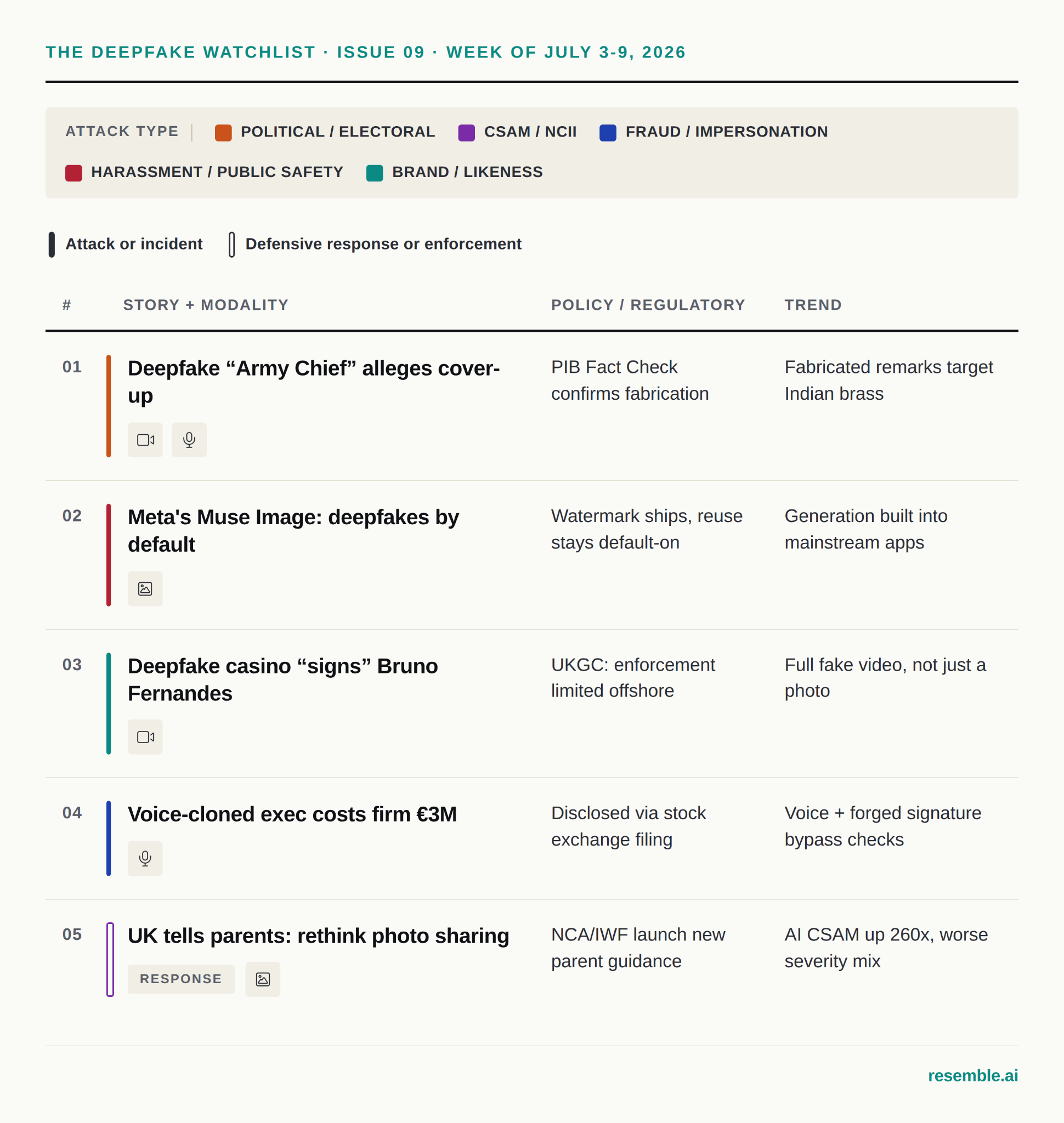
1. A viral deepfake had India's Army Chief accusing his own institution of a cover-up
Newschecker's Did Army Chief General Seth accuse previous leadership of hiding bodies of Op Sindoor martyrs? July 7 fact check confirmed that a viral video showing Indian Army Chief General Dhiraj Seth accusing former military leadership of hiding the bodies of Operation Sindoor's martyrs was AI-doctored, a finding echoed by India's own PIB Fact Check unit.
- Category: Political / Electoral
- Type: Attack
- Modality: Video, Audio
- Policy / Regulatory: PIB Fact Check, the Indian government's own fact-checking arm, publicly confirmed the clip was fabricated alongside independent outlets.
- Trend: Fabricated statements attributed to senior military and political figures have become a recurring tactic in disinformation targeting Indian institutions since Operation Sindoor.
- Attack vector: Attackers layered a cloned voice and face onto real address footage of General Seth to invent remarks he never made about a still-raw national tragedy.
What makes this one land differently than the usual political deepfake is the target. Most fabricated statements put words in a politician's mouth to make them look foolish or extreme to voters who already have an opinion about them either way. This one had the man leading the Indian Army accuse his own predecessors of hiding soldiers' bodies from the country and the Prime Minister himself, an accusation aimed squarely at the chain of command's credibility, at a moment when Operation Sindoor's casualties are still a live and painful subject for the families involved.
Newschecker's writeup describes a distorted name tag on Seth's uniform and reports that four separate tools all returned a synthetic verdict on the footage, with Resemble's flagging it at 96 percent confidence. That kind of convergence across independent tools is a genuinely reassuring signal, but every one of them did its job only after the video had already spread widely enough to need debunking in the first place.
2. Meta ships a deepfake generator that runs on your public photos by default
CNET's Meta Has a New AI Image Tool, and I Already Used It to Deepfake My Friend's Instagram reports that Meta's new Muse Image model let a reporter generate an AI image of a colleague, sourced entirely from her public Instagram account, in under a minute.
- Category: Harassment / Public Safety
- Type: Attack
- Modality: Image
- Policy / Regulatory: Meta ships an invisible "Content Seal" watermark and a detection tool alongside Muse Image, but the reuse permission defaults to on.
- Trend: Platforms are increasingly building deepfake generation directly into mainstream consumer apps rather than leaving it to third-party tools.
- Attack vector: Anyone can generate an AI image of a public Instagram user by referencing their username, no upload or technical skill required.
This is not a third-party tool in a legal gray area. It is a feature Meta shipped directly into Instagram, WhatsApp, and the Meta AI app, on by default for every public account. The CNET reporter generated her colleague dressed as a pirate using nothing but a public username, and the colleague had no idea until she was told.
Opt-out models lean on user inertia rather than informed consent, and public Instagram accounts, the kind ordinary people keep for entirely unrelated reasons, are now source material for AI generation unless someone finds the toggle to turn that off. Meta paired the launch with a watermark and a detection tool, the right instinct, but the generation feature defaults to on while the protective controls default to opt-in. Getting the defaults backwards like that is the whole ballgame.
3. An unlicensed casino built an entire deepfake ambassadorship around Bruno Fernandes
The Guardian's A footballing deepfake: how Bruno Fernandes fell victim to an unlicensed betting operator reports that unlicensed casino operator QH88 produced a one-minute AI deepfake video appearing to show the Manchester United captain signing an ambassador contract at Old Trafford, an endorsement that never took place.
- Category: Brand / Likeness
- Type: Attack
- Modality: Video
- Policy / Regulatory: The UK Gambling Commission says it acts on unlicensed operators when it becomes aware of them, but offshore incorporation makes enforcement largely symbolic.
- Trend: Illegal sportsbooks are increasingly building fabricated video endorsements around footballers rather than just lifting a photo or a logo.
- Attack vector: QH88 generated a full deepfake video depicting a contract signing, a step beyond the doctored image or fake quote typical of past athlete-likeness cases.
Most athlete deepfake cases have been a lifted photo or a fabricated quote bolted onto a real image. QH88 went further and staged an entire fictional business relationship on video, Fernandes supposedly signing as brand ambassador inside a real stadium for a casino that has nothing to do with him. His name carries enormous weight in Vietnam, where Manchester United remains the country's most popular club, and QH88 built its campaign around exploiting exactly that.
Forensic reviewers cited by the Guardian found the tells you would expect, blurred details, small continuity errors, faces that read as slightly generic under scrutiny, but none of it stopped the video from anchoring an entire fake website. The Gambling Commission's honest answer, that it acts when it becomes aware of unlicensed operators, says a lot about the limits of enforcement against operators incorporated specifically to make cease-and-desist letters pointless.
4. A voice-cloned executive costs an Indian SaaS company €3 million
Inc42's Capillary Technologies' Subsidiary Hit By €3 Mn Cyber Fraud reports that a Bengaluru-based SaaS company's overseas subsidiary lost roughly €3 million after attackers used voice cloning, forged signatures, and social engineering to impersonate senior executives and authorize fraudulent transfers.
- Category: Fraud / Impersonation
- Type: Attack
- Modality: Audio
- Policy / Regulatory: Capillary disclosed the incident through a mandatory stock exchange filing and notified its cyber and crime insurer.
- Trend: Voice-cloned executive impersonation remains the most financially damaging deepfake attack vector against corporate treasury functions.
- Attack vector: Attackers cloned the voices of company leadership and paired the audio with forged signatures to authorize transfers to unauthorized accounts.
Capillary's disclosure highlights how ordinary these types of attacks have become. A finance team at an overseas subsidiary heard what sounded like senior leadership authorizing a transfer, backed by a forged signature, and moved roughly €3 million before anyone caught it. The company has recovered €450,000 so far and is working with banks and cybercrime authorities on the rest.
What stands out is the layering. Voice cloning alone gets flagged more often now, so attackers are pairing it with forged paperwork and social engineering, each element covering for the others' weaknesses. A cloned voice with no supporting documentation raises suspicion on its own. Paired with a forged signature and a plausible reason for urgency, the combination passes the informal verification most finance teams still rely on.
5. UK agencies launch a campaign warning parents about AI-generated child abuse imagery
The National Crime Agency's New guidance for parents and carers as AI-manipulated images of children become a growing concern reports that the NCA and the Internet Watch Foundation launched a July 3 campaign urging parents to tighten photo-sharing habits, after identifying a sharp rise in AI-generated child sexual abuse videos over the past year.
- Category: CSAM / NCII
- Type: Response
- Modality: Image
- Policy / Regulatory: The NCA and IWF launched a joint awareness campaign, the first time UK agencies have explicitly asked parents to change their own sharing habits as a defense.
- Trend: AI-generated child sexual abuse material is growing far faster than traditional CSAM, with the most severe legal category overrepresented.
- Attack vector: Criminals scrape publicly shared, fully clothed photos and use generative AI to fabricate sexualized content without ever contacting or grooming a child.
The IWF identified 3,440 AI-generated child sexual abuse videos in 2025, versus just 13 the year before, and 65 percent fell into the UK's most severe legal category, a higher share than the 43 percent rate in traditional material. The technology is not just making this content easier to produce. It is making the worst of it easier to produce.
What the campaign asks parents to do is important: treat their own posting habits, family and school photos included, as the primary point of vulnerability. It cites an earlier case, from months before this launch, where a gang scraped a UK school's website for student photos and attempted to extort the school, background rationale rather than new news. It requires no contact with a child and no grooming, just a public photo, which shifts the calculus for anyone who has ever posted a class picture.
Honorable mentions
Three more stories from this week worth a look, even though they did not make the main rundown.
NatWest's CEO becomes the latest deepfaked banking executive. TechRadar's 'They are another reminder of criminal activity designed to defraud people': NatWest boss becomes latest City figure caught in AI social media scam reports a fabricated image depicted CEO Paul Thwaite in a fake BBC interview about his pay, part of a pattern that has also hit Bank of England governor Andrew Bailey. NatWest confirmed the image was fake.
FBI Richmond deepfaked its own Special Agent in Charge to teach people how convincing this technology has gotten. The field office posted a video pairing a synthetic version of Ian Kaufmann alongside the real him, pushing people toward independent verification before acting on an urgent request.
Two Indian courts moved on deepfake likeness cases within two days of each other. The Bombay High Court ordered removal of morphed content involving actor Preity Zinta, and the Delhi High Court granted actor Ravi Kishan interim relief against unauthorized use of his likeness.
The pattern
- Every story this week reduces to the same question: how do you verify who or what you are looking at before you act. India's own government fact-checkers needed four detection tools to debunk a fabricated Army Chief. A finance team at Capillary's subsidiary had no way to verify a voice on a call was real. UK parents are now being told their own photo-sharing habits are the verification layer for their children's safety.
- The Seth deepfake and Meta's Muse Image launch sit at opposite ends of the same problem. One shows detection working, four tools converging on the same correct verdict after the fact. The other shows a platform shipping generation capability with the default set to on and the protective controls set to opt-in. Detection can catch what already exists. It cannot do anything about a tool built to make more of it by default.
- The EU's AI Act brings its Article 50 transparency rules into force on August 2, requiring AI-generated audio, image, video, and text to be marked in a way that is both machine-readable and detectable. Coming right behind Meta's decision to ship the opposite design, the timing could help set the tone for whether platforms treat authenticated-by-default as a competitive baseline or as a regulatory box to check after the fact.
Watching next week
- EU AI Act Article 50 enforcement. Transparency obligations become enforceable August 2, and the industry's Code of Practice signatory deadline lands July 22, will be curious to see who signs and who does not.
- Capillary Technologies' recovery. The company has recovered €450,000 of the roughly €3 million lost so far, and its insurance settlement will shape how much of the remainder becomes a lasting financial hit.
- Meta Muse Image's expansion. Meta has said Muse Image is coming to Facebook and advertisers next, with a video version reportedly in development, both worth watching for whether the reuse defaults change.
- Further Operation Sindoor disinformation. Newschecker notes this is part of a recurring pattern targeting Indian military and political figures, and further fabricated clips are likely.
The Deepfake Watchlist publishes every Friday. Subscribe to receive it in your inbox, or follow Zohaib Ahmed on LinkedIn for the weekly social companion. Track every documented incident in the Resemble Deepfake Incident Database, and read the full methodology in our 2025 Deepfake Threat Report.