
Deepfake detection in forensics helps security and investigation teams review audio, image, and video evidence for signs of manipulation before that evidence shapes a case decision. The risk is no longer limited to obviously fake files.
The FBI’s 2025 Internet Crime Report shows 22,364 AI-related complaints and nearly $893 million in losses. It also highlights that scammers use fake social profiles, voice clones, identity documents, and convincing videos. This makes evidence verification more important when the media affects fraud, access, or legal decisions.
For security, fraud, legal, compliance, and investigation teams, the core challenge is determining when a media file is sufficiently reliable to influence a case.
In this blog, you’ll explore how deepfake detection in forensics supports evidence review, what teams should verify across audio, image, and video evidence, and how structured documentation helps convert detection output into strong case decisions.
Key Takeaways:
- Deepfake detection in forensics helps teams review audio, image, and video evidence before it influences a case decision.
- Forensic review should connect detection output with source history, file origin, case context, and related records.
- Audio, image, and video evidence need different review checks, including speech consistency, visual stability, metadata, and timing.
- Detection results should be reviewed alongside human judgment, documentation, escalation rules, and clear evidence handling before they shape a case decision.
- A strong workflow helps security, fraud, legal, compliance, and investigation teams decide when media can support action or needs deeper review.
What Deepfake Detection in Forensics Means for Security & Investigation Teams
Deepfake detection in forensics involves reviewing audio, images, or video evidence to determine whether it may have been manipulated, generated, or misrepresented. The purpose is to support a strong case, not just to label something as real or fake.
Here’s what deepfake detection means in an investigation workflow:
- Connecting Media Review to a Case Decision
Forensic review matters when audio, video, or image evidence affects fraud, legal, access control, or incident response decisions.
Teams usually try to confirm:
- What media they are reviewing: Audio, image, video, meeting recording, screenshot, or any submitted file
- Why it matters: Whether it impacts identity verification, payment approval, access control, or case escalation
- Who needs to review it: Security, fraud, legal, compliance, IT, or investigation teams
- What decision depends on it: Escalation, identity checks, access pause, evidence preservation, or case closure
- Separating Suspicion from Reviewable Evidence
Unusual audio or video does not automatically indicate manipulation. Compression artifacts, lighting variation, network instability, device limitations, and format conversion can all introduce distortions that resemble synthetic signals.
A forensic workflow separates these effects from genuine anomalies by grounding interpretation in case context, source reliability, and cross-evidence validation before any action is taken.
For recorded audio, video clips, screenshots, images, or submitted media, Resemble Detect can help review audio, video, and image evidence as part of a broader case file. Resemble Detect uses DETECT-3B Omni to provide multimodal deepfake detection context across audio, image, and video, helping reviewers decide whether submitted media needs closer forensic review.
Resemble Intelligence adds an explainability layer on top of that detection result. It is designed to show why media was flagged, including artifacts, fraud type, liveness status, and a human-readable forensic breakdown.
Together, DETECT-3B Omni and Resemble Intelligence can help reviewers understand:
- What was reviewed: Audio, video, or image evidence tied to the case file.
- What was flagged: Artifacts or abnormalities that contributed to the detection result.
- Why it matters: Fraud type, liveness status, or review context behind the flag.
- How to document it: A structured explanation that can support escalation, audit review, and comparison with timelines, metadata, statements, and other evidence.
This gives forensic, security, legal, and investigation teams a clearer way to review media evidence when case authenticity needs closer examination.
The context also makes it important to understand how forensic teams approach the review of AI-generated audio, images, and video.
Also Read: The Race to Detect Deepfake Videos: Challenges and Strategies
How Forensic Teams Review AI-Generated Audio, Images, and Video
Forensic teams review AI-generated media by checking each format separately, then comparing the findings against the full case record. The goal is to decide if the evidence is reliable enough to support a fraud, access, legal, or compliance decision.
Here’s how forensic review usually works across audio, image, and video evidence:
- Audio Review Focuses On Voice And Recording Consistency
Audio review helps teams examine how a recording aligns with the claimed speaker, event, or communication path. This is especially useful when teams are reviewing suspected synthetic audio tied to identity verification, payment approval, account access, or fraud escalation.
Teams usually look for:
- Speech rhythm and pacing across the recording
- Sudden changes in voice quality, tone, or clarity
- Background sound shifts that do not fit the setting
In fraud cases, audio review may also support deepfake vishing investigations where a voice clip influences payment, access, or identity decisions.
- Image Review Tests Visual And File-Level Consistency
Image review helps teams check if a still image supports the claimed person, document, location, or event. Screenshots, profile images, ID photos, and submitted files can all become part of an investigation record.
The review usually focuses on:
- Lighting, shadows, and reflections
- Face, hand, object, or edge inconsistencies
- Metadata, file history, and source channel
- Video Review Examines Motion, Timing, And Visual Stability
Video review helps teams study visible behavior, movement, and timing across a clip or meeting record. This also applies when teams review recorded interviews, meeting clips, or deepfake live video calls that influence identity, access, or incident timelines.
Forensic teams usually examine:
- Lip movement against spoken audio
- Face edges during movement
- Frame stability, blur, or flicker during motion
- Liveness indicators and whether the media suggests a real person was physically present
- Resemble Intelligence Adds Explainable Forensic Context
For teams that need more than a detection score, Resemble Intelligence can help turn deepfake detection results into a more reviewable forensic report. Resemble describes Intelligence as the explainability layer built to work with DETECT-3B Omni, providing a human-readable breakdown of artifacts, fraud type, and liveness status.
A Resemble Intelligence report can help reviewers understand:
- What was detected: Acoustic or visual artifacts, abnormalities, and other review factors found in audio, image, or video evidence.
- Speaker and subject context: Speaker profile details such as language, dialect, emotion, and speaking style, where available.
- What was said or shown: Content intelligence, including transcription and message-intent context.
- What type of risk appeared: Fraud classification, including examples such as executive impersonation, account takeover, synthetic media fraud, and presentation attacks.
- Liveness and expected behavior: Liveness indicators and expected-behavior review factors that help assess the media capture context.
- Whether the file was altered: Digital alteration checks for editing, splicing, tampering, staged media, or synthetic background replacement.
- How to document the case: Structured report fields that can support legal, compliance, regulatory, or escalation workflows.
This review process is guided by key factors that help teams evaluate deepfake detection within forensic workflows.
Also Read: How Does Deepfake Detection Work
5 Review Factors for Deepfake Detection in Forensic Evidence Workflow
A deepfake detection in the forensics workflow should help teams review suspicious media before they escalate, close, or act on it. This checklist focuses on source, context, detection quality, documentation, and risk-based next steps.
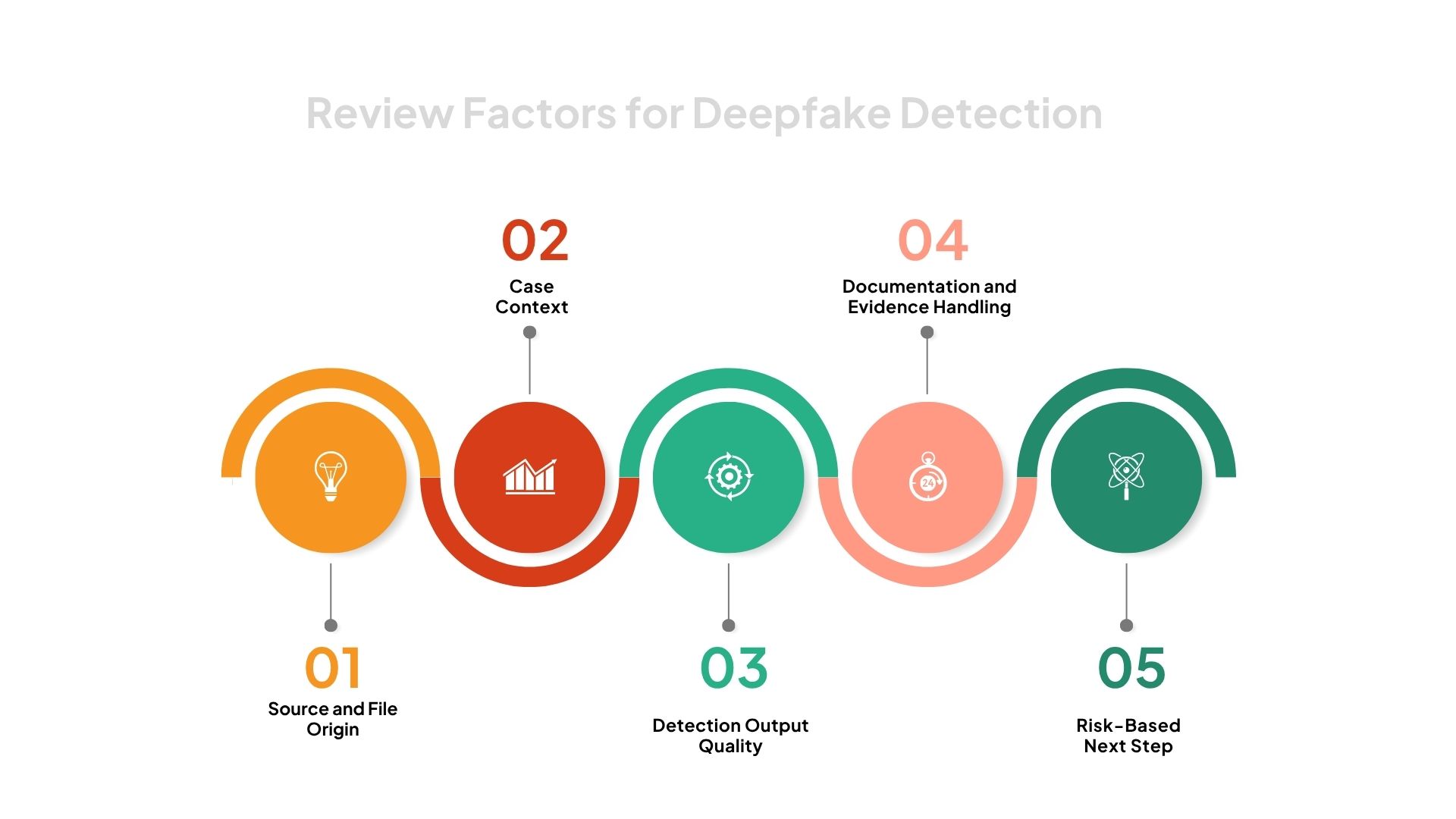
Here are the key review factors you should consider:
- Source and File Origin
Source review helps teams understand where the file came from and how much trust they can place in it. Media from unknown, forwarded, or re-uploaded sources often need stronger verification.
Check:
- Who submitted the file
- Which channel did the file come through
- Whether the file is original, forwarded, compressed, or re-uploaded
- Whether timestamps match the case timeline
- Case Context
Case context connects the media to the broader investigation rather than treating it as a standalone file. This is especially important when a clip, image, or recording influences access decisions, fraud review, legal escalation, or compliance reporting.
Compare:
- The media against known identity records
- The file against messages, logs, or meeting records
- The claimed timeline against system activity
- The media claims against transaction or access details
- Detection Output Quality
Detection output quality determines if reviewers can understand and act on the finding. A useful output should include:
- The media type reviewed
- What inconsistency or anomaly was flagged
- Where it appeared in the file
- Confidence context and known limitations
- A clear path for human review or escalation
- Documentation and Evidence Handling
Documentation helps teams preserve the review trail and explain how decisions were made. This matters when findings affect access control, fraud escalation, compliance review, or legal action.
Document:
- Original file and related records
- Review notes and timestamps
- Detection output and reviewer interpretation
- Team ownership and escalation path
- Final decision and reason for action
- Risk-Based Next Step
The next step should align with the media's associated risks. Not every anomaly needs escalation, but high-impact decisions should not move forward on unresolved evidence.
Teams may decide to:
- Preserve the evidence and continue review
- Request another proof point
- Pause access, payment, or onboarding activity
- Escalate to security, fraud, legal, compliance, or IT
- Close the concern when media and context support the decision
Once you understand these review factors, it becomes easier to evaluate whether a deepfake detection and forensics workflow is reliable and consistent.
How To Validate A Deepfake Detection Forensics Workflow
Deepfake detection forensics should be tested before teams rely on detection outputs in high-impact evidence review. The goal is to confirm whether reviewers, tools, and escalation rules produce consistent decisions when the same media is reviewed under controlled conditions.
Here are the workflow checks that can strengthen deepfake evidence review:
- Test with known benign artifacts: Use approved examples of compression, poor lighting, packet loss, motion blur, audio noise, and format conversion so reviewers understand normal file degradation before escalating suspicious patterns.
- Use controlled synthetic-media samples: Test audio, image, and video samples across different file qualities, formats, and scenarios to identify where detection output is clear, uncertain, or needs human review.
- Compare outputs across review methods: When a result is borderline, compare it with another approved review method or with a trained reviewer to understand why the findings differ before using them in a case decision.
- Run reviewer consistency checks: Give the same test file to multiple trained reviewers and compare their interpretations to identify training gaps, unclear escalation rules, or inconsistent review standards.
- Recheck the workflow after major cases: After a major case, a false-positive concern, or an inconclusive review, assess whether the process worked as expected and update test samples, escalation rules, and reviewer guidance.
Once the workflow checks are in place, explainable reports can help teams test whether reviewers are interpreting findings consistently across cases.
Use Explainable Reports To Check Review Consistency
A detection workflow is easier to validate when reviewers can compare how the same type of finding is explained across cases. This helps teams identify whether decisions are being made consistently, or whether reviewers need clearer guidance.
Use a Resemble Intelligence report during validation to check:
- Reviewer alignment: Do different reviewers interpret the same flagged artifact in a similar way?
- Escalation consistency: Do similar types of fraud lead to similar follow-up steps?
- Evidence clarity: Does the report give enough context for legal, compliance, or investigation teams to understand the finding?
- Process gaps: Are reviewers missing the same artifact type, liveness indicator, or alteration pattern across cases?
- Documentation quality: Can the report support a clear case note without relying only on memory or subjective interpretation?
Also Read: Deepfake Detection Methods: A Comprehensive Guide to Spotting Fakes
How Resemble AI Supports Deepfake Detection in Forensics
Manual review still matters, but security and investigation teams are not expected to identify every inconsistency in audio, images, or video solely by sight or sound.
Resemble AI adds a multimodal detection and intelligence layer for forensic review across audio, video, and images. Resemble Detect returns a verdict, an explanation, and a chain of custody, while Resemble Intelligence adds forensic context, including abnormalities, fraud classification, liveness status, confidence per modality, and audit-trail support.
When evidence comes from a live call or meeting recording, live meeting protection can help teams review audio and video concerns as they occur. Resemble Meetings supports this use case by adding detection context for high-trust meetings where identity, access, or fraud decisions may be affected.
For forensic teams, the output needs to answer practical review questions:
- Was the media flagged?
- Which format raised concern, audio, image, video, or multiple formats?
- Where did the inconsistency appear?
- Why was it flagged?
- Who should review it next?
Resemble AI supports API-based detection workflows and deployment across cloud, on-prem, and air-gapped environments, depending on the organization’s configuration. This helps teams route detection outputs to security, fraud, legal, compliance, or investigation workflows rather than treating them as isolated tool scores.
For forensic review, those outputs can be assessed alongside original files, source history, timestamps, transaction records, access logs, and reviewer notes. They should not replace investigative judgment. They give teams another review point when media authenticity affects a case decision.
Turn Deepfake Evidence Review Into A Clear Case Decision
Deepfake detection in forensics is most useful when suspicious media could drive a high-impact decision.
Security and investigation teams should review the original file, source history, case context, detection output, and documentation trail before escalating or closing a case. When audio, image, or video evidence affects fraud, access, legal, or compliance decisions, the review should stay structured and proportionate.
The strongest forensic process is the one that connects media evidence to case facts, includes human review, ensures clear ownership, and provides strong next steps.
If your team is reviewing high-risk audio, image, or video evidence, explore how Resemble AI can support multimodal deepfake detection in forensic workflows. Book a demo to get started.
FAQs
- How is deepfake detection different from deepfake forensics?
Deepfake detection looks for signs that audio, image, or video evidence may be synthetic, altered, or inconsistent. Deepfake forensics connects that result to the file source, case context, evidence handling, reviewer notes, and final decision. Detection flags a concern, while forensics helps teams decide how much weight to give the media in an investigation.
- Can deepfake detection work on low-quality or compressed files?
Deepfake detection can support review on low-quality or compressed files, but results may be harder to interpret. Compression, re-uploads, background noise, poor lighting, and missing metadata can create artifacts that look suspicious. Teams should preserve the original file when available and compare detection output with source history, timestamps, and case records.
- What should teams do when a deepfake detection result is inconclusive?
An inconclusive result should prompt further review, not an immediate case decision. Teams can request the original file, compare related messages or logs, review additional media, and document why the result could not be confirmed. If the evidence affects access, payment, fraud response, or legal escalation, a human reviewer should examine the case before action.
- How should security teams validate a deepfake detection tool before using it in forensics?
Security teams should test the tool inside real review workflows, not only through sample demos. They should check supported media types, explanation quality, false-positive handling, documentation options, reviewer handoff, and escalation fit. The goal is to confirm whether the tool helps teams make clearer case decisions, not just whether it produces a score.
- Why does the chain of custody matter in deepfake evidence review?
Chain of custody shows where the file came from, who handled it, when it was reviewed, and how it moved through the investigation. Without that trail, even useful detection output may be harder to rely on during legal, compliance, or fraud review. A clear chain of custody helps teams explain how they reached a decision and what evidence supported it.
- How often should teams recheck their deepfake detection workflow?
Teams should recheck their workflow on a set schedule and after major incident reviews. Synthetic media methods, file-sharing behavior, internal systems, and attacker tactics can change over time. A practical review should cover detection settings, escalation rules, reviewer training, documentation standards, and whether the workflow still fits current risk levels.
- How can teams use deepfake detection without creating privacy or fairness issues?
Teams can reduce privacy and fairness concerns by applying review rules consistently and limiting detection to relevant case evidence. Reviewers should document why the media was checked, who had access to the output, and how the finding influenced the decision. Storage, retention, processing, and access controls should be reviewed against the organization’s deployment configuration and compliance requirements.
- What should teams look for in a deepfake detection forensics tool?
Teams should look for audio, image, and video review, clear explanations, confidence context, and a smooth handoff to human reviewers. A useful tool should show what was flagged, where it appeared, and what needs review next. It should also fit existing security, fraud, legal, compliance, or investigation workflows, rather than turning evidence review into an isolated tool check.
- Can deepfake evidence create legal or compliance risk?
Yes, deepfake evidence can create legal or compliance risk when it affects identity, access, fraud decisions, employee actions, or formal escalation. The risk grows when teams act on media without preserving the source, the review steps, the detection output, and the final reasoning. Legal counsel should review cases where manipulated media may affect rights, obligations, enforcement, or reporting duties.
- What red flags suggest deepfake evidence needs further review?
Further review may be needed when audio and video do not align, voice quality shifts suddenly, face edges appear unstable, metadata is missing, or the file conflicts with case records. One anomaly is not proof of manipulation. Repeated inconsistencies across the media, source history, timeline, and related records should trigger a structured review.
- How should teams document a deepfake evidence review?
Teams should document the original file, source channel, timestamps, related records, detection output, reviewer notes, and final decision. Notes should separate observed facts from interpretation, such as “lip movement and audio did not align at 02:14”, instead of assuming intent. This creates a clearer review trail for security, fraud, legal, and compliance teams.
- How does Resemble AI support deepfake detection in forensic workflows?
Resemble AI supports forensic review workflows by helping teams assess audio, image, and video evidence for possible manipulation through multimodal deepfake detection. Its outputs can be reviewed alongside original files, source history, timestamps, transaction records, access logs, and reviewer notes. This gives teams another review point when media authenticity affects a fraud, legal, compliance, or access decision.is in question and a fraud, legal, compliance, or access decision is at stake.y