




For teams building generative voice or media products, AI watermarking has moved from a future compliance consideration to a near-term product, security, and audit requirement. The European Commission states that AI Act Article 50 transparency rules apply from 2 August 2026, and California’s AI Transparency Act (SB 942) adds disclosure and detection-tool duties for covered AI-generated audio, image, and video content. If your product creates synthetic media, watermarking now affects how you prove origin, support audits, and manage downstream trust risk.
These 2026 updates matter because labels only cover disclosure. Audits, disputes, and incident reviews need a stronger record: which system produced a voice clip, image, or video; whether that evidence survives compression or upload; and whether external synthetic media is detected before it poses a risk.
This article breaks down the latest watermarking generative AI news, where the technology works, where it fails, and what teams need around it before the new transparency requirements take effect.
Key Takeaways
- AI watermarking embeds or attaches a machine-readable marker to AI-generated content.
- EU AI Act Article 50 transparency rules apply from 2 August 2026.
- The EU Code of Practice process now emphasizes secure metadata and watermarking, with optional fingerprinting, logging, and verification protocols.
- The European Commission published May 2026 draft Article 50 guidelines and three technical studies covering text, audio, image, and video marking and detection.
- Many organizations serving California users are evaluating provenance workflows to support anticipated compliance needs.
- Audio and image/video marks can be durable in normal production use, but no mark should be treated as removal-proof.
- Text watermarking is weaker because paraphrasing, translation, and rewriting can damage the statistical pattern.
- Watermarking is outbound provenance. Deepfake detection is inbound screening. Enterprise teams need both.
2026 AI Watermarking Updates
For the past few years, watermarking lived in voluntary pledges, standards work, and product roadmaps. That changed when Article 50 deadlines and California’s disclosure duties began to point in the same direction: AI-generated media needs a record of origin that can be checked later.
The point for product and security teams is simple: a visible badge is not enough for audits, dispute reviews, or post-incident investigations. A useful stack has to mark content at creation, preserve provenance where possible, and support verification after the content leaves the original product.
Also read: What Is AI Watermarking and Why Does It Matter in 2026?
Article 50 and California: What Is Mandatory, What Is Draft, and What Teams Should Track
The regulatory picture is still moving, but it is specific enough to affect product architecture now. Product, compliance, and legal stakeholders should separate enforceable duties, draft guidance, and technical studies instead of treating all of them as the same type of source.
EU AI Act Article 50: The August 2026 Constraint
Article 50 focuses on transparency for certain AI systems and AI-generated or manipulated content. The European Commission says the relevant transparency rules apply from 2 August 2026.
The Commission’s first draft Code covered two groups: providers of systems that generate content under Article 50(2), and deployers labeling deepfakes, as well as certain AI-generated or manipulated text, on matters of public interest under Article 50(4). The March 2026 second draft gives providers more practical details. It describes a two-layer marking approach using secured metadata and watermarking, with optional fingerprinting, logging, and detection or verification protocols.
For buyers, this turns into three questions:
- Does the product mark outputs in a machine-readable way?
- Does it keep a provenance record that can travel with the media?
- Does the vendor document how the method maps to Article 50?
Note: This article is for informational purposes only and does not constitute legal advice. Consult qualified counsel regarding applicable regulations.
EU Draft Guidelines and Technical Studies: Why They Matter for Buyers
The May 2026 draft Article 50 guidelines are useful because they are written for competent authorities, providers, and deployers. That makes them more practical for product and legal review than a high-level summary of the AI Act alone.
The European Commission also published technical studies on marking and detection for AI-generated content. These studies matter because they separate the problem by media type. Audio, image, video, and text do not behave the same way after compression, editing, upload, export, or rewriting.
For teams buying watermarking systems, that means one generic claim is not enough. Ask vendors to show results by media type and by the edits your pipeline actually uses.
California AI Transparency Act: Detection and Disclosure Duties for Covered Media
California’s AI Transparency Act creates a U.S. reference point for provenance planning. SB 942 requires covered providers to make an AI detection tool available at no cost to users, offer a manifest disclosure option, and include latent disclosure in covered AI-generated image, video, or audio content where technically feasible and reasonable.
The details differ from the EU. The product lesson is similar: disclosure needs to be readable by people, provenance needs to be readable by machines, and detection needs to work after content leaves the generator.
What an AI Watermark Proves, and What a Visible Label Cannot
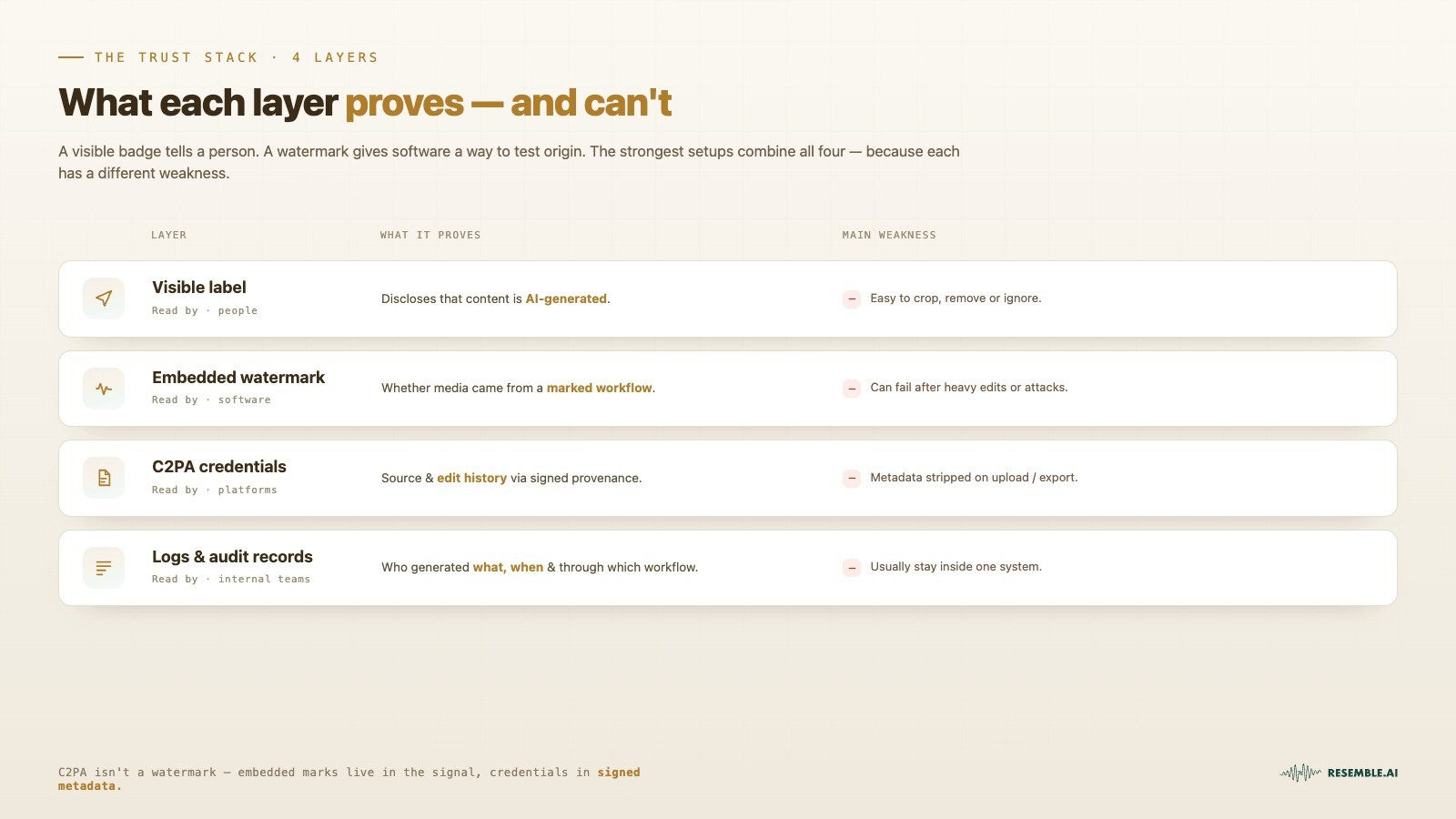
AI watermarking adds a machine-readable marker to generated content. A verifier can later check whether a file came from a specific system, model, vendor, or workflow.
A visible label indicates that content is synthetic. A watermark gives software a way to test origin. A provenance record, such as C2PA Content Credentials, can add source and edit history through signed metadata.
C2PA is not the same as a watermark. The C2PA specification describes Content Credentials as a cryptographically bound structure that records provenance for a digital asset. Embedded marks live in the media signal or output pattern itself. Many enterprise deployments combine both
For enterprise teams, the practical output is a chain of custody. A good setup should answer:
- Did this asset come from our system?
- Was it edited after generation?
- Can a partner verify it without opening a support ticket?
- What survives when a platform strips metadata?
- What proof remains after compression or clipping?
Audio, Image, Video, and Text: Where the Technology Holds Up
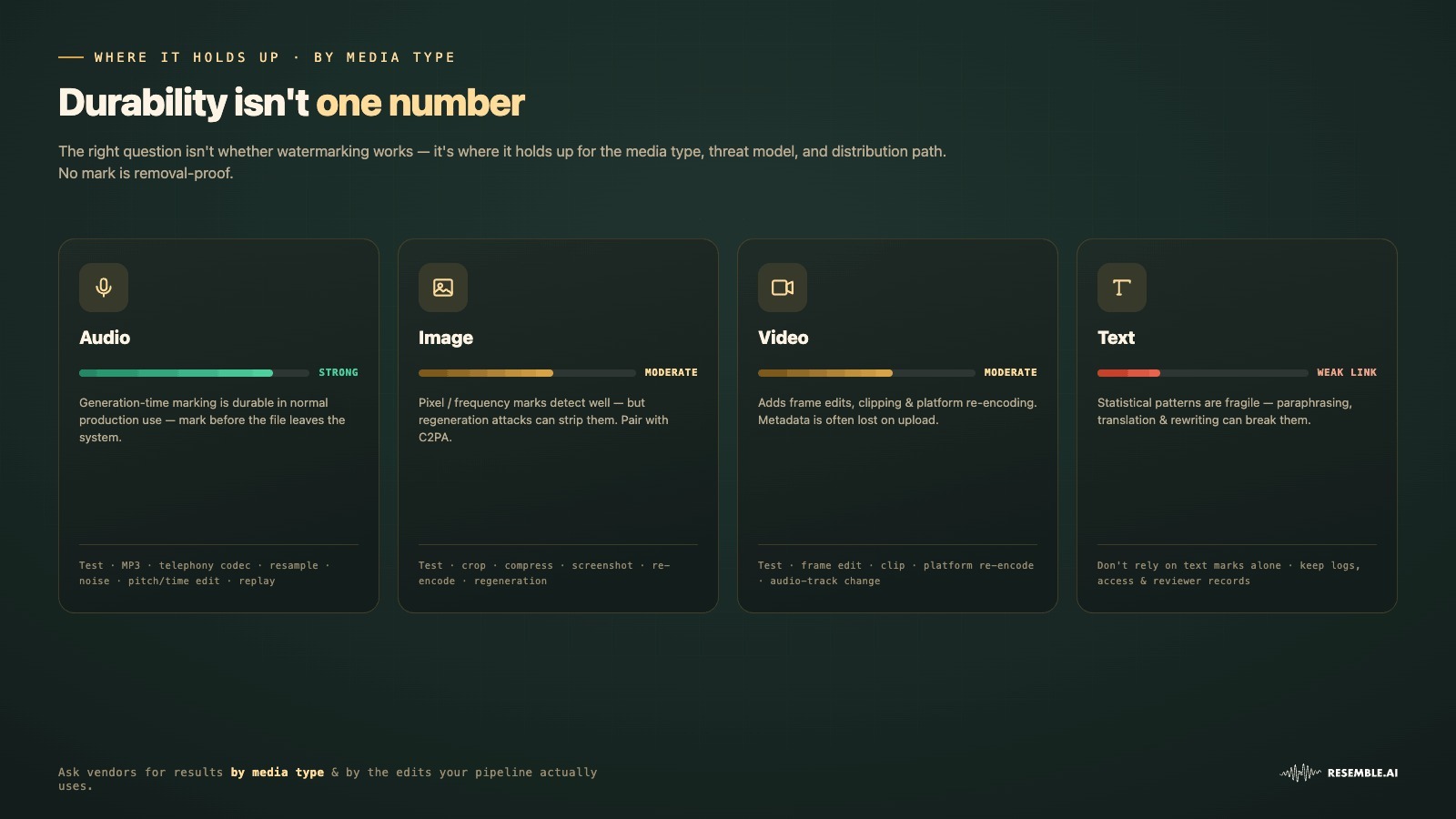
The right question is not whether watermarking works. The right question is where it works well enough for the media type, threat model, and distribution path.
Audio: Why Generation-Time Marking Matters for Voice AI Workflows
Audio watermarking embeds a hidden marker into the sound signal. In voice AI, the strongest setup applies the mark during generation, before the file leaves the system.
Post-processing can still add a useful marker, but it first creates a clean, unmarked file. That gap can matter during audits or disputes because the team has to explain how every output became marked.
For voice agents, IVR systems, call-center audio, and narrated media, test audio marks against the transformations your files actually face:
- MP3 compression
- telephony codecs
- resampling
- background noise
- pitch edits
- time edits
- replay through a speaker and a microphone
Image and Video: Metadata Alone Is Not Always Enough
Image and video marks usually modify pixel values or frequency-domain features in ways that a verifier can detect. Video has the added problem of frame edits, clipping, and platform re-encoding.
C2PA Content Credentials are useful because they give a signed provenance record. They should not be the only layer. Metadata is often lost when users upload, export, take screenshots of, or repost files.
Research on invisible image watermarks has shown that regeneration attacks can remove pixel-level signals across several watermarking schemes. That does not make image marks useless. It means buyers should ask which edits were tested, where the detector fails, and how the system records uncertainty.
Robustness depends heavily on the editing pipeline, so buyers should validate watermark recovery under their own production conditions rather than relying solely on vendor demonstrations.
Text: The Weak Link in the Chain
Text watermarking usually changes word or token choices to create a statistical pattern. That pattern is fragile.
Paraphrasing, translation, shortening, and rewriting tools can weaken detection. Recent research on paraphrasing attacks and text-watermark reliability shows that even methods designed to resist edits can fail under certain attack settings.
For text-heavy workflows, do not rely on text marks alone. Keep output logs, access records, reviewer notes, and policy controls. Treat text watermarking as one evidence point, not the whole record.
The Failure Mode Buyers Miss: Outbound Provenance and Inbound Deepfake Detection
Many teams buy watermarking as if it solves deepfake risk. It solves only the part connected to the content your own system creates.
Watermarking answers: Did this asset come from our generation workflow?
Deepfake detection answers: Is this outside call, upload, video, or voice note synthetic or manipulated?
A bank using an AI voice for customer service needs provenance on its own generated speech. The same bank also needs detection of incoming calls, live video meetings, identity checks, and executive impersonation attempts.
This is why the stack has to cover both sides of the threat surface: what your team generates and what enters your environment.
Six Vendor Questions Before You Commit to a Watermarking System
The August 2026 deadline gives teams enough time to test, but not enough time to buy into vague claims. These questions keep procurement tied to evidence.
Ask for test files, SDK details, verification outputs, known failure cases, retention terms, and coverage by media type. A credible vendor should be able to show where the method works, where it degrades, and how those limits are documented.
Watermarking, Provenance, and Deepfake Detection: How Resemble Addresses the Problem
Resemble AI’s role is strongest in workflows where synthetic media needs to be marked at creation, verified after distribution, and checked again when external media enters the business. PerTh and Watermarker address generated media and provenance. Detect and Meetings address synthetic content that arrives through calls, uploads, meetings, or review queues.
PerTh Multimodal: Watermarking Across Audio, Video, Image, and Text
Resemble AI's PerTh Multimodal extends the original audio-only PerTh watermarker to audio, video, image, and text in a single API. Each modality uses a purpose-built encoding approach — spectral/psychoacoustic for audio, pixel-level for images and video, linguistic rewriting for text — tuned to withstand the transformations content actually undergoes: compression, re-encoding, cropping, and platform reprocessing. For voice AI teams, the key detail is timing: the mark is applied during generation, so content carries provenance from the start rather than depending on a visible label added later.
The original PerTh model remains open source and audio-only, and is embedded in every Chatterbox output by default. PerTh Multimodal is the enterprise evolution of that same design goal, built for teams that need coverage beyond audio.
Resemble Watermarker: Dual-Layer Provenance with C2PA
Resemble Watermarker is the product layer built on PerTh Multimodal. It pairs the embedded watermark with C2PA Content Credentials — reading existing SynthID and C2PA marks, and writing and signing its own C2PA manifest on every watermarked file. That gives teams two independent provenance signals: a mark inside the media itself, and a signed metadata record recognized by C2PA-compatible platforms.
That distinction matters in practice. Metadata gets stripped constantly — uploads, exports, screenshots, reposts. When that happens, the embedded watermark survives as a fallback signal even after the C2PA manifest is gone. Buyers should evaluate both layers together rather than treating either as sufficient alone.
Resemble AI Detect and Meetings: Screening External Media
Resemble Detect provides the inbound side of this equation: screening audio, image, and video content that enters your business from outside your own generation workflow — submitted recordings, user-uploaded videos, suspicious voice notes, and identity-check assets produced by someone else.
Resemble AI Meetings brings deepfake detection to Zoom, Microsoft Teams, Google Meet, and Webex. For executive approvals, hiring, legal review, customer support, and finance workflows, live screening addresses risks that outbound watermarking cannot.
Together, these layers give teams a way to mark what they create, keep provenance available for review, and check external media before it creates risk.
Suggested read: How Does Deepfake Detection Work?
Conclusion
Watermarking generative AI content is moving from a best practice to an operational requirement. Article 50 creates the clearest near-term compliance driver in the EU, while California reinforces the need for machine-readable provenance, disclosure, and verification capabilities. The technology is useful, but its limits matter: audio, image, and video watermarking can provide meaningful provenance signals, while text watermarking remains more fragile and easier to disrupt.
The teams deploying generative AI at scale are best positioned for 2026 because they are building both sides of the trust stack: provenance for the media they generate and detection for the media they receive. If your AI workflows still lack generation-time marking, verifiable provenance records, or deepfake detection for incoming content, these are the areas to prioritize before the new transparency requirements take effect.
If you are evaluating watermarking, provenance, or deepfake detection capabilities ahead of the 2026 compliance deadlines, you can contact us to discuss your use case and explore implementation options that fit your operational and compliance requirements.
Frequently Asked Questions
1. What does AI watermarking prove in an audit or content dispute?
AI watermarking can help prove that a piece of media came from a marked generation workflow. In a dispute, that can support questions such as whether a file came from your system, whether a generated voice clip matches your provenance process, or whether a downstream copy still carries the expected marker. It does not prove everything by itself. Teams still need generation logs, user activity records, content storage records, and verification outputs to support a stronger audit trail.
2. Why is watermarking generative AI news relevant for voice AI teams in 2026?
Voice AI teams are directly exposed because synthetic speech can be distributed, replayed, compressed, used in call flows, or disputed after the fact. EU Article 50 duties apply from 2 August 2026, and the European Commission’s 2026 materials place machine-readable marking and verification at the center of the provider-side transparency discussion. For voice agents, the practical question is whether generated speech is marked at creation and whether that mark survives the audio path the business actually uses.
3. What should a provider document before Article 50 duties apply?
A provider should document which outputs are marked, when the marker is applied, which media types are covered, how verification works, and which known edits may weaken detection. The documentation should also explain whether secured metadata, embedded marking, logs, fingerprinting, or verification protocols are part of the system. That record matters because a legal or compliance team cannot rely on a broad claim that “AI content is labeled.” They need to understand the method, coverage, and limits.
4. How do the EU draft Code and May 2026 guidelines change vendor review?
They make vendor reviews more concrete. The March 2026 second draft Code describes secured metadata and watermarking as the core marking layers for providers. The May 2026 draft guidelines and technical studies then give buyers a stronger reason to ask for evidence by media type. A vendor claiming Article 50 readiness should be able to demonstrate how its method handles audio, images, video, and text separately, rather than treating synthetic content as a single, uniform output category.
5. Why is generation-time marking better for AI voice agents?
Generation-time marking adds the marker before the audio leaves the system. That gives the buyer a cleaner provenance story because the generated file starts its life already marked. Post-processing can still help, but it creates an unmarked version first. In a regulated or high-risk workflow, this can raise harder questions about whether every generated output was actually marked before use.
6. What audio tests should buyers ask for before trusting a watermark?
Buyers should ask for tests that match their production audio path. For voice AI, that usually means MP3 compression, telephony codecs, resampling, added noise, pitch edits, time edits, and replay through a speaker and microphone. A lab result on a clean WAV file is not enough if the product will be used in call centers, IVR systems, mobile apps, browser playback, or meeting tools.
7. When does C2PA help, and when is an embedded watermark still needed?
C2PA helps when teams need a signed provenance record that shows the source and edit history. It is useful for partner review, media workflows, and cases where downstream tools can read Content Credentials. An embedded watermark is still needed because metadata can be stripped during uploads, exports, screenshots, or reposts. In many workflows, C2PA and embedded marking should be reviewed together rather than treated as substitutes. Because these mechanisms solve different problems, many organizations deploy both rather than choosing between them.
8. Where do image and video watermarks usually fail?
Image and video marks can weaken after cropping, compression, frame edits, platform re-encoding, screenshots, or regeneration attacks. Video also has added complexity because the mark may need to survive across frames and through changes to the audio track. Buyers should ask where the detector returns uncertainty, where it fails, and whether the system keeps records explaining failed or partial verifications.
9. Why is text watermarking harder to rely on for enterprise provenance?
Text has no stable waveform or pixel structure. Most text marks depend on statistical patterns in word or token choices, and those patterns can weaken when text is shortened, paraphrased, translated, or rewritten by another model. For text-heavy workflows, watermarking should be paired with output logs, access controls, reviewer records, and clear content handling rules.
10. Does watermarking reduce deepfake fraud risk?
It reduces one part of the risk: disputes around content your own system generated. It does not stop an attacker from generating fake media on another system and sending it into your workflow. That is why deepfake detection is still needed for incoming calls, meetings, identity checks, media uploads, claims review, and finance approval flows.
11. What should procurement ask a watermarking vendor to provide?
Procurement should ask for sample-marked files, verification outputs, supported media types, tested edits, known failure modes, C2PA support, deployment options, retention terms, and Article 50 mapping. They should also ask whether third parties can verify the mark outside the vendor’s own dashboard. The goal is to move the review from claims to evidence.
12. How does Resemble fit without making watermarking a standalone buying decision?
Resemble fits where teams need to connect generated audio, media provenance, and inbound deepfake detection. PerTh and Watermarker address generated media and provenance. Resemble Detect and Meetings address synthetic media that enters from outside systems. That matters because the operational problem is two-sided. Teams need proof for what they create and detection for what they receive.

.avif)
