




Complete Guide to EU AI Act Watermarking Requirements for Generative AI
August 4, 2026 — Updated to reflect changes in the Digital Omnibus.
Intro
The compliance deadline has arrived. Article 50 of the EU AI Act took effect on August 2, 2026, and it applies to every team deploying generative AI in European markets.
The timeline shifted shortly before it landed. The Digital Omnibus on AI, signed July 8, 2026, deferred the AI Act's high-risk obligations by more than a year. It did not defer Article 50. If you prepared for a single August 2026 cliff, part of your plan just got easier and part of it is now live.
One carve-out remains inside Article 50 itself. A grandfathering rule extends the machine-readable marking deadline to December 2, 2026 for generative systems that were already on the market before August 2. Anything you place on the market from August 2 forward needs to meet the marking requirement now.
Penalties for Article 50 breaches run to €15 million or 3% of total annual worldwide turnover, whichever is higher.
The harder part was always readiness rather than awareness. Many teams still need to move from policy understanding to tested watermarking controls. A 2025 study found that only 38% of AI image generators implemented adequate watermarking practices, which reflects how unprepared much of the industry was heading into this.
For teams using generative AI to create synthetic audio, voices, images, or video for EU audiences, that gap is both a compliance risk and a trust risk. This guide walks through what the EU AI Act watermarking requirements demand and what your checklist should cover now that the obligations are in force.
Key Takeaways
- Article 50 requires covered AI-generated outputs to be machine-readable and detectable as artificial or manipulated where technically feasible.
- The Act requires machine-readable marking and is technology-neutral. Watermarking is the most practical way to meet it for audio, image, and video, but it is one method rather than the letter of the law.
- The Digital Omnibus deferred the high-risk obligations, not Article 50. Transparency duties are live as of August 2, 2026.
- Teams should map every output type, including text, synthetic voice, audio, images, video, and edited media.
- Watermarking, labeling, and disclosure are separate controls, so each one needs its own owner, test, and documentation path.
- Watermarks need real workflow testing after compression, editing, re-encoding, cropping, paraphrasing, storage, and platform upload.
- Deepfake and synthetic media reviews should combine technical marking with clear disclosure when realistic content could affect trust.
The Digital Omnibus and Article 50, In Plain Language
This part causes more confusion than anything else in the Act, so here it is without the legal vocabulary.
The EU AI Act is one law made of several parts, and the parts switched on at different times.
Article 50 is the transparency part. It is short and it is about honesty. It says: tell people when they are dealing with AI, and tell them when content was made or altered by AI. It applies broadly, to almost anyone putting generative AI in front of people.
The high-risk rules are a different part. They cover AI used to make consequential decisions about people, in areas like hiring, credit scoring, education, and medical devices. These rules are much heavier. They involve audits, conformity assessments, technical files, and registration.
The Digital Omnibus is not a new law. It is an amendment that changed the AI Act's timing. It was signed on July 8, 2026.
What the Omnibus changed: the high-risk rules got pushed back. Standalone systems listed in Annex III now have until December 2, 2027. AI built into regulated products under Annex I has until August 2, 2028.
What the Omnibus did not change: Article 50. The transparency obligations took effect on August 2, 2026, exactly as originally scheduled.
So if you read guidance in 2025 saying everything arrived in August 2026, half of that was right. The transparency rules did arrive. The high-risk rules did not.
One More Split, Inside Article 50
Article 50 itself has two kinds of duties, and they have different timing.
Telling people (no grace period). If your system talks to people, you say it is AI. If you deploy a deepfake, you disclose it. If you run emotion recognition or biometric categorization, you inform the people exposed to it. All of this has been required since August 2, 2026. There is no extension.
Marking the file (partial grace period). Providers of generative AI systems have to mark outputs in a machine-readable format so they can be detected as artificially generated. This is required now for anything you ship from August 2 forward. December 2, 2026 applies only to systems that were already on the market before August 2.
The practical takeaway: the marking work has a runway for legacy systems. The disclosure work does not, and disclosure is the part many teams have not started.
Are You In Scope If You Are Not In Europe?
Probably yes, if your content reaches European audiences.
The European Commission's guidance treats use in the EU as happening wherever the deployer foresees or authorizes their AI outputs being distributed in the EU. The guidance suggests this includes publishing to the open, globally accessible internet, without requiring that the content specifically target the European market.
In practice, that makes it difficult to place synthetic content online and treat Article 50 as somebody else's problem, short of geo-blocking the EU. US-headquartered companies with European customers, employees, partners, or simply European readers should assume they are in scope and confirm with counsel.
What Is AI Watermarking?
AI watermarking is the process of embedding a unique, identifiable signal into AI-generated content.
The content could be audio, text, images, or video. The signal tells anyone inspecting the content that it was created by an AI system, not a human.
These signals come in two forms.
Some are invisible to the human eye or ear, like subtle changes in an audio waveform or pixel-level modifications in an image. Others are visible, like a label or symbol placed directly on the content. The goal in both cases is the same: traceability.
Watermarks should ideally survive editing, compression, and distribution. If someone modifies a watermarked audio file, the watermark should still be recoverable on the other end.
How Generative AI Watermarks Get Embedded
There are two main approaches teams use to apply watermarks to AI-generated content:
Both approaches rely on specialized detection algorithms to later verify whether a piece of content carries a watermark.
Meeting the EU AI Act Watermarking Requirements Is More Complex Than It Looks
Article 50(2) of the EU AI Act requires that AI-generated outputs be marked in a machine-readable format, detectable as artificially generated, and supported by technical solutions that are effective, interoperable, robust, and reliable.
Worth noting before going further: the Act specifies machine-readable marking, not watermarking specifically. It is written to be technology-neutral. Watermarking is the most practical way to satisfy it for audio, image, and video, and it is what most implementations use, but the legal requirement is the outcome rather than the method.
That sounds straightforward on paper. In practice, those four requirements create real engineering tension with each other.
Here is where teams run into difficulty:
- Robustness vs. quality: Making a watermark harder to remove often means making more noticeable changes to the content, and that can degrade audio, image, or video quality.
- Interoperability vs. reliability: Watermarking technologies are not yet standardized across the industry. A watermark embedded by one system may not be readable by another, which creates detection gaps across workflows.
- Scale vs. consistency: Maintaining watermark integrity across large volumes of generated content, especially after compression or format conversion, is technically demanding.
In our experience building and testing these systems, no single watermarking technique holds up on its own across real distribution conditions. A layered approach that combines metadata embedding, imperceptible watermarks, and detection capability is what actually survives.
For teams working with synthetic voice and audio specifically, this matters more than it does elsewhere. Audio files pass through compression pipelines, get shared across platforms, and get edited before final delivery. A watermark that does not survive that journey does not meet the standard.
Which Generative AI Outputs Need Machine-Readable Marking?
Article 50(2) applies when AI systems, including general-purpose AI systems, generate synthetic audio, image, video, or text content. For generative AI teams, the review should start with the output type, how users receive it, and whether detection remains possible after distribution.
But, keep in mind that the output type changes how marking needs to work.
For example, a product team using AI voice in a customer support flow may generate thousands of short audio responses. These files may later be compressed, stored, reviewed, or shared across QA systems. The watermark needs to remain detectable after those normal workflow steps.
A media team creating AI-assisted video assets has a different problem. The file may move through editing software, resizing, captions, platform uploads, and version changes. If the mark disappears after basic publishing steps, the control does not hold up in practice.
So the first review is simple: identify every generative AI output, map where it travels, and test whether machine-readable marking still works after normal use.
Resemble Watermarker gives teams a practical way to test this across AI-generated audio, images, video, and text. It helps embed provenance signals and verify whether they remain detectable after content moves through normal editing, storage, publishing, and review workflows.
Also read: Audio Watermarking News and Trends: What's Next?
How Watermarking Connects To Deepfake Detection And Synthetic Voice Trust
Article 50(4) of the EU AI Act adds a separate disclosure duty for deepfakes and certain AI-generated public-interest text. This duty took effect on August 2, 2026 with no grace period.
Watermarking may help systems detect synthetic content, but people still need clear notice. Those are two different jobs.
What Counts As A Deepfake
Article 3(60) defines a deepfake as AI-generated or manipulated image, audio, or video content that resembles existing persons, objects, places, entities, or events and would falsely appear to a person to be authentic or truthful.
The Commission's guidance clarifies several points that surprise teams:
- Intent does not matter. Whether the content falsely appears authentic is assessed independently of whether you meant to deceive anyone. No fraudulent intent is required for the labeling duty to apply.
- The person does not have to be real. A realistic synthetic depiction of a person who does not exist but looks like they could still counts as a deepfake, even where no identifiable individual's rights are involved. This affects anyone generating synthetic stock-style people.
- Cloned voices count. AI-generated speech that resembles a real person in a realistic setting falls squarely inside the definition.
- Clearly impossible content generally does not. Content that is evidently fantastical, such as mythical creatures in real-world settings, falls outside the definition because it would not be taken as authentic.
- Minor technical edits generally do not. Adjusting lighting, correcting color, or reducing noise does not normally make content a deepfake, because it does not meaningfully change how truthful the content appears.
How Disclosure Has To Work
Two requirements catch teams out.
Timing. Disclosure has to reach the person at first exposure to the content at the latest.
Form. Disclosure has to be clear, distinguishable, and perceivable by a person without any special tools or extra steps, which in practice means a visible or audible label. Deployers cannot rely on the provider's embedded machine-readable marking to satisfy their own disclosure duty. The machine-readable mark serves systems. The label serves people.
The Artistic And Creative Carve-Out
Where a deepfake forms part of an evidently artistic, creative, satirical, or fictional work, the disclosure duty is lighter. You still have to disclose, but you can do it in a way that does not spoil the work, for example in accompanying materials rather than stamped on the content itself.
The Commission reads these categories narrowly. Content that is purely informative or commercial in nature does not qualify for the reduced regime, even if it is stylized.
AI-Generated Text On Matters Of Public Interest
Article 50(4) also covers text. If you publish AI-generated or AI-manipulated text for the purpose of informing the public on matters of public interest, you have to disclose that it is AI-generated. The exception is text that has been subject to human review with someone holding editorial responsibility for it.
A Practical Review
In practice, teams should treat deepfake review as a checkpoint separate from watermarking. A useful review asks:
- Does the content involve a realistic person, voice, place, or event, or something that could plausibly be real?
- Could viewers or listeners believe the content is authentic, regardless of what we intended?
- Is the disclosure clear, human-perceivable, and delivered before anyone relies on the content?
- Does the watermark still support later detection or review?
This separates two connected duties: machine-readable marking for systems, and clear disclosure for people.
Our Deepfake Detector Chrome Extension helps users check images, video, and audio while browsing. It returns a clear verdict, confidence score, and detection breakdown, so synthetic media review becomes easier during everyday content checks.
2026 Readiness Checklist for the EU AI Act Watermarking Requirements for Generative AI
Use this checklist to turn Article 50 requirements into product, legal, and engineering work. It confirms what your team generates, how it is marked, and how detection works. It also clarifies what proof you can produce if a regulator or customer asks.
- Identify every generative AI output type, including text, audio, voice, images, video, and edited media.
- Map where each output travels after generation, including editing tools, CMS platforms, storage systems, and public channels.
- Confirm where the watermark is applied, either during generation or after the output is created.
- Test whether the mark remains machine-readable after compression, cropping, resizing, re-encoding, paraphrasing, or reuploading.
- Check whether detection tools can still identify the output as artificial or manipulated after normal content handling.
- Confirm which outputs need human-facing disclosure under Article 50(4), and whether that disclosure reaches people at first exposure in a form they can perceive without special tools.
- Document technical limits, especially where watermarking performance depends on format, quality, platform, or workflow conditions.
- Assign ownership across product, engineering, legal, compliance, security, and content teams.
- Keep evidence of testing, failed cases, remediation steps, and final approval.
- Recheck watermarking controls whenever the model, output format, publishing workflow, or distribution platform changes.
Note: Watermarking, Labeling, and Disclosure Are Not the Same Control
One of the most common points of confusion in Article 50 planning is treating watermarking, labeling, and disclosure as interchangeable.
They are separate obligations, and they attach to different parties in the content chain. Mixing them up creates real blind spots.
Who Carries Which Obligation
Article 50 places distinct obligations on providers of generative AI systems and on deployers who put that content in front of users. Here is how the three controls break down:
Why Treating These as One Control Creates Compliance Risk
A visible label on a piece of audio content does not satisfy the machine-readable marking requirement. And a watermark embedded in a file does not fulfill the disclosure obligation when that file depicts a real person in a deepfake context. The Commission has been explicit on that second point: a deployer cannot point to the provider's embedded mark as their disclosure.
A simple visible watermark can be cropped or edited out, which is why machine-readable metadata has to be embedded into the file itself, so that other platforms and regulators can programmatically verify the content's origin even after the visual label is removed.
For teams working with synthetic voice, this distinction is particularly relevant. Your audio pipeline likely involves all three controls at different stages: watermarking at generation, labeling at distribution, and disclosure when that audio is used in a context involving real individuals or public-facing interactions.
What Can Break Watermarks After AI Content Leaves the System
Embedding a watermark at generation is only one part of the compliance picture. What happens to that watermark as the content moves through compression pipelines, editing tools, and distribution platforms is where many teams discover gaps they did not plan for.
The regulation requires that marking be robust, meaning it needs to survive the real-world journey of the content well past the point of creation.
For audio specifically, that journey is long and frequently destructive to embedded signals.
The Main Failure Points
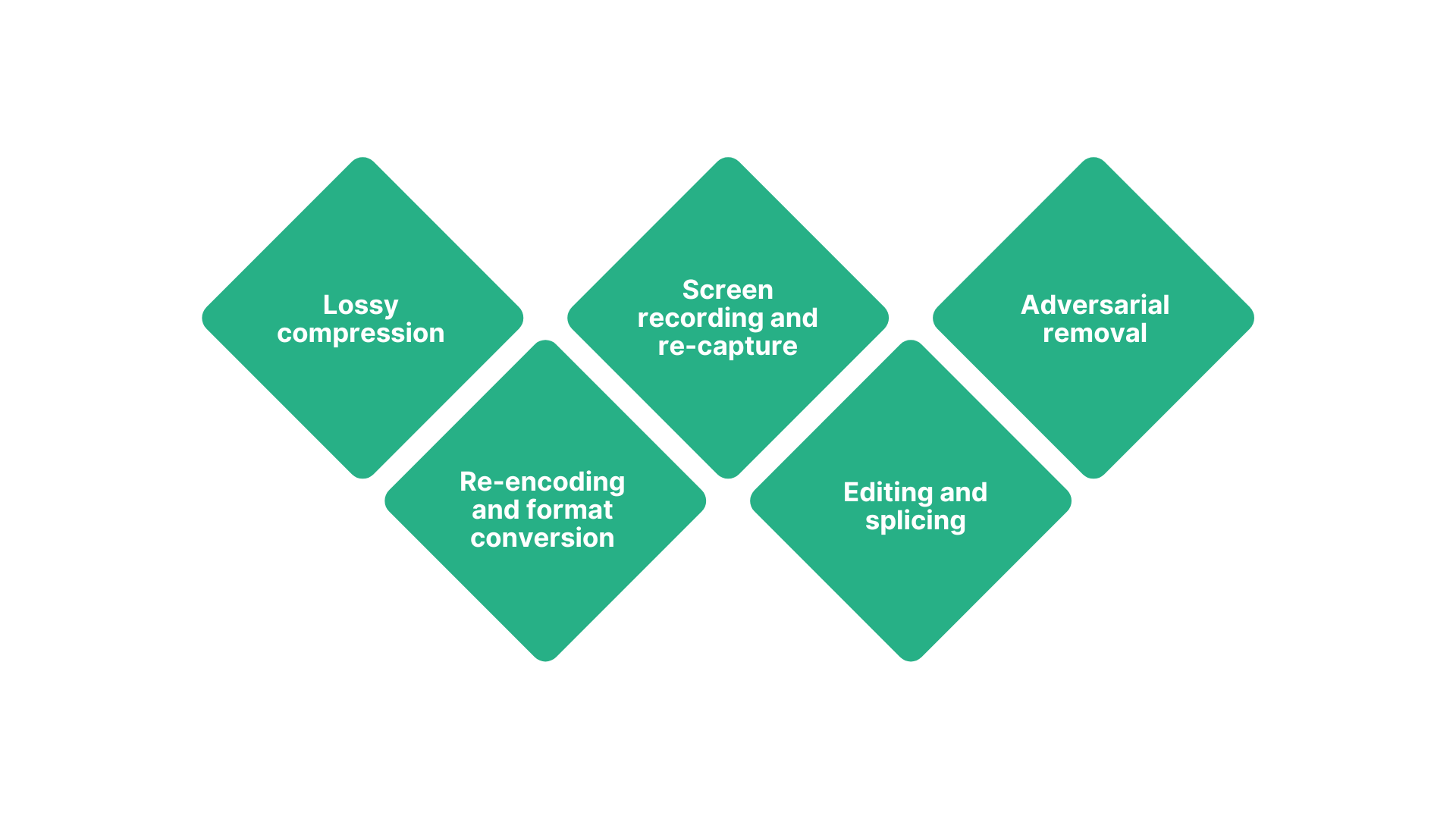
Social media platforms and messaging applications automatically compress uploaded files to save server space, and this process alters audio frequencies. That can weaken or remove the patterns some invisible watermarks rely on, and for generative voice content it is a common workflow risk.
Here are the most common ways watermarks get degraded or lost after leaving the source system:
- Lossy compression: Converting audio to MP3 or AAC at lower bitrates discards frequency data, and that is often where watermark signals live. Modern watermarking systems are designed specifically to survive compression, streaming, re-recording, and platform-level audio processing, but older or simpler implementations frequently do not.
- Re-encoding and format conversion: Changing an audio file from one format to another creates a new file. If the watermark is embedded in the original encoding, that signal may not transfer cleanly.
- Screen recording and re-capture: Recording audio playing from a speaker, or taking a screen recording of a video, creates an entirely new file and bypasses provenance metadata completely.
- Editing and splicing: Cutting segments of audio, adjusting speed or pitch, or layering audio over other content can all degrade or partially remove an embedded watermark signal.
- Adversarial removal: In higher-risk contexts, bad actors can deliberately attempt to strip watermarks using signal-processing tools or by passing audio through a second AI model.
What Robustness Requires
Practice is converging on combining metadata-based approaches like C2PA with imperceptible embedded watermarking, so that when metadata is stripped, the signal in the content itself still provides a recoverable fallback.
For audio systems, this means a single-layer approach is not enough. A watermark that lives only in file metadata will not survive most distribution workflows.
One that is embedded directly into the audio waveform has a better chance of persisting, but only if it was designed to survive the specific compression and encoding formats your pipeline uses.
A Practical Robustness Check for Audio Pipelines
Before assuming your watermarking implementation is compliant, run it through the conditions your content will actually face:
- Does the watermark survive MP3 or AAC compression at the bitrates your distribution pipeline uses?
- Does it persist after the audio is re-encoded to a different format?
- Is it recoverable after speed or pitch adjustments?
- Does it remain intact after being spliced or trimmed?
- Can it be detected after the file has been uploaded and re-downloaded from the platforms you distribute on?
The point of a multi-layered approach is to ensure that marking cannot be removed or manipulated through routine content handling. Testing under real distribution conditions, not just controlled environments, is the only way to verify that your implementation holds up where it needs to.
Resemble Identity adds another review layer when audio watermarks face real distribution stress. It helps teams enroll speaker profiles and compare incoming audio against known voices. It can also flag impersonation or replay patterns across calls, recordings, and audio submissions.
This is useful when files are compressed, re-recorded, or stripped of metadata. For audio-risk workflows, identity verification can sit alongside watermarking and deepfake detection.
Common Mistakes Teams Should Fix Now
Compliance usually fails in small workflow details rather than in policy intent. These mistakes weaken Article 50 compliance because marking depends on each individual content path. Since the obligations are already in force, these are worth auditing this quarter rather than next.
- Treating watermarking as a final step: Add marking rules early, because post-generation fixes can miss files, create version issues, or leave synthetic outputs unmarked during review and export workflows.
- Ignoring format changes: Test detection after compression, re-encoding, resizing, cropping, trimming, paraphrasing, and platform upload, because normal content handling can weaken technical marks quickly.
- Confusing disclosure with watermarking: Use both controls where needed. Visible disclosure helps people notice AI content, while machine-readable marking supports later technical detection and review. Neither substitutes for the other.
- Assuming the December date is a general deadline: December 2, 2026 applies only to machine-readable marking on systems that were already on the market before August 2, 2026. Disclosure duties and marking on new systems are live now.
- Assuming you are out of scope because you are not in Europe: The Commission's guidance reads use in the EU broadly, including content published to the open internet.
- Testing only in controlled conditions: Run checks through real publishing paths, because lab tests may miss compression, metadata stripping, editing changes, and platform processing that affect detection.
- Leaving ownership undefined: Assign clear owners across product, engineering, legal, security, and content teams, so marking decisions do not stall during launch or audit preparation.
- Forgetting existing systems: Review systems already on the market, because the grandfathering rule creates a different remediation timeline rather than a reason to delay.
Also read: Deepfake Audio Detection Tools: A Buyer's Guide
What To Document Before Launching Generative AI In The EU
Documentation should show how marking works, where it applies, and how your team verified it under real conditions. The goal is not paperwork for its own sake. It is proof that the control was designed, tested, reviewed, and maintained.
- Output inventory: List every generated output type, including text, synthetic voice, audio, images, video, edited media, and deepfake-like content created by the system.
- Watermark placement: Record whether the mark is added during generation, after generation, or within publishing workflows, and explain why that approach was selected.
- Detection testing: Keep evidence showing whether detection works after compression, re-encoding, cropping, editing, paraphrasing, reuploading, storage transfer, and other expected content handling steps.
- Technical limits: Document where marking may fail or weaken, especially across low-quality audio, heavy editing, metadata stripping, platform compression, or unsupported file formats.
- Disclosure review: Record where human-facing disclosure is required, how it is delivered, and at what point in the user experience it appears. Note the basis for any reliance on the artistic or creative carve-out.
- Ownership and approval: Identify accountable teams, decision owners, reviewers, approval dates, testing records, and remediation steps, so compliance evidence remains clear after launch.
As organizations build these documentation and review processes, tools such as Resemble Intelligence can help strengthen them. It supports the analysis of audio, image, and video content by providing deeper detection context, so documentation is not limited to a single watermark result.
How Resemble AI Helps Teams Prepare For EU AI Act Watermarking Review
EU AI Act readiness needs more than asking whether a watermark exists. Teams need to prove where synthetic media was created, whether provenance survives normal handling, and how reviewers investigate disputed content.
- Resemble AI supports that workflow across watermarking, detection, identity review, and documentation.
- Resemble Watermarker: Helps teams embed provenance into generated audio, images, video, and text. This is useful when content passes through compression, publishing tools, or metadata-stripping platforms.
- Resemble Detect: Gives reviewers a verdict, explanation, and chain-of-custody view across audio, video, and images. This supports review when provenance alone does not answer whether the media was manipulated.
- Resemble Intelligence: Adds forensic reporting for legal, compliance, and trust teams. It helps explain why a file was flagged, not only that it was flagged.
- Resemble Identity: Supports synthetic voice risk review by checking who is speaking. This helps when cloned voices, replayed audio, or impersonation risks affect customer support, finance, or media workflows.
- Deepfake Detector Chrome Extension: Helps teams check images, video, and audio during browser-based review. This is useful for fast checks before media is trusted or escalated.
Together, these tools help teams connect marking, verification, detection, and evidence into one practical EU AI Act readiness workflow.
Turn Watermarking Readiness Into A Tested Workflow
EU AI Act readiness should end with proof, not assumptions. The reliable path is to map every generated output, test how marks survive normal handling, and document where disclosure, detection, and human review are still needed.
Now that the obligations are in force, teams should be able to answer three questions on demand: which synthetic files are marked, how they are verified, and where the control is known to weaken.
Resemble AI helps teams move from checklist planning to practical review. Its watermarking, detection (available on-prem), identification, and media analysis workflows support provenance checks across synthetic audio, images, and video.
For teams running generative AI systems in European markets, this connects technical marking with review evidence and governance.
Book a demo today to see how these capabilities can support your AI governance and compliance workflows.
FAQs
1. What are the EU AI Act watermarking requirements for generative AI?
The EU AI Act requires covered AI-generated outputs to be marked in a machine-readable format and detectable as artificially generated or manipulated, where technically feasible. The Act specifies machine-readable marking rather than watermarking specifically, so it is technology-neutral, but watermarking is the most practical way to meet it for audio, image, and video. For teams, this means marking needs to work after creation, editing, storage, and distribution.
2. When do the EU AI Act watermarking rules start applying?
Article 50 transparency obligations took effect on August 2, 2026. Under the Digital Omnibus, generative AI systems that were already on the market before that date have until December 2, 2026 to meet the Article 50(2) machine-readable marking requirement. Systems placed on the market from August 2, 2026 onward have to meet it now, and the disclosure duties under Article 50(1), (3), and (4) have no grace period at all.
3. Did the Digital Omnibus delay the EU AI Act?
It delayed part of it. The Omnibus, signed July 8, 2026, deferred the high-risk obligations: standalone Annex III systems now have until December 2, 2027, and AI embedded in regulated products under Annex I has until August 2, 2028. It did not defer Article 50, which took effect on schedule on August 2, 2026.
4. Which generative AI outputs need machine-readable marking?
Review AI-generated text, synthetic audio, voice, images, video, and edited media. Deepfakes and manipulated media need the closest review because they can appear realistic and carry a separate disclosure duty. The key step is mapping where each output travels after generation.
5. Is watermarking the same as labeling AI content?
No. Watermarking creates a machine-readable signal that systems can detect later. Labeling gives people a visible notice that content is AI-generated. Both controls may be needed in public workflows, and one does not substitute for the other.
6. Is disclosure different from watermarking?
Yes. Disclosure is a user-facing notice, while watermarking is a technical marking control. The Commission has been explicit that a deployer cannot rely on the provider's embedded machine-readable mark to satisfy their own disclosure obligation. Disclosure has to be perceivable by a person without special tools, and it has to reach them at first exposure at the latest.
7. Who is responsible for watermarking under Article 50?
Article 50 separates responsibilities across the content chain. Providers of generative AI systems carry the machine-readable marking duty. Deployers carry labeling and disclosure duties when that content reaches users, especially in public-facing or real-time media contexts.
8. What counts as a deepfake under the EU AI Act?
Article 3(60) defines a deepfake as AI-generated or manipulated image, audio, or video content that resembles existing persons, objects, places, entities, or events and would falsely appear authentic or truthful. Intent to deceive is not required. A realistic depiction of a person who does not exist can still qualify. Clearly fantastical content and minor technical edits like color correction generally do not.
9. Does Article 50 apply to companies outside the EU?
It can. The Commission's guidance treats use in the EU broadly, covering situations where a deployer foresees or authorizes distribution of AI outputs in the EU, and suggests that publishing to the globally accessible internet may be enough. Companies outside the EU whose synthetic content reaches European audiences should confirm their position with counsel rather than assume they are exempt.
10. What are the penalties for breaching Article 50?
Up to €15 million or 3% of total annual worldwide turnover, whichever is higher.
11. Why is generative AI watermarking hard to implement?
Robustness, quality, interoperability, and reliability pull against each other. A stronger watermark may affect output quality. A watermark from one system may be harder to detect in another workflow if standards differ.
12. What can break a watermark after AI content leaves the system?
Compression, re-encoding, trimming, resizing, cropping, paraphrasing, and platform uploads can all weaken watermark signals. Screen recording or re-capture can bypass provenance metadata entirely. Test watermarks through the same paths your content will actually use.
13. Does the EU AI Act apply to synthetic voice and audio?
Yes. Synthetic voice and audio are covered, including AI speech, cloned voice, IVR audio, voice agents, and localized audio content. Cloned voices also fall inside the deepfake definition when they resemble a real person in a realistic setting. Testing should reflect compression, editing, storage, and review workflows.
14. What should teams document before launching generative AI in the EU?
Document output types, watermark placement, detection tests, technical limits, disclosure review, and approval ownership. Testing records should include both successful and failed cases. This creates clear evidence of how the control was designed and maintained.
15. What is the best first step now that the obligations are live?
Start with a complete inventory of generated outputs across text, audio, voice, images, video, and edited media. Map where each output travels after generation. Then test whether marking survives normal editing, publishing, storage, and platform handling, and confirm that human-facing disclosure is in place wherever Article 50(4) applies.


.avif)