In September, our CTO Tedi Papajorgji took the stage at the Exploratorium in San Francisco for GMI's Summer Signal conference.
More than 200 builders, investors, and AI founders were in the room and teams from Runway, Luma, MiniMax, and Inworld AI were showing what’s possible with real-time video generation, agentic filmmaking, and interactive AI characters.
Tedi opened his presentation with a guessing game. The audience saw a video of a press conference, a voice clip, and a photo of a dog on a couch, then had to decide whether each was real or fake.
All three were synthetic and I would say less than 10% of the folks in the room guessed all three correctly - and that was after being told they needed to decide if the content was real or fake - they were already on high alert.

Everyone else focused on what generative AI can create (and how realistic it is) and we wanted to bring home the fact that the best human detection is wrong, most of the time.
That became a pretty good description of our work in Q3. After officially sunsetting voice generation as a paid product, we put the full company behind detection. Generative models kept changing, and our work increasingly focused on detection that could understand more than the fingerprints of models it had already seen.
DETECT-World: Looking Beyond the Fingerprints
Our previous-generation model, DETECT-3B Omni, was already strong, ranking first on DFBench and covering audio, image, and video across 51 languages. But like most detection models, it relied heavily on learning the artifacts that known generators leave behind and looking for those artifacts in new content.
That gets harder as the number of generators grows. A new model launches, your detector has never seen its outputs, and performance can drop until you retrain it. You end up constantly collecting new examples and teaching the model what to look for.
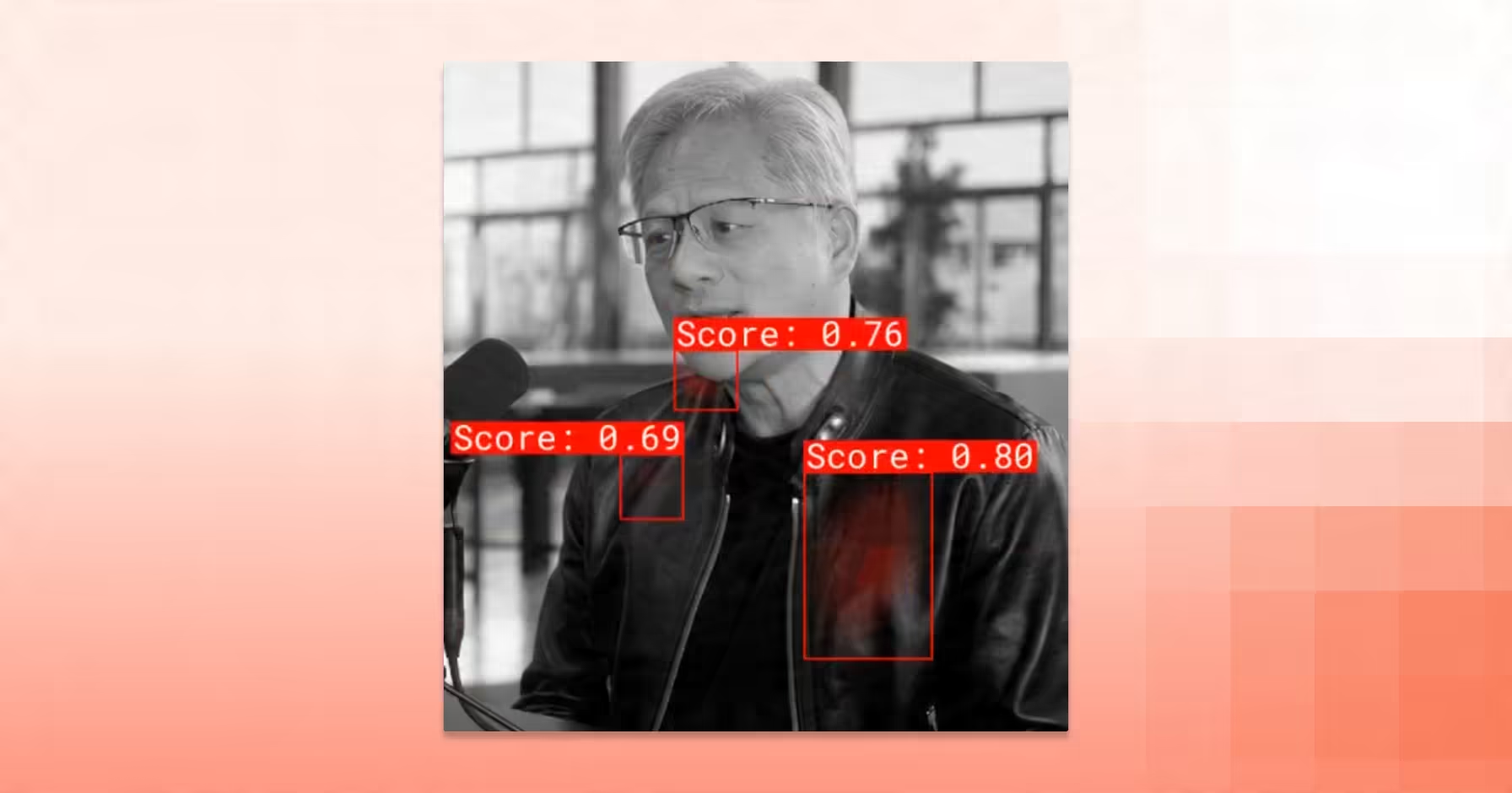
DETECT-World takes another approach where it still looks for the artifacts associated with generated content, but it also looks at whether the content itself makes sense.
Is the lighting consistent across a face? Do the shadows fall the way they should based on the light source? Does movement in the background make sense from one frame to the next? Do the lips actually match the audio?
Those signals are useful because they aren't tied to one particular generator and the physics don't change when a new generator launches.
The results for our new model have also been really compelling. Video deepfake detection accuracy increased from 80.96% to 98.2%, while image accuracy went from 86.70% to 95.8%. Audio accuracy reached 99.47%, with a false positive rate of 0.66%, and latency dropped 66% to 399 milliseconds.
On the independent Podonos audio deepfake detection benchmark, DETECT-World ranked first out of 18 evaluated systems as of August 2026. It was the only system on the board with both false positive and false negative rates below 1%. Our previous model, DETECT-3B Omni, ranked second.
We also tested DETECT-World against Haotian AI's real-time face-swap tool, which was new to the model. It identified the generated content with approximately 95% accuracy without prior exposure to the generator, retraining, or fine-tuning.
That idea of looking beyond known patterns also shaped how we thought about the rest of the detection stack this quarter.
At GMI, we showed another side of that work with Model Behavior, an exhibit built from UMAP visualizations our models produce internally. Each dot represents a piece of media, with similar and different examples arranged into clusters.
Seen together, the visualizations start to look almost organic: a flock of birds, a river delta, shapes forming and separating as the model finds relationships in the data.
For us, it was a way to make something that normally happens inside a model visible to people. Detection comes down to understanding how media fits with what the model has learned about real and manipulated content, rather than relying on a single artifact.
Fully Automated, Forensic-grade Investigation
That same idea came up when we started working on what happens after a detection result.
A trust and safety analyst looking at a piece of social media content with a 94% manipulation probability still needs to know what kind of manipulation occurred, how strong the evidence is across different forensic dimensions, and whether the content actually needs to be removed.
That's why we launched Investigator this quarter: six managed forensic investigators available through our API, each built around a specific verification workflow.
They cover social media moderation, insurance claim materials, breaking news footage, documents and receipts, forensic evidence, and identity documents and presented individuals.
Each investigation brings together multiple forensic analysis layers and returns evidence and explanations alongside the result. The goal is to give the person reviewing the content enough context to make a decision without having to piece the investigation together manually.
This came up repeatedly in conversations with enterprise customers. The detection itself was highly accurate, but when next steps require more than “is this AI or not,” the Investigator’s full context, multi-API results and recommendations were needed..
Detecting What Entity is Operating - Bot, AI or Human?
For the past three years, when we talked about detection, we were usually talking about media: is this audio, image, or video AI-generated?
Now there's another question worth asking: what if the thing interacting with your website or application is AI?
Agent Detection is our System One model and a new product for us. Website and app owners can add a single line of code and start getting visibility into their traffic within minutes.
Instead of relying on user-agent strings, which agents can spoof, the model looks at behavioral signals such as cursor movement, typing rhythm, and interaction patterns. Each verdict includes reasoning, so operators can see why a visitor was classified as a human, an AI agent, or something that needs further review.
That gives organizations choices about what to do with different types of traffic. They might reroute agents to APIs or MCP servers, restrict access to sensitive areas such as billing or credential management, or prevent specific activities such as account deletion.
I don't think the answer is to block every AI agent. Some are doing useful things, and personal usage is already exploding, so organizations will have to set policy for routing, allowance and restriction. The problem is knowing what is happening in your systems and having enough information to decide how to respond, and solving it starts by knowing whether you are dealing with a human, a bot or an agent..
In that sense, Agent Detection is a natural extension of the work we've already been doing. We started by asking whether a piece of media was generated or manipulated in both content and calls and now we're also looking at behavior, whether the thing interacting with a system is an AI agent and what it is doing.
Seeing the Work in the Real World
Some of the recognition we received this quarter reflected that broader approach.
DETECT-World won Best Technological Solution at the Global Anti-Scam Summit America and at Visual 1st, we won Best Technology, presented by Google's Navin Sarma.
.jpg)
.jpg)
The awards were encouraging, but I found the conversations around them more interesting. People are starting to ask questions that go beyond “is this fake?” They want to know where something came from, how confident they should be in the result, and what they can actually do with that information.
That's also where watermarking fits into the picture. Detection can identify signs of manipulation, while watermarking can help establish provenance.
We have worked on both for years, and signing the EU Code of Practice on Transparency of AI Generated Content alongside Google, Anthropic, Meta and more as a technology provider of marking and detection solutions was an important step in making that part of our approach more explicit.
Zohaib also joined a panel at Google's AI safety event in September on agentic safety and observability. A point he returned to was that organizations need visibility into what is happening before they can put meaningful controls around it.
That applies to new AI systems, but it also shows up in much older infrastructure. We're seeing it in legacy call center systems dealing with voice-clone calls, just as we're seeing it in websites dealing with AI agents.
What We Owe Each Other
All of this brings me back to that room at the Exploratorium.
The audience had to decide whether a few pieces of media were real or fake. A year ago, that might have felt like a reasonable question for people to answer on their own but now it’s impossible.
As generative models get better at reproducing reality, our own judgment becomes less reliable. Sometimes we decide something is fake because it doesn't fit our expectations and other times, we believe something because it confirms what we already expect to be true.
Models can approach the problem differently. They can look across a much larger body of evidence and examine the relationships between things that are difficult for a person to see.
That's part of why we wanted Model Behavior at GMI. The visualizations gave people a way to see how a detection model organizes that evidence, rather than treating the final score as a black box.
The question underneath all of this is still a simple one: does this deserve your trust?
For us, answering that question increasingly means more than returning a score. It means understanding the content, investigating the evidence, knowing when something is new, and giving people enough context to decide what happens next.
What's Next
We're launching Resemble AI for Microsoft Teams shortly, bringing bot-free real-time deepfake detection into the meetings where teams are already making important decisions.
And that's just the start. We have a lot more new products and partnerships coming that will help organizations detect AI across content, calls, and behavior.
If any of this is relevant to what you are building or protecting, we would like to hear from you, book a call with our team.