

Virtual meetings have become a standard part of how organizations operate, but they also create new opportunities for synthetic identity fraud. Resemble AI’s Q2 2025 Deepfake Threat Intelligence Report documented 487 verified deepfake incidents and $347.2 million in losses over a three-month period, highlighting the growing financial impact of synthetic media attacks.
If you work in security, product, CX, or leadership, you are likely dealing with a growing concern where audio, video, and images can no longer be assumed to be authentic. AI-generated faces and voices can now blend into live meetings with a level of realism that makes manual checks unreliable, especially when attention is focused on the agenda rather than identity signals.
Reducing impersonation risk in virtual meetings requires more than watching for unusual facial movements or relying on a single detection score. Teams need a process that combines real-time deepfake monitoring with identity checks, context-specific verification, and clear escalation steps when something does not add up. Building those checks into normal meeting workflows makes suspicious interactions easier to investigate without depending on employees to recognize a convincing deepfake on sight.
This blog explores how deepfakes appear in virtual meetings, why they are harder to detect today, and what practical steps teams can take to identify and reduce these risks in real-time environments.
Key Takeaways:
- Virtual meetings now carry a higher risk of impersonation, as AI-generated voices and faces can appear convincing enough to pass casual human judgment, making identity verification essential during live communication.
- Detection has become more difficult due to real-time synthetic generation, synchronized audio-visual outputs, and platform compression, while human attention limits make subtle inconsistencies easier to miss.
- The presence of deepfakes in meetings is often revealed by subtle cues such as facial movement irregularities, audio-lip-sync mismatches, behavioral differences, and context gaps that only become noticeable when viewed together.
- Effective protection relies on layered verification, combining identity checks, conversational validation techniques, real-time monitoring, and organizational processes rather than depending on visual observation alone.
Why Deepfakes in Virtual Meetings Are Becoming Harder to Detect
Deepfake detection in virtual meetings is becoming more complex because generation systems are improving faster than traditional human recognition methods. Modern deepfake systems can generate synchronized audio-visual output in real time, which reduces the obvious mismatches that earlier models typically produced.
- Multimodal alignment: Voice, facial expressions, and head movement are now often generated in sync. This reduces isolated inconsistencies that were previously easier to notice.
- Lower latency: Faster processing allows synthetic responses to keep pace with natural conversation flow. This reduces pauses or timing gaps that once signaled manipulation.
- Platform compression: Video conferencing tools compress audio and video streams to maintain call stability. This can mask small visual or audio distortions that might indicate synthetic content.
- Subtle anomalies: Remaining inconsistencies are often minor and intermittent, making them difficult to identify in real time, especially during active discussions.
- Human limits: Manual detection becomes unreliable in fast-paced meetings where attention is split across multiple speakers and tasks.
- High-value targeting: Deepfake use is increasingly focused on sensitive workflows like approvals, hiring, and executive communication, increasing the impact of missed detection.
- Intentional realism: Modern systems are designed to mimic natural communication noise, including slight lag or audio imperfections, to blend into normal meeting behavior.
- Conversation noise: Interruptions, topic shifts, and multi-speaker dynamics create natural complexity that can hide subtle synthetic patterns.
Also Read: What Is Deepfake Detection?
What a Deepfake Looks Like During a Virtual Meeting
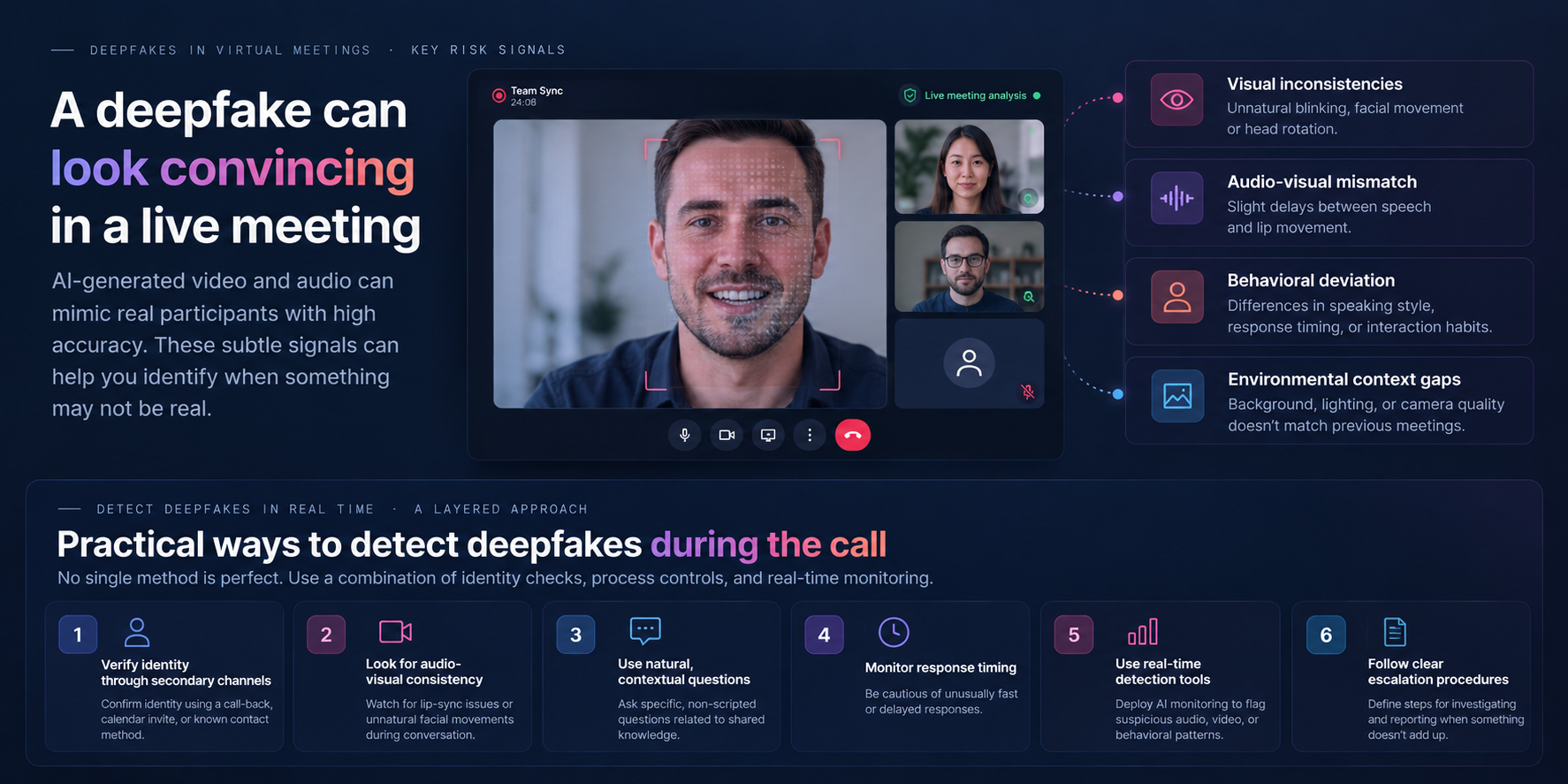
A deepfake in a virtual meeting is not always immediately recognizable as synthetic. In many cases, it behaves like a normal participant with subtle inconsistencies that may only become noticeable under closer observation or repeated interaction.
- Visual inconsistencies in facial behavior
In some cases, synthetic video may show minor inconsistencies in facial movement, especially around areas like eye blinking, jaw motion, or head rotation. These signals are often subtle and may vary depending on lighting and video quality.
Rather than being obvious distortions, they may appear as slight unnatural smoothness or delayed motion relative to speech.
- Audio-visual mismatch signals
One of the more common indicators is a mismatch between spoken audio and lip movement. Even when both are high quality, synchronization may not remain perfectly stable under dynamic conversation conditions.
This can appear as slight delays or unnatural alignment between speech rhythm and facial movement, especially during fast exchanges.
- Behavioral pattern deviation
A synthetic participant may not fully match the expected behavioral patterns of the impersonated individual. This can include differences in speaking style, response timing, or interaction habits.
In security-sensitive environments, even small deviations from known communication behavior may indicate a need for additional verification.
- Environmental and contextual inconsistencies
In some cases, background noise, lighting, or camera quality may not match previously observed conditions for a participant. While these signals alone are not definitive, they can contribute to a broader suspicion pattern when combined with other indicators.
Organizations improving browser-level protection may consider Chrome Deepfake Detection as part of their security stack.
How to Detect Deepfakes in Real Time During Virtual Meetings
Real-time deepfake detection works best when automated monitoring is supported by identity checks, meeting procedures, and human review. Detection signals can flag suspicious activity as it happens, while the surrounding verification process gives teams the context needed to decide whether an interaction should be trusted or escalated.
- Identity verification through secondary channels
Real-time verification should not rely only on what appears inside the meeting window. A secondary confirmation step helps validate whether the participant is genuinely who they claim to be.
How it works in practice:
- Confirm identity using a separate communication channel (secure chat, internal directory, or known contact method)
- Validate meeting presence against pre-shared participant lists for sensitive discussions
- Cross-check unexpected attendees before sensitive topics begin
This approach reduces dependency on video or voice alone, which can be manipulated in a deepfake meeting scenario.
- Cross-checking audio and visual consistency together
Instead of evaluating voice and video separately, inconsistencies often emerge when both are analyzed together in real time.
What to observe:
- Lip movement not fully aligned with the speech rhythm
- Voice tone shifting without matching facial expression
- Emotional cues not matching the verbal context
When audio and facial behavior feel “slightly disconnected,” it may indicate synthetic generation. However, this should be treated as a signal, not proof, since network delays or compression can also cause similar effects.
- Monitoring response timing and conversational flow
Natural conversations have interruptions, overlaps, and spontaneous shifts. Synthetic participants may struggle with these dynamic patterns.
Key indicators:
- Slight delay before answering unexpected questions
- Overly structured or “prepared” responses
- Difficulty handling interruptions or rapid topic changes
In a deepfake meeting, these timing gaps may appear subtle but become noticeable when the conversation becomes less predictable.
- Using structured but natural questioning
Unplanned and context-specific questions can help surface inconsistencies in real time. Asking someone to respond to a new detail, clarify a recent point, or react to an unexpected prompt can provide an additional signal when identity or authenticity is in doubt.
Effective approach:
- Ask follow-up questions tied to the prior discussion context
- Introduce scenario-based queries that require reasoning, not scripted answers
- Shift topics slightly to test conversational flexibility
This technique helps identify whether responses remain contextually grounded or start drifting into generic output patterns.
- Observing behavioral realism under pressure
Behavioral cues often reveal more than visual ones, especially when conversations become complex or fast-paced.
What to watch for:
- Limited variation in tone during emotional or high-stakes topics
- Repetitive phrasing patterns across different questions
- Lack of natural hesitation, clarification, or self-correction
These signals are not definitive but can indicate whether the participant is fully adaptive or following a constrained response model.
- Leveraging detection systems as a supporting signal
AI-based detection tools can analyze audio-visual streams for patterns that may indicate synthetic manipulation, such as inconsistencies in speech structure or signal irregularities.
How it should be used:
- Treat outputs as risk indicators, not final verdicts
- Combine with human observation and identity checks
- Use alerts to trigger additional verification steps rather than immediate conclusions
In a deepfake meeting, detection tools add a structured layer of analysis, but their reliability depends on factors like audio quality, compression, and the sophistication of the synthetic model.
Teams exploring real-time safeguards may evaluate Resemble Meetings to understand how synthetic signals can be detected during live sessions.
Best Practices to Reduce Deepfake Risks in Virtual Meetings
Reducing deepfake risk relies on organizational controls rather than depending solely on detection during live sessions. Prevention is generally more reliable than post-event identification.
- Risk-based meetings: Classify meetings based on sensitivity. High-risk discussions involving finance, credentials, or executive decisions should follow stricter verification than routine conversations.
- Multi-step checks: Avoid finalizing critical decisions within a single call. Add follow-up validation steps to reduce exposure to real-time impersonation attempts.
- Team awareness: Train employees to recognize subtle inconsistencies such as timing delays or behavioral mismatches. Focus on pattern recognition rather than reacting to normal technical issues.
- Use detection tools: Use detection to flag meetings that need closer review, while leaving the final decision to a human reviewer. Set a clear threshold for when to trigger escalation, since an unused alert is as good as no detection at all.
- Control media exposure: Limit unnecessary sharing of recorded voice and video content. Reducing public exposure helps minimize the data available for synthetic replication.
- Embed verification: Integrate identity checks directly into workflows for high-impact decisions. This ensures verification becomes part of the process rather than an additional step.
How Resemble AI Supports Deepfake Detection in Virtual Meetings
Resemble AI is now focused on multimodal deepfake detection and enterprise trust infrastructure across audio, image, and video. Its earlier work building foundational voice models gave the team a detailed understanding of how synthetic media is created at the model level, expertise that now informs its approach to identifying manipulated and AI-generated content. For meeting security, Resemble combines real-time detection with identity verification, fraud signaling, provenance controls, and human-readable forensic context rather than treating deepfake detection as a standalone check.
Here’s how we can help you:
- Multimodal detection: Evaluates audio, video, and images together to surface inconsistencies in speech, facial movement, and visual artifacts during a deepfake meeting, along with explainable outputs like verdicts and traces.
- Live meeting monitoring: Integrates with Zoom, Teams, Google Meet, and Webex to flag synthetic voices, face swaps, and AI-generated personas during active calls for real-time risk visibility.
- Low-latency analysis: Designed for near-real-time processing, with reported speeds under 300 ms, enabling faster signal generation during live conversations.
- Wide model coverage: Trained across 250+ generative AI tools to improve detection resilience against different voice and media manipulation techniques.
- Performance context: Reports high accuracy across audio and visual detection, but results should still be validated against real meeting conditions and enterprise environments.
- Identity verification layer: Generates voice signatures from a few seconds of audio and compares them against known profiles to support speaker verification during meetings.
- Flexible deployment: Available across cloud, private cloud, and on-premises setups, supporting organizations with strict data control requirements.
- Explainable outputs: Flags come with supporting signals and anomaly explanations, helping teams understand detection reasoning rather than relying on binary results.
By combining generation awareness with detection capabilities, organizations can better understand how synthetic media behaves across both creation and misuse contexts.
Conclusion
Deepfake activity in virtual meetings is becoming more difficult to identify through manual observation alone, especially as real-time generation systems improve in realism and responsiveness. This shifts the challenge from visual detection to structured verification and layered security.
Organizations can reduce exposure by combining identity verification processes, employee awareness, and system-level monitoring rather than relying on any single method. In practice, resilience comes from how well these layers work together during live communication.
As synthetic media continues to evolve, teams that proactively design verification and detection workflows will be better positioned to maintain trust in remote collaboration environments.
For organizations evaluating how to strengthen detection and verification in communication systems, exploring platforms like Resemble AI may help clarify how synthetic media signals can be assessed within real-world workflows and security architectures.
FAQs
What role do Convolutional Neural Networks (CNNs) play in detecting deepfakes?
Convolutional Neural Networks analyze spatial patterns in video frames to detect subtle artifacts such as irregular textures, lighting inconsistencies, and facial distortions. They learn hierarchical features, making them effective in distinguishing manipulated faces from authentic human expressions in real-time analysis.
What is 3D liveness detection, and how does it help identify deepfakes?
3D liveness detection verifies depth, motion, and spatial geometry of a face to ensure it belongs to a live person. It analyzes head movement, eye dynamics, and facial depth cues, making it difficult for AI-generated deepfakes to pass verification.
Which biological markers are difficult for deepfakes to replicate?
Biological markers such as micro-expressions, pupil dilation patterns, heartbeat-induced skin color changes, and natural eye movement rhythms are extremely difficult for deepfakes to replicate accurately, as they require real physiological signals that synthetic video generation cannot consistently reproduce.
Is there a documented incident response plan for deepfake fraud in virtual meetings?
Yes, many organizations maintain documented incident response plans for deepfake fraud in virtual meetings. These plans define detection protocols, escalation steps, communication guidelines, and mitigation actions to reduce financial, reputational, and security risks from impersonation attempts.
How quickly can deepfake detection tools be integrated into existing video conferencing platforms?
Integration of deepfake detection tools into existing video conferencing platforms typically ranges from a few days to several weeks, depending on API readiness, platform compatibility, security requirements, and the complexity of real-time processing pipelines.
How do real-time deepfake detection APIs integrate with platforms like Microsoft Teams or Google Meet?
Real-time deepfake detection APIs integrate with platforms like Microsoft Teams or Google Meet through SDKs, browser extensions, or middleware services that analyze video streams, flag anomalies, and send alerts without disrupting ongoing communication sessions.
Can low-resolution video make deepfakes harder to detect during virtual meetings?
Yes, low-resolution video can make deepfakes harder to detect because fine-grained artifacts, facial inconsistencies, and texture errors become less visible. However, advanced detection models compensate by analyzing temporal patterns and behavioral cues instead of relying solely on visual clarity.
What security policies should companies implement to prevent deepfake-based CEO fraud?
Companies should implement multi-factor authentication, strict identity verification for high-value approvals, secure communication channels, employee training on social engineering, and real-time anomaly detection systems to prevent deepfake-based CEO fraud and unauthorized financial transactions.
Are there open-source tools available for detecting deepfakes in video conferencing?
Yes, though it's worth being precise about what each one does. FaceForensics++ and the DFDC (Deepfake Detection Challenge) dataset both provide labeled data and baseline detection models for research use. OpenFace is a general facial behavior analysis toolkit — useful as a building block for detection research, but not a deepfake detector on its own. Be cautious with tools like DeepFaceLab: it's built for creating deepfakes, not detecting them, and shouldn't be confused with detection resources. Most of these require meaningful technical expertise to deploy effectively.
How does network latency affect the reliability of deepfake detection in real time?
Network latency can delay video frame processing in real-time deepfake detection systems, potentially causing slower alerts or missed anomalies. However, edge computing and optimized streaming pipelines help reduce latency-related accuracy issues.
What role does temporal consistency play in detecting deepfake video manipulation?
Temporal consistency examines how facial features, expressions, and movements remain coherent across consecutive video frames. Deepfakes often introduce subtle frame-to-frame inconsistencies, which detection models use to identify synthetic or manipulated content.
What future advancements in AI might make deepfake detection more challenging in virtual meetings?
Future AI advancements, such as highly realistic generative models, multimodal synthesis, and adaptive diffusion systems, may make deepfakes harder to detect by producing more convincing facial expressions, voices, and behavioral realism.