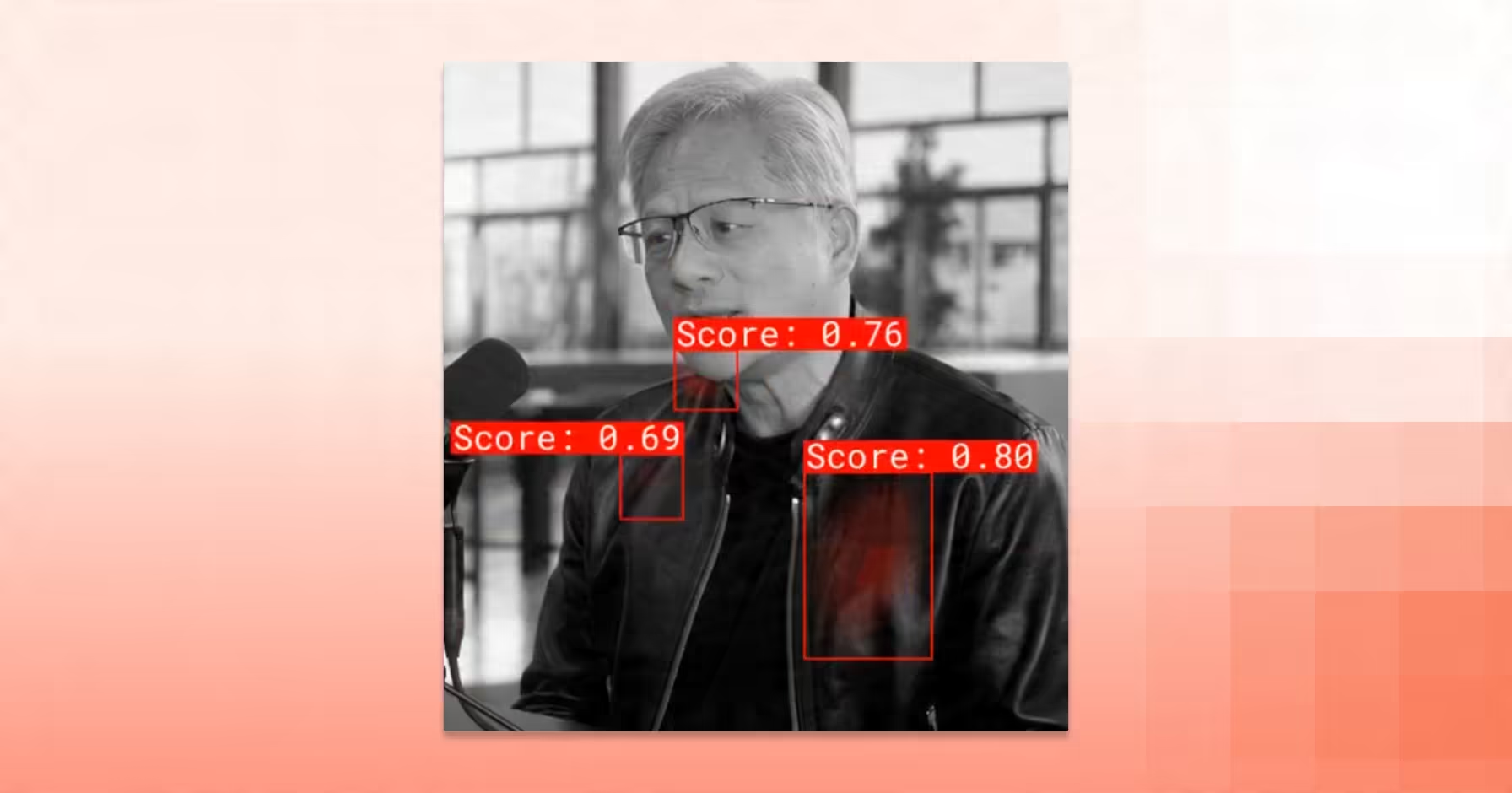

Security teams, product builders, and operations leaders are now facing attacks where the voice on the call, the face on the video, and the routine approval request can all be fabricated —and none of the usual social cues give it away.
In Gartner's 2025 AI Risk Management Survey, 62% of organizations reported experiencing at least one deepfake incident in the prior 12 months.
To keep up, you need security systems that can assess more than just text or login credentials. Modern defenses now combine detection models that flag synthetic audio, video, or images with verification steps that confirm identity across multiple signals. This shift means fraud, security, and product teams now need to verify not just what a message says, but whether the person delivering it is who they claim to be.
This blog explores how deepfake phishing attacks work, how detection systems operate in practice, and how organizations can improve their defense posture through layered security approaches.
In a nutshell
- Deepfake phishing attacks use synthetic audio, video, and images to impersonate trusted individuals, combining identity spoofing with psychological manipulation to trigger sensitive actions.
- Early warning signals often appear through inconsistencies such as unusual communication channels, voice or behavioral mismatches, cross-platform identity conflicts, and pressure to bypass verification steps.
- Detection systems analyze both media and behavior using techniques like audio pattern analysis, video frame consistency checks, liveness verification, and model-based risk scoring to identify synthetic content.
- Effective phishing protection relies on layered defenses including multi-factor authentication, structured approval workflows, behavioral anomaly detection, access controls, and cross-channel verification processes.
- Modern governance and compliance approaches focus on content provenance, internal policies for synthetic media, evolving regulatory requirements, and continuous monitoring across communication systems.
What is a Deepfake Phishing Attack?
A deepfake phishing attack refers to a form of social engineering where synthetic audio, video, or images are used to impersonate a trusted individual or entity. Unlike traditional phishing, which often relies on text-based deception, these attacks attempt to replicate identity signals that humans naturally trust, such as voice tone, facial expressions, or speaking patterns.
At a functional level, these attacks combine two elements: identity spoofing and psychological manipulation. The synthetic component makes the communication appear legitimate, while the phishing layer introduces urgency or requests sensitive actions such as fund transfers, credential sharing, or access approvals.
Key Warning Signs to Watch For

Deepfake-driven phishing attempts rarely rely on a single obvious signal. Instead, risk typically emerges from a combination of behavioral, contextual, and communication anomalies. The goal is not to detect “perfect fakes” but to identify patterns that feel inconsistent with normal operational behavior.
- Channel mismatch: Sensitive instructions delivered through unexpected media (like voice or video instead of formal written processes) may signal impersonation risk.
- Voice inconsistency: Subtle irregularities in tone, pacing, or speech rhythm can sometimes appear in synthetic audio, especially in high-quality but imperfect deepfakes.
- Behavior gaps: Requests or communication patterns that do not align with known behavior, responsibilities, or historical context may indicate manipulation.
- Cross-platform conflict: Differences in identity signals across email, chat, and voice/video channels can suggest synthetic or tampered communication.
- Verification resistance: Any push to skip secondary approvals or discourage confirmation through independent channels can be a strong warning sign of social engineering.
- Context drift: When the content of a request feels unusual or unrelated to normal operational patterns, especially under time pressure, it may indicate risk.
Resemble Meetings joins Zoom, Teams, Google Meet, and Webex calls directly and runs detection in real time during the conversation — flagging potential voice clones or synthetic participants while the call is still in progress, rather than only in post-call review.
Also Read: Audio Deepfake Detection Benchmark Results: How 8 Systems Performed in 2026
Modern Deepfake Detection Techniques
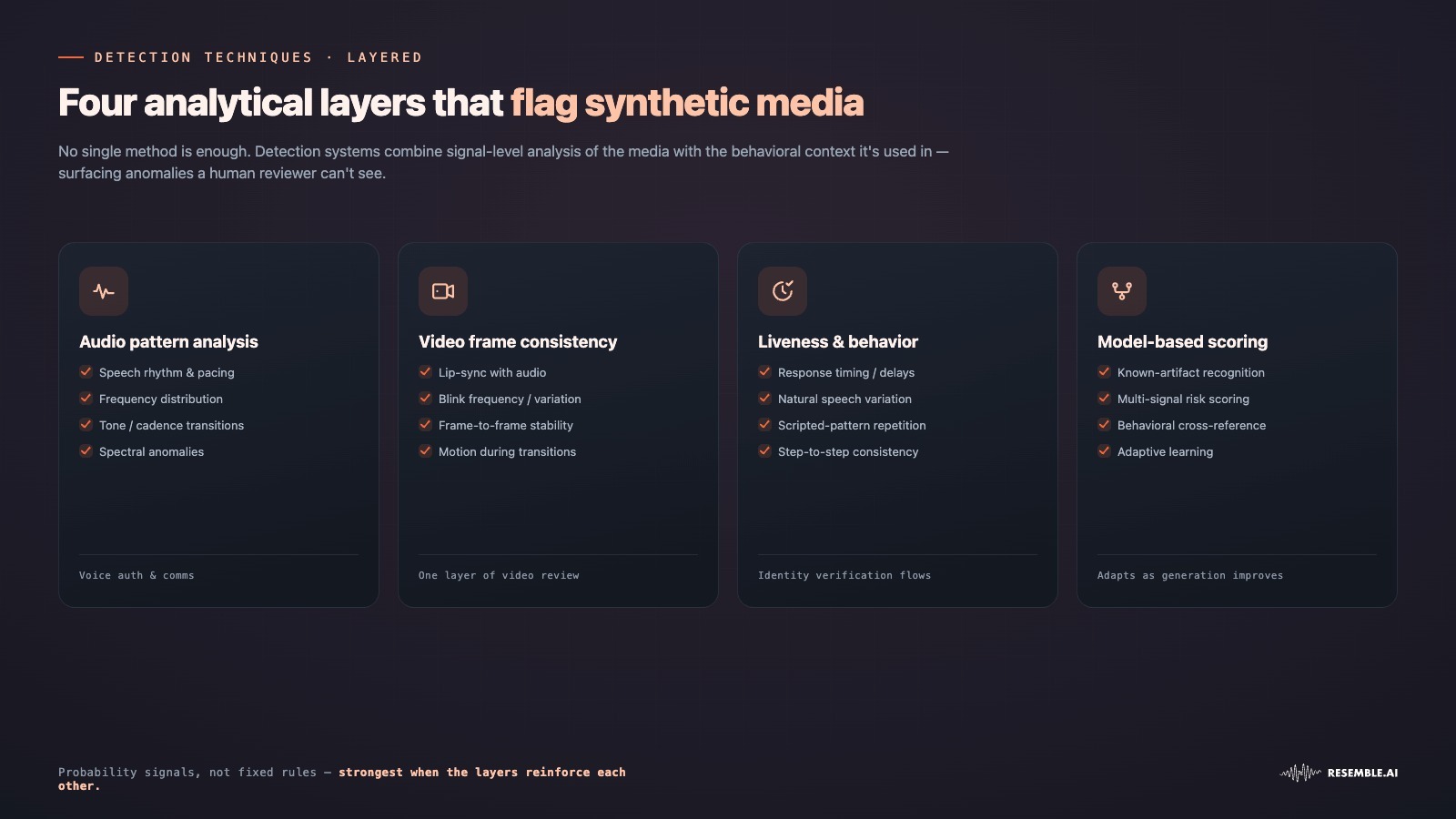
Modern deepfake detection systems focus on identifying patterns and inconsistencies that may indicate synthetic manipulation in audio, video, or image data. Rather than relying on a single method, detection systems typically combine multiple analytical layers to improve reliability across different types of content.
At a high level, detection systems analyze both the signal-level characteristics of media and the behavioral context in which it is used. This combination helps identify anomalies that may not be visible to human reviewers.
- Audio Pattern Analysis
Audio-based detection examines speech characteristics that may differ from natural human speech. The goal is to identify patterns that could indicate synthetic generation.
These systems typically analyze:
- Speech rhythm and pacing consistency
- Frequency distribution across vocal ranges
- Sudden transitions in tone or cadence
- Spectral anomalies in generated audio
This approach is often used in voice-based authentication and customer communication systems, though performance can vary depending on audio quality.
- Video Frame Consistency Analysis
This technique evaluates whether facial movements and speech remain naturally aligned throughout a video. It helps identify visual inconsistencies that may result from synthetic generation.
Key focus areas include:
- Lip movement synchronization with audio
- Eye blinking frequency and variability
- Frame-to-frame facial stability
- Motion consistency during speech transitions
It is commonly used as one layer of video verification rather than a standalone detection method.
- Liveness and Behavioral Signal Verification
Liveness detection focuses on confirming whether communication is occurring in real time and reflects natural human interaction patterns. It is commonly used in identity verification workflows where impersonation risk is higher.
Typical signals evaluated include:
- Response timing and interaction delays
- Natural variation in speech or movement
- Unexpected repetition or scripted behavior patterns
- Interaction consistency across verification steps
This method is particularly relevant in enterprise authentication flows, where attackers may attempt to replay or synthetically generate responses. However, it works best when combined with additional verification layers rather than being treated as a single checkpoint.
- Contextual and Model-Based Detection Systems
Model-based detection uses machine learning systems trained on large datasets of both real and synthetic media. These systems evaluate probability-based signals rather than relying on fixed rules.
Core components include:
- Pattern recognition across known synthetic artifacts
- Risk scoring based on multiple signal inputs
- Cross-referencing behavioral and media-level data
- Adaptive learning from new attack patterns
Unlike rule-based detection, this approach is designed to adapt as synthetic generation techniques improve. However, performance may vary depending on training diversity and how closely new attacks resemble known patterns.
For lightweight, everyday screening, the Deepfake Detector for Chrome extension can flag potentially synthetic content before it's forwarded or acted on. It is useful as an early signal, though enterprise workflows should route confirmed-risk cases to Resemble Detect for full analysis.
Phishing Protection Techniques in the Age of Deepfakes
Phishing protection today requires a shift from static rules to adaptive verification systems. Traditional methods such as password checks or email filters are not sufficient when attackers can mimic identity in real time.
Modern protection strategies focus on layering verification across systems, users, and behavioral signals.
- Strengthen Identity Verification Beyond Voice and Video
Deepfake attacks exploit a natural tendency to trust familiar voices and faces. Relying solely on what employees hear or see can create security gaps, especially during high-pressure situations.
Organizations may want to consider:
- Multi-factor authentication (MFA) for sensitive actions
- Secondary approval workflows for financial or access-related requests
- Cross-channel verification, such as confirming a voice request through a secure messaging platform
Voice and video are the two signals attackers are actively targeting, which is exactly why verification built only on those two channels is the weakest link to shore up first.
- Use Behavioral Anomaly Detection
Attackers can imitate a person's voice or appearance, but replicating their normal communication behavior is often more difficult.
Behavioral monitoring systems look for unusual patterns such as:
- Requests made outside normal working hours
- Sudden changes in approval workflows
- Unusual communication channels for sensitive requests
- Unexpected escalation of urgency
These signals help security teams identify situations that may require additional validation before action is taken.
- Implement Structured Verification Protocols
Deepfake phishing attacks often succeed when employees bypass established processes because a request appears to come from a trusted source.
A structured verification framework can reduce this risk by defining:
- Which requests require additional approval
- When identity verification is mandatory
- How high-risk communications should be validated
- Escalation procedures for suspicious interactions
Clear procedures create consistency and reduce reliance on individual judgment alone.
- Limit High-Risk Actions Through Access Controls
Security controls can reduce the impact of a successful impersonation attempt by restricting what can be approved or executed through a single communication channel.
Common approaches include:
- Segregating approval and execution responsibilities
- Limiting transaction authority based on role
- Requiring multiple approvals for critical actions
- Restricting privileged access through additional authentication layers
This approach focuses on reducing potential damage even if an attacker successfully gains trust.
- Integrate Deepfake Detection Into Communication Workflows
Detection systems are most effective when they become part of existing communication and security processes rather than operating as standalone tools.
Organizations may integrate detection capabilities into:
- Contact center platforms
- Voice communication systems
- Video conferencing environments
- Fraud monitoring workflows
This allows suspicious audio or video interactions to be flagged for review before decisions are made.
- Reinforce Employee Awareness With Scenario-Based Training
Employee awareness remains important, but training programs need to evolve alongside the threat landscape.
Instead of focusing only on traditional phishing emails, organizations may want to prepare teams for:
- Voice-based impersonation attempts
- Synthetic video communications
- Executive impersonation scenarios
- Requests designed to bypass standard verification processes
Training is most effective when it teaches employees how to verify requests rather than simply recognize suspicious content.
Also Read: How to Detect Deepfake Interviews in Remote Hiring in 2026?
Emerging Standards, Governance, and Compliance
As synthetic media becomes more common in enterprise communication, governance frameworks and security standards are gradually evolving to address new risk categories.
These frameworks focus less on specific attack types and more on establishing consistent processes for identity verification, auditability, and risk monitoring.
- Content Authenticity and Provenance
Organizations are increasingly looking for ways to verify where digital content originated and whether it has been modified. This is driving interest in content provenance, authenticity frameworks, and AI-generated content labeling.
Key considerations include:
- Media labeling for AI-generated content
- Metadata and provenance tracking
- Watermarking and authenticity signals
- Verification of content sources
Provenance adds an additional trust layer and can complement deepfake detection systems in identity-sensitive environments.
- Internal Governance for Synthetic Media
Organizations using or encountering synthetic media need clear policies that define how it is created, reviewed, and monitored.
A governance framework may include:
- Approval processes for AI-generated content
- Disclosure requirements
- Vendor risk assessments
- Incident response procedures
- Employee awareness programs
Strong governance helps create accountability without limiting legitimate business use cases.
- Evolving Regulatory Expectations
Regulators are paying closer attention to synthetic media, deepfake misuse, and digital identity risks. Current discussions increasingly focus on transparency, disclosure, and accountability.
Organizations may want to monitor developments related to:
- AI-generated content disclosures
- Synthetic media labeling requirements
- Data privacy considerations
- Identity fraud prevention obligations
- Audit and record-keeping expectations
Rather than treating compliance separately, many organizations are integrating these controls into existing cybersecurity programs.
The long-term direction of governance in this space is likely to focus on continuous monitoring rather than static compliance checks. This means systems will need to adapt alongside emerging attack patterns and deployment environments.
How Resemble AI Can Help Strengthen Deepfake and Phishing Protection
Deepfake phishing attacks increasingly use audio, video, and image-based content. Resemble AI approaches this challenge by combining synthetic media expertise with detection capabilities that help organizations evaluate content authenticity across multiple communication channels.
Here’s how we can assist you:
- Multimodal Detection: Analyzes audio, video, and images to identify potential synthetic or manipulated content across different attack vectors.
- Workflow Integration: Detection signals can be integrated into fraud prevention, identity verification, and trust-and-safety workflows.
- Explainable Results: Provide forensic indicators and contextual insights to help teams understand why content may be flagged.
- Broad Coverage: Detection systems are evaluated against more than 250 generative AI models, helping address a wide range of synthetic media threats.
- Fast Response: Supports authenticity checks in under 300 milliseconds across many scenarios, enabling near-real-time verification.
- Verification Layers: Combine detection with capabilities such as watermarking and media verification to strengthen trust in content.
- Enterprise Applications: Support identity-sensitive workflows across customer support, financial operations, media publishing, and internal communications.
- Layered Security: Works best alongside authentication controls, behavioral analysis, and approval workflows rather than as a standalone defense.
- Flexible Deployment: Offers API-based and enterprise deployment options for organizations evaluating deepfake detection tools and phishing protection integration.
By combining detection, verification, and workflow integration, Resemble AI helps organizations incorporate authenticity checks into broader security and fraud prevention strategies.
Conclusion
Deepfake-driven phishing represents a shift in how identity-based attacks are executed, moving from static communication channels to dynamic, multi-modal impersonation techniques. The evolving threat landscape requires systems that combine detection, prevention, and continuous monitoring across communication channels.
A more resilient approach involves layered defense strategies that integrate behavioral analysis, identity verification workflows, and AI-based detection systems. These layers work together to reduce reliance on any single point of trust and improve overall detection confidence in uncertain scenarios.
Long-term resilience depends on adopting adaptive systems that can evolve alongside emerging attack methods. As deepfake techniques continue to improve, security frameworks will need to maintain alignment between detection capabilities and real-world communication behavior.
If you’re evaluating how to operationalize these layered defenses, exploring integrated platforms like Resemble AI can help clarify how detection, generation, and workflow security can operate within a unified framework.
FAQs
- What are the most common types of deepfake phishing attacks?
Deepfake phishing often appears as voice impersonation calls, fake video messages, and synthetic emails with manipulated media. Attackers use them to trick employees into sharing credentials, approving payments, or revealing sensitive business information under false urgency or authority.
- How can deepfakes be used to impersonate executives in business email compromise scams?
Attackers combine AI-generated voice or video with spoofed emails to impersonate executives requesting urgent transfers or data access. The realism of tone, facial cues, and context increases trust, making employees more likely to bypass normal verification steps.
- Can blockchain technology verify the authenticity of media to counter deepfakes?
Blockchain can help by storing immutable timestamps and origin records for media files. This allows verification of whether content has been altered. However, adoption is still limited, and it works best when integrated with broader authentication and media provenance systems.
- Why is standard phishing training insufficient for deepfake threats?
Traditional training focuses on text-based scams, while deepfakes exploit audio-visual trust signals. Employees may recognize suspicious emails but still trust realistic voice calls or videos, making updated, multimodal awareness training essential for modern threat environments.
- What are the legal and regulatory challenges around deepfake detection and liability?
Regulations lag behind rapid AI advancements, making accountability unclear when harm occurs. Challenges include proving intent, identifying creators, cross-border enforcement, and determining whether platforms, developers, or users hold responsibility for deepfake-generated fraud or misinformation.
- How can watermarking AI-generated content help prevent deepfake misuse?
Watermarking embeds invisible identifiers into AI-generated media, signaling synthetic origin. This helps platforms and users detect manipulated content quickly. However, advanced attackers may attempt removal, so watermarking works best alongside detection models and content verification frameworks.
- What best practices should individuals follow to protect themselves from deepfake phishing?
Individuals should verify requests through separate channels, avoid acting on urgent multimedia messages, and confirm identities using known contact methods. Being cautious with emotional or high-pressure content also reduces the risk of falling victim to impersonation attacks.
- How can organizations respond quickly when a deepfake incident is detected?
Organizations should activate incident response teams, isolate affected systems, and verify authenticity through trusted channels. Rapid communication, internal alerts, and forensic analysis help contain damage and prevent further spread of manipulated content across teams or external platforms.
- What role does media forensics play in identifying deepfake content?
Media forensics analyzes inconsistencies in lighting, audio patterns, facial movements, and metadata. These techniques help detect synthetic alterations that are not visible to the human eye, supporting security teams in validating whether content is authentic or manipulated.
- How can organizations implement a “verify out-of-band” policy for financial requests?
Organizations can require financial approvals to be confirmed through a separate communication channel, such as direct phone calls or secure apps. This reduces reliance on email alone and prevents attackers from succeeding through spoofed or AI-generated instructions.
- How can deepfake detection be built into identity verification (KYC) processes?
Deepfake detection can be integrated into KYC using liveness checks, facial biometrics, and AI-based anomaly detection. These systems analyze real-time behavior and micro-expressions to ensure users are physically present and not using synthetic or replayed identities.