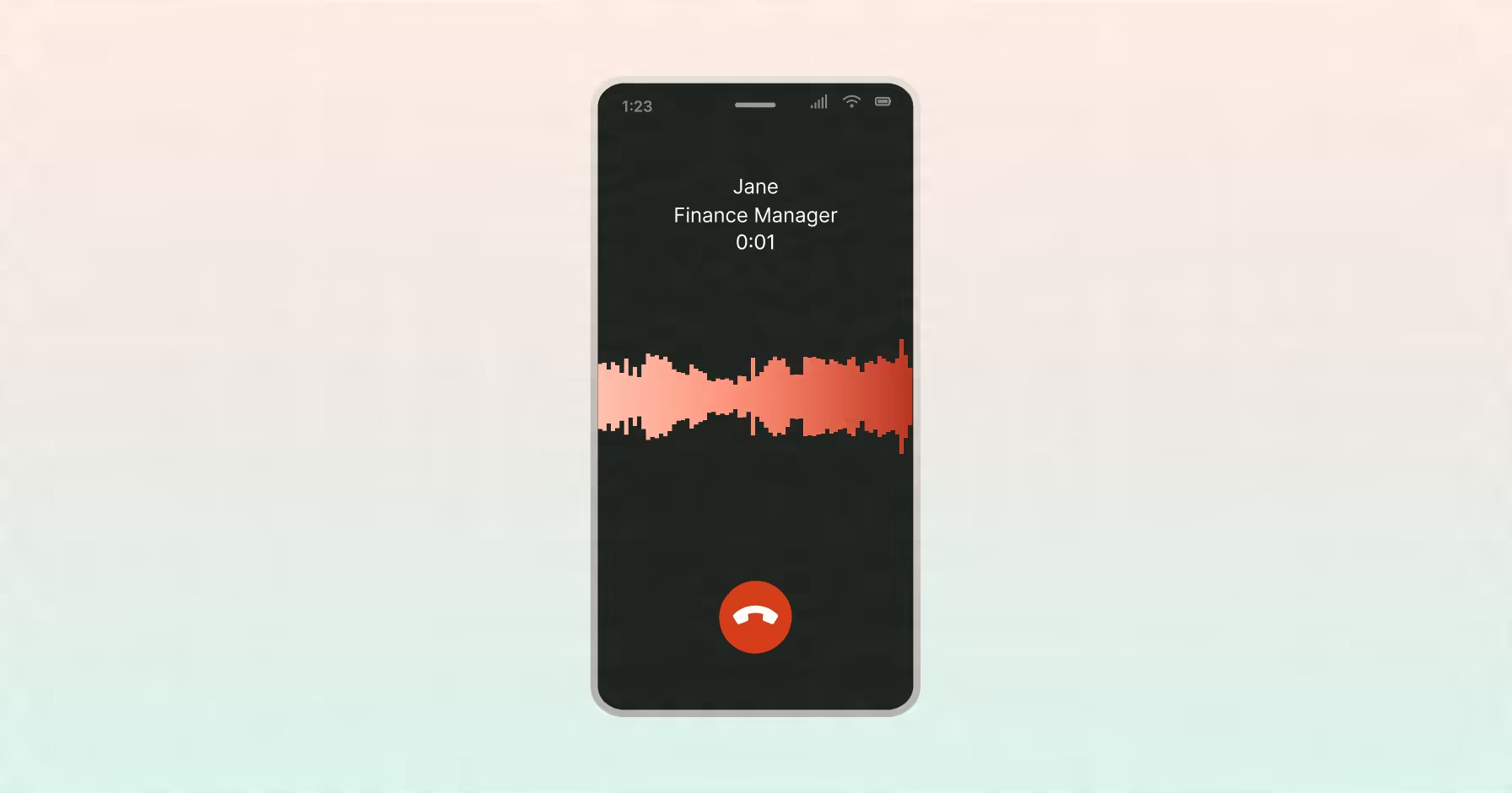

Voice deepfakes now show up on the same channels telecom fraud teams already watch: customer care lines, high-risk IVR paths, and wire or account-change requests that sound like a known executive or subscriber. STIR/SHAKEN and related caller-ID authentication raise assurance on who claims the number. They leave open whether the voice on the line is a live person or a synthetic performance. Treat this page as a controls brief you can hand to architecture and procurement.
Key takeaways
- Deepfake detection scores the media path (audio, and when needed image/video) and returns a verdict plus confidence your fraud stack can act on.
- Caller-ID authentication and biometric voice ID answer different questions; synthetic-speech detection sits beside them in the control set.
- Buyers should lock latency budgets, false-positive cost, explainability, retention, and deployment (API, VPC, on-prem, air-gapped) in writing.
- Map every verdict to a playbook action: allow, step-up, hold for review, or block and case.
- Resemble Detect is built for real-time and batch workflows with API and enterprise deployment options; lock SLAs in procurement.
What is deepfake detection for telecom fraud?
Deepfake detection for telecom fraud is the practice of analyzing call audio (and related media) to decide whether speech is likely human or AI-generated or AI-altered, then routing that decision into fraud, trust-and-safety, or contact-center controls. A production-grade system returns a clear verdict, a confidence score, and enough explanation for an analyst or automated policy to act inside the call or case timeline.
Why voice deepfakes are a CSP and fraud-ops problem now
Clone quality and time-to-audio have dropped. Attackers can rehearse a short target sample and replay a convincing voice into care, collections, or executive outreach. Fraud loss shows up as unauthorized ports, SIM or account takeovers, APP-style authorized push payment pressure, and social engineering that defeats knowledge-based checks.
Industry and regulator attention on illegal robocalls, spoofing, and AI-generated voice messaging continues to rise. The FCC robocall and consumer protection work and call authentication (STIR/SHAKEN) program address network trust and illegal calling. They leave open, by themselves, whether a voice on an authenticated session is synthetic. That media-layer gap is what detection is for.
Attack patterns fraud teams actually see
- Vishing with a familiar voice - “CEO” or “family member” urgency on a wire, gift-card, or credential path.
- Care and IVR bypass - synthetic speech aimed at account recovery, port-out, or high-risk self-service trees.
- Contact-center social engineering - live or near-live generation to keep an agent in a helpful posture past normal friction.
- Scale plays - many short attempts across numbers or queues where manual listen-back cannot keep up.
These hit that gap in a few recurring situations: the number may look right, the script may sound right, and the voice still fails a synthetic-media check.
What good detection looks like
Score the control the way you score other real-time fraud signals:
- Latency - budget from audio window to verdict must fit the live path (streaming or short chunk) or the post-call case path.
- Verdict + confidence - a decision your policy engine can branch on, alongside headline accuracy numbers from a lab card.
- Explainability - enough rationale for QA, disputes, and model governance (see also voluntary framing in the NIST AI Risk Management Framework).
- False-positive cost - every misfire burns agent time or customer trust; tune thresholds per queue risk. Lab-clean clips understate how ordinary telephony processing (codec, VoIP, noise, reverb) can move scores. Resemble’s Proteus work stress-tests those chains and found genuine audio easier to push toward a spoof verdict than the reverse, which is the failure mode you budget for in production FP cost.
- Deployment fit - API into the media path; VPC, on-prem, or air-gapped where policy requires.
- Retention and deletion - align with enterprise and GDPR-style requirements; prefer configurable retention over one-size defaults. For live-call monitoring, buyers also ask whether accuracy holds steady across what is said and who is speaking. Resemble’s DETECT-3B-Omni content and demographics study (with Deutsche Telekom) reports 98.3% overall accuracy and equivalence within about ±2 percentage points across the content and demographic splits tested, which is the kind of evidence privacy and model-risk reviews look for.
Deepfake detection is one control among several, with clear limits. It sits next to identity proofing, device and SIM signals, velocity rules, and human escalation.
Architecture: where detection sits in the voice path
In a typical CSP or enterprise voice path, audio is tapped or forked from the SBC, CCaaS, or recorder, scored by a detector, and the verdict is written back to the fraud engine, CRM case, or agent desktop.
Fig. 1 - Deepfake detection on the carrier voice path
.jpg)
Design choices that matter in procurement:
- Streaming vs chunk vs full-call batch
- Where PII and audio buffer
- How verdicts join existing case IDs
- Failover when the detector is slow or down (fail-open vs fail-closed by queue risk)
From verdict to action
A score is only useful if your team knows what to do with it. Make it clear what happens next.
Fig. 2 - From detection result to action
.jpg)
Buyer evaluation checklist for security and fraud leaders
Use this table in RFP or security review. Require written answers and a pilot on your audio.
How deepfake detection compares to adjacent voice security controls
Teams often evaluate detectors next to caller authentication and voice biometric or call-fraud suites.
For FCC context on authentication and spoofing consumer harm, see the Commission’s call authentication overview and caller ID spoofing guidance.
How Resemble Detect fits
Resemble Detect analyzes audio, images, and video and returns verdicts, confidence scores, and explanations aimed at real-time and batch enterprise workflows. Teams integrate via API; enterprise programs can discuss cloud, VPC-style, on-premises, or air-gapped deployment. Streaming audio detection supports live paths; batch covers backlog and case review. On contact-center stacks such as 8x8, Detect can screen inbound call audio for synthetic or cloned speech without replacing the dialer or routing fabric. Product documentation for integrations can be found at docs.resemble.ai/detect, including streaming audio detection for live monitoring.
- Verdict-oriented outputs for policy engines
- Multimodal when a case is more than audio
- Explainability path for analysts (see also Resemble Intelligence)
- Developer surface for detect create, batch, streaming, and retrieval
- Research feedback loops on telephony-like robustness (Proteus) and content/demographic stability for call monitoring (DETECT-3B-Omni)
To learn more about how Resemble can help you prevent Telecom fraud, book a demo today.
FAQ
Does STIR/SHAKEN replace deepfake detection?
STIR/SHAKEN and related caller-ID authentication improve trust in number attestation on participating networks. A call can carry strong attestation and still present synthetic speech. Use authentication and media detection together. Start with the FCC call authentication pages for the network side of the story.
Can detection run on live contact-center calls?
Yes, when you integrate a streaming or low-latency chunk path into the media fork and set a timeout policy. Prove p95 on your codec and queue mix in a pilot before hard cutover. Ask how the model behaves after ordinary line processing; Proteus documents how codec, VoIP, and noise chains can shift scores on real audio paths. For CCaaS-specific landing (including 8x8), see the contact-center FAQ below.
Can Resemble Detect run on live calls in 8x8 or other contact centers?
Yes. On contact-center and CCaaS paths such as 8x8, Resemble Detect can screen inbound call audio for AI-cloned or synthetic speech aimed at agents or self-service flows. It sits beside existing routing. It is not a rip-and-replace dialer.
Live monitoring uses a streaming or API path into the media fork; batch covers recordings and case review. Cloud and on-prem options stay available where policy requires. Setup detail lives on the 8x8 integration page and in streaming Detect docs. For other contact-center stacks, start from the same media-fork pattern and confirm fit with us.
What about CEO or wire-fraud voice clones?
Treat high-risk payment and account-change intents as a separate policy tier: detection + step-up + dual control. The detector is an input to the wire playbook, not the whole playbook.
How is deepfake detection different from voice biometrics?
Voice biometrics check whether the speaker matches an enrolled voiceprint. Deepfake detection checks whether the audio looks AI-generated or AI-altered. You need enrollment and consent for biometrics. General synthetic-speech detection does not.
Those answers can disagree on the same call. An unknown live caller may fail biometric match and still look human to a detector. A clone of an enrolled customer may confuse biometrics while a media detector is built to catch generation artifacts. Most fraud stacks keep both and use the comparison table above for the full axes.
Resemble Detect vs Pindrop: what is the difference?
Procurement shortlists often put Resemble Detect beside Pindrop and other call-fraud suites. The products are not interchangeable. Pindrop-class tools usually emphasize call authentication, channel risk, and biometric or anti-spoof checks: is this call or speaker consistent with what you expect? Resemble Detect scores whether the media (audio, and when needed image or video) is likely synthetic, then returns a verdict, confidence, and explanation your fraud policy can act on.
Primary question, enrollment need, and insert point differ (comparison table above). Pilot on your codec mix and queues. Put latency, false-positive budget, retention, and deployment into the contract rather than ranking vendors from a blog.
Do we need voice biometric enrollment for deepfake detection?
No for general synthetic-speech detection. That path scores generation artifacts without an enrolled voiceprint. You still may want biometric enrollment on known-customer auth and agent-verification steps. Many programs run both controls side by side.
How should we think about regulations and governance?
Map controls to your jurisdiction (telecom consumer rules, privacy, financial-crime expectations) and to internal model-risk practice. The NIST AI RMF is a voluntary reference many enterprises already use for govern/map/measure/manage language. For live-call monitoring under GDPR-style necessity arguments, see also Resemble’s DETECT-3B-Omni work on content and demographic stability (Deutsche Telekom collaboration). This article does not substitute for legal advice.
On-prem or air-gapped - is that possible?
Enterprise Detect programs can discuss on-premises and air-gapped options when cloud egress is restricted. Confirm scope, update mechanics, and support in the SOW.
Audio-only or multimodal?
Telecom fraud is mostly audio-first. Keep image/video detection available for KYC selfies, ticket attachments, or social-originated evidence packs without forcing every call through a multimodal pipeline.
What is the false-positive impact on agents?
Measure incremental handle time and escalation rate in the pilot. Tune thresholds per queue; a collections line and a high-value wire queue should not share one blind cutover threshold. Expect more pressure on genuine audio under compression and noise than lab cards show; budget QA sampling for that class of miss.
How do we integrate with the existing fraud stack?
Common pattern: media fork to Detect API or stream, then webhook/event to fraud decisioning, then agent desktop banner or IVR branch. Align case IDs and retention with your SIEM and CQ tools. On CCaaS platforms such as 8x8, the same fork pattern applies to inbound agent and self-service audio; see the contact-center FAQ and 8x8 integration.
Where do we start a pilot?
Pick one high-risk intent (port-out, password reset, wire callback), define success metrics (catch rate on red-team audio, FP budget, latency), and run shadow mode before enforcement.
.avif)