
Financial institutions are facing a growing problem that traditional AML controls were not designed to handle. Customer onboarding, identity verification, and account recovery workflows increasingly rely on digital interactions, while fraud tactics are becoming harder to detect.
Entrust's 2025 Identity Fraud Report found that AI-generated identity fraud continues to increase as financial institutions expand digital onboarding, making advanced identity verification and fraud detection increasingly important.
For compliance, fraud prevention, and financial risk teams, the challenge is no longer limited to verifying documents and customer data. It also includes determining whether the person behind the interaction is genuine.
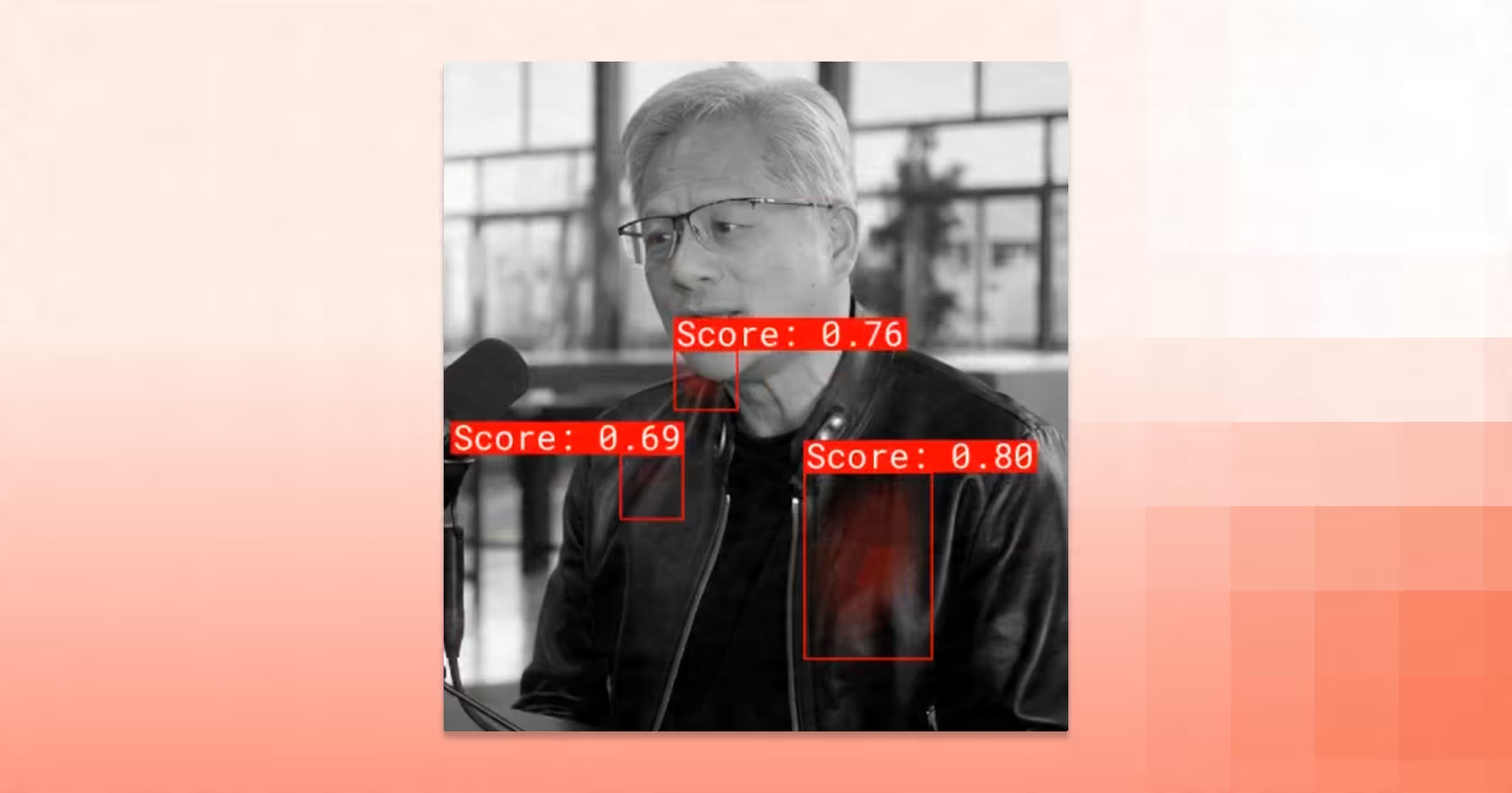
This is where deepfake detection for AML compliance is becoming an important part of modern risk management. Deepfake detection systems are designed to identify signs of manipulation in audio or video, or of synthetic identities, before they move further into onboarding, verification, or monitoring workflows. When combined with identity verification, biometric checks, and risk-based AML controls, these tools can help defend against fraud without relying solely on traditional verification methods.
This article explores why deepfakes matter for AML programs, how detection technologies work, where they fit within compliance workflows, and what organizations should evaluate before deploying these systems at scale.
Key Highlights:
- Deepfakes pose new risks to customer onboarding, identity verification, fraud prevention, and AML compliance programs.
- Additional verification layers can support customer due diligence, remote onboarding, ongoing monitoring, and fraud investigation.
- Audio and video analysis, liveness detection, and behavioral risk scoring play key roles in identifying synthetic media threats.
- Detection limitations, false positives, evolving attack methods, integration challenges, and governance requirements influence deployment success.
- Risk-based verification, clear escalation procedures, continuous testing, and layered controls help improve the use of deepfake detection within AML workflows.
Why Deepfakes Matter for AML
Deepfakes are no longer limited to social media misinformation or celebrity impersonation. Financial institutions are increasingly evaluating the impact of synthetic media on customer onboarding, identity verification, fraud prevention, and AML compliance.
Here’s why it matters:
- Identity fraud can create pathways for financial crime: Criminals may use impersonation techniques to open accounts, gain unauthorized access, or support mule account operations that can later be used to move illicit funds.
- Synthetic media can support financial crime activities: AI-generated audio and video may be used to impersonate real individuals, create synthetic identities, or strengthen fraud schemes that seek access to financial services and accounts.
- Remote onboarding has expanded the attack surface: As more institutions rely on digital onboarding, criminals have more opportunities to exploit manipulated media during identity verification, customer due diligence, and account creation.
- Impersonation can bypass trust-based processes: Financial institutions often rely on voice calls, video verification, and customer interactions to confirm identity. AI-generated media may exploit these trust mechanisms if additional safeguards are not in place.
- Fraud and money laundering risks are increasingly connected: While deepfakes do not directly cause money laundering, successful impersonation or identity fraud can help criminals gain access to accounts and financial systems that may later be used for illicit activity.
- Compliance teams need stronger verification layers: Many organizations are evaluating deepfake detection, biometric verification, and risk-based authentication as additional controls that complement existing AML frameworks rather than replace them.
- Regulators are emphasizing identity assurance: Across many jurisdictions, there is growing attention on customer due diligence, fraud prevention, and digital identity verification, making identity authenticity a more important part of compliance programs.
Also Read: Deepfake Awareness Training: An Ultimate Guide for Businesses
How Deepfake Detection Strengthens AML Compliance Programs
Deepfake detection is not a replacement for AML systems. Instead, it serves as an additional layer of verification to help organizations assess whether submitted audio, video, or biometric content may have been manipulated.
Understanding where this layer fits is important for realistic deployment planning.
- Supporting Customer Due Diligence (CDD)
Customer due diligence is a foundational component of AML compliance.
During onboarding, institutions seek to verify:
- Customer identity
- Risk profile
- Ownership information
- Source of funds when appropriate
Deepfake detection can support these efforts by helping identify suspicious audio or video artifacts that may warrant further review.
Rather than automatically rejecting customers, detection systems typically act as risk indicators that trigger additional verification procedures.
This layered approach helps organizations balance security with customer experience.
- Strengthening Remote Onboarding Processes
Remote onboarding has become increasingly common across banking, fintech, insurance, and digital financial services.
While convenient, remote onboarding introduces new identity verification challenges.
Organizations may need to evaluate:
- Video submissions
- Selfie verification workflows
- Live identity checks
- Voice-based interactions
Deepfake detection technologies can help identify anomalies that suggest manipulated media may be involved.
For AML teams, this provides additional visibility during one of the most vulnerable stages of the customer lifecycle.
- Enhancing Ongoing Monitoring Efforts
AML compliance does not end after onboarding.
Financial institutions continuously monitor customers for suspicious activity and evolving risk indicators.
Deepfake detection may contribute to ongoing monitoring by supporting:
- High-risk account verification
- Account recovery processes
- Authentication events
- Sensitive transaction approvals
When combined with existing monitoring systems, detection tools can provide additional context for risk assessment purposes.
- Strengthening Fraud Investigation Processes
Fraud and AML teams frequently work together when suspicious identity-related activities occur.
Detection systems may help investigators:
- Review potentially manipulated media
- Assess impersonation attempts
- Prioritize higher-risk cases
- Gather additional evidence for investigations
This can improve investigative efficiency while supporting broader compliance objectives.
- Supporting Layered AML Controls
One of the most important principles in AML compliance is layered defense.
No single technology can prevent all financial crime risks.
Deepfake detection works best when combined with:
- Identity verification
- Behavioral analytics
- Device intelligence
- Transaction monitoring
- Human review processes
- Risk scoring systems
This layered approach generally provides stronger protection than relying on any single control.
Also Read: Proactive Detection Techniques for Watermarking Voice Cloning Output
Key Deepfake Detection Technologies Used in AML Compliance
Deepfake detection technologies use different methods to identify signs of synthetic media. Understanding these approaches helps AML teams evaluate capabilities, limitations, and deployment fit.
No single detection method works in every situation. Most organizations benefit from combining multiple verification methods.
- Audio Deepfake Detection
Audio deepfake detection focuses on identifying synthetic or manipulated speech.
This matters because voice cloning tools can generate highly realistic outputs using relatively small amounts of training data in some cases.
Detection systems may analyze:
- Speech patterns
- Frequency characteristics
- Acoustic inconsistencies
- Temporal artifacts
- Model-generated audio signatures
These systems attempt to identify patterns that differ from naturally produced speech.
- Video Deepfake Detection
Video deepfake detection examines visual content for signs of manipulation.
Detection systems may evaluate:
- Facial movements
- Eye behavior
- Expression consistency
- Temporal patterns
- Rendering artifacts
These systems attempt to identify irregularities that may indicate synthetic generation.
- Liveness Detection Systems
Liveness detection attempts to determine whether a real person is present during verification.
While deepfake detection analyzes content authenticity, liveness systems focus on confirming real-time human participation.
Examples include:
- Blink detection
- Facial movement analysis
- Challenge-response verification
- Motion tracking
Many organizations use liveness detection alongside document verification and biometric analysis to strengthen onboarding controls.
- Risk Scoring and Behavioral Analysis
Modern AML programs increasingly rely on risk-based decision-making.
Behavioral analysis systems examine factors such as:
- User interaction patterns
- Device characteristics
- Session behavior
- Historical account activity
Rather than making binary decisions, these systems contribute signals that help determine overall risk levels.
- Image Deepfake Detection
Image detection systems analyze uploaded selfies, identity documents, and other visual assets for signs of AI-generated or manipulated content. They can evaluate inconsistencies in facial features, lighting, image artifacts, and editing patterns that may indicate synthetic or altered media. Within AML workflows, this provides an additional layer of verification during remote onboarding and identity verification.
This layered approach often provides stronger protection than relying on any single detection method.
Industry Challenges in Deploying Deepfake Detection for AML Compliance
Deepfake detection offers significant potential benefits, but deployment comes with challenges that organizations should understand before implementation.
Recognizing these limitations improves decision-making and prevents unrealistic expectations.
- Detection limits: Deepfake detection systems are designed to identify signs of manipulated media, but their accuracy can vary with audio quality, video resolution, attack methods, and environmental conditions. No solution can guarantee the detection of every synthetic media attack.
- False positives: Legitimate customers may occasionally be flagged as suspicious. This can create onboarding delays, additional verification steps, and higher investigation workloads for compliance teams.
- Evolving threats: Deepfake generation models continue to improve, requiring detection systems to adapt regularly. Organizations may need ongoing updates and testing to maintain effectiveness against emerging attack techniques.
- Limited explainability: Some detection platforms provide risk scores without clearly showing why content was flagged. Compliance teams often need more transparency to support investigations, audits, and decision-making.
- Integration complexity: Deepfake detection tools must work alongside existing KYC, AML monitoring, fraud prevention, and case management systems. Poor integration can reduce operational efficiency and create fragmented workflows.
- Operational costs: Deploying deepfake detection often involves technology investments, workflow adjustments, staff training, and ongoing monitoring. Institutions must evaluate whether the benefits align with operational requirements and risk exposure.
- Human oversight: Automated detection can help identify suspicious content at scale, but high-risk cases often require manual review. Human investigators remain an important part of effective AML and fraud prevention programs.
- Regulatory uncertainty: Expectations around synthetic media risks and deepfake detection continue to evolve. Financial institutions may need to adapt their controls as regulatory guidance becomes more defined.
Also Read: Real-Time Audio Deepfake Detection: How Live Verification Works
Best Practices for Integrating Deepfake Detection into AML Workflows
Deepfake detection delivers the most value when it is integrated into existing AML and identity verification processes rather than deployed as a standalone control. The goal is to improve risk visibility while maintaining smooth onboarding, monitoring, and investigation workflows.
- Apply risk-based verification measures: Not every customer or transaction carries the same level of risk. Additional deepfake screening may be more appropriate for high-value transactions, high-risk accounts, or sensitive account changes where identity assurance is critical.
- Establish clear escalation procedures: Detection systems typically generate risk signals rather than definitive conclusions. Compliance and fraud teams should have documented processes for reviewing flagged cases and determining when additional verification is required.
- Test performance under real-world conditions: Detection tools should be evaluated using different devices, audio qualities, network conditions, and user environments. Real-world testing often reveals operational challenges that may not appear in controlled demonstrations.
- Monitor false positives and false negatives: An effective AML workflow balances fraud prevention with customer experience. Regularly reviewing detection outcomes helps organizations identify where verification processes may be creating unnecessary friction or missing potential risks.
- Align detection with existing AML investigations: Detection alerts should feed into case management, fraud review, and suspicious activity investigation processes. This helps analysts assess deepfake-related risks within the broader context of customer behavior and transaction activity.
- Maintain governance and model oversight: Detection technologies require ongoing monitoring to ensure they remain effective as synthetic media techniques evolve. Regular performance reviews, audits, and policy updates can help keep controls aligned with compliance objectives.
- Continuously reassess emerging threats: Deepfake technology continues to evolve, which means detection strategies should evolve as well. Periodic reviews of detection coverage, risk thresholds, and verification workflows can help organizations adapt to new attack methods over time.
How Resemble AI Helps Financial Institutions Detect Deepfakes and Strengthen AML Controls
Financial institutions evaluating deepfake detection for AML compliance often need more than a simple real-or-fake score.
Resemble AI approaches this challenge through a multimodal detection framework that analyzes audio, video, and image content. Rather than focusing solely on voice-cloning risks, the platform is designed to help organizations investigate synthetic media signals across various identity verification and fraud-prevention scenarios.
Here’s how we can help you:
- Real-time analysis: Detection results are available in under 300ms, allowing teams to assess suspicious content during verification workflows rather than only after review.
- AML and fraud use cases: Support scenarios such as synthetic identity checks, fake KYC submissions, executive impersonation attempts, and transaction verification workflows.
- Live interaction monitoring: Can be applied to calls, meetings, and customer verification sessions where manipulated media may affect identity-related decisions.
- Enterprise deployment options: Offer features such as SOC 2 Type II, SSO/SAML support, and on-premises deployment options, helping institutions align detection workflows with existing security requirements.
- Explainable risk signals: Provide analysis on why content may be flagged, giving investigators additional context during compliance reviews and fraud investigations.
- Scalable global coverage: Supports 50+ languages with real-time APIs, making it suitable for organizations operating across multiple regions and customer channels.
- Independent benchmarking: In the 2026 Podonos benchmark evaluating multiple commercial audio deepfake detection systems, Resemble AI's DETECT-World achieved 99.5% detection accuracy across the evaluated dataset. As with any detection platform, organizations should validate performance using their own operational environments and threat models.
For organizations exploring synthetic media risks, evaluating platforms such as Resemble AI can help clarify how audio deepfake detection fits into broader AML, fraud prevention, and identity verification strategies.
Conclusion
Deepfake detection for AML compliance is emerging as an important layer within broader risk-management frameworks. It can help organizations identify suspicious identity signals, strengthen customer due diligence processes, and improve visibility into potential impersonation attempts.
As financial crime becomes increasingly influenced by synthetic media and AI-generated impersonation, institutions that proactively test, evaluate, and strengthen verification workflows will likely be better positioned to manage risk, support compliance objectives, and maintain trust across digital financial systems.
If your organization is assessing how voice AI, synthetic media, and deepfake detection affect AML workflows, exploring solutions from companies like Resemble AI can provide useful insight into both the opportunities and the safeguards involved in deploying these systems responsibly.
FAQs
- Which types of financial crime use deepfakes to bypass AML controls?
Deepfakes are used in identity fraud, account takeover, synthetic identity creation, and impersonation scams. Criminals exploit them to bypass onboarding checks, evade KYC verification, and mislead remote video verification processes used in AML compliance workflows.
- How can deepfakes enable identity fraud in KYC and onboarding processes?
Deepfakes allow fraudsters to impersonate real customers during onboarding using synthetic video or voice. They can match stolen documents with manipulated live likenesses, bypassing biometric checks and tricking remote verification systems into approving fake or stolen identities.
- How can transaction monitoring systems be tuned to trigger deepfake detection investigations?
Transaction monitoring can flag anomalies like rapid account creation, inconsistent behavioral biometrics, or mismatched session data. Integrating identity verification signals and escalating cases with failed liveness checks helps trigger targeted deepfake-focused AML investigations.
- What data sources (video calls, uploaded IDs, voice samples) are most useful for deepfake detection in AML?
High-value sources include live video verification sessions, selfie and ID document uploads, voice authentication samples, and behavioral biometrics like typing patterns. Cross-referencing these inputs improves detection accuracy for manipulated or synthetic identity signals.
- How should institutions handle evidence collection and chain of custody for suspected deepfakes?
Institutions should securely store original media files with timestamps, metadata, and audit logs. Access must be restricted, and all handling steps must be documented. This ensures integrity, supports investigations, and maintains admissibility for regulatory or legal review.
- What governance and policy changes are needed to include deepfake risk in AML frameworks?
AML frameworks should explicitly define deepfake risk, update KYC policies, and integrate AI-based verification controls. Governance structures must assign accountability, ensure escalation paths, and require periodic model validation and risk assessments for synthetic media threats.
- Which regulatory expectations or guidance exist regarding deepfake mitigation in financial services?
Regulators increasingly expect robust digital identity verification, fraud detection controls, and AI risk management. While specific deepfake rules are evolving, guidance under AMLD, FATF recommendations, and model risk management frameworks emphasizes strong authentication and monitoring controls.
- How can institutions measure the effectiveness of deepfake detection controls within their AML program?
Effectiveness can be measured by detection accuracy, false positive rates, time-to-detection, and successful fraud-prevention rates. Regular audits, red-teaming exercises, and comparisons with known attack simulations help validate control performance over time.
- What privacy and data protection considerations arise when collecting biometric or media data for deepfake detection?
Institutions must ensure lawful processing, data minimization, and secure storage of biometric data. Consent, retention limits, and encryption are essential. Compliance with GDPR-like frameworks is critical when handling sensitive identity and media verification data.
- How should institutions validate and periodically test third-party deepfake detection solutions?
Third-party tools should be tested using benchmark datasets, adversarial simulations, and real-world fraud scenarios. Regular performance reviews, bias checks, and stress testing ensure continued reliability and alignment with evolving deepfake techniques.
- What metrics and KPIs should be tracked to monitor deepfake-related AML risk (e.g., detection rate, time-to-investigation)?
Key KPIs include detection rate of synthetic identities, false positives, average investigation time, escalation volume, and prevention success rate. Tracking model confidence scores and verification failure patterns also helps assess emerging deepfake risk trends.
- What training and awareness should AML investigators and frontline staff receive about deepfakes?
Training should cover recognizing visual and audio manipulation signs, understanding verification failures, and responding to alerts. Staff should also learn about escalation protocols, case-handling procedures, and how deepfakes affect KYC, onboarding, and transaction monitoring.