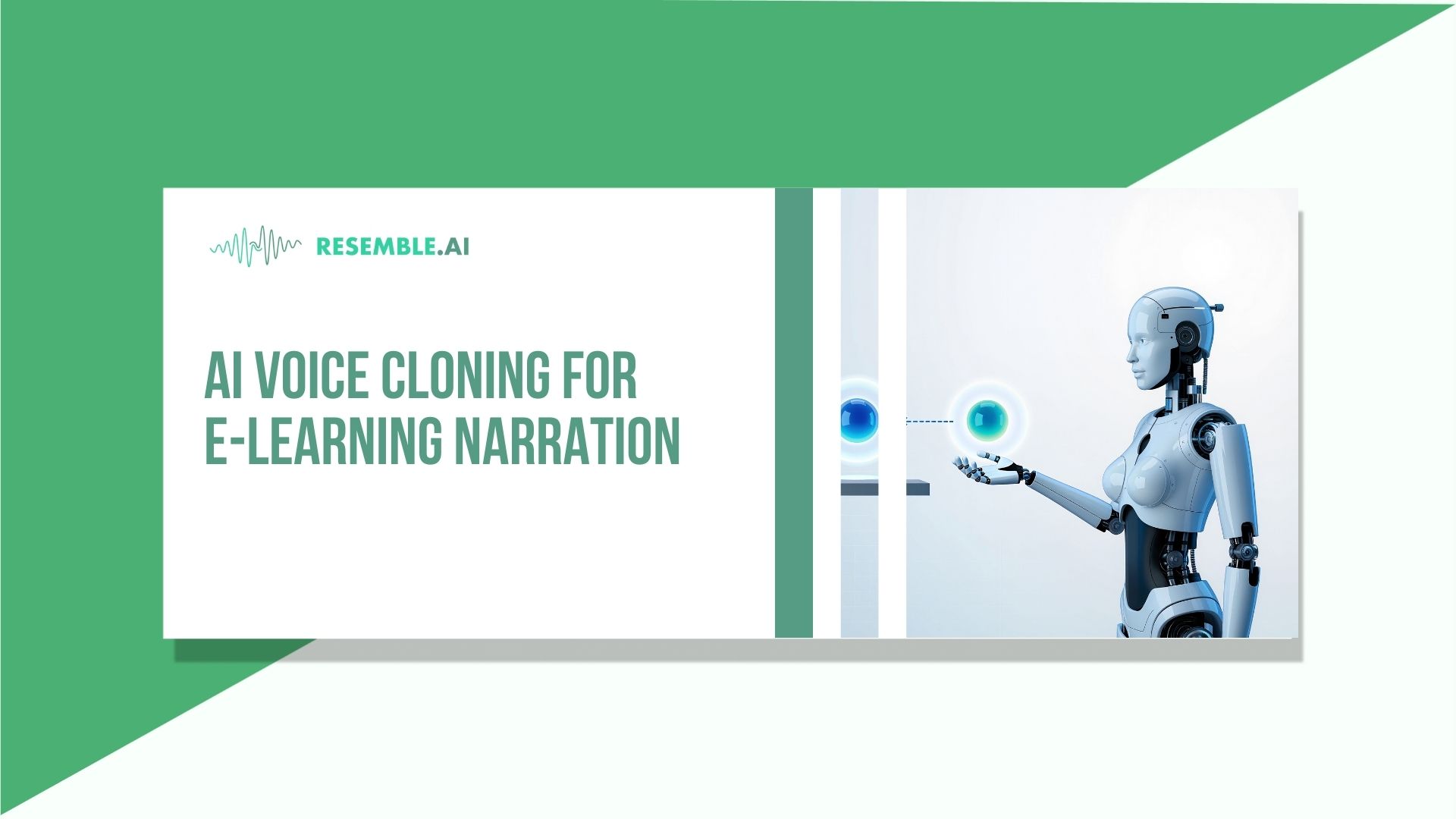
E-learning has transformed the way knowledge is delivered, yet content creators often face persistent challenges: maintaining consistent audio quality, scaling production efficiently, and reaching learners across languages and regions. Traditional narration methods that rely on human voice actors are expensive and time-consuming.
With the AI voice cloning market projected to grow to $7.72 billion by 2029 at a CAGR of 23.9%, this technology is quickly becoming a practical solution for modern e-learning. AI voice cloning provides high-quality, customizable voice experiences that are scalable, multilingual, and ethically managed.
By bridging the gap between instructional design and learner engagement, voice cloning allows educators and enterprises to deliver personalized learning at scale while retaining professional audio standards. This blog explores the impact of AI voice cloning on e-learning narration, detailing how it works, its benefits, best practices, and the ethical considerations creators should be mindful of.
In a nutshell:
- AI voice cloning transforms e-learning narration by enabling realistic, expressive, and consistent voice experiences across courses.
- It allows rapid, scalable content production while maintaining professional audio quality and instructor persona.
- Multilingual and accessibility features make learning inclusive for global audiences and diverse learner needs.
- Ethical safeguards and clear consent ensure responsible use, preventing misuse or bias in AI-generated narration.
- Best practices combine AI efficiency with human oversight, delivering engaging, personalized, and reliable learning experiences.
What is Voice Cloning for E-Learning Narration?
Voice cloning in e-learning refers to using AI technologies to replicate a human voice for narrating educational content. Unlike generic text-to-speech systems, AI voice cloning creates realistic, expressive, and highly adaptable voices that creators can personalize for specific courses, learners, or instructional styles.
It allows creators to maintain the same “instructor persona” across multiple courses, update recordings easily, and localize content without starting from scratch. This consistency improves comprehension and builds trust—two key components of successful learning experiences.
Types of Voice Cloning Models Used in E-Learning
E-learning applications utilize different AI voice cloning models based on the scope, quality, and scale of narration required. The primary models include:
- Few‑shot or Rapid Cloning: Needs only a small sample of voice (sometimes just a few seconds) to create a voice clone. Ideal for quickly generating narration for small courses, prototypes, or rapid updates.
- Professional Voice Cloning: Uses longer, higher-quality recordings to capture nuance, tone, emotion, and pacing. Suited for enterprise-level e-learning, branded voices, or scenarios where expressiveness matters.
- Voice Conversion / Speech-to-Speech: Converts one person’s voice into another in real time. For example, a guest instructor’s voice can be matched to a course’s cloned narrator, maintaining consistency.
- Multilingual Voice Cloning: As global learners demand content in their native languages, multilingual cloning models allow a single digital voice to speak in over 100 languages and regional accents.
These models actively engage learners while improving production efficiency. If you want to experiment with natural-sounding, multilingual narration without advanced setup, you can explore how Resemble AI’s cloning options adapt to different e-learning needs.
In the following section, let’s look at how AI voice cloning actually operates behind the scenes to produce natural, engaging narration.
Also Read: Rapid Voice Cloning 2.0: New Voice Cloning Model with Unmatched Accuracy
How AI Voice Cloning Works for E-Learning Narration?
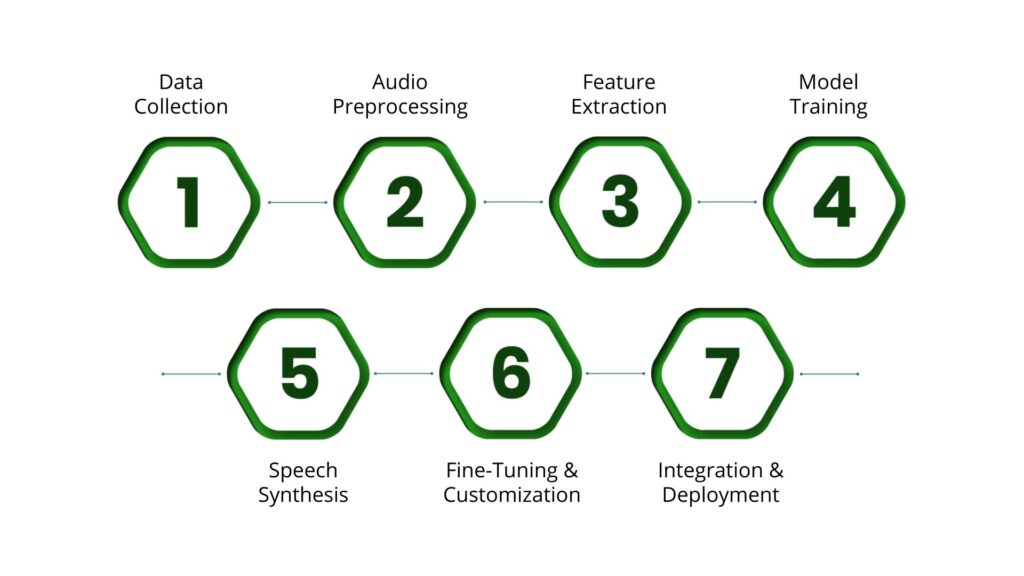
AI voice cloning relies on deep learning algorithms trained on high-quality audio datasets. Here’s a step-by-step look at how it works in e‑learning narration:
Step 1: Data Collection
The process begins with recording the target voice. Short samples (a few seconds) allow rapid cloning, while longer, high-quality recordings capture subtle tonal nuances for professional-grade cloning. These recordings capture the speaker’s tone, pitch, pace, and natural inflections.
Step 2: Audio Preprocessing
The raw audio is cleaned to remove noise, normalize volume, and ensure clarity. The recording is converted into formats (like spectrograms) that the AI model can interpret effectively. This step ensures the AI focuses on the voice characteristics rather than background sounds.
Step 3: Feature Extraction
The AI extracts essential features from the preprocessed audio, such as speaker identity (voice fingerprint), prosody (rhythm and intonation), and linguistic content. These features form the foundation of the cloned voice, enabling it to sound natural and consistent.
Step 4: Model Training
Using advanced deep learning techniques, the AI learns to generate speech that matches the extracted features. Some models support few-shot learning, requiring minimal input, while high-fidelity models use larger datasets to capture subtle emotional nuances and expressive tones.
Step 5: Speech Synthesis
Once trained, the model generates speech from text (text-to-speech) or converts one voice to another in real-time (speech-to-speech). The synthesized speech mirrors the original voice’s tone, pitch, and emotional style.
Step 6: Fine-Tuning and Customization
Creators can adjust parameters such as pitch, speed, emphasis, and emotion to match the pedagogical goals of the e-learning course. This allows for narration that is both engaging and learner-centric.
Step 7: Integration and Deployment
Finally, the voice is integrated into video modules, interactive lessons, or localized content. The cloned voice can easily be updated for new scripts or translated into different languages while maintaining the same recognizable persona.
By automating these steps, e-learning creators can focus on instructional design rather than production logistics, ensuring content remains learner-centric. Next, let’s look at the benefits of voice cloning for e-learning creators.
Also Read: Deepfake Detection: Emerging Deep Learning Techniques
Benefits of Voice Cloning for E-Learning Creators
AI voice cloning provides several advantages that directly impact the efficiency, quality, and engagement of e-learning programs:
- Consistency Across Modules: Maintaining the same voice and tone across multiple courses enhances learner familiarity and comfort, which can improve retention and comprehension.
- Scalability and Speed: AI-generated narration allows educators to produce large volumes of content quickly. Courses that once took weeks to record can now be completed in a fraction of the time.
- Cost Efficiency: By reducing the need for multiple voice actors or studio sessions, voice cloning lowers production costs while maintaining high-quality audio standards.
- Localization and Accessibility: Multilingual voice cloning enables content creators to reach global audiences, while AI-generated narration can be adapted for accessibility tools, such as screen readers, enhancing inclusivity.
- Personalization and Engagement: AI voices can be tailored to the audience’s preferences, adjusting tone, style, and emotional expression to make lessons more relatable and engaging.
- Accessible Learning for All: Learners with hearing, cognitive, or learning differences often need clear, steady, and emotionally neutral narration. AI voice cloning supports controlled pacing, flawless clarity, and predictable delivery, making content more inclusive.
These benefits empower educators, content creators, and enterprises to optimize e-learning production workflows while enhancing learner experience. Next, let’s understand the challenges and ethical considerations that shape responsible voice-cloning practices.
Challenges and Ethical Considerations in Voice Cloning for E-Learning Narration
While voice cloning offers immense potential, creators must also address challenges and ethical concerns:
- Data Privacy and Consent: Voice rights must be secured before cloning any speaker. Ethical use requires explicit consent and a clear understanding of how, where, and for how long the cloned voice will be used.
- Deepfake Misuse: Voice cloning can be misused to create misleading or harmful content. Following ethical guidelines, using AI watermarking, and monitoring content help prevent misuse.
- Quality vs. Realism: Even as AI voices become more realistic, they may still miss subtle human inflections in complex emotional contexts. Creators should balance AI narration with human oversight when necessary.
- Accuracy and Pronunciation Challenges: Subjects like medical education or engineering demand precise pronunciation. Without proper tuning and phonetic control, narration can sound unnatural or unclear.
- Bias and Representation: AI models must be trained on diverse datasets to avoid unintentional biases that could affect pronunciation, accent handling, or gender representation in educational content.
By addressing these considerations, e-learning creators can responsibly adopt AI voice cloning while maintaining trust and credibility. If you want to apply these practices without worrying about technical complexities, Resemble AI offers built-in ethical safeguards and intuitive editing tools that simplify the entire workflow.
In the next section, let’s discuss how teams can apply best practices to deliver narration that is professional, engaging, and ethically sound.
Best Practices for Using AI Voice Cloning in E-Learning Narration
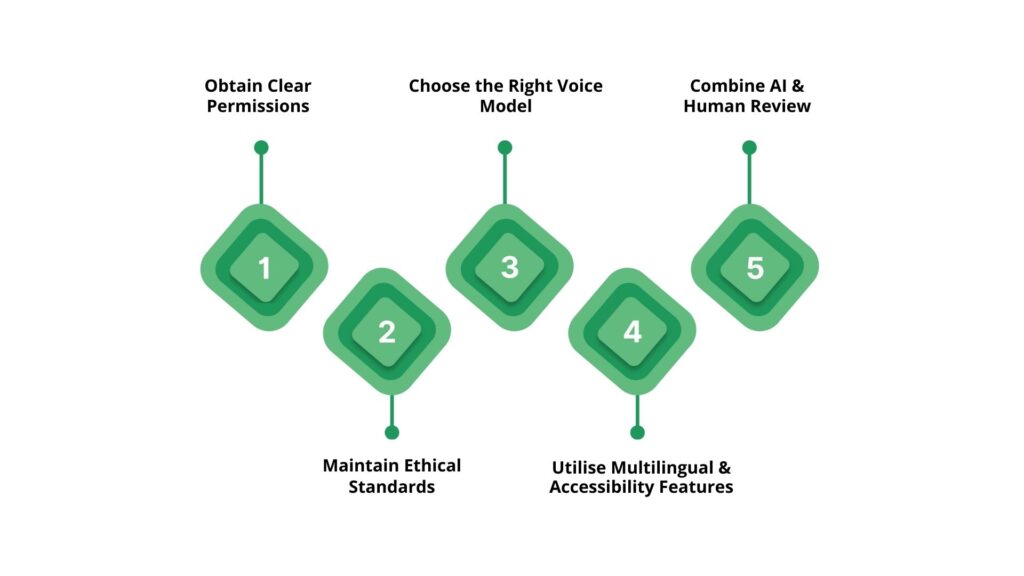
To maximize benefits and minimize risks, here are some recommended best practices for creators, instructional designers, and enterprises using AI voice cloning for e‑learning:
- Obtain Clear Permissions: Always ensure all voice data used for cloning is authorized, especially when replicating real educators or instructors.
- Maintain Ethical Standards: Implement AI watermarking, content monitoring, and clear disclosure of AI-generated voices to maintain transparency.
- Choose the Right Voice Model: Select between rapid or professional voice cloning based on course requirements, ensuring that narration quality aligns with learning objectives.
- Utilise Multilingual and Accessibility Features: Use AI to expand course reach and improve accessibility, catering to learners with diverse linguistic and cognitive needs.
- Combine AI and Human Review: Even high-quality AI narration benefits from human editing to ensure context, clarity, and emotional nuance are accurate.
Following these practices enhances the learning experience while safeguarding ethical standards and operational efficiency.
How Resemble AI Supports High-Quality E-Learning Narration?
Resemble AI offers creators a suite of real-time voice technologies that streamline production, enhance quality, and support large-scale e-learning operations. Its platform is built for flexibility, accuracy, and global reach.
Here’s how we can assist you:
- Rapid and Professional Voice Cloning: Creators can choose between quick voice replication or detailed professional cloning, ensuring content is produced efficiently without compromising quality.
- Multilingual Support: With support for over 120 languages, Resemble AI enables the localization of educational content for global learners, simplifying international expansion.
- Audio Editing Tools: The platform’s intuitive editing interface allows creators to make changes to audio as easily as editing text, reducing production time and technical barriers.
- Voice Design: Educators can generate entirely new AI voices from text descriptions, giving them flexibility to create distinctive narrators that enhance learner engagement.
- Real-Time Speech-to-Speech Transformation: Resemble AI’s speech-to-speech technology allows for live dubbing or dynamic content adaptation, which is particularly valuable for webinars, online workshops, and interactive courses.
- Ethical Safeguards: Includes features for AI watermarking and responsible voice usage to prevent misuse and ensure compliance.
By integrating these features, Resemble AI empowers e-learning creators to deliver high-quality, scalable, and engaging content while adhering to ethical and privacy standards.

Conclusion
AI voice cloning is reshaping the future of e-learning narration, offering scalable, personalized, and consistent audio experiences that enhance learner engagement. Educators and content creators can now overcome traditional barriers of cost, localization, and production time while maintaining high-quality standards.
Responsible adoption is key: ensuring ethical use, securing voice data, and implementing AI watermarking protects both creators and learners. With the right practices and tools, AI voice cloning enables content pipelines to evolve for global, digital learning environments.
For organizations ready to transform their e-learning production, Resemble AI provides the advanced voice cloning and audio editing tools that make high-quality e-learning narration accessible, efficient, and engaging. Schedule a demo with us today and explore the possibilities of AI-powered narration.
FAQs
1. What file formats are supported for exporting voice narration in e-learning systems?
Most e-learning platforms support standard audio formats like MP3, WAV, and AAC for exporting voice narration. These formats ensure broad compatibility, maintain audio quality, and can be easily integrated into Learning Management Systems (LMS) or multimedia content without additional conversion.
2. How is voice data secured when creating a cloned voice model?
Voice data is secured through encryption during storage and transmission. Reputable AI voice cloning systems also implement access controls, anonymization, and strict privacy policies, ensuring that user recordings are protected from unauthorized use and compliant with data protection regulations such as GDPR or CCPA.
3. Are there copyright or licensing issues associated with cloned voices?
Yes, using cloned voices can raise copyright or licensing concerns. Cloning a voice without permission may violate the original speaker’s rights. Organizations should obtain consent, adhere to licensing agreements, and ensure ethical usage to avoid legal complications when using cloned voices commercially or publicly.
4. How can educators or organizations integrate cloned voices into LMS platforms?
Educators and organizations can integrate cloned voices by exporting narration in supported audio formats (MP3, WAV) and embedding them into LMS course modules, quizzes, or presentations. Some platforms offer APIs or plugins for seamless automation, making it easy to synchronize voice narration with existing e-learning content.
5. Does AI voice cloning require professional audio recording to start with?
No, professional recordings aren’t strictly required. Modern AI voice cloning can generate high-quality voice models from clear, moderately recorded samples. However, using well-recorded audio improves naturalness, reduces noise, and enhances overall clarity, especially for professional e-learning or public-facing content.