
As generative AI reshapes content creation, sharing, and consumption, verifying the authenticity of AI-generated content has never been more critical. With over 80% of enterprises predicted to adopt generative AI tools in 2026, concerns around misuse, deepfakes, and content authenticity continue to rise.
Enter AI watermarking: a vital tool designed to trace and verify AI-generated content, ensuring that its origin remains transparent and trustworthy.
This blog dives into AI watermarking, explaining what it is, how it works, its benefits for creators and platforms, and why it’s essential for maintaining trust in the digital world. Whether you’re a content creator, platform provider, or tech enthusiast, this guide will provide clear insights into how watermarking can protect your work, enhance content safety, and drive responsible AI use.
Key Takeaways
- AI watermarking embeds hidden identifiers in AI-generated content, ensuring its authenticity and traceability, even when the content is edited or redistributed.
- Invisible vs visible watermarking: Invisible watermarks are preferred for AI-generated content as they don’t alter the user experience but remain detectable for verification.
- AI watermarking is crucial for preventing misinformation, helping platforms identify and manage manipulated media, such as deepfakes, and ensuring content trust.
- Applications across industries: Used in journalism, advertising, education, and social media to protect content, maintain attribution, and secure intellectual property.
- Challenges include robustness to manipulation, the need for standardization, and potential privacy concerns regarding traceability, requiring ongoing research.
- Resemble AI integrates watermarking into its platform, offering built-in traceability, secure content generation, and seamless workflow integration for creators and enterprises.
What Is AI Watermarking?
AI watermarking is the process of embedding imperceptible markers or identifiers within AI-generated content, which can be detected or extracted at a later time. Unlike traditional watermarks that are visibly placed on images or videos, AI watermarks work behind the scenes, ensuring the origin of the content can always be traced back, even if it’s shared or modified. This allows content creators, platforms, and consumers to verify the authenticity of AI-generated content, protecting intellectual property and enhancing trust in digital environments.
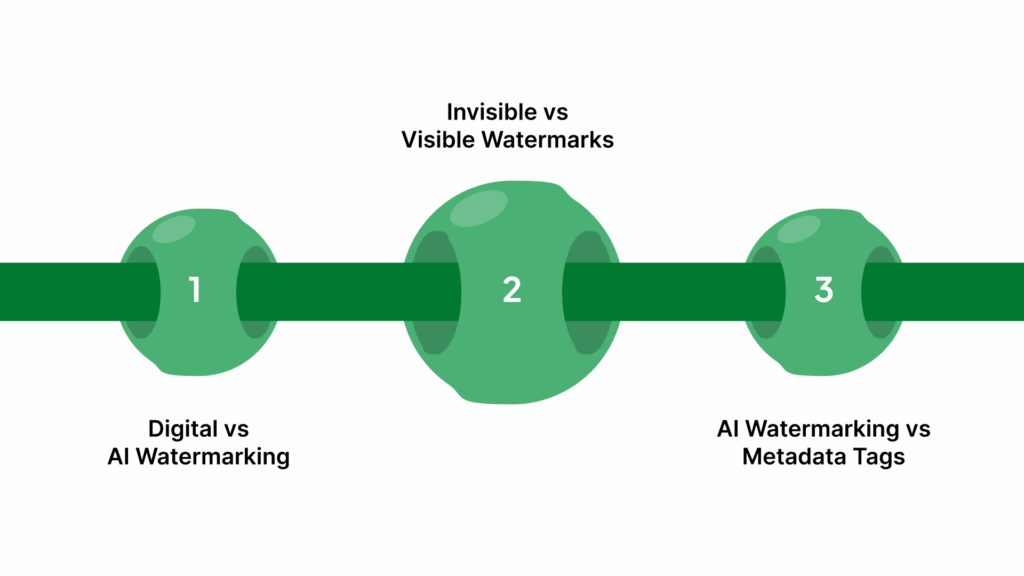
Digital vs AI Watermarking
Traditional digital watermarking typically involves embedding visible or subtle markers directly within the media itself, like logos on images or videos. In contrast, AI watermarking involves embedding information within the content’s algorithmic structure, making the markers almost imperceptible and undetectable to human eyes or ears. This ensures that AI-generated content can be verified without altering the user experience.
Invisible vs Visible Watermarks
While visible watermarks are often used for branding or copyright protection, invisible watermarks are the preferred method for AI-generated content. Invisible watermarks don’t affect the user experience, and they ensure content remains undistorted, but still verifiable. This is particularly important for AI-generated works like deepfake videos or AI-created images, where the goal is to ensure transparency and prevent misuse while maintaining the content’s appearance.

AI Watermarking vs Metadata Tags
While metadata tags offer basic information about the content, like the file’s creation date or author, AI watermarking goes further by embedding unique identifiers within the content itself. Metadata can easily be modified or stripped from content, making it less reliable. In contrast, AI watermarks are harder to tamper with, offering a more resilient and secure method for tracking and verifying AI-generated content, even if it’s altered or redistributed.
Now that we know what AI watermarking is, let’s look at how it actually works behind the scenes.
How AI Watermarking Works
AI watermarking might sound complex, but it essentially involves embedding hidden signals into content (such as text, images, audio, or video) that can be detected later. These hidden identifiers help trace the origin and verify the authenticity of AI-generated media. Let’s break down the technical mechanisms that make AI watermarking so effective.
Embedding Signals in Outputs
AI watermarking works by embedding codes or markers directly within the content itself. These signals can be embedded in various formats, such as in the pixels of an image, audio waveform, or even the way text is written. These markers are designed to be imperceptible to the human eye or ear, ensuring the user experience is unaffected while maintaining a trackable marker for later verification.
Detection & Verification Algorithms
Once content is marked with a watermark, special detection tools are used to read and validate these hidden signals. These algorithms search for the unique patterns, codes, or modifications embedded in the content. When the content is accessed, the algorithm can quickly detect the watermark, authenticate the source, and verify whether it has been altered, ensuring the integrity of the content.
Cryptographic vs Statistical Watermarks
There are two main types of AI watermarking: cryptographic and statistical. Cryptographic watermarks use encryption to securely embed the marker in a way that’s extremely hard to tamper with, providing robust security against attempts to alter or remove it. Statistical watermarks, on the other hand, rely on statistical methods to embed data in a way that’s not easily detectable, but still traceable using specific tools. Both types offer distinct advantages depending on the level of security and the use case.
Real-Time Watermark Generation
One of the impressive aspects of AI watermarking is the ability to generate watermarks in real-time as content is produced. For example, as AI creates a new piece of media—whether it’s generating an image, composing a song, or creating a video—watermarking algorithms can instantly embed the necessary signals. This means content is protected and traceable from the moment of its creation, without any post-production steps required.
Understanding the mechanics helps us appreciate why watermarking is valuable, and that leads us to its real benefits.
Why AI Watermarking Matters
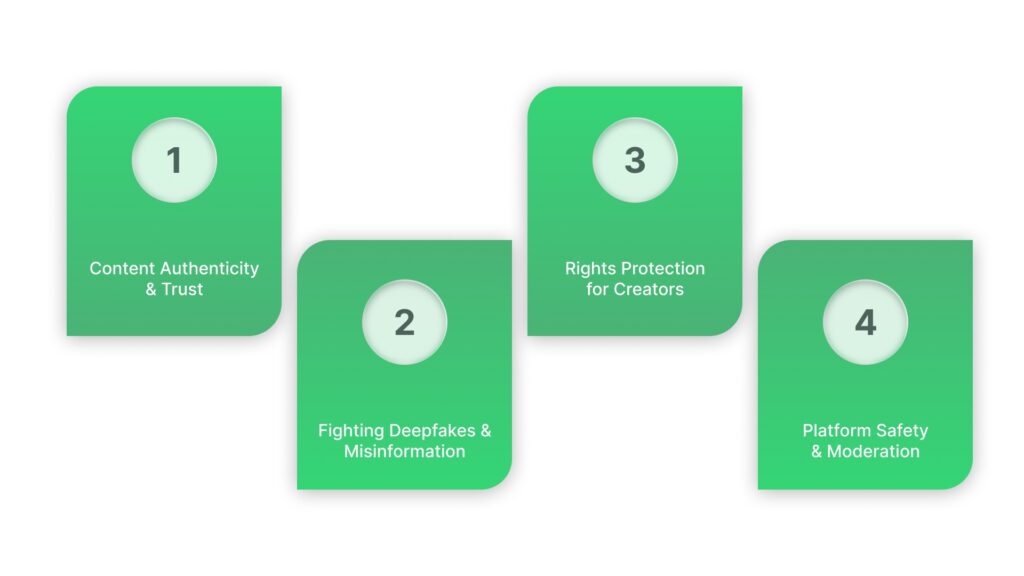
As AI-generated content becomes more prevalent, ensuring its authenticity, integrity, and rightful use is crucial. AI watermarking serves as a critical tool in this process, offering several key benefits to content creators, platforms, and users alike. Here’s why AI watermarking is so important today.
Content Authenticity & Trust
In a world where AI can generate almost anything, from images to text and audio, it’s becoming increasingly difficult for users to differentiate between human-created and AI-generated content. AI watermarking helps solve this problem by embedding invisible markers that indicate the origin of the content. This enables users to trust the content they engage with, knowing it’s been properly attributed to its source and verified for authenticity.
Fighting Deepfakes & Misinformation
With the rise of deepfakes and AI-driven misinformation, distinguishing real from fake content has become a significant challenge. AI watermarking acts as a powerful defense against this issue. By marking AI-generated media with tamper-proof watermarks, platforms and users can quickly identify manipulated content, ensuring that the truth prevails. It helps prevent the spread of misleading or harmful content by making it easier to track and flag as artificial.
Rights Protection for Creators
For content creators, maintaining control over their intellectual property is a top priority. AI watermarking plays a pivotal role in protecting their rights by ensuring that they are properly attributed for their work. These watermarks can also clarify reuse permissions, making it easier to track when content is used inappropriately or without permission. This helps protect creators from unauthorized distribution and misuse of their work.
Platform Safety & Moderation
As AI-generated content becomes more widespread, platforms need to ensure that the content shared on their sites aligns with their safety and moderation guidelines. AI watermarking helps platforms quickly identify AI-generated material, making it easier to flag and manage potentially harmful or inappropriate content. By utilizing watermarks, platforms can streamline their content review processes and take swift action when needed, ensuring a safer digital space for users.
With these benefits in mind, let’s explore how AI watermarking is implemented and some of the challenges it faces in real-world applications.
Ensure your AI content is responsibly marked. Explore how Resemble AIcan embed secure watermarks in generated audio.
Limitations & Challenges of AI Watermarking
While AI watermarking holds significant promise for securing content and ensuring authenticity, there are still challenges to address. The technology is continuously evolving, and several limitations must be acknowledged before widespread adoption. Here are some key challenges AI watermarking faces today.
Robustness to Manipulation
One of the primary concerns with AI watermarking is whether the watermarks can survive editing or transformation. In many cases, watermarks can be altered, removed, or rendered ineffective when the content undergoes processing such as cropping, resizing, or compression. The robustness of these markers is a critical factor in their long-term usefulness, and researchers are actively working on solutions to create more resilient watermarking techniques that can withstand various manipulations without losing integrity.
False Positives & Detection Errors
Watermarking systems are not immune to errors. False positives occur when content that isn’t AI-generated gets flagged as such due to detection system misreadings. This issue can lead to unwanted disruptions, such as genuine content being incorrectly labeled or flagged. Detection systems need to be highly accurate and sophisticated to minimize errors and ensure that only legitimate AI-generated content is identified. Continuous improvements in detection algorithms are essential to reduce these instances.
Standardization & Interoperability
The lack of standardization across watermarking platforms poses another challenge. Different AI watermarking tools may use various methods and protocols, making it difficult for systems to work together. This lack of interoperability can create inefficiencies in content verification and attribution, especially across platforms that use different watermarking technologies. There is a pressing need for universally accepted standards that allow watermarks to be detected and validated across multiple systems and devices.
Privacy Considerations
As AI watermarking grows in importance, it raises concerns about privacy. Embedding identifiable markers in content could potentially allow for user tracking, linking specific content with individuals or their behaviors. Striking a balance between traceability and privacy is a significant challenge. Effective watermarking should not infringe upon user rights or privacy while still ensuring that content can be reliably verified. Research into privacy-conscious watermarking methods is ongoing to address these concerns.
Despite these challenges, AI watermarking is already proving valuable in several industries. Let’s now explore how this technology is being used today.
Real‑World Use Cases

AI watermarking is rapidly being adopted across various industries to enhance content authenticity, security, and accountability. Here are some practical scenarios where AI watermarking is already providing significant value.
News Organizations & Journalism
In the age of misinformation, news organizations are increasingly using AI watermarking to verify the legitimacy of their sources. By embedding watermarks in original content, journalists can ensure that their reports are protected from tampering or misrepresentation. This is particularly crucial for ensuring that multimedia content—such as images and videos—is not altered and presented as original, helping to maintain the credibility and trust of news outlets.
Advertising & Brand Safety
For brands and advertisers, maintaining control over their messaging and protecting against content misuse is vital. AI watermarking helps ensure that ads and brand messages are not altered or misused by third parties. Watermarks provide a way to track the origin of content and verify its authenticity, ensuring that marketing materials are not tampered with or misleadingly presented in other contexts. This is especially important for companies looking to maintain brand integrity across digital platforms.
Education & Research Content
Educational institutions and researchers are using AI watermarking to track the use and reuse of digital content. By embedding watermarks in research papers, online courses, and textbooks, creators can monitor how their content is distributed and ensure proper attribution. Watermarking also provides a way to prevent content theft or plagiarism, helping to maintain academic integrity and protect intellectual property.
Social Media & Platform Governance
Social media platforms, where content manipulation and deepfakes are widespread, are beginning to implement AI watermarking to help detect manipulated media. By watermarking content at the point of creation, platforms can quickly identify whether content has been altered or misused. This is particularly valuable for identifying fake news, altered images, and videos that can spread disinformation, helping platforms maintain a safer, more trustworthy environment.
With these practical use cases demonstrating the real-world value of AI watermarking, let’s now dive into how organizations can implement this technology responsibly.
Best Practices for Using AI Watermarks
As AI watermarking continues to evolve, creators, developers, and platforms need to adopt best practices to maximize its potential and ensure it’s used effectively. Here are some actionable tips to help you implement AI watermarking in a responsible and efficient way.
Combine with Metadata & Provenance Standards
While AI watermarking is a powerful tool for verifying content authenticity, it’s most effective when combined with other verification methods, such as metadata and provenance standards. Metadata can provide additional context on the origin, creator, and modifications of a piece of content. Together, watermarks and metadata offer a more comprehensive solution for tracking content across different platforms and ensuring it hasn’t been altered.
Educate Audiences on What Watermarks Mean
Not all users will immediately understand the significance of AI watermarks, especially as they become more commonplace. It’s crucial for creators, brands, and platforms to educate their audiences about what watermarks signify. When viewers, users, and consumers understand the purpose of watermarks—such as verifying the authenticity of a piece of content—they’re more likely to trust the content they encounter and recognize manipulated media.
Use Detection Tools Regularly
To ensure that watermarks are working as intended, it’s important to regularly use detection tools that can scan and verify content. These tools help identify whether the content is authentic or has been tampered with. By consistently checking watermarked content, creators and platforms can detect and address any potential issues early, ensuring the content remains reliable and protected.
Keep Watermarks Updated with Standards
AI watermarking technology is still evolving, so it’s important to keep watermarks updated in line with industry standards and technological advancements. This includes using the latest watermarking algorithms, ensuring compatibility with new media types, and maintaining the ability to resist tampering. Regularly updating your watermarking methods ensures that your content remains secure and in line with best practices.
Learn how Resemble AI supports responsible content generation with watermarking and detection workflows built for modern teams.
Before we wrap up, let’s spotlight one trusted platform in this space.

How Resemble AI Integrates AI Watermarking for Ethical Content Creation
Resemble AI is committed to promoting responsible AI use in content creation and distribution. As part of this commitment, we’ve integrated AI watermarking features into our platform, enabling creators, enterprises, and developers to track and authenticate content effectively. Here’s how Resemble AI is at the forefront of ethical content production with AI watermarking.
- Built-in Watermarking and Traceability Features: Resemble AI’s watermarkingcapabilities allow users to embed imperceptible, detectable markers into AI-generated content, ensuring its authenticity. This embedded traceability is critical for creators who want to prove the legitimacy of their work while preventing unauthorized use or misattribution.
- Supporting Responsible AI Use: Resemble AI’s platform goes beyond just watermarking; it also helps support responsible AI practices by implementing clear policies around content usage. With built-in detection signals and governance hooks, Resemble AI enables platforms to enforce responsible content sharing, flagging manipulated or unauthorized content in real time.
- Integration into Creative & Enterprise Workflows: Resemble AI offers seamless API and integration capabilities that allow users to incorporate watermarking directly into their creative and enterprise workflows.
Conclusion
AI watermarking has quickly emerged as a crucial technology in maintaining the integrity and authenticity of AI-generated content. As AI tools become more prevalent in content creation, the need for traceability and verification has never been greater. Watermarking offers creators a way to protect intellectual property, helps platforms manage risks associated with user-generated content, and empowers audiences to confidently distinguish between AI-generated and human-created material.
For anyone seeking to ensure the safety, trustworthiness, and legal compliance of their content, AI watermarking is an essential tool.
Ready to generate and protect trustworthy AI content? Explore Resemble AI’s watermarking and secure generation tools today. Schedule a demo!
FAQs
1. What exactly is AI watermarking and how does it work?
AI watermarking embeds imperceptible identifiers within AI-generated content (text, images, audio, or video), making it traceable and verifiable. These markers help to prove the authenticity and origin of content.
2. Can AI watermarking prevent deepfake misuse?
While watermarking helps identify AI-generated content, it does not stop all forms of misuse. It provides a layer of accountability but cannot completely eliminate deepfake creation or distribution.
3. Is AI watermarking visible to users or hidden in the file?
AI watermarking can be either visible or invisible. Visible watermarks are typically user-noticeable (like a logo), whereas invisible watermarks remain hidden in the file, detectable only by specialized tools.
4. Are there standards for AI watermarking across platforms?
While the need for standards is recognized, AI watermarking lacks universal guidelines. Different platforms may use varying methods for embedding and detecting watermarks, though some consistency is emerging in industry practices.
5. How do I check if content has an AI watermark?
There are specialized detection tools available that can scan content for hidden watermarks. These tools work by analyzing the output file for traceable markers embedded during the creation process.