


You’re probably familiar with the constant challenge of managing an overwhelming number of customer inquiries while trying to maintain high-quality support. It’s tough to handle repetitive questions without overloading your team.
Today, your customers expect fast, efficient service, and that is where chatbots have proven their value. Conversational AI voicebots offer automated solutions that handle basic queries, so your team can focus on more complex issues.
But there’s more on the horizon. The future of customer interactions lies in voicebots, an evolution of conversational AI. With over 45,000 AI-focused companies, 30% of which specialize in conversational AI, the industry is advancing rapidly.
In this guide, you will learn how voicebots are transforming customer service and how you can use this technology to improve your operations.
At a Glance
- Definition: Voicebots enable businesses to interact with customers using AI-powered voice technology that understands natural language.
- Technologies: Voicebots rely on ASR, NLP, and TTS to understand and respond to customer queries.
- Voicebot vs IVR: Voicebots offer more flexibility, personalization, and scalability than traditional IVR systems.
- Benefits: Voicebots provide 24/7 customer support, reduce costs, and increase customer satisfaction.
- Best Practices: Successful voicebot implementation requires CRM integration, personalized voice, and continuous optimization.
What is a Conversational AI Voicebot?
A conversational AI voicebot is an AI-powered system that interacts with people using spoken language, much like talking to a real person. It combines technologies like speech recognition, NLP, and TTS to understand what users are saying and respond naturally.
The goal is to make conversations with machines feel intuitive and straightforward with no menus, no typing, just human-like dialogue.
For businesses, voicebots are becoming an essential part of how they connect with users. As customers expect faster, more natural conversations, voicebots help companies scale communication without compromising on quality or personalization.
To truly understand the power of voicebots, it’s essential to dive into the core technologies that make them work effortlessly.
Also Read: Voice Design: Transforming Text into Unlimited AI Voices
Core Technologies Behind Voicebot Conversational AI
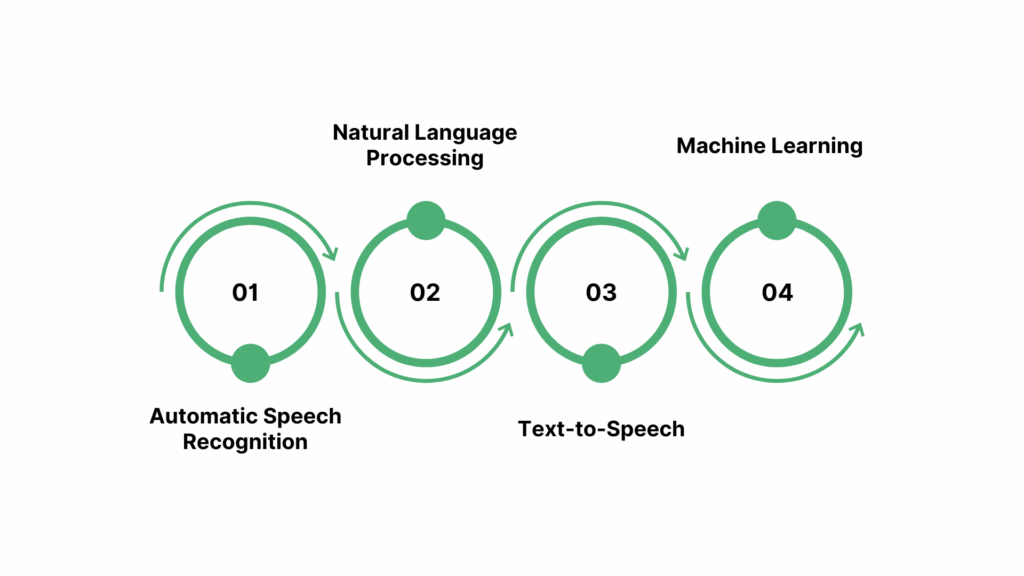
Voicebot conversational AI relies on a combination of advanced technologies to facilitate seamless and intelligent voice interactions. These core technologies work together to interpret speech, understand context, and generate natural-sounding responses.
- ASR (Automatic Speech Recognition): Converts spoken words into text, enabling the voicebot to understand what the user is saying, even in noisy environments.
- NLP (Natural Language Processing): Analyzes the transcribed text to extract meaning, context, and intent, helping the voicebot understand complex queries and respond accurately.
- TTS (Text-to-Speech): Transforms the voicebot’s text-based responses into natural-sounding speech, ensuring the conversation feels human-like and engaging.
- Machine Learning: Allows the voicebot to learn from past interactions, improving its understanding and responses over time, enhancing accuracy and adaptability.
If you are seeking scalable, high-quality voice solutions, Resemble AI offers advanced voice cloning and Speech-to-Speech (STS) technologies. These tools enable more personalized, human-like interactions that enhance the overall conversational AI experience.

To truly understand the impact of voicebots, it’s important to explore the process behind their functionality.
How Voicebots Work: A Step-by-Step Breakdown

Voicebots rely on advanced AI technologies to transform spoken commands into meaningful actions. Understanding their workflow allows businesses to create smoother, more efficient customer interactions. Here’s how each step unfolds to deliver a seamless voice-based experience:
1. User Input
A customer speaks a command or request, using any device with voice recognition capabilities. This voice input could be a query or an instruction, such as asking for account details or making a transaction.
2. Speech Recognition (ASR)
The voice input is captured by Automatic Speech Recognition (ASR), which converts spoken language into text. This step ensures that the voicebot accurately transcribes the user’s speech for further processing.
3. Natural Language Processing (NLP)
NLP interprets the transcribed text, understanding the intent behind the user’s request. It breaks down the input to identify key entities, phrases, and emotions, allowing the bot to contextualize the conversation.
4. Response Generation
After understanding the intent, the voicebot generates an appropriate response. The response could involve fetching information, answering questions, or guiding the customer through a task, tailored to the user’s needs.
5. Text-to-Speech (TTS)
The generated response is converted into human-like speech through Text-to-Speech (TTS) technology. This ensures that the interaction feels natural, engaging, and easy to understand for the customer.
6. Action Execution
The voicebot then performs the necessary action, such as processing a payment, updating information, or scheduling an appointment. Depending on the request, it may also escalate the issue to a human agent if needed.
7. Learning and Adaptation
Voicebots continuously improve through machine learning by analyzing each interaction. This helps enhance future responses, personalize experiences, and improve the overall quality of the service over time.
As voicebots continue to evolve, it’s essential to understand how they compare to traditional systems like IVRs. While both play a role in automating customer interactions, the differences in their functionality, flexibility, and user experience can significantly impact the customer service experience.
Also Read: Rapid Voice Cloning 2.0: New Voice Cloning Model with Unmatched Accuracy
Voicebot vs. IVR: Key Differences and Why It Matters
Understanding the differences between voicebots and traditional IVRs is important for improving customer interactions. While both systems help automate customer service, their capabilities and impact on user experience vary. Knowing these distinctions can guide you in choosing the best solution for your business needs.
| Feature | Voicebots (Conversational AI) | IVR (Interactive Voice Response) |
|---|---|---|
| Technology / Logic | Use AI/NLP to interpret intent and respond in natural language. | Based on rigid, menu-driven flows (keypad presses or simple voice commands). |
| Interaction Style | Open-ended speech, conversational, handles multi-turn dialogues. | Linear, menu-based navigation, limited to predefined paths. |
| Flexibility & Adaptability | High can adapt to new queries, multilingual support, and voice context. | Low—limited to scenarios mapped in advance; struggles with complex or unexpected queries. |
| Use Cases | Complex queries, support workflows, multilingual voicebots, and personalization. | High-volume routing, simple self-service tasks, basic info retrieval. |
| User Experience | More human-like, engaging, and less frustrating for callers. | It can be frustrating due to rigid menus and pressing keys. |
| Cost & Scalability | Potentially higher initial cost, but scales adaptively and handles more diverse requests. | Generally, lower cost to implement, but less agile, and may lead to hidden costs from inefficiencies. |
| Ideal Fit | Organizations requiring natural-language voice interaction, personalization, and multilingual support. | Situations with predictable, simple tasks and high call volumes with minimal variation. |
Why These Differences Matter:
- If your use case involves complex, multi-step conversations or integrations with backend systems, a voicebot offers better adaptability and context-awareness.
- If your needs are strictly predictable, basic self-service, or simple routing, the cost-efficient IVR may still suffice, but beware of evolving user expectations.
As customer expectations grow, voicebots offer a smarter, more flexible solution to meet the demand for personalized, efficient service.
Why Choose Voicebots for Customer Service?

Voicebots are revolutionizing customer service by increasing operational efficiency and providing faster, more personalized responses that directly enhance customer satisfaction. Here’s how voicebots can transform your service model, making it more helpful, empathetic, and quicker for your customers:
1. Quick Response
Voicebots ensure fast and timely responses, meeting customers’ demand for speed and convenience. This leads to a positive experience, with AI-powered bots handling queries efficiently and reducing wait times.
2. Self-Service Options
Voicebots automate routine tasks like booking appointments, updating account details, and processing transactions. This self-service capability empowers customers to resolve their issues independently, reducing the need for human agents.
3. Cost Reduction
Implementing voicebots can cut operational costs by decreasing the need for additional staff. By automating repetitive tasks, companies can provide 24/7 support while saving significant costs in labor and infrastructure.
4. Increase Revenue
Voicebots enable personalized messaging and offers throughout the customer journey. This improves conversions, customer retention, and lifetime value, boosting overall revenue.
5. 24/7 Customer Support
With voicebots, your customer service becomes available around the clock. No matter the time, customers can rely on the bot for fast responses, ensuring high availability without the need for human intervention.
6. Boost Customer Satisfaction
Voicebots provide instant, accurate responses, ensuring that customers don’t face long wait times or inconsistent information. This leads to higher satisfaction as issues are resolved quickly and effectively.
Discover how KomBea used Resemble AI’s technology to boost productivity and enhance customer service in call centers. Read the full case study to see real-life results!
When selecting a voicebot, it’s essential to consider the unique needs of your business, especially when working in industries that require precision, scalability, and adaptability.
What to Look for When Choosing Your Voicebot

Whether you’re building a customer service solution or creating engaging experiences for users, choosing the right voicebot will help you enhance operational efficiency and ensure user satisfaction.
1. Realistic Voice Quality and Customization
A key consideration is the quality of voice synthesis. A voicebot with high-quality, natural-sounding speech will ensure smooth, human-like interactions. Customizable voices are essential for aligning the bot with your brand’s tone. Opt for a solution that allows easy voice cloning or adjustments to match your specific requirements.
2. Multilingual Capabilities
As businesses increasingly operate in global markets, multilingual support is no longer optional. Look for a voicebot that can support a variety of languages and regional accents. This ensures that your customers across different geographies receive consistent and personalized experiences, without the need for multiple systems or extensive setup.
3. Seamless Integration with Existing Tools
Your voicebot should integrate seamlessly with your existing customer support platforms, CRM systems, and other essential tools. Whether it’s syncing with your ticketing system or integrating with your helpdesk, make sure the voicebot can work within your existing infrastructure to improve efficiency.
4. Scalability and Flexibility
As your business grows, your voicebot solution should be able to scale effortlessly. Choose a platform that can handle increasing customer interactions, seasonal spikes, and the addition of new use cases without compromising performance.
Flexibility is also crucial, allowing you to easily adjust features, workflows, or voice personalities as your needs evolve.
5. Advanced AI and Natural Language Processing
Look for a voicebot powered by advanced AI, especially one that incorporates Natural Language Processing (NLP). NLP allows the bot to understand and interpret customer queries accurately.
This makes interactions more intuitive and ensures that the bot can handle a wide range of scenarios, from simple queries to more complex support requests.
6. Security and Compliance
In industries like cybersecurity and entertainment, ensuring that your voicebot adheres to the highest security standards is critical. The voicebot should comply with data protection regulations and use encryption to protect user data.
Additionally, AI-generated voices must be secure to avoid risks such as deepfake impersonation or unauthorized voice cloning.
7. Continuous Learning and Improvement
Finally, choose a voicebot with machine learning capabilities that can continuously improve over time. The system should learn from interactions and feedback, optimizing its responses and becoming more accurate as it processes more data.
To fully understand and utilize the potential of voicebots, it’s necessary to follow a set of best practices that ensure smooth integration and maximize their impact.
Also Read: Resemble AI Partners with Carahsoft to Bring Voice AI and Deepfake Detection to the Public Sector
Strategies for Implementing Voicebot Conversational AI
Getting started with voicebots helps businesses streamline customer service and enhance the overall experience. However, to achieve better results and ensure smooth deployment, there are a few best practices you should follow.
Here are the key strategies for effective voicebot implementation:
- Integration with CRM systems: Integrate voicebots with your CRM to provide personalized responses, maintain customer history, and ensure smooth transitions to human agents when necessary.
- Customer support platforms: Ensure that voicebots are integrated with your existing customer support platforms, allowing for consistent and unified service across all channels.
- Customizing the voice and tone: Adapt the voice and tone of the voicebot to reflect your brand identity. This makes interactions feel more personal and aligned with your company’s values.
Once your voicebot is up and running, it’s important to measure its performance to ensure it’s meeting your goals.
Measuring the Effectiveness of Your Voicebot
Measuring the effectiveness of your voicebot is essential to ensure it’s meeting customer expectations and delivering on business objectives. By tracking performance, you can identify areas for improvement and optimize the system over time.
Key KPIs to Track:
- Response Time: Measure how quickly the voicebot responds to customer queries to ensure timely service and reduce wait times.
- Customer Satisfaction (CSAT): Monitor feedback from customers to gauge how well the voicebot is meeting their needs and providing a positive experience.
- Conversion Rate: Track how often voicebot interactions lead to desired outcomes, such as completed purchases or successful issue resolutions.
- Call Deflection: Measure the percentage of calls or queries handled by the voicebot that would otherwise have been directed to a human agent, improving efficiency.
- Continuous Feedback & Machine Learning: Regularly collect feedback and use machine learning models to adapt and enhance the voicebot’s performance, ensuring it improves over time.
How Resemble AI Enables Human-like Voicebot Experiences
When voicebots become part of your customer-service stack, they need to sound natural, scale globally, and maintain trust. Resemble AIdelivers these capabilities through high-fidelity voice synthesis, multilingual support, and security features, enabling voicebots that feel human, not robotic.
Key Features & How They Support Voicebots:
- Multilingual Voice Support (100+ languages): You can clone or localize a voice across 100+ languages, enabling voicebots to serve global users while maintaining brand voice.
- Rapid Voice Cloning: With only ~20-30 seconds of audio, you can replicate a voice, enabling fast deployment of branded voice assistants or voicebots without recording thousands of minutes.
- Speech-to-Speech Support: Converts speech input into natural responses in another language or voice style, useful for voicebots handling multilingual inquiries in real-time.
- Emotional & Accent Control: Adjust tone, dialect, and emotional delivery so voicebots convey appropriate style and create a more human interaction.
- Security & Authenticity Tools: Built-in watermarking, voice identity verification, and deepfake detection help protect voicebots from misuse, ensuring trust for your customers.
Conclusion
The integration of voicebots in your customer service operations is becoming a necessity. As customers demand faster, more personalized interactions, voicebots offer a way to meet these rising expectations efficiently. With AI advancements, voicebots are poised to improve customer engagement, helping businesses reduce costs, improve service quality, and scale their operations.
Resemble AI’s solutions, such as advanced voice cloning, can help you deliver high-quality, natural-sounding customer interactions. By customizing voices in 60+ languages, it ensures easy integrations and offers scalable solutions tailored to your specific business needs.
Book a demo with Resemble AI today and take the first step towards transforming your customer experience.
FAQs
Q1. What are the key challenges when integrating voicebot conversational AI with existing systems?
A1. Integrating voicebot conversational AI with existing CRM systems or customer support platforms can be challenging. Issues often arise around data synchronization, ensuring smooth handoffs to human agents, and maintaining a consistent user experience across all touchpoints. It’s crucial to choose a platform with seamless integration capabilities to reduce these friction points.
Q2. How can voicebots be used in industries other than customer service, like gaming or entertainment?
A2. Voicebots can be used in gaming for interactive voice-controlled gameplay, allowing users to control actions with natural language. In entertainment, voicebots help streamline content discovery, create interactive voice assistants, or even assist with user interactions in virtual environments, improving engagement and experience for users.
Q3. What security concerns should businesses be aware of when implementing voicebot AI?
A3. Security concerns with voicebot AI include risks like data privacy breaches and voice cloning attacks. It’s essential to choose a voicebot solution that complies with data protection regulations, employs encryption, and incorporates deepfake detection technology to safeguard against unauthorized use of AI-generated voices.
Q4. Can voicebots handle multilingual customer support?
A4. Yes, voicebots can handle multilingual customer support, allowing businesses to serve customers in multiple languages. Choosing a platform like Resemble AI, which supports over 120 languages, ensures that you can offer consistent, high-quality interactions across global markets, without needing to build separate systems for different regions.
Q5. How does AI voicebot technology improve customer experience over traditional voice systems?
A5. AI voicebots provide more flexible, personalized, and context-aware interactions compared to traditional IVR systems. Unlike rigid menu-driven systems, voicebots can understand natural language, adapt to customer needs, and offer a human-like experience, leading to quicker resolutions and higher customer satisfaction.