


Simply “watching” a video isn’t enough anymore to determine its authenticity. Today, deepfake videos can make anyone appear to say or do things they never actually said or did. A single convincing fake can mislead audiences, harm reputations, or be used as false evidence. This has made AI video analyzers vital for distinguishing between factual and fabricated content, especially on social media, news platforms, and in legal investigations.
However, their power extends far beyond simply detecting deepfakes. Modern AI video analyzers can also track objects, detect behaviors, measure engagement, and extract insights from massive volumes of video content. From security teams verifying footage to marketers analyzing audience reactions, these tools turn raw video into actionable intelligence.
This guide will break down how AI video analyzers work, the top tools available in 2025, and provide guidance on choosing the right one for your specific goals.
Overview:
- Introduction to AI Video Analyzers: Explains what AI video analyzers are and why they’re essential for businesses today.
- Importance for Security and Business: Covers deepfake detection, operational efficiency, customer insights, and compliance benefits of AI analysis.
- How AI Video Analysis Works: Details the five stages: ingestion, object detection, tracking, authenticity verification, and insights generation.
- Top AI Video Analyzer Tools: Reviews leading platforms in 2025, highlighting features, best use cases, and differentiators.
- Choosing the Right Solution and Future Trends: Guides selection based on goals, deployment, ROI, and upcoming AI innovations.
Why Are AI Video Analyzers Important for a Business in 2025?
AI video analyzer tools use computer vision, machine learning, and artificial intelligence to automatically detect, interpret, and extract insights from video content. Instead of passively recording, they actively analyze frame-by-frame data to identify objects, recognize actions, measure patterns, and even flag manipulated or synthetic content such as deepfake videos.
In 2025, when video has become one of the most dominant forms of digital content, this ability is more critical than ever. Businesses are flooded with video streams from marketing campaigns, social media, security systems, and user-generated content. AI video analyzers help them make sense of it all, quickly, accurately, and at scale.
Key Reasons for Incorporating AI Video Analyzers into Security Strategy:
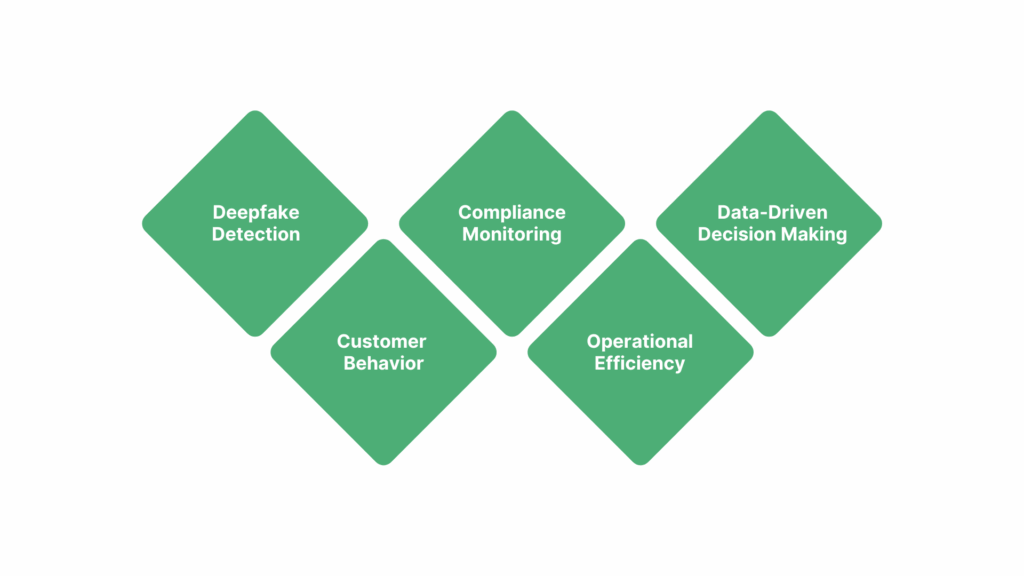
- Deepfake Detection & Content Verification: Identify signs of manipulation such as facial inconsistencies, audio-visual mismatches, or unnatural frame transitions to protect brand trust and verify authenticity.
- Customer Behavior & Engagement Analysis: Track where viewers look, how long they stay, and how they react, providing marketers and product teams with actionable user insights.
- Security & Compliance Monitoring: Spot policy violations, restricted content, or unusual behavior in real time, helping organizations maintain regulatory compliance and workplace safety.
- Operational Efficiency & Automation: Automate tedious manual video review, freeing up teams to focus on decision-making instead of combing through hours of footage.
- Data-Driven Decision Making: Turn raw visual data into measurable KPIs, enabling businesses to base strategies on evidence rather than guesswork.
In short, AI video analyzers are shifting video from a passive record into an active data source. By combining authenticity verification with behavioral analytics and operational insights, they give businesses a competitive edge in a video-first digital landscape.
Also Read: Introducing Real-Time Deepfake Detection for Google Meet: Ensuring Authenticity in Video Conferences
Behind the Scenes: The 5 Stages of AI Video Analysis
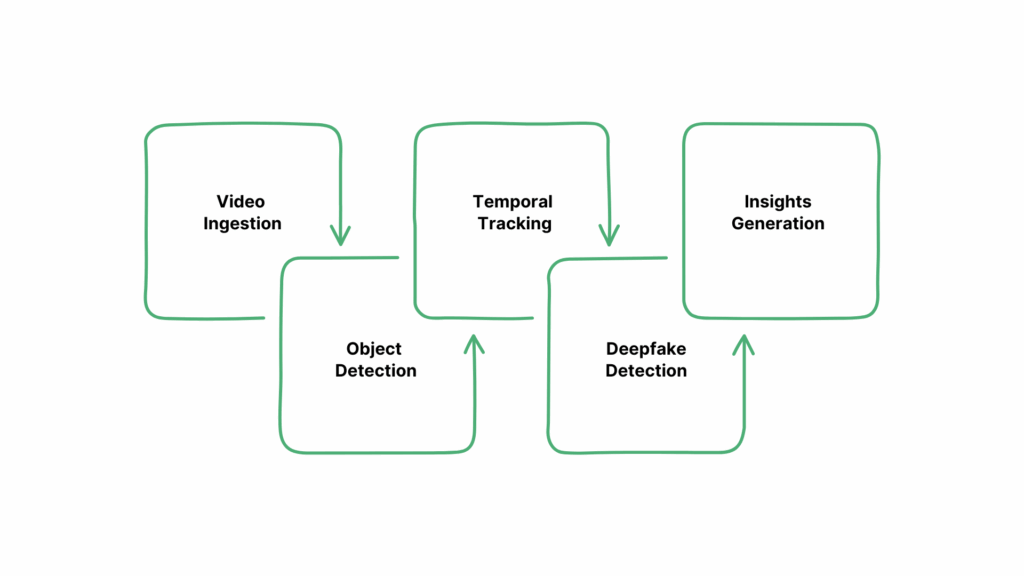
AI video analyzer platforms transform raw video footage into actionable insights through a tightly orchestrated pipeline of computer vision, machine learning, and artificial intelligence.
From decoding pixel data to detecting objects, recognizing actions, and even spotting deepfake manipulations, each stage builds on the last to deliver accurate, real-time analysis.
Here’s how it works:
Step 1: Video Ingestion & Frame Processing
This is where the system first receives the video input and prepares it for analysis. The raw footage is decoded into individual frames, normalized for quality, and stripped of useful metadata. It’s like cleaning and lining up puzzle pieces before solving the bigger picture.
Core Technologies: Video streaming protocols (RTSP, WebRTC), video decoders, frame extractors, metadata parsers.
What Happens:
- Incoming video streams are decoded and split into individual frames.
- Embedded metadata (timestamps, device IDs, location) is extracted.
- Frames are normalized for resolution, color balance, and frame rate to prepare for AI analysis.
Note: Clean, consistent input ensures accuracy across all downstream models.
Step 2: Object Detection & Scene Understanding
Once the frames are ready, the AI begins identifying what’s actually visible in them. It detects objects, labels them, and understands how they’re positioned in the scene, forming the basic visual map that all later analysis relies on.
Core Technologies: Convolutional neural networks (YOLO, Detectron2), semantic segmentation models, edge computing accelerators.
What Happens:
- The system scans each frame to detect and label objects (people, vehicles, faces, items).
- Spatial relationships between objects are mapped to understand the scene context.
- Bounding boxes and masks are generated for tracking and further analysis.
Note: Accurate object detection forms the foundation of behavioral and event analytics.
Step 3: Temporal Tracking & Behavior Analysis
Here, the system adds the dimension of time. It tracks how objects move across frames, learns their behavior patterns, and spots unusual or noteworthy activities, essential for understanding real events instead of just static snapshots.
Core Technologies: Multi-object tracking (SORT, DeepSORT), action recognition models, spatiotemporal CNNs.
What Happens:
- Detected objects are tracked across consecutive frames to capture motion patterns.
- The system identifies activities, interactions, and anomalies (e.g., loitering, crowd formation).
- Behavioral data is timestamped for timeline reconstruction and audits.
Note: Temporal context enables understanding of not just what is present, but what is happening.
Step 4: Authenticity & Deepfake Detection
This stage verifies if the video content is genuine. The AI looks for subtle visual and audio clues that could reveal manipulation or deepfake content, ensuring the footage can be trusted before any decisions are made from it.
Core Technologies: GAN fingerprinting, visual artifact detection, audio-video sync analysis, FFmpeg forensic tools.
What Happens:
- Frames are analyzed for pixel-level inconsistencies, unnatural lighting, or compression artifacts.
- Audio-video alignment checks detect dubbed or manipulated segments.
- AI models flag signs of synthetic content (like deepfake-generated faces or voices).
Note: Authenticity checks protect against misinformation and media tampering.
Step 5: Insights Generation & Feedback Loop
Finally, all the analyzed data is turned into meaningful insights. The system compiles metrics, visual reports, and alerts, feeds results into business tools, and learns from new feedback, so accuracy improves with every video it processes.
Core Technologies: Analytics dashboards, knowledge graphs, BI integrations, AI model training pipelines.
What Happens:
- Analyzed data is converted into structured insights: counts, heatmaps, timelines, anomaly reports.
- Insights are pushed to business tools (CRM, ERP, security platforms) via APIs.
- Feedback from user validation improves model accuracy over time.
Note: Continuous feedback ensures the system evolves with changing video patterns.
Also Read: Detecting Deepfake Voice and Video with Artificial Intelligence

5 Best AI Video Analyzers For Businesses in 2025
As video becomes the dominant medium for communication, marketing, and security, AI-powered video analysis tools are reshaping how organizations extract value from their content.
Platforms like Resemble AI, iWeaver, and VidIntel are setting new standards with real-time analytics, emotion detection, and intelligent automation, helping teams save time, reduce errors, and uncover insights hidden in massive video libraries.
Whether it’s a content creator, security operator, or enterprise analyst, these tools deliver the precision, scalability, and speed needed to stay competitive in the fast-evolving video landscape.
Here are the top 10 tools that are currently dominating in the AI video analytics space:
1. Resemble AI

Resemble AI is an advanced AI platform originally known for its hyper-realistic voice synthesis, but its capabilities now extend into video content authenticity and analysis. It enables organizations to detect synthetic media, verify the authenticity of audiovisual content, and generate realistic voice tracks for video production, all while maintaining strong security safeguards.
This makes it ideal for enterprises, newsrooms, legal teams, and social media platforms that need to both analyze and authenticate video at scale.
Key Features:
- Synthetic Media Detection (DETECT-2B): Identifies AI-generated voice or dubbed audio inside video files with 94–98% accuracy, helping spot manipulated or deepfake content.
- Audio-Visual Watermarking (PerTH): Embeds invisible watermarks into generated audio tracks within videos, enabling provenance tracking and reducing the risk of tampering.
- Speaker & Identity Verification: Matches speakers in video to known voiceprints using just a few seconds of audio, allowing rapid authentication of source material.
- Multilingual Voice Overlays: Generates synchronized multilingual audio for video content, accelerating localization while maintaining emotional tone.
- Chatterbox (Open Source): Lets developers build real-time video narration and dialogue systems with emotion-aware voice cloning, useful for interactive or adaptive video content.
- Audio Intelligence: Analyzes audio for anomalies, synthetic voice patterns, and other subtle manipulations to detect deepfake or spoofed audio content.
- Deepfake Detection for Meetings: Monitors live video and audio streams in conferencing platforms to prevent AI-generated impersonation and secure real-time communication.
- Security Awareness Training: Offers tools and simulations to train employees on identifying deepfakes and understanding potential risks, enhancing organizational cyber resilience.
Why It Stands Out: Resemble AI is more than a voice engine. It’s a powerful tool for validating and enriching video content. By combining authenticity detection with multilingual voice generation, it helps businesses combat misinformation while also speeding up content creation.
This dual focus on security and creativity makes it one of the most versatile AI video analyzers available today.
Also Read: Resemble AI’s Commitment to the AI Voluntary Code of Conduct
2. ScreenApp

ScreenApp is an AI-powered video monitoring and analysis platform designed to provide real-time insights while keeping resource usage minimal. It is optimized for teams that need instant video analytics without heavy infrastructure demands.
Best for: Organizations requiring real-time video monitoring and lightweight deployment
Key Features:
- Real-Time Video Analysis: Delivers immediate detection and insights for live video streams.
- Lightweight Deployment: Optimized to run efficiently on standard hardware, reducing dependency on high-end servers.
- Integrated API: Facilitates seamless integration with existing workflows, dashboards, and alert systems.
Differentiator: Unlike typical video analytics tools that rely heavily on cloud servers, ScreenApp balances local processing with cloud orchestration, providing fast, reliable analysis without overloading infrastructure or compromising performance.
3. Google Video Intelligence API
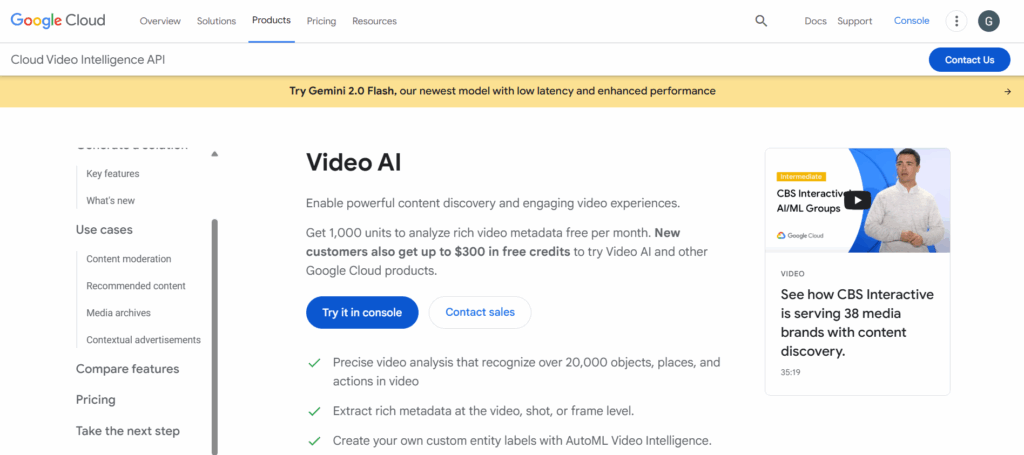
Google Video Intelligence API is a cloud-based AI service that analyzes video content to extract actionable insights, helping organizations index, search, and moderate videos efficiently.
Best for: Teams needing scalable, automated video analysis and metadata extraction
Key Features:
- Automated Video Tagging & Labeling: Detects objects, actions, and scenes for efficient content indexing.
- Shot & Scene Detection: Breaks videos into segments for detailed analysis and faster review.
- Speech & Explicit Content Detection: Transcribes speech and flags sensitive or inappropriate content automatically.
Differentiator: Unlike traditional manual review systems, Google Video Intelligence API leverages Google’s cloud AI and machine learning models to provide highly accurate, scalable, and automated analysis of both stored and streaming video content.
4. Microsoft Azure AI Video Indexer
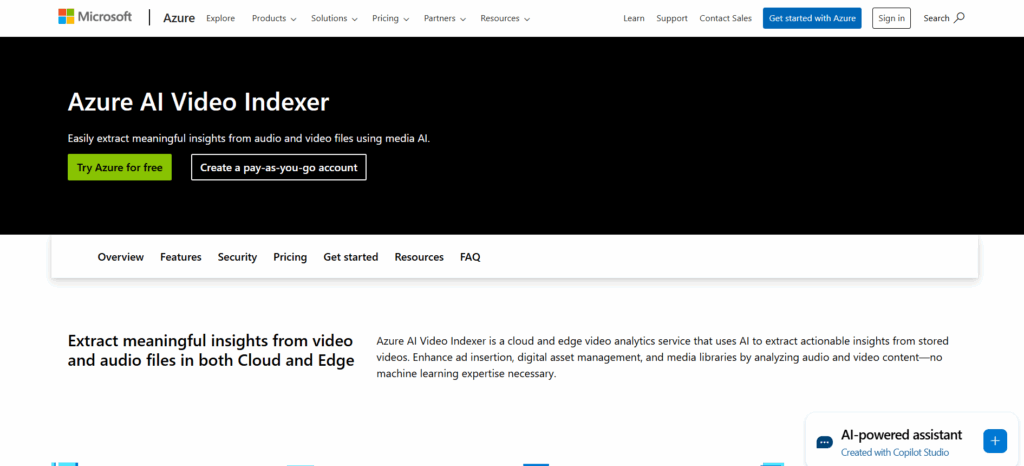
Microsoft Azure AI Video Indexer is a cloud-based video analysis platform that uses AI to extract insights from video and audio content, helping organizations improve content discovery, accessibility, and security.
Best for: Teams looking to automatically analyze video content for metadata, speech, and visual insights
Key Features:
- Automatic Metadata Extraction: Identifies faces, emotions, key phrases, and objects within video content.
- Speech-to-Text & Translation: Transcribes spoken words and supports translation for global accessibility.
- Content Moderation & Sentiment Analysis: Flags inappropriate content and analyzes emotional tone.
Differentiator: Microsoft Azure AI Video Indexer stands out for its comprehensive content understanding, combining video, audio, and text analysis with Microsoft’s cloud infrastructure to provide scalable, real-time insights for enterprise video management.
5. Virtual Sapiens

Virtual Sapiens develops AI-driven synthetic media solutions and deepfake detection tools, enabling organizations to create, monitor, and verify realistic virtual humans in video content.
Best for: Companies leveraging synthetic avatars for marketing, training, or virtual interactions while ensuring content authenticity
Key Features:
- Synthetic Human Detection: Identifies AI-generated virtual characters and deepfake manipulations.
- Real-Time Monitoring: Tracks virtual human activity and flags suspicious or manipulated content instantly.
- Integration API: Allows seamless embedding into content creation, distribution, and verification workflows.
Differentiator: Virtual Sapiens stands out for its focus on synthetic human content, offering tools that not only detect deepfakes but also support safe and authentic use of virtual avatars in professional settings.
Also Read: Resemble Enhance: Open Source Speech Super Resolution Model
How to Choose the Right AI Video Analyzer?
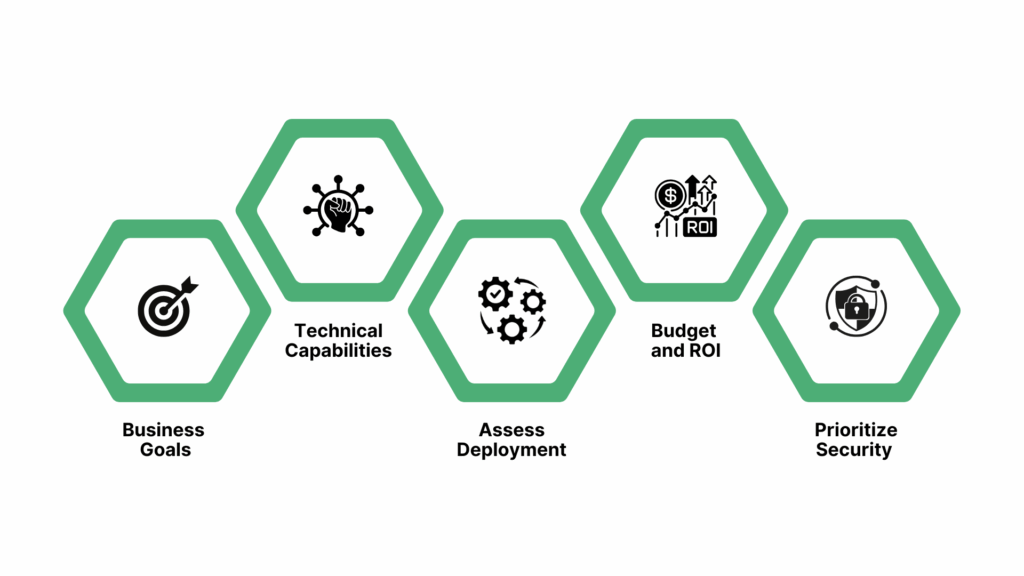
Choosing the right AI video analyzer isn’t just about picking the tool with the flashiest features. It’s about aligning the platform with your specific business needs. With the wide range of solutions available in 2025, from cloud-native platforms like Eagle Eye Networks to hybrid systems like iWeaver, making the right choice requires careful evaluation.
Here are some considerations to keep in mind when choosing an AI video analyzer:
1. Define Your Business Goals
Start by identifying what you want to achieve with AI video analytics:
- Security & Surveillance: Detect intrusions, suspicious activities, or verify identities.
- Marketing & Engagement: Analyze viewer behavior, content performance, or customer interactions.
- Operations & Efficiency: Monitor workflows, track equipment usage, or optimize employee performance.
Clearly defining the objective ensures that you choose a solution designed for your primary use case.
2. Evaluate Technical Capabilities
Not all AI video analyzers are built the same. Consider:
- Analytics Precision: Can the platform detect objects, emotions, or anomalies accurately?
- Real-Time Processing: Do you need instant insights (e.g., live events) or is batch processing sufficient?
- Resolution & Scale: Will it handle 4K/8K video, multiple streams, or large data volumes without lag?
Matching technical capabilities to your requirements prevents underperformance and wasted investment.
3. Assess Deployment & Integration Needs
Different platforms have different deployment models:
- Cloud-Based: Offers scalability and accessibility, but depends on internet bandwidth.
- Hybrid (Cloud + Local): Reduces server load and latency for high-volume tasks.
- On-Premises: Gives full control over data and security but requires more hardware resources.
Also, check for API support or integrations with your existing systems like CRM, ERP, or content management platforms.
4. Consider Budget and ROI
Pricing can vary widely:
- Free tiers (iWeaver, Canva Pro) may suit startups and small businesses.
- Enterprise-grade platforms (Eagle Eye, VidIntel) offer advanced analytics but at a higher cost.
Factor in long-term benefits like efficiency gains, labor savings, and enhanced decision-making to evaluate ROI.
5. Prioritize Security & Compliance
If your videos contain sensitive or personal data, ensure the platform:
- Supports encryption and secure storage
- Offers watermarking or verification models for authenticity
- Complies with GDPR, HIPAA, or industry-specific regulations
This protects your business from legal risks and reputational damage.
Selecting the right AI video analyzer is about fit, not flashiness. By defining business goals, assessing technical and integration requirements, considering budget, and prioritizing security, organizations can pick a platform that drives actionable insights while maximizing efficiency and ROI.
Also Read: Deepfake Detection: Emerging Deep Learning Techniques
What’s in Store for AI Video Analyzers in the Future?
As we look ahead to 2025 and beyond, AI video analytics is poised for significant transformation. The evolution of video threats and the corresponding advancements in AI video analyzers will shape the future of security, surveillance, and operational intelligence.
Here’s how video threats might evolve:
1. Increased Sophistication of Cyber Threats: Cybercriminals are using AI and machine learning to create more sophisticated attacks, including deepfakes and synthetic media, which can deceive traditional security systems.
2. Proliferation of IoT Devices: The growing number of connected devices increases the potential entry points for cyberattacks, making comprehensive video surveillance more critical than ever.
3. Privacy Concerns and Regulatory Challenges: As surveillance capabilities expand, so do concerns about privacy and data protection, leading to stricter regulations and the need for compliance in video analytics solutions.
Here’s how AI video analyzers will evolve to counter these emerging threats:
- Integration of Generative AI: AI video analyzers will incorporate generative AI to enhance contextual understanding and interpret complex environments, enabling more accurate threat detection and response.
- Enhanced Real-Time Processing: Advancements in AI chip technology, such as Nvidia’s upcoming Rubin CPX, will facilitate faster processing of video data, allowing for real-time analysis and quicker response times.
- Multi-Layered Security Approaches: AI video analyzers will adopt multi-layered security strategies, combining video analytics with other security measures like access control and intrusion detection systems to provide comprehensive protection.
- Adaptive Learning Capabilities: Future AI video analyzers will feature adaptive learning, enabling them to evolve and improve their detection algorithms based on new data and emerging threats, ensuring they remain effective against sophisticated attacks.
- Privacy-First Design: To address growing privacy concerns, AI video analyzers will implement privacy-first designs, incorporating features like data anonymization and compliance with global data protection regulations to safeguard personal information.
The future of AI video analyzers is marked by rapid advancements aimed at countering increasingly sophisticated video threats. AI video analyzers will continue to play a pivotal role in ensuring security and operational intelligence in an ever-evolving digital landscape.
Considering these factors, Resemble AI stands out as a strong contender for businesses seeking future-ready AI video analyzers for their security needs.

Also Read: Resemble AI’s Commitment to the AI Voluntary Code of Conduct
Conclusion
The evolution of video analysis doesn’t have to come at the cost of efficiency or accuracy. With advanced AI video analyzers, businesses can gain actionable insights from their video data in real time, detecting threats, anomalies, or trends with unmatched precision.
Whether it’s monitoring for deepfakes, tracking operational metrics, or analyzing customer behavior, forward-thinking organizations are setting new standards for intelligent video-driven decision-making.
Tools like Resemble AI make this possible by combining high-speed processing, hybrid cloud-local architectures, and intelligent analytics into unified platforms.
Ready to see it in action? Schedule a demo with Resemble AI and experience how next-generation video intelligence can transform your business operations and security workflows.
FAQs
1. Can AI video analyzers “watch” a video like a human and provide insights beyond transcripts?
Yes. Modern AI video analyzers can process both visual and audio content in real time. They detect objects, faces, actions, and anomalies while also analyzing audio for speech, sentiment, and context. Unlike basic transcript-based tools, these analyzers combine computer vision and audio analysis to deliver actionable insights across security, marketing, or operational use cases.
2. Which AI video analyzers can handle full video content, not just frames or transcripts?
Tools like Resemble AI, VidIntel, and TwelveLabs are designed to analyze complete video streams, integrating frame-by-frame visual analysis with audio understanding. This allows businesses to monitor live events, detect deepfakes, and extract patterns in a way that static transcript-only solutions cannot. Many platforms also offer API integration, enabling automated workflows and large-scale video processing.
3. Can AI video analyzers work with my existing camera setup in 2025?
Yes. Most modern AI video analysis platforms are designed to be camera-agnostic, meaning they can integrate seamlessly with legacy CCTV, IP cameras, and even hybrid systems. Advanced AI solutions now enhance low-resolution feeds, optimize frame processing in real time, and extract actionable insights without requiring costly hardware upgrades, enabling organizations to scale quickly.
4. Which industries are seeing the biggest impact from AI video analysis today?
Industries such as security, retail, healthcare, logistics, education, and media are seeing transformative benefits. AI video analyzers provide real-time anomaly detection, operational insights, automated content moderation, and fraud prevention. Organizations using these tools can improve safety, optimize workflows, and make data-driven decisions from vast amounts of video content that would otherwise be impractical to process manually.
5. How do organizations measure ROI from AI-powered video analytics in 2025?
ROI is measured through a combination of quantitative and qualitative metrics, including faster threat detection, fewer false alarms, reduced operational costs, and minimized need for manual video review. Beyond security, businesses also track insights for marketing analytics, compliance adherence, and operational efficiency, ensuring that AI-driven video analysis delivers measurable impact across multiple business functions.